On September 21, 1978, a man walked into a government office in Rapid City, South Dakota, and asked for a copy of a birth certificate. The certificate belonged to Joseph Newton Chandler III, born March 11, 1937, in Buffalo, New York. The man used that document to apply for a Social Security card and then moved to the suburbs of Cleveland, Ohio. For the next twenty-four years, he lived as Joseph Newton Chandler III, a man who had technically been dead since December 21, 1945.
That was the day an eight-year-old boy by that name died in a head-on car collision two miles west of Sherman, Texas, along with his parents, Joseph Newton Chandler II and Ellen Christina Chandler. The family had been driving from Tulsa, Oklahoma, to Weatherford, Texas, to visit the boy’s grandmother four days before Christmas. The truck driver, L. C.
Black, and his passenger, G. R. Hutchinson, both from DQ, Arkansas, walked away without a scratch. The Chandlers were buried, the boy in Greenwood Cemetery, and the name was filed away in county records.
Nobody had any reason to think about it again. For more than three decades, nobody did. The birth certificate sat in a records office attached to a boy who would never grow up. Paperwork with no person attached to it, and paperwork with no person attached to it can be stolen.
In 1978, the Social Security Administration did not cross-reference death records. If you had a birth certificate, that was good enough. Whoever filed that request in Rapid City knew exactly what they were doing. The new Joseph Newton Chandler III found work as an electrical draftsman, first at a small engineering firm called Edco, then at Lubrizol Corporation, a chemical company in Wickliffe, Ohio.
He was good at his job, quiet and competent, the kind of technical problem solver who doesn’t require small talk. By around 1986, he settled into a small efficiency apartment in Eastlake, Ohio, a working-class suburb about twenty miles northeast of Cleveland along the shore of Lake Erie. He lived there for the next sixteen years. The way he lived told a story by itself.
One dish, one set of utensils. No family photographs, no personal letters, no address book, no holiday cards. Bare walls, minimal furniture, homemade gadgets scattered around, including a breaker box rigged to change the television channel automatically during commercials. Shelves of finance books and get-rich-quick manuals, empty vitamin bottles, camera lenses with no apparent purpose, and a television left tuned to static for hours at a time.
He ate alone, slept alone, and left the apartment only for work, or occasionally to eat at a restaurant by himself. He had no visitors. Nobody ever came to his door. His coworker at Lubrizol, a man named Mike Anderisen, was probably the closest thing he had to a friend.
They worked together for roughly twelve years, and Anderisen would later become the executor of his estate. Even after more than a decade of daily proximity, Anderisen told investigators he barely knew the man. The stories coworkers told after his death painted a picture of someone simultaneously brilliant and completely disconnected from ordinary human behavior. He once drove approximately 700 miles from Ohio to an L.
L. Bean store in Maine, stood in the parking lot, saw that there were no open spaces, and drove the 700 miles back home without ever going inside. He went to a Halloween party in 1992 dressed as Al Capone and stood in the corner the entire night without speaking to a single person. He memorized zip codes for fun but could never remember his own birthday.
On his rental application, he listed a sister named Mary Wilson in Columbus, Ohio. When investigators checked the address, it was a vacant lot. Mary Wilson did not exist. He claimed he had grown up in East Liverpool, Ohio.
He told coworkers he had been married before, sometimes to a Catholic woman, sometimes to a Cuban woman who married him for immigration purposes. None of it was true. Then there were the things that made people uneasy. He kept a packed suitcase by the door at all times, ready to go.
Every so often, he would say something strange to a coworker: They’re getting close. Then he would disappear for a few days, sometimes longer, before showing up again as if nothing had happened. Nobody pressed him on it. Nobody asked who “they” were.
There was also a moment, years before his death, when something almost slipped. He turned to a coworker and said quietly, “There’s something I want to tell you one day. ” That day never came. For twenty-four years, this man woke up every morning and remembered to be someone he wasn’t.
He remembered which lies he had told which people. He remembered that his birthday wasn’t actually his birthday. He remembered not to mention places he’d actually been, people he’d actually known, a family he’d actually raised. Every conversation was a performance.
Every interaction carried the risk of a slip. And the remarkable thing is, he almost never slipped. Lubrizol laid him off in 1997. He was in his seventies by then, at least the age his stolen identity would have made him.
Without work, his world shrank even further. In the months before his death, he made a phone call to a woman in Texas who did not know him. Investigators were never able to determine who she was or why he called her. It may have been a wrong number.
Or it may have been something else. U. S. Marshal Pete Elliott later speculated that the man might have been looking for a daughter.
In 2000, he was diagnosed with advanced colon cancer. He had surgery at a hospital in Lake County, Ohio. The doctors removed tissue and preserved a biopsy sample in paraffin wax, standard medical procedure, and placed it in storage at the hospital. That tissue sample, sealed in wax and filed in a freezer, would sit there for eighteen years.
It would outlast the man it came from. It would outlast the investigation that tried to identify him. It would eventually become the single piece of evidence that cracked the entire case. Sometime around July 23, 2002, the man living as Joseph Newton Chandler III sat in his bathroom in that Eastlake apartment and made a final decision.
He closed the blinds. He turned off the air conditioning. He crossed off the days on his wall calendar leading up to that date. Then he used a .
38 caliber Charter Arms revolver, purchased about three months earlier for roughly $263, to end his life. He left no suicide note, no letter, no explanation of any kind. The body was not discovered for approximately one week. In the July heat, with the windows sealed and the air conditioning off, decomposition was severe.
A neighbor eventually reported the smell. The landlord called 911. Detective Theodore Crouch was one of the first officers inside. What he found was a scene shaped by time and summer heat.
The body was on the bathroom floor in the fetal position. The skin had turned black. Decomposition was so advanced that visual identification was impossible and fingerprints could not be recovered. The revolver was beside him.
What struck investigators wasn’t what they found. It was what they didn’t find. Nothing personal, nothing sentimental, nothing that said, this is who I am. It was the apartment of a man who had been prepared for a very long time to vanish at a moment’s notice.
Eastlake Police Chief Larry Reek described the progression in blunt terms. “It started off as a regular suicide, as standard as you can get. Nothing suggested foul play. Nothing seemed out of the norm.
Then we had loads of questions. ”
The questions started with the money. The man had roughly $82,000 in a bank account. There was no will, no designated beneficiary.
Under Ohio law, a probate court had to conduct a good faith search for next of kin. If relatives could be found, the money went to them. If not, the estate would eventually escheat to the state. Probate lawyers started pulling on every available thread.
The rental application went nowhere. The sister in Columbus was fictitious. His emergency contacts at work were coworkers. A genealogist traced the Social Security number and driver’s license information back to a birth certificate from Buffalo, New York, naming his parents as Joseph Newton Chandler and Ellen Christina Chandler, maiden name Cober.
The genealogist followed the Cober line, tracing the family from New York to California. Eventually, they located Ellen Cober’s niece. The niece told investigators that the real Joseph Newton Chandler III was dead. Had been dead since 1945.
Eight years old, killed in a car accident in Texas along with both parents. Every assumption the investigators had made collapsed. The Social Security number, the driver’s license, the tax records, the employment history at Lubrizol — all of it was attached to a name that belonged to a boy who had been in the ground since the Truman administration. The body had been cremated.
The fingerprints were gone. The apartment had been emptied. Nobody had any idea who the man actually was. The case went public, and the internet devoured it.
The mystery of Joseph Newton Chandler III became one of the most discussed unidentified person cases in the online true crime community. Reddit threads ran for years. Author James Renner, who wrote about unsolved Ohio cases, was so captivated that he partly based a novel on it. He interviewed former Lubrizol employees, visited the Eastlake apartment building, and floated theories ranging from espionage to mental illness.
The most dramatic theory came first: the Zodiac Killer. The man had lived in Northern California before moving to Ohio. The timing overlapped with the Zodiac’s active period. There was a resemblance between the composite sketches and the few photographs of the Eastlake man.
But the theory had fundamental problems. The Zodiac craved attention. He wrote letters, taunted police. The man in Eastlake avoided all human contact.
When authorities compared DNA profiles, there was no match. Not even close. Then came the D. B.
Cooper theory, the legendary hijacker who jumped from a plane in 1971 with $200,000 in cash. The timing and the West Coast connection were enough for some, but there was no evidence. Others floated more exotic possibilities: a Nazi war criminal, a Russian intelligence asset. These theories were fueled partly by unverified reports that the man’s computer contained internet searches related to Nazism and plastic explosives.
Pete Elliott was asked about those claims. “I wish I could confirm that,” he said. He couldn’t. The computer had been accidentally damaged by earlier investigators, and the contents were never independently verified.
There was also a specific suspect: Steven Campbell, a fugitive engineer from Cheyenne, Wyoming, wanted for attempted murder connected to a 1982 bombing. Campbell had also assumed a dead person’s identity. But DNA excluded the Eastlake man, and Campbell was eventually arrested in New Mexico in 2025. After the man’s true identity was revealed in 2018, Bay Village, Ohio police examined whether he could be connected to the unsolved 1989 kidnapping and murder of ten-year-old Amy Mihaljevic.
The proximity was there, the timeline fit, but he was ultimately ruled out. Every theory shared the same underlying assumption: the man was hiding because he had done something violent. But there was no warrant for his arrest, no criminal record in any name, no unsolved crime pointing back to him, no evidence of violence ever. In 2014, more than a decade after the man’s death, the case got a second life.
Peter J. Elliott, the U. S. Marshal for the Northern District of Ohio, decided to reopen it.
Elliott was the longest-serving U. S. Marshal in Ohio history, appointed in 2003 by President George W. Bush.
In 2015, he created a dedicated cold case unit within his office specifically for investigations like this one. “He was running from something,” Elliott told reporters. “I can’t say what that thing was he was running from, but I would suspect based on my experiences, it’s something that was pretty bad in the past. ”
The obstacles were enormous.
The body had been cremated thirteen years earlier. The apartment had been cleared and rerented. The estate had been settled. Traditional investigative tools were essentially useless.
But Elliott’s team had one thing left: that tissue biopsy from the colon cancer surgery in 2000, sitting in paraffin wax at a Lake County hospital, untouched, unexamined, nearly forgotten. They extracted a DNA profile and ran it through CODIS, the FBI’s national criminal database. Nothing came back. No matches.
The man’s DNA wasn’t in the criminal system. But by 2016, a new tool was emerging. It was called forensic genealogy, and Elliott was willing to try it even though he didn’t fully understand it. “It was the first time in U.
S. Marshal Service history since 1789 that we’d ever utilized forensic genealogy, and I had no idea what it was and I’m still not sure I do,” he later admitted. In 2016, Elliott reached out to Dr. Colleen Fitzpatrick, a forensic genealogist and founder of an organization called Identifinders International.
Fitzpatrick wasn’t a newcomer to impossible cases. She had previously helped solve the identity mystery of Lori Erica Ruff, another woman who had lived and died under a stolen name. Fitzpatrick started with the Y chromosome. Comparing the Eastlake man’s Y-STR profile against public genetic genealogy databases, she identified a probable surname: Nichols, or a variation — Nicholls, Nicholson.
It was a lead, a real one. But a surname alone, without a specific individual, was like finding one piece of a jigsaw puzzle in a warehouse full of boxes. For the next year or so, the investigation stalled on that single word. Then the DNA Doe Project entered the picture.
Founded in 2017 by Fitzpatrick and Dr. Margaret Press, it was a nonprofit with a specific mission: using autosomal DNA analysis and public genealogy databases to identify John and Jane Does across the country. The same technique would soon become world-famous when it identified the Golden State Killer in April 2018. The Chandler case became one of the DNA Doe Project’s earliest investigations, and one of its hardest.
The tissue sample was nearly two decades old, embedded in paraffin wax since the surgery. Roughly 80% of the genome had degraded. There were fewer than 20 nanograms of usable DNA in the entire sample. For context, a typical forensic sample might contain hundreds or thousands of nanograms.
They were working with almost nothing. The solution required brute force science. Dr. Wenning Tang at AMD Biotech performed two separate rounds of whole genome sequencing, each at 30 times depth.
Justin Loe of Full Genomes Corporation and Dr. Greg Magoon of Aerodyne Research handled the bioinformatics. Individually, each sequencing round was too noisy to produce useful results. The matches were distant, third cousins and beyond.
But when the two runs were combined into an effective sequence with 60 times the depth, the picture sharpened. A new third cousin match emerged, and the genealogists began building family trees, branch by branch, generation by generation, cross-referencing public records, census data, marriage certificates, and birth registries. The trees converged on a family in New Albany, Indiana, a small city just across the Ohio River from Louisville, Kentucky. The surname was the same one Fitzpatrick had flagged two years earlier from the Y chromosome analysis: Nicholls.
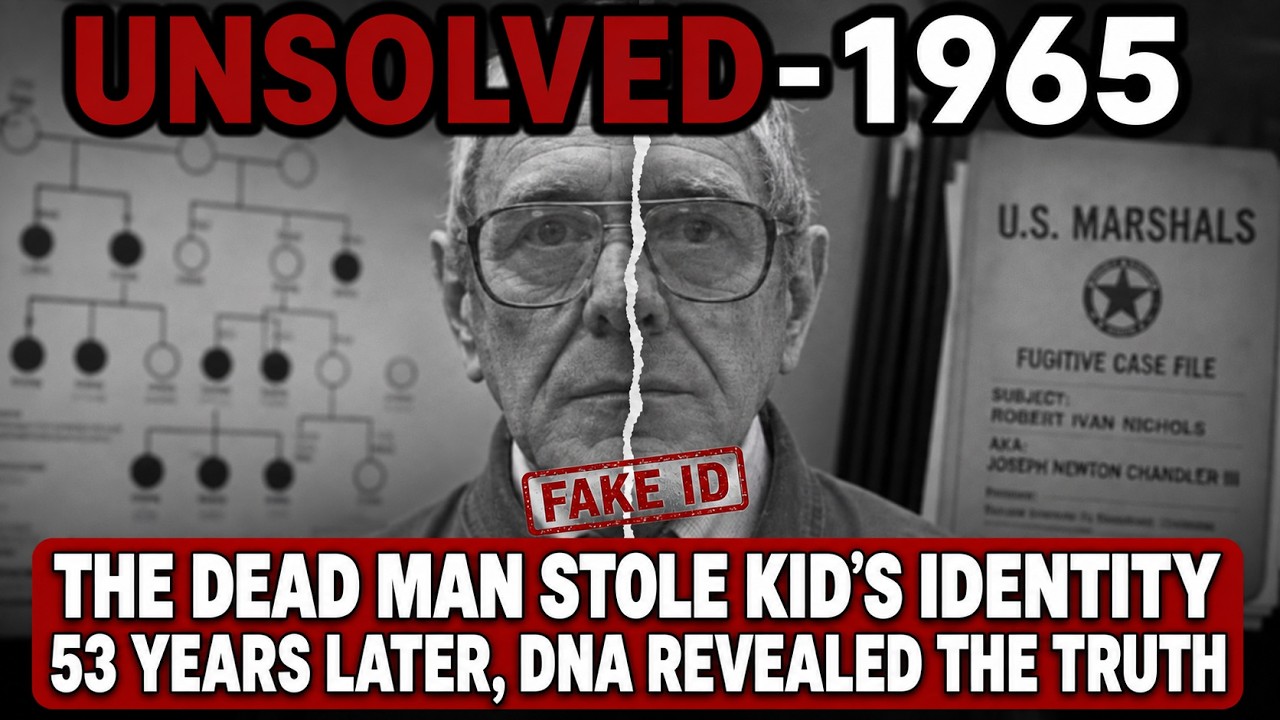
The genealogists pulled a birth certificate for a man named Robert Ivan Nichols, born September 12, 1926, in New Albany, Indiana, to Silas and Alpha Nichols. The family’s address was listed as 1823 Center Street. Center Street. Remember the fictitious sister, Mary Wilson, supposedly living in Columbus, Ohio?
The address the Eastlake man gave was on Center Street — a vacant lot in Columbus. But the street name was real. It was the street where the Nicholls family actually lived, 400 miles away, in New Albany, Indiana. He had used a piece of his own real past when constructing his fake identity.
A small, almost unconscious detail, the kind that slips through when you’re building a lie from memory instead of imagination. Dr. Margaret Press later described the moment they put those two documents side by side. “When we compared those two documents, we said, ‘Bingo, we’ve got him.
‘”
On March 5, 2018, the DNA Doe Project officially identified the man as Robert Ivan Nichols. The identification had taken approximately 1,500 hours of genetic genealogy research. They needed confirmation DNA from a known family member. The U.
S. Marshals tracked down Nichols’s surviving son, Phillip, who was living in Ohio. His DNA was a match. The identification was confirmed beyond doubt.
The ghost of Eastlake, Ohio, finally had a real name. Robert Ivan Nichols was born on September 12, 1926, in New Albany, Indiana, one of four boys raised by Silas and Alpha Nichols in a modest home on Center Street. In 1944, at eighteen years old, he graduated from high school and enlisted in the United States Navy. The war in the Pacific was reaching its most desperate phase, and Nichols was assigned to the destroyer minelayer USS Aaron Ward as a fireman.
His job was to keep the ship from burning when it got hit. On May 3, 1945, the Aaron Ward was stationed off the coast of Okinawa. That afternoon, the ship came under attack from multiple Japanese kamikaze aircraft and bombs in a concentrated assault lasting less than an hour. The ship was struck repeatedly.
Fires broke out across the ship. Crew members were killed and wounded in rapid succession. The vessel took catastrophic damage and by all logic should have gone to the bottom. It did not, largely because of the damage control teams who fought to keep it afloat while planes dove into them.
Nichols was wounded during the attack. Shrapnel hit him in the back and hip. Of his roughly sixteen-man firefighting team, he was reportedly one of only four who survived. A shipmate standing just two feet from him was killed.
The entire ordeal lasted approximately fifty-two minutes. Nichols later called it “52 minutes of hell. ” The ship survived. The Navy awarded the crew a Presidential Unit Citation.
Nichols received the Purple Heart for his wounds. He came home a different person. The first thing he did was burn his Navy uniforms in the family’s coal bin. He took the model airplanes he’d built as a kid, wooden planes he’d once been proud of, and shot them apart with a BB gun.
He never spoke about the war again. Not to his parents, not to his wife, not to his children. Something in him had closed permanently. In 1947, he married Leverne Agnes Coberly.
They’d met at a square dance. Three sons came after: Phillip, Charles, and David. The family settled near Louisville, Kentucky, and Nichols took a white-collar job as a draftsman at General Electric. From the outside, it looked like a normal life.
From the inside, it was something else entirely. His son Phil would later describe his father as “like a stranger who lived in our house. ” Nichols was devoutly Baptist, rigorously frugal, and undeniably intelligent. He built things constantly: a handmade kayak, intricate mechanical gadgets.
But he couldn’t connect with the people living under his own roof. He was emotionally absent in a way that went beyond quiet or reserved. There was a wall around him that his wife and sons could never get through. Phil would later wonder whether his father had undiagnosed PTSD from the war, or possibly something on the autism spectrum, or both.
Then, in 1964, something shifted. Nichols told Leverne to get a driver’s license. He told her to find a job. She didn’t think much of it at the time.
Then he filed for divorce. He gave his wife and sons approximately two days’ notice. He packed a suitcase, climbed into a brand-new 1964 Ford Falcon convertible, and told Leverne that she would learn why “in due time. ”
He drove to Dearborn, Michigan first, took an engineering job there, reportedly designing cooling systems for race cars.
For a while, there were still threads connecting him to his old life. He wrote letters to his parents in Indiana saying he’d moved to Richmond, California. A letter to Phil was postmarked from Napa. Brief communications, just enough to show he was alive.
And then came the last communication. An envelope addressed to Phil. Inside was a single penny. No letter, no explanation, no goodbye.
Just a penny. Phil has never been able to figure out what it meant. A penny is the smallest unit of currency in America, the least valuable thing you can send someone. You can read that a lot of different ways, and none of them are comforting.
The family reported Robert Ivan Nichols missing in 1965. They hired private detectives to search for him in California and Indiana. The investigators came back with nothing. It was as if he had walked off the edge of the map.
IRS records later showed that Nichols continued using his real Social Security number for tax purposes until approximately 1976. For over a decade, he was somewhere in America, working and filing taxes as Robert Ivan Nichols, and still nobody in his family could find him. He wasn’t hiding from the government. He was hiding from the people who loved him.
Somewhere around 1976 or 1977, he stopped using his real number entirely. And in September of 1978, he walked into that office in Rapid City, South Dakota, and became Joseph Newton Chandler III. The final severing. Phil believes this is a key part of the mystery: that his father didn’t just leave, but vanished because vanishing meant he’d never have to pay child support.
In the 1960s, changing your name and crossing a few state lines was enough to disappear from the legal system entirely. Leverne was left with three boys and no financial support. Robert never sent a dollar. She eventually remarried about three years after the divorce, built a new life, had ten grandchildren, but never found out what happened to her first husband.
She died in 1992. Silas Nichols died in 1982. Alpha died in 1990. Neither parent ever saw their son again after 1964, nor learned where he went or why.
David, the youngest, was nine years old the day his father drove away. Old enough to remember, young enough that the memory would warp and shift over the decades. He grew up carrying that absence like a stone in his pocket. He died in 2015, three years before the DNA Doe Project identified his father.
David never got his answer. Phil carried the question longest. For more than half a century, he didn’t know if his father was alive or dead. Whether he had started a new family somewhere, whether he ever thought about the three boys he left behind.
Phil never stopped wondering, but he also never stopped hoping. He always said he hoped Robert found a happy life somewhere. On June 21, 2018, the U. S.
Marshals held a press conference in Cleveland to announce the identification. Phil was there. He was quiet, measured. He did not express anger.
He expressed relief. “This put to rest a mystery in our family. What happened to him? ” Phil told reporters.
“We’re grateful the discoveries have been made. ”
Pete Elliott stood at the podium and paid tribute to the scientists. “Dr. Colleen Fitzpatrick and Dr.
Margaret Press and their teams did phenomenal work,” he said. “Not only did they knock the ball out of the park, they told us what seat he was sitting in and who bought the ticket. ”
The emotional complexity of that press conference is hard to overstate. This was a son standing in a government building in Cleveland, learning that his father had been living in a suburb of the same city for decades.
That he had worked a normal job, paid rent, gone to the grocery store, probably driven on some of the same highways Phil had driven on. That he had been right there for years and years and never once picked up the phone. Phil didn’t have a villain to confront. He didn’t have a crime to prosecute.
He didn’t even have a father to be angry at, because the man was already dead. What he had was information: a name, a timeline, and the knowledge that his father had chosen solitude over his own sons and maintained that choice every single day for the rest of his life. It wasn’t a single decision made in 1964. It was a decision made every morning for twenty-four years.
Every Christmas, every birthday, every time the phone rang and he didn’t answer it. The abandonment wasn’t a moment. It was a practice. The math was brutal and simple.
Robert Ivan Nichols lived as Joseph Newton Chandler III for twenty-four years. His son Phillip was living in Ohio. They were in the same state, possibly for a very long time. They could have run into each other at a gas station, a grocery store, a highway rest stop.
They never did. Not once. The question that survived the investigation — the question the DNA couldn’t answer — is why. He had no arrest warrant, no criminal record in either identity.
He was not in witness protection, not connected to any known crime. So why does a decorated war hero, a Purple Heart recipient, a father of three young boys, steal the identity of a dead child and vanish for half a century? Phil’s theory is the most grounded and probably the most painful: that Robert didn’t want to be found by the courts, didn’t want to pay child support. It’s an ugly theory.
It’s also the one that requires the fewest assumptions. The second theory is war trauma. What happened aboard the USS Aaron Ward was by any measure one of the most violent experiences a person could survive. Fifty-two minutes of kamikaze attacks.
Friends dying two feet away. Shrapnel in the back. And when he came home, there was no therapy, no diagnosis, no understanding of what we now call post-traumatic stress. He burned his uniforms.
He destroyed his model planes. He never talked about it. Some people who survive that kind of violence spend the rest of their lives running from it, even when nobody’s chasing them. The packed suitcase, the white noise on the television, the refusal to connect — these might be the behaviors of a man whose nervous system never came home from the Pacific.
The third theory is darker, and it’s the one that kept the marshals invested for years. Between 1965, when Robert Ivan Nichols vanished, and 1978, when someone stole a dead boy’s birth certificate in South Dakota, there are thirteen years only partially accounted for. IRS records show he used his real number until about 1976. But where was he?
Doing what? With whom? Those thirteen years are the black box of this case. If he committed a crime during that window, if he hurt someone, if he witnessed something he shouldn’t have, if he made enemies in the kind of world where enemies come looking, that would explain everything.
But there is no evidence of a specific crime, no warrant, no victim, no cold case from that era that points back to him. Just a gap in the timeline. There’s also a detail about the identity theft itself that investigators have never fully explained. How did Robert Ivan Nichols come to know about a boy named Joseph Newton Chandler III who died in Texas in 1945?
How did he know that this particular child’s birth certificate would be available? Did he know the Chandler family? Did he read about the car accident in a newspaper decades earlier and file the name away? Did someone teach him the technique?
In 1978, the dead-baby-identity method was known in certain criminal circles, but it wasn’t common knowledge. Either way, he wasn’t just running. He was planning. The honest answer is that we don’t know, and we may never know.
The only evidence that could move the needle — a documented crime in the 1964-to-1978 window, a records hit from Michigan or California or South Dakota, a familial DNA link to an unsolved case — has never materialized. What we do know is this. Robert Ivan Nichols lived a life of extraordinary self-imposed isolation. One dish, one fork, a television tuned to static, a packed suitcase by the door.
He carried the weight of two identities for twenty-four years. He lived in the same state as his own son and never once reached out. He had $82,000 in the bank and not a single person in the world to leave it to. He could have explained everything in a letter, a phone call, a note left in that apartment before he pulled the trigger.
He had a calendar with the days crossed off. He had time to plan. He had time to write something down. He chose not to.
Whatever his reason was, whatever the thing was that made Robert Ivan Nichols decide in the mid-1970s that his own name had become dangerous, he protected that secret more carefully than he protected anything else in his life. More than his relationships, more than his children, more than his own comfort. The secret was the thing he kept. Everything else he gave away or let go.
Most cold cases ask who died. This one asked who lived. The name on the gravestone was corrected. The man behind the mask was found.
But the question at the center of it all — the one question that Robert Ivan Nichols was the only person on earth who could answer — remains open. Go back to the beginning. December 21, 1945. A car on a Texas highway, a family of three, a boy named Joseph Newton Chandler III, eight years old, on his way to see his grandmother for Christmas.
For more than seventy years, that boy’s name was tangled up in a mystery he had nothing to do with. The identification in 2018 untangled it. It separated the boy from the ghost. Joseph Newton Chandler III is no longer a mystery.
He’s a child who died in a car crash four days before Christmas on a road in Texas with his mother and father beside him. And Robert Ivan Nichols is no longer a ghost. He’s a man. A complicated, damaged, brilliant, isolated man who survived one of the worst naval battles of the Second World War, came home broken, built a family he couldn’t connect with, and spent the second half of his life hiding in plain sight in a suburb of Cleveland.
He ate alone, slept alone, and died alone, surrounded by gadgets and finance books and the static hum of a television tuned to nothing. Phil got his answer. He didn’t get closure exactly. Closure implies that the story makes sense, that the ending resolves the tension.
Phil got a name and a timeline and the knowledge that his father was alive for decades, living a quiet Spartan life less than a day’s drive from where Phil himself was raising a family. The knowledge that his father chose solitude over his own sons and maintained that choice until the day he died. That’s not closure. That’s information.
Sometimes information is all you get. But the record is corrected now. The name is restored. The boy is the boy again, and the man is the man.
And the case, after fifty-three years of silence, is closed. At least the parts that science can close.
