In August 1881 the survey crew for the Atlantic and Pacific Railroad reached the rim of Canyon Diablo and stopped. They were standing on the high plateau north of Arizona, on ground that looked flat in every direction until it simply ended. Below them the canyon dropped 225 feet and gaped almost 550 feet from rim to rim, cutting straight through the red limestone with no warning at all. There was no river at the bottom.
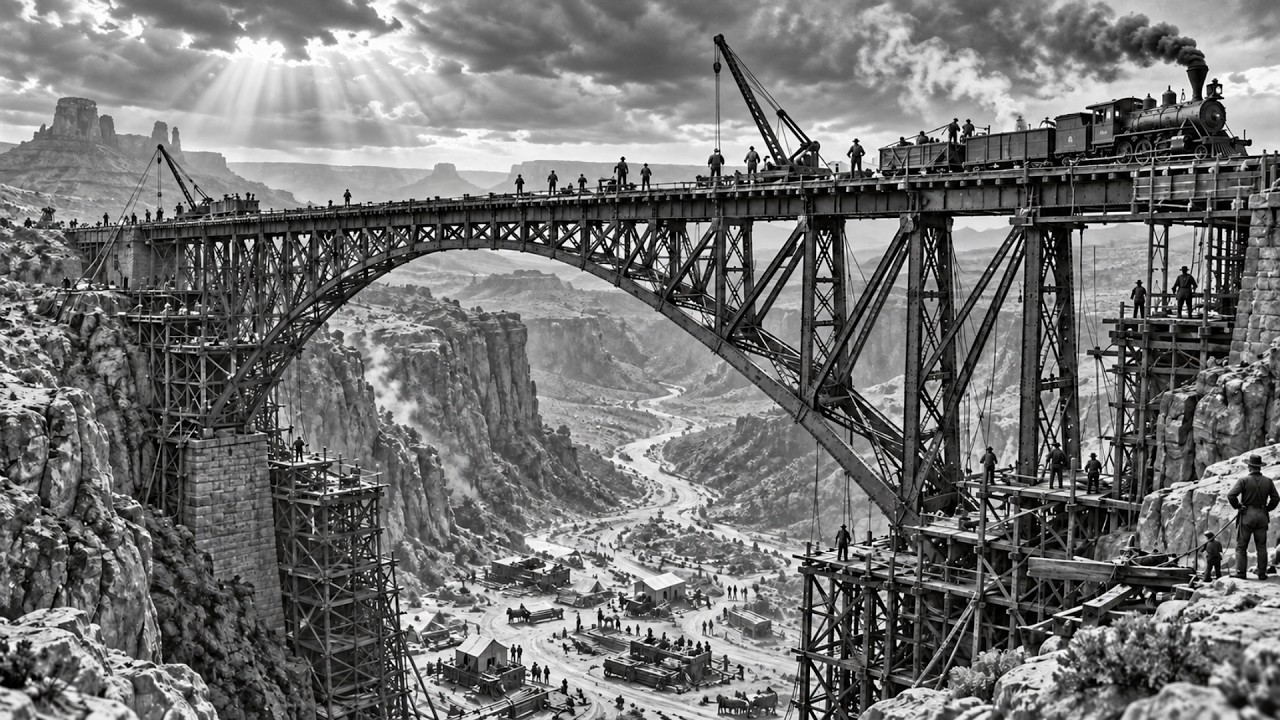
No road reached it from either side. There was almost nothing down there but rock, and the railroad had to cross it. The A&P was building a line from Albuquerque to the California coast, owned jointly by the Atchison, Topeka and Santa Fe and the St. Louis and San Francisco.
Through 1881 it had been pushing west across New Mexico and into Arizona at a pace Eastern newspapers called remarkable, laying as much as two miles of track on a good day across flat desert country. Canyon Diablo ended the illusion that the plateau country north of Flagstaff was going to be generous to the railroad in every respect. The grades were manageable, the rock was sound, and the straightaways were long. But the Colorado Plateau is cut by canyons, and Canyon Diablo was the deepest and widest one standing between the end of track and the coast.
The canyon took its name from the Spanish word for devil, and the men who first wrote that name on a map had reason for the choice. It slices the Coconino Plateau east to west for twenty miles through country that offers no warning. You can stand on the edge before you even realize the canyon is there. The walls drop almost vertically.
The rock at the bottom is the same limestone that forms the south rim of the Grand Canyon, fifty miles to the northwest. In 1881 a wagon road had been cut down to the canyon from the south, but it reached the rim and stopped. There was no crossing, no ford, nothing a loaded freight wagon could use. The only way the railroad could get across was to build over it.
The A&P’s chief engineer in Arizona was a man named A. A. Robinson. He had come from Kansas, where he had spent years building stretches of the Santa Fe main line across the flatlands of the Great Plains, and he knew better than anyone what crossing the canyon meant for the construction schedule.
The line had a contractual obligation to reach a point in California by a specific date, and the penalties for missing it were written in terms that made failure ruinous. So Robinson ordered what railroad engineers of that era called a temporary bridge. The word temporary carried a great deal of meaning in that decision, because what it actually meant was that they would build something capable of moving a train across this canyon quickly enough to hold the schedule, and that they would build something better when they had time. The design was standard for the period.
You built timber trestles, A-frame bents that carried the bridge, anchored them to the canyon walls or the floor below, then laid the track across the top. Railroads had thrown up temporary bridges across hundreds of gulches and creek beds across the West. In the previous twenty years the Union Pacific had used them to cross the Laramie Mountains of Wyoming, and the Central Pacific had used them in the Sierra Nevada of California. The technique was understood.
The materials were available. What was not standard about Canyon Diablo was the depth. A 225-foot drop meant the bents closest to the canyon walls had to stand on the very edge, seated on rock instead of soil, with nothing beneath them for most of their height but air. The timber had to be heavier and the framing tighter than anything required to span a shallow stream, and the footings had to be pinned directly into the limestone of the rim because there was no other way to hold the structure in place.
The men who did the work arrived at Canyon Diablo in the winter of 1881 and early 1882, with weeks to get the job done. The construction camp that formed at the crossing was typical of what railroads were building in those years, at least in its first stage. Tents went up first, then plank shacks, then more permanent frame buildings as the weeks passed, and the camp showed no sign of leaving. There was a company store and a boarding house for the regular workmen.
A water tank stood beside the track on the east rim. And there were other establishments, the ones the railroad did not run and never officially sanctioned. A railroad construction camp in 1882 was a place where thousands of men were paid in cash at the end of every week, in the middle of a country with nowhere else to go and nothing else to spend it on. The people who followed those camps to provide places to spend the money were not, as a rule, the most law-abiding residents of any territory.
The town of Canyon Diablo grew up along the east rim of the canyon and on both sides of the track where it ended at the edge of the gorge. At its peak it held between one and two hundred people, depending on which account you read. The railroad workmen were the majority. The rest ran the businesses that served them.
The territorial government of Arizona was nowhere near. Flagstaff was thirty miles to the west, and Flagstaff itself was only a small settlement in 1882, a lumber camp and a railroad water stop that had not yet been incorporated as a town. The nearest county seat with a sheriff’s office was Prescott, more than a hundred miles south across rough country. Canyon Diablo had no marshal, no judge, no jail.
And the saloon owners, gamblers, and operators of the other establishments that most needed law enforcement were not spending their own money to fund it. The accounts of what happened in Canyon Diablo during the spring and summer of 1882 became known across the territory before the end of the year. The exact numbers in those accounts vary. The Arizona Silver Belt, a weekly published in Globe, described Canyon Diablo in 1882 as a place where, in its words, no man’s life was worth five cents after dark.
The Arizona Weekly Miner of Prescott ran a series of short items about the camp through the spring and summer that read like casualty reports from a small war. What is beyond dispute across all of those accounts is that the town went through a succession of men willing to call themselves marshal, and that few of them lasted long. The most complete single account in the records concerns a man named Edward Hines, who took the marshal’s job in the spring of 1882 and held it for roughly three months before being shot dead outside a saloon on a Saturday night. Hines came from Texas, where he had worked as a lawman in a cattle-trail town, and he was not a man who had lived a sheltered life.
Even so, Canyon Diablo killed him. The inquest into his death was recorded in the territorial press, and its language about the circumstances was precise enough to be read two ways. After Hines, the town’s businesses had trouble finding any man willing to take the badge for more than a few weeks at a time. The records that survive name at least ten men who held the office of marshal during the town’s active period.
Some lasted a month. Some lasted less. The main line of the A&P stretched across Arizona for nearly 355 miles, from the New Mexico border to the California line. In the summer of 1882, while the bridge at Canyon Diablo was the only crossing of the gorge, every supply train heading for construction west of the canyon had to cross that timber bridge.
Every rail, every spike, every pound of food, and every gallon of water for the grading crews working toward Flagstaff and beyond crossed those 550 feet of temporary timber. If the bridge was damaged or burned, or if the approach track to it was pulled up, the entire construction effort on the western half of the A&P’s Arizona line would stop, not for a day, but for however long it took to repair or rebuild 225 feet of structure in a desert canyon with no roads to it and no water supply. The A&P’s operating management knew it. Orders were issued to the construction superintendent at Canyon Diablo to station guards at both ends of the bridge around the clock.
A reference to those orders surfaces in a court record years later, in a dispute over liability for injuries to one of the company’s employees, where the posting of the guards was mentioned as background to the working conditions at the crossing. The reference is brief, but it confirms what the engineering logic of the situation makes obvious. A timber bridge standing over a 225-foot chasm in the middle of an unpoliced territory, at a town with no effective law enforcement and a population that included a large number of armed men with no stake in the company’s success, needed guarding. The threats the guards were watching for came from more than one direction.
The Apache Wars were not over in 1882. Geronimo did not surrender until 1886, and through the early years of that decade the conflict between the army and various Apache bands generated raids across a wide expanse of the territory. The Canyon Diablo crossing lay north of the main area of operations, and the Navajo Nation lay between it and Apache country to the south. But the railroad was not operating in what any sensible observer would call a safe zone, and the company was not about to leave a vital facility unguarded on that assumption.
Then there were the workers themselves. The Chinese laborers who laid much of the track on the western end of the line had been recruited from California with promises about wages and working conditions that the company did not always keep. In the spring of 1882 there were work stoppages at several points along the line over wage disputes. The bridge was the most obvious target for anyone who wanted to force the railroad to listen.
You did not have to destroy it. You only had to threaten it. The threat alone was enough to halt construction and bring management to the table. And management knew it.
Then there was simple criminality in Canyon Diablo. The town in its full uproar included men who had come to Arizona Territory because Arizona Territory in 1882 was a place where you could do things you could not do in Kansas or Missouri without an arrest warrant following you. Some of those men understood the bridge’s value to the company. A locked strongbox in the construction camp’s store was worth whatever cash was in it.
The bridge was worth the entire western half of the Arizona line. So the guards stayed through the spring and summer of 1882. And as construction pushed west toward Flagstaff and the town of Canyon Diablo began to empty out behind it, the men stood at the two ends of the timber bridge and walked its length. The accounts that describe them are few and indirect.
None of the men who served as bridge guards at Canyon Diablo left memoirs that survive. What the records give us is their presence as a fact. The guards were there, they were armed, and the bridge was never attacked. Whether that outcome was because of the guards, or in spite of the town, the records do not say.
The temporary timber bridge those guards walked was never meant to be permanent. Robinson and the company’s engineering department knew from the start that the timber structure was a stopgap, and the specifications for the permanent iron bridge were being drawn even while the timber bridge was under construction. The question was when, not whether. Through 1882 and 1883, while work continued on the western end of the line, the replacement iron bridge was fabricated in sections back East and shipped by rail to the end of track.
The design was a deck truss, the kind where the track rides on top of the structure rather than through it. A deck truss of that span and height was not a simple structure. And placing it in position across a canyon 225 feet deep, with the timber bridge still standing, required a precise sequence. The iron sections had to be raised and set without disturbing the timber bridge enough to interfere with traffic, because the trains could not be stopped.
Every day that freight trains crossed that section of the A&P line was a day the company was recovering the cost of the line. The work was done in stages over several months, and when the final connection was made and the iron bridge was approved to carry trains, the timber bridge was dismantled from below. The wood came out piece by piece, and the canyon was crossed in iron. That iron bridge was not the last crossing at Canyon Diablo either.
As the A&P was formally absorbed into the AT&SF system in the late 1880s and 1890s, the Santa Fe found itself operating a line built for 1882 traffic and required to carry 1900 traffic. The locomotives were heavier, the cars longer, the load per train greater. The iron bridge at Canyon Diablo had to be replaced, like iron bridges across the country in that period, with one designed for loads the earlier engineers had not planned for. In 1900 the Santa Fe replaced the iron bridge with a steel structure.
Steel had become the standard material for major railroad bridges in the 1890s, once the cost of producing structural steel in large quantities and consistent quality had come down to where the railroads could use it. The steel bridge erected at Canyon Diablo in 1900 could carry a loaded freight locomotive without the bending and flexing that had begun to show in the old iron structure. It was a permanent crossing in a way the earlier bridges were not quite. Though permanent, in the context of railroad main lines, only meant that nobody had yet planned to replace it.
The BNSF Railway, which absorbed the AT&SF in 1995, operates the crossing at Canyon Diablo today as part of one of the busiest freight corridors in the United States. Intermodal containers, coal, grain, and auto parts cross that canyon several times a day on trains the men who built the timber bridge in the winter of 1881 would not have recognized. The current structure at Canyon Diablo is concrete and steel. It is not the timber bridge, not the iron bridge, and not the 1900 steel bridge.
It is what remains after decades of maintenance, upgrading, and eventual replacement. The town did not survive past the second bridge. It barely survived past the first. When construction moved west in the summer of 1882, the workers went with it.
The saloons and gambling dens that had followed the workers from New Mexico packed up and followed them again, toward Flagstaff and down off the plateau to the west. The frame buildings along the east rim of Canyon Diablo were either torn down for their lumber or left standing until they fell. By the end of 1882 the town had fewer than a dozen permanent residents. By the mid-1880s those were gone too.
What the disappearance of the town of Canyon Diablo left behind was a cemetery, some scattered foundation stones, and the crossing itself. The cemetery is the clearest record of what the town was. The documented burials include men who died of work injuries, others who died of disease in the camp, and men who died of violence, in circumstances the records describe with varying precision. Some of the headstones are gone, replaced by bare mounds of earth.
Some of the men buried there are entered in the records only by their occupation and physical description, either because their names were unknown to the company or because recording them was not considered worth the trouble. The cemetery sits today on private land. It has been fenced and documented by the Arizona Historical Survey. If you want to understand Canyon Diablo in a single image, that fenced piece of ground in the desert is the answer.
A town that lived less than a year left behind more dead than it could name. There is one account, found in a collection of interviews conducted by an Arizona historian in the 1930s, that sheds a different light on the bridge than the official records. The historian was interviewing an elderly man in Winslow, Arizona, who said he had been a ten-year-old boy at Canyon Diablo in 1882, living there with his father, who ran a freight operation supplying the construction camp. The man was in his early sixties when the interview was recorded, and his memory for specific detail had the precision that comes from a childhood experience that never quite fades.
He remembered the building of the timber bridge. He remembered the smell of freshly cut lumber in the desert air, and the sound of hammers on the bents in the morning when the air was cold enough to see your breath. He remembered watching from the east rim as the structure grew span by span out across the canyon toward the far wall, and the moment when the last section was laid and you could see through from one side to the other clearly. What stood out most clearly in his memory, the historian noted, was the guards.
He said that for as long as the timber bridge was the only crossing, there were men walking back and forth on it at every hour of the day and night. He watched them from the rim when he was supposed to be asleep. He said they walked the same boards so many times that by the end of the summer you could see where their boots had worn the planks smooth. That detail is not in the construction records.
The worn planks, and the men who walked them until they knew every board by the feel of it under their feet. Robinson designed the crossing and the replacement bridge, and he is recorded in the professional literature of the period as one of the finest railroad engineers working in the Southwest in those years. His decisions on the timber bridge design and the permanent iron span are documented in the trade publications of the 1880s. His name appears in the legal and financial history of the A&P.
The guards are in none of that. They appear in one legal record as an operational fact, and in the memory of a ten-year-old boy from Winslow who watched them from the rim and could not sleep. Now here is the part of the record worth contemplating. Canyon Diablo.
The canyon, not the town, not the railroad crossing, gave its name to something that happened on the same plateau 50,000 years before any of this. About fifteen miles east of where the railroad crossed, a meteorite struck the Colorado Plateau at an estimated speed of 26,000 miles per hour, blasting a crater in the rock 3,900 feet wide and 560 feet deep. The impact vaporized most of the meteorite and threw the displaced rock outward in a ring still visible around the crater’s edge today. The crater was examined by Anglo-American settlers in the 1870s and 1880s, at about the same time the A&P was building its line across the plateau.
A Philadelphia mining engineer named Daniel Barringer became convinced in the 1890s that the crater was formed by a massive iron meteorite and that the meteorite itself still lay buried beneath the crater floor. He spent 26 years and a large part of his personal fortune drilling for it. He never found a mass worth extracting, because the meteorite had largely vaporized on impact. But his work proved beyond doubt that the crater was not a volcanic formation but an impact site, and its scientific name is Barringer Crater, or Meteor Crater, or Canyon Diablo Crater.
The iron meteorite fragments collected from the surface around the crater in the decades after the railroad was built are classified as Canyon Diablo meteorites, named for the canyon where the first significant samples were collected. Fragments of them sit in museum collections around the world. The science that eventually dated the solar system itself, fixing the age of the Earth at about 4. 5 billion years, was worked out partly using lead isotope ratios from Canyon Diablo meteorite samples.
A piece of rock from a canyon in northern Arizona, collected by men working near the same ground where the railroad guards walked the planks smooth in 1882, contributed to one of the foundational measurements of modern cosmology. It is not a connection anyone designed. It is just geography. The canyon was there.
The meteorite fragments were on the ground around it. And the men who gave the canyon its name gave the crater and the meteorite, and eventually the scientific measurement, their name as well. The A&P line across Arizona, built on Robinson’s decisions and the labor of thousands of men for wages in an Arizona winter, became the main line of the AT&SF and eventually of BNSF. It is one of the highest-volume freight lines in the country today.
The BNSF main line runs parallel to what was once Route 66 and is now Interstate 40 for most of the length of northern Arizona, between Winslow and Flagstaff. That track crosses Canyon Diablo and passes within fifteen miles of Barringer Crater. And most people in cars on the highway look out at the red desert and the distant mesas and do not know that either of those things is there. The site of the town of Canyon Diablo is reachable by a dirt road north of Interstate 40 near the Two Guns exit.
Two Guns is a separate story involving a roadside zoo, a disputed massacre site of Navajo people, and a land ownership fight in the 1920s that ended in gunfire, and Route 66 once ran through what remained of it. The ruins of the Two Guns zoo are still visible from the old highway alignment. The animal cages rust in the desert beside the road. Neither the Canyon Diablo town site nor the Two Guns ruins sit on public land.
What remains above ground at the railroad camp is modest. Foundation lines, debris in the soil, and the fenced cemetery. If you want to see what the crossing looks like today, take the Canyon Diablo exit from Interstate 40 and head north on the dirt road until the ground opens up in front of you. The canyon is exactly as it always was.
It appears without warning. You are on flat ground and suddenly the rock ends and the walls fall away to reveal the depth of the gorge below you. And if the light is right, you can see the BNSF bridge from the rim. That concrete and steel structure carries the railroad across almost the same spot where the timber bridge, the iron bridge, and the 1900 steel bridge stood before it.
The same 550 feet, the same canyon walls, the same 225-foot drop to the limestone at the bottom. The timber bridge is gone, and the men who guarded it are gone. The town that grew up around them is now just broken glass and foundation stones on a private ranch. What remains of Canyon Diablo?
The crossing is now a freight railroad that moves in a single day what an A&P train moved in a month in 1882, operating on a structure nobody guards because there is no need. The Apache Wars are over. The construction camp is a century and a half in the past. The men who walked the planks until they wore smooth in a single summer are not recorded in any roll of names.
But the canyon is still the canyon, and the trains still cross it. The road that carried those trains to the crossing, the road that built the crossing, and the road the railroad later replaced are each a story of their own. The next story is how the Santa Fe fought the Southern Pacific for forty years over the same desert route, and what that fight cost both of them before one of them gave in.
