On a cold January morning in 1864, the ice lay thick on the Potomac, and a single bidder stood in a courthouse in Alexandria, Virginia. The property on the block was Arlington, eleven hundred acres of hilltop land across the river from Washington, with a great columned house at its center. The bidding opened and closed with one offer: the United States government, $26,800. The sale was for taxes.
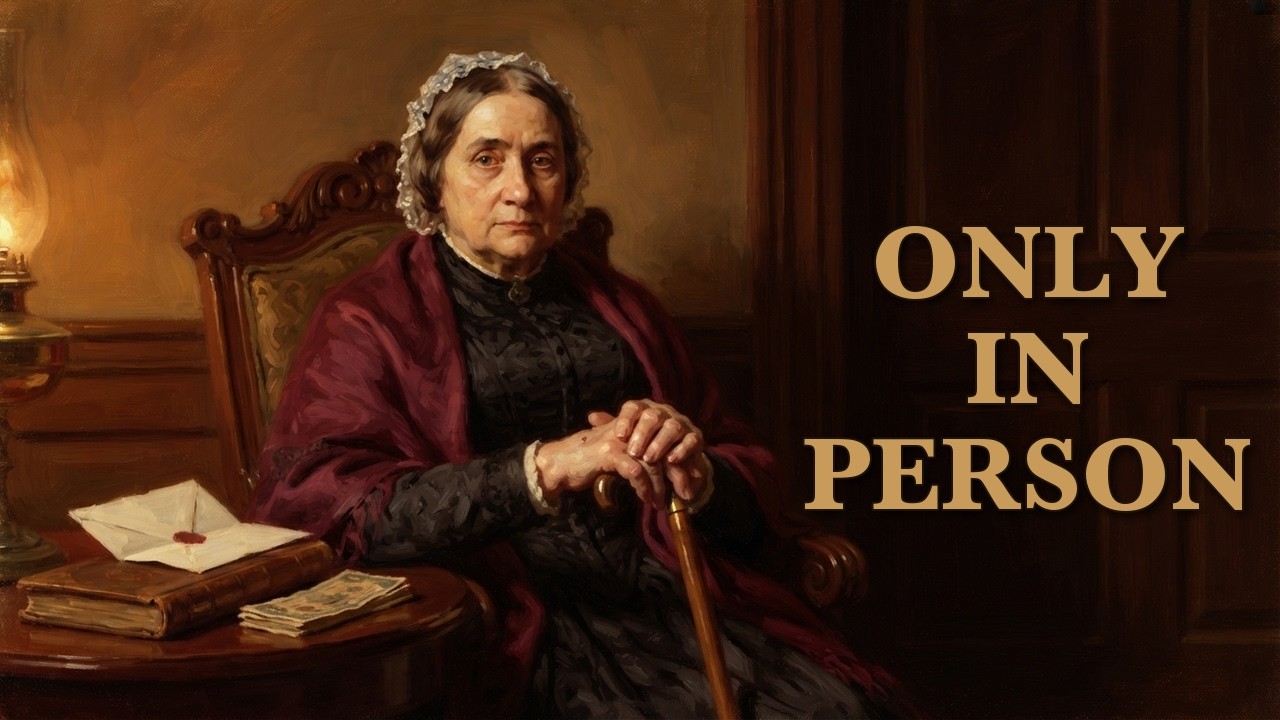
The tax bill, if paid in person, came to $92. 07. The owner, Mary Custis Lee, was not there. She was in Richmond, behind Confederate lines, crippled by arthritis so severe she could barely walk.
She had sent her cousin, Philip Fendall, with the money. The commissioners refused to take it. The law, they said, required the owner, or someone authorized by her, to appear in person. The government bought her home for a fraction of its worth, and the bodies began to arrive.
That August, twenty-six soldiers were buried along the edge of the rose garden, a few yards from the house. Eighteen years later, the Supreme Court of the United States would decide whether that refusal had been legal. Mary would not live to hear the answer. This is the story of a daughter who received a house by one piece of paper and lost it by another, and of the enslaved people on that land whose names appeared in the same documents.
Mary Anna Randolph Custis was born on October 1, 1807, the only surviving daughter of George Washington Parke Custis and his wife, Mary. Her father’s name carried the family’s pride. He was the grandson of Martha Washington, raised by George Washington himself at Mount Vernon, and he liked to call himself the son of Mount Vernon. Arlington was his.
His father had bought the land in 1778, and between 1802 and 1818 Custis built upon it a great house designed by the architect George Hadfield. The bricks and mortar were made by enslaved people from red clay and oyster shells dredged from the Potomac. Inside, Custis created a kind of shrine. The National Park Service calls it the Washington Treasury: oil paintings, Washington china, the tent Washington used in the Revolution, a full lantern from Mount Vernon, and most precious of all, the bed in which Washington died.
Mary grew up in that house. She learned Greek and Latin. She painted nature scenes, some of which still hang in Arlington House today. Like her mother, she loved roses; enslaved gardeners planted eleven varieties in the flower garden.
She was in no hurry to marry. She refused several men, one of them Sam Houston, and described herself as a strong fortress. Then, on June 30, 1831, in the family sitting room at Arlington, she married a young army lieutenant named Robert E. Lee.
They had seven children, six of them born at Arlington in a small dressing room off the bedroom. Her husband was gone most of the time. In 1853 he wrote to her, sadly, that he belonged to a profession which forbade all hope of domestic enjoyment. But he loved the place.
A year later he called Arlington the spot where all my affections and attachments are centered more strongly than anywhere else in the world. There was another person in that house. When Mary was a little girl, her personal maid was a young enslaved woman named Maria Carter Syphax. According to the National Park Service, Maria was Mary’s older half-sister, the daughter of Mary’s father and an enslaved woman named Arianna Carter.
The Park Service adds one quiet sentence: it is not known whether Mary ever knew or acknowledged the kinship. Family tradition holds that Maria married in 1821 in that same family sitting room, ten years before Mary did. Maria was later freed and given seventeen acres of Arlington land to live on. The Park Service’s own pages differ on exactly when and how that happened.
Those seventeen acres would reappear decades later in a courtroom. Mary and her mother taught enslaved children to read even after Virginia laws forbade it in the 1840s. Yet the Park Service is blunt: Mary Lee, like her parents and other Virginia slaveholders, professed to hate slavery while benefiting from it daily. That was the house.
A family proud of the Washington name, living on the labor of people they owned. Then Mary’s own body began to fail her. She developed severe rheumatoid arthritis. By the 1850s she used the stairs only twice a day, spending most of her waking hours in one room, the morning room.
An enslaved person carried her downstairs each morning and back up in the evening. Around 1855 she wrote to her husband, I suffer so much from pain and stiffness. Her doctors called it rheumatism. One historian, Elizabeth Brown Pryor, has suggested the evidence points to mercury poisoning from a medicine called blue mass.
That is one historian’s explanation; the records do not settle it. On April 23, 1853, Mary’s mother died. Two years later, her father sat down and wrote what would happen to Arlington after his death. He wrote the will himself.
At the bottom he noted: this will, written by my own hand, signed, sealed, and executed. The date was March 26, 1855. To his daughter he gave the Arlington estate, but not forever. He left her the use of everything during her lifetime: the horses, carriages, furniture, pictures, all for her life.
After her death, Arlington would pass to her eldest son, George Washington Custis Lee, to be his heir and his heirs forever, on one condition: that he bear the Custis name and motto. The Washington relics were to stay with Mary at Arlington for the rest of her life, then go to that same son. Each of his four granddaughters was to receive $10,000. Two other farms, White House and Romancoke, went to two of Mary’s other sons.
So Mary did not own Arlington outright. She held a life estate in it. It was her home and her father’s trust, but legally it was already on its way to her son. Then came the clause about people.
Custis wrote that his slaves would be freed, but he wrote it with conditions, and the conditions mattered. After the legacies to his four granddaughters were paid and the debts of the estate required to pay those legacies were settled, he wrote, then I give freedom to my slaves. The emancipation would be carried out by his executors in such a way as they saw most fit and proper. And another line: that emancipation was to be completed within no more than five years from the date of his death.
Five years. He named four executors. The first name on the list was his son-in-law, Robert E. Lee.
George Washington Parke Custis died at Arlington on October 10, 1857, and was buried there. On the first day of 1858, Lee signed an inventory of the estate. Across the Custis plantations there were nearly two hundred enslaved people; sixty-three of them lived at Arlington. The list includes a man named Thornton Gray, a woman named Selina Gray, and their children.
Selina would have a significant part to play. Three years later, Mary would hand her the keys to the house. For now, the will’s countdown had begun. Five years.
The question was what Lee would do with those five years. Lee found the estate deep in debt. As executor, he decided he needed the enslaved people to work to bring Arlington back to solvency. He hired many of them out to work for other people.
At Arlington, the number fell from sixty-three to thirty-eight by the 1860 census. Some of the enslaved people at Arlington said Custis had promised them freedom at the moment of his death. The Lee family denied it, pointing to the will’s text. Both sides of that argument are in the records.
What the will actually says is what you just heard: freedom after the estates and debts were settled, within five years. Lee went to court to extend the time. The American Civil War Museum records what happened: the state courts in 1858 and 1862 refused Lee’s petition to postpone indefinitely the emancipation of his wife’s slaves, and forced him to comply with the will’s terms. His wife’s slaves.
That is how the museum frames it. In late spring of 1859, three of them decided not to wait. Wesley Norris, his sister Mary Norris, and a man named George Parks fled toward Pennsylvania. They were captured in Maryland near the border and brought back to Arlington.
What happened next, the Park Service says, has been disputed for more than 150 years. Here is what the record contains. On June 24, 1859, the New York Tribune published an anonymous letter stating that Lee ordered the three whipped. Lee did not respond publicly.
In July he wrote to his son Custis: the New York Tribune has attacked me for my treatment of your grandfather’s slaves, but I shall not reply. He has left me an unpleasant legacy. An unpleasant legacy. He meant the people.
Seven years later, in 1866, Wesley Norris gave his own account to the National Anti-Slavery Standard. He said that when they were brought before Lee, we told him plainly that we considered ourselves free. He then told us he would teach us a lesson we would never forget. Norris said they were ordered to receive fifty lashes each, except my sister, who received only twenty.
He added that the overseer had humanity enough to refuse to whip us, so a county policeman named Dick Williams was called in to do it. Then, Norris said, General Lee ordered the overseer to thoroughly wash our backs with brine, which was done. Lee denied it in a private letter in 1866: there is not a word of truth in it. Douglas Freeman, Lee’s foremost biographer, called the story defamation.
But Elizabeth Brown Pryor, writing in 2007, thought Norris’s account rang true. That is where the records stand: one man’s account and another man’s denial. None of the documents I was able to read record what Mary said about any of this. Two years later, war reached her doorstep.
On April 20, 1861, Robert E. Lee resigned from the United States Army. According to the family account preserved by the Park Service, he handed Mary two letters. Well, Mary, it is decided.
Here is my resignation and a letter I have written to General Scott. Within days he took command as a general in Virginia. In 1862 he was given command of the Confederate army defending Richmond, renaming it the Army of Northern Virginia. He became, in the Park Service’s phrase, one of the most successful Confederate generals.
He went south to Richmond, and from there he wrote to her. War is inevitable, and there is no telling when it will burst around you. He wanted her to leave. She did not want to go.
On May 5 she wrote, I will not leave this house even if the whole Northern army surrounds it. Then a cousin came from Washington. Orton Williams worked in General Scott’s office, and he brought a warning: you must pack everything you value at once and send it off in the morning. So began the packing, and the enslaved people of Arlington did the work.
They packed the silver into boxes. They packed the Washington, Custis, and Lee papers to be sent to Richmond. On May 9 Mary wrote that they had sent things to a relative’s house, Ravensworth: all our wine and stores, our pictures, and the piano. Then she waited.
She sat for hours in an arbor on the south side of the house. She described how it felt. The yellow jasmine in full bloom filling the air with its perfume, but a deathlike stillness everywhere. Perfume of jasmine.
The silence. Those are her words, not mine. She also recorded her fears: that my beautiful home, endeared by a thousand memories, might become a scene of carnage. She left Arlington on May 15, 1861, expecting to return in a few weeks.
Before she went, she handed the keys of the house to Selina Gray. The Park Service says the gesture placed the responsibility for the family’s property on her. What was left behind was locked in cupboards, in the attic, and in the cellar, including many of the Washington relics. The enslaved people of Arlington were left behind too, expected to keep working as usual.
Who was Selina Gray? She was born into slavery at Arlington, the daughter of Leonard and Sally Norris, second generation of her family enslaved there. She was Mrs. Lee’s personal maid and the head housemaid.
According to family tradition, she married Thornton Gray in the same parlor where Mary married Robert Lee. The Park Service adds that while the church recognized the marriage, the bonds of enslaved people were not legally binding. She raised her children in one room in the quarters south of the house; the children slept in an attic above, where there was not enough space to stand upright. Now she held the keys to the mansion.
Nine days after Mary left, before dawn, the river began to fill with soldiers. In the early hours of May 24, 1861, Union troops crossed the Potomac into Virginia. James Parks, an enslaved man at Arlington, watched them come. He said they looked like swarms of bees coming.
The estate changed hands without a fight. From far away, Mary wrote to a general. It never occurred to me, she wrote, that I should have to ask permission to enter my own house. General McDowell replied.
He would not use her house as his quarters: I am here temporarily and encamp on the grounds, preferring that to sleeping in the house. But the house did not remain untouched. Soldiers began carrying things away. Here Selina Gray intervened.
According to the Park Service, she ordered them not to touch any of Mrs. Lee’s belongings. She even went to General McDowell herself. McDowell recorded what she told him.
She had been entrusted by her mistress with the key to one of the cellar rooms, that room had been broken open some time since and was now open, and she said she wished to be relieved of the responsibility of keeping the key. McDowell sent the remaining Washington relics to the Patent Office in Washington for safekeeping. The Park Service puts it plainly: thanks to Selina Gray’s efforts, many of the Washington relics were saved for future generations. Why did she do it?
She was still enslaved. The Park Service does not speculate, and neither will I. We do not know why Mrs. Gray made that decision.
At Christmas 1861, Lee wrote to his wife. We had better make up our minds to a general loss. The army settled in. Soldiers wrote their names on the walls.
They sat with their feet on the tables in the Lee daughters’ rooms. The forests were cut down. Two forts, Fort Whipple and Fort McPherson, were built on the property. Meanwhile Mary moved from house to house, and in July 1862 she settled in Richmond.
There she and her daughters knitted socks for Confederate soldiers, hundreds of pairs. On October 20, 1862, her daughter Annie died. The courts were pressing Lee to carry out the will. On December 29, 1862, in Spotsylvania County, Robert E.
Lee signed a deed of emancipation. It freed and released the slaves named below, belonging to the Arlington estate, from slavery forever. On the list of names were Selina Gray and Thornton Gray and their six children: Emma, Sarah, Harry, Agnes, Ada, and Thornton. The deed was signed three days before Lincoln’s Emancipation Proclamation took effect.
It was recorded in the court records of Richmond on January 2, 1863. By that time, the Park Service notes, most of the enslaved people of Arlington had already joined the Union lines. Selina Gray was free. In May 1863 the government chose Arlington as the site of Freedman’s Village, a settlement for people who had gained their freedom.
It opened that December. Over the years it would house several thousand residents. A Washington newspaper ran the news under the headline: Seizure of General Lee’s Lands Very Properly Made. But the land had not been seized.
Not yet. That required a tax. On June 7, 1862, Congress passed a law to collect direct taxes in the insurrectionary districts of the United States. It was amended the following February, and the amended law contained one line that would decide everything.
If the owner did not appear in person before the board of commissioners by the day of sale and pay the tax, the land could be sold. The tax on Arlington, if paid personally, was $92. 07. The National Park Service’s Historic Structures Report adds a 50 percent penalty payable in Alexandria.
Sources differ on the year of assessment. Mary was in Richmond, behind enemy lines, barely able to walk. So she sent her cousin, Philip R. Fendall, to Alexandria with the money.
Years later, the Supreme Court described exactly what happened to him. There was undisputed evidence that Mr. Fendall appeared before the commissioners in due time and offered, on behalf of Mrs. Lee, the owner of the property, to pay the taxes, interest, and costs.
He was told that the commissioners could not receive the money from anyone other than the owner in person. The court named the commissioner who applied that rule: Hawxhurst. More than a century later, Chief Justice William Rehnquist summed it up in a speech in Arlington County. Mrs.
Lee, too feeble to appear in person, sent a relative to pay the tax. And so, on January 11, 1864, Arlington was put up for sale. The ice, according to Robert Poole’s account, was thick on the river. The only bid came from the United States: $26,800.
The certificate of sale stated the purpose for which the government wanted the land: for government use, for war purposes, military, charitable, and educational purposes. War. Military. Charitable.
Educational. The word cemetery was not in it. On May 13, 1864, a soldier named William Christman was buried in the northeast corner of the Arlington estate. He was twenty-one years old, of the 67th Pennsylvania.
He died of peritonitis. A simple white-painted pine headboard with black lettering marked his grave. He was the first soldier buried at Arlington. The army’s quartermaster general was Montgomery Meigs.
He had no sympathy for Lee. In 1861 he had written that no officer who had taken the oath should escape the loss of all his property and civil rights and exile. On June 15, 1864, Meigs proposed turning the land around the house into a national military cemetery. Secretary of War Edwin Stanton approved it the same day, no more than two hundred acres.
Meigs wrote: the grounds around the mansion are admirably adapted for such use. He wanted the graves close together, close enough that no one could ever live in that house again. But the officers using the mansion did not want the dead near them. Meigs later complained: my intention was to commence burials near the mansion.
But the officers, some of whom occupied the mansion, did not like to have the dead buried near them. So the first graves were placed in the far corner of the property. Meigs insisted. He got his way.
Robert Poole writes that one of the first officers buried near the house was Captain Alba Packard of the 31st Maine. He was buried where Mary Lee used to sit and read in warm weather, surrounded by the scent of honeysuckle and jasmine. In August 1864, the Park Service records the burial of twenty-six bodies along the perimeter of Mrs. Lee’s rose garden, a few yards from the mansion.
They kept coming. By the end of 1864, Poole writes, there were about forty officers’ graves around that garden. Her mother’s roses. Her own garden.
Ringed with graves. The purpose was written down. In December 1865, one of Meigs’s officers explained it in a letter: the burials near the house would secure the land to the government by making it undesirable as a residence or home in the future. The same letter mentioned a visit by Lee’s brother, Smith Lee, who suggested the house could still be made a pleasant residence by fencing off the cemetery and moving the officers buried around the garden.
The answer came in April 1866. In the rose garden, Meigs built a vault for the remains of 2,111 unknown soldiers. No one could move those. By 1868, about fifteen thousand soldiers were buried at Arlington.
Mary heard about the graves and did not let it pass. The war was over. On December 2, 1865, she followed her husband to Lexington, where he became president of Washington College. She was now mostly confined to a wheelchair, but she was not quiet.
She wrote, I cannot write calmly of my dear Arlington home. To a friend she said, the graves have been planted even up to the very door without any regard for public decency. And then, if justice and law are not entirely extinct in the United States, I shall have it back again. I shall have it back.
She wrote to newspapers, relatives, and politicians. She tried to recover the Washington relics from the Patent Office. She even wrote to Selina Gray, asking what had become of her furniture. Selina wrote back in November 1872, and her letter survives.
There is not a tree to be seen but the cemetery. Everyone took your things at the time of the war. About the bookcase Mary had asked about, Selina answered honestly: the bookcase you speak of, I can tell you nothing of it. She wrote that her family now owned a house: ten acres of land.
It is very poor, but we hope to improve it as time goes on. It was a town by the factory about halfway to Alexandria. She wrote, yes, I hope one may yet see Arlington restored to you all. Then a postscript.
P. S. This branch and this bud I send you, is from what you planted on your mother’s grave. A rosebud from Arlington, sent by the woman who had held its keys.
In April 1873 Selina wrote again. The old arbors in the flower garden are still as they were. She did not say whether they were the arbors where Mary sat in 1861. The records do not tell us that.
In that letter she counted her family. For my children, I have eight. It would be easy to end Mary’s story here, as a grieving widow writing letters. But that is not her full truth.
After the war she complained about formerly enslaved workers and called them ungrateful. She wrote that she wished to see all the freed men and women forced to leave the South, either to the North or to Africa. She wrote, it is hard to be tormented, we Southerners, who gave them far more than their labor repaid, with their presence all our lives. Those are her words.
They belong to her story as much as the rose does. She also wrote, I cannot take root in new soil. I am too old to do so. Robert E.
Lee died in Lexington on October 12, 1870. Within weeks, according to Poole, Mary petitioned Congress to consider the government’s claim to Arlington and the cost of moving the dead. The Senate voted it down, 54 to 4. Then, in 1873, she went back.
It was June. She was in a carriage and could not get out. So a man or woman who had been enslaved brought her a cup of water from the well. The records do not give that person’s name.
She wrote about it later. I went to my dear old home, but it was so changed that it seemed like a dream of the past. She said she would not have known it was Arlington but for some of the old oaks and those trees planted by the General and myself, raising their long arms toward the sky that seems to smile on the desecration around. In another letter quoted by Poole, she signed herself Carmar.
My visit has resulted in one good effect. The change is so complete that I no longer feel any desire to return, and will be more content to give up all my rights in it. She had finally returned, in person. And she could not get out of the carriage.
That October, her daughter Agnes died. Mary Custis Lee died in Lexington on November 5, 1873, at the age of sixty-six. She was buried beside her husband. Her life estate in Arlington ended with her death.
By her father’s will, the land now passed to her eldest son. On paper, Custis Lee owned a national cemetery. George Washington Custis Lee took a different path from his mother. On April 6, 1874, he filed a petition in Congress asking for compensation instead.
He argued that his mother’s attempt to pay the tax was equivalent to paying it. The petition was rejected in committee. So in April 1877 he filed a lawsuit. It was an action for the land itself, filed in Alexandria and then moved to a federal court before Judge Robert Hughes.
The disputed land was about eleven hundred acres. The suit was against the men who controlled it for the government, except for seventeen acres held by Maria Syphax. Maria Syphax, Mary’s half-sister. Her seventeen acres had also been taken when the government took control of Arlington.
Her son William fought to get them back. In 1866 Congress passed a law restoring them, signed by President Andrew Johnson. Congress gave back her small piece of Arlington sixteen years before Custis Lee won his case in court. The attorney general’s position was blunt.
The land, he said, for more than ten years, has been and now is held, occupied, and possessed by the United States. On January 30, 1879, after a six-day trial, the jury found for Custis Lee. Judge Hughes wrote one sentence that reaches back to Mary in Richmond. A severe illness lasting only ninety or a hundred days would have been sufficient to make the owner liable to lose her property irrevocably.
The government appealed. On December 4, 1882, the Supreme Court of the United States ruled for Lee, five to four. Justice Samuel Miller wrote the majority opinion. The court looked directly at the rule that had caused Philip Fendall’s money to be refused.
By refusing his money, the court said, the owner was deprived of an important right. The sale made under such circumstances is therefore void, just as if the tax had been paid or tendered. Just as if it had been paid. The court noted that the jury had found the land had been taken without due process of law and without any compensation.
Then Justice Miller wrote the words for which the case is remembered. No man in this country is so high that he is above the law. No officer of the law may set that law at defiance with impunity. All the officers of the government, from the highest to the lowest, are subject to the law and bound to obey it.
He described what Lee was asking for: the right to possess the plaintiff’s private home. The other side deserves to be heard too. Four justices dissented, including the Chief Justice. One of them wrote: I, with the Chief Justice, Justice Bradley, and Justice Woods, am unable to concur in the judgment of the majority of the court.
But the majority had pointed to a way out. The government could purchase the property through fair negotiation. It did. In March 1883, Custis Lee accepted an offer of $150,000.
On March 31, 1883, he signed the deed transferring the property. The man who received it for the government was the Secretary of War, Robert Todd Lincoln. The Park Service notes that only from that day did the full legal title to Arlington rest in the federal government. Nineteen years after that cold morning in Alexandria, more than a century later, Chief Justice Rehnquist looked back.
There was no doubt that the tax commissioners were wrong when they refused to accept Mrs. Lee’s offer to pay the money due as taxes by a relative. Then he added: neither statute imposed any such requirement. No such requirement.
Freedman’s Village remained on the land until 1900. When it closed, the government paid $75,000. In 1888, John Syphax, Maria’s son, wrote that he hoped to see full and complete justice done even to the weakest member of this great republic. The descendants of Selina Gray returned to the house in the 1920s and 1930s and helped restore it.
So return to January 11, 1864. Ice covered the Potomac. One bidder in Alexandria. A tax of $92.
07 refused because the woman who owed it could not appear in person. Eighteen years later, the Supreme Court ruled that refusal was wrong. The sale was void as if the tax had been paid. Mary had been dead for nine years.
Her name was Mary Anna Randolph Custis. Her father’s will gave her the use of Arlington for life. She spent that life trying to get home. She returned only once.
She could not get out of the carriage. She was bedridden. She was in pain. And she held views about the people who served her that her personal letters do not allow us to soften.
In that same house there was another woman whose name deserves to be spoken here. Selina Gray. Born enslaved at Arlington. Freed by a document in 1862.
The woman who was given the keys, who asked the soldiers not to touch Mrs. Lee’s belongings, and who, the Park Service says, saved many of the Washington relics through her efforts. In 2014, the National Park Service purchased a Civil War-era stereograph believed to show her with two of her daughters. And in the fall of 1872, she sent Mary a rosebud from the roses Mary had planted on her mother’s grave at Arlington.
Mary never lived in that house again, but a piece of Arlington came back to her, through Selina’s hand.
