The paper Heinrich Himmler clasped in his hands that day in 1935 was no ordinary policy document—it was a design for a whole population. Germany was losing men on the Western Front, and the Reichsführer-SS had reached a stark conclusion: the only path to victory was to out-breed the enemy. The directive he drafted and signed off on bore the name Lebensborn, and it converted the most private act of human existence into a state-run production line for Aryan offspring. Virtually nothing about the scheme was known until the early 1980s.
The one comparatively clear reference to it in the war’s immediate wake was a Life Magazine piece from the summer of 1945, which covered the so-called “Miracle Children of Lebensborn.” Yet the article’s plainly hostile tone meant it was taken, understandably enough, as propaganda rather than a singular historical source. Deepening the obscurity was the fact that, right before Germany capitulated, the Nazis burned most of the records connected to the Lebensborn project. The program simply slipped from memory beneath the flood of facts about Nazi atrocities that emerged in the postwar trials.
Public curiosity about the so-called breeding program did not stir until 1975, when published photographs and the commentary of professional researchers on them sparked interest. What those images exposed was a chain of maternity homes where the healthiest, pure-blooded Aryan girls in the country were brought together with the most pedigreed specimens of the Aryan race—not to fall in love, but to conceive. The program’s origin lay in a demographic crisis of Hitler’s own making. Germany desperately required a constant replenishment of its human resources.
Once the war began, the male population was inevitably dying and being wounded at the fronts, so Germany had to sustain a high birth rate. For all the horrors of the Nazi regime, its propaganda for large families and the state support behind them was built to a very high standard. A woman who bore at least four children received the Silver Parental Cross, which carried very extensive privileges. She could walk into any shop or office without standing in line.
When purchasing food, mothers of large families were supposed to be given the finest and freshest goods. They drew financial support from the state, free travel, and numerous other benefits. And yet even such unprecedented measures to encourage motherhood failed to deliver what Berlin needed. Himmler himself, in one of his speeches, laid out the stakes plainly: “The value of all blood and the size of our population—we are dying out.
We are here to lay the foundation for the next generation, to create history.”
Those very foundations became the Lebensborn program. But before it was officially adopted, Himmler once again set about vigorously attacking the Catholic Church for condemning polygamy. The SS chief, by contrast, strongly championed the thesis that pure-blooded Aryans not only could but should engage in extramarital relationships so that Germany would gain ever more new citizens.
If these citizens—even those born out of wedlock—had pure-blooded Aryans as parents, then the state stood ready to take a hand in raising them too. It was perhaps despair over the grim demographic situation that led Himmler to personally order—and it was an order, not a request—that all SS officers have sexual relations with Aryan women at every opportunity. Carrying out the program was entrusted to an organization of the same name, founded in 1935. Its logic was simple: the healthiest, pure-blooded Aryan girls were selected across the country, and the so-called Lebensborn houses became the places where these girls could meet the most pedigreed representatives of the Aryan race.
What’s more, such meetings might involve young people in love, brides, or even wives—or they could be arranged by order. In other words, any German girl who cleared a medical commission—the so-called screening for purity of blood—could become a patient of a Lebensborn maternity hospital. There she would conceive and then give birth. Every patient of these maternity hospitals received first-rate medical care by the standards of the time, along with food, living conditions, and even ideological indoctrination.
The model institution, the most important in the network of maternity hospitals, stood in the village of Steinhöring. German women carrying children conceived by a German also frequently stayed in such hospitals. All patients, at their own request, were granted complete confidentiality. This applied above all to mothers of illegitimate children, and to those who came to the Lebensborn house to conceive and give birth voluntarily.
Every baby born under the program was carefully examined for the absence of pathologies and for Aryan racial belonging. As a rule, illegitimate children or children born by order soon found new families. They were sent there with new documents and never learned who their real parents were. In Germany, the Lebensborn program ran 17 maternity homes and six infant homes.
For the German women who came to give birth by order, there were even relatively democratic rules. They could pick the man with whom they intended to conceive a child. Equally surprising was the fact that such women took pride in their role, believing that in this way they were helping their native Germany. Himmler himself, in one of his speeches, said: “With every child she gives birth to, she fights for the nation.
”
The program was an effort to raise so-called super children. Their fathers were only specially chosen men: taller than 180 centimeters, or 70 inches, always fair-haired and blue-eyed. Nearly the same requirements applied to the mothers. Both were checked against genealogical records reaching back to the 1750s, to rule out even the possibility of kinship.
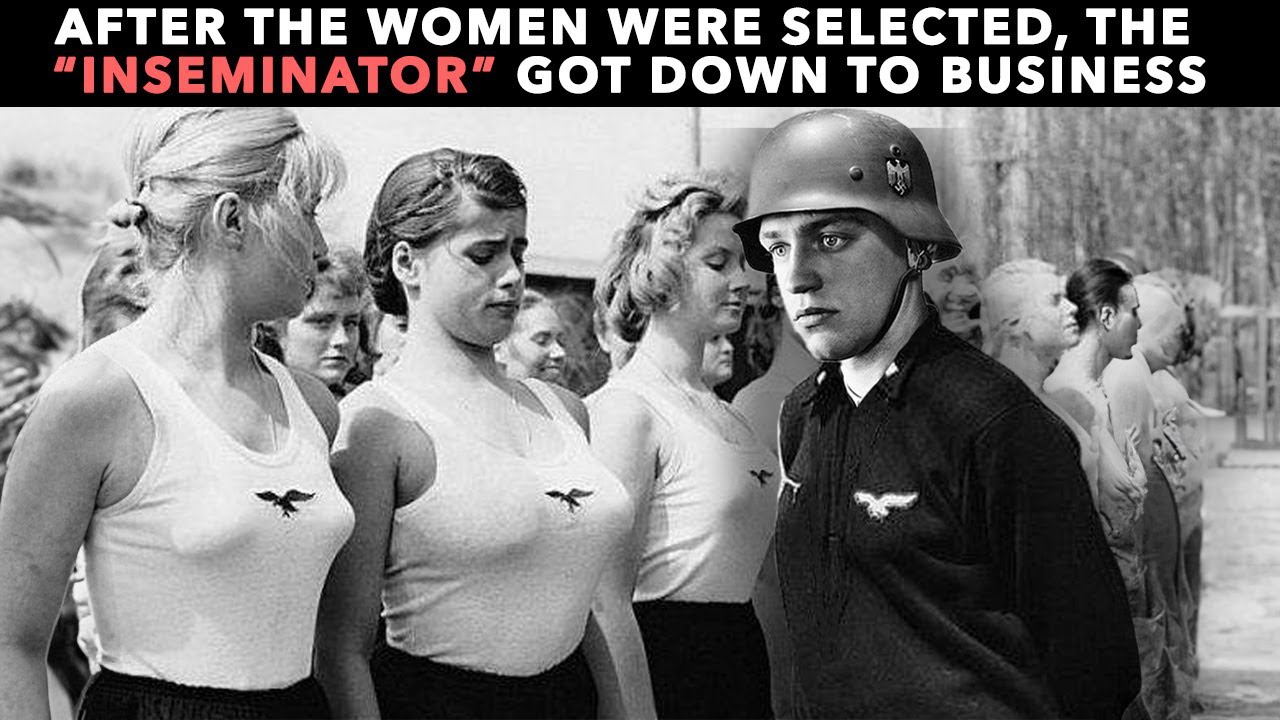
Once the candidates were selected and agreed upon, the inseminator set to work. For the first three nights he visited one girl, for the next three nights another. On Sundays, the inseminator had a day off. The visits went on until conception occurred.
The conditions offered to women in labor were so good that by 1938, at least 8,000 babies had been born in the special maternity hospitals. Any German family could also surrender a newborn to a maternity hospital, having first supplied all the necessary documents on the child’s health and racial purity. With the outbreak of World War II, Lebensborn branches were opened in the occupied countries as well. Three maternity hospitals opened in Poland, one in France, and one each in the Netherlands and Luxembourg, plus ten in Norway.
This stemmed from a catastrophic shortage of pure German women. So in the occupied countries, healthy, fair-haired, and blue-eyed girls were likewise given the chance to contribute to strengthening the Reich. Tellingly, Hitler’s propaganda stayed silent about Aryan blood purity in this case, inventing the excuse that in the occupied countries these were so-called “forgotten cousins of Aryanism.”
The babies born under the program, before leaving the maternity hospital, underwent a rather peculiar baptismal rite, one closer to Celtic or even Satanic rituals.
The baptism was performed beneath the Nazi banner, alongside a portrait of the Führer and a flaming torch. The officiant extended a special SS dagger above the infant and recited this so-called prayer: “We receive you into our community as part of the body. You shall grow beneath our protection and bring honor to your name, pride to your brotherhood, and lasting glory to your race.” Once this rite was completed, the child was deemed to have become, for all time, a loyal servant of the Reich.
No one can say with certainty how many children were born under the Lebensborn program in total. As noted earlier, the bulk of the records—down to the very procedure for feeding infants—were destroyed as the armies of the Anti-Hitler Coalition drew near. Some researchers put the figure at no fewer than 9,200 births overall, yet only pre-war data covering 8,000 births was available. Documentation survives only for Norway.
By some accounts, at least 20,000 children were born in Norway to German fathers, 85,000 in France, and roughly 700 in Denmark. Determining which of these arrived as part of the Lebensborn program is far from easy. What is certain is that before the war, and in Norway alone, no fewer than 12,000 such babies were born. After the war, the fate of the children born under the Lebensborn program remained for the most part unknown.
In Norway, the leading psychiatrists pronounced that a woman who had slept with the Nazis and borne children by them should be regarded as insane. Accordingly, the first attempt was to deport the children to Germany. When that failed, they were either handed over to other families or simply consigned to asylums. Only in the 1980s did the Prime Minister of Norway offer an apology to the surviving children and their mothers.
By that time, one of the most celebrated babies of the Lebensborn program had already made her own way in the world. Anni-Frid Lyngstad, born under the program to a Norwegian mother after a relationship with a German officer named Alfred Haase, escaped the persecution that followed Norway’s liberation and settled in Sweden. There she became one of the vocalists of ABBA, one of the most popular groups on earth—a child the Reich had claimed as its own, raised instead on the far side of the sea.
