The case did not truly conclude when the newspapers declared it over. It concluded nine days after the county road supervisor, Coburn Ash, stepped out of his kitchen at four-thirty in the morning and failed to return. And even then, it continued to conclude quietly each summer, for as long as anyone remained who cared about the integrity of the records in Garren County. What the divers brought up from Rose Cut quarry in July of 1927 rests in the courthouse files at Belcher, Kentucky, beneath a red thread in a cabinet that no one is allowed to remove.
I have seen it. I have held one of the pieces in my own hands, and I still cannot tell you what truly lay at the bottom of that water. Only what rose to the surface. Coburn Ash was fifty-two years old in the summer he disappeared.
He had the broad chest of a man who had spent thirty years swinging a nine-pound hammer for the county road commission. His face had been scorched by the sun so many times it had taken on the color of tobacco. His hands did not welcome being touched during an argument. He owned a farm on the east side of Truman Hollow, six acres of poor, rocky ground he no longer worked, and a small barn he maintained.
His wife, Virba Ash, raised chickens and put up her own preserves, and by then their two grown daughters lived elsewhere—one in Louisville, the other married to a railroad man in Indiana. It was a large house, and Coburn Ash was its head. Not the kind of man who wandered off alone. According to Virba, he went to bed on the night of June 28 at his usual time, just after nine.
She woke at three in the morning to a dog barking in the yard and could not fall back asleep. When she reached across the bed at four-thirty, the space beside her was empty and the covers were cold. His work boots were gone from the porch. His coat was not on its peg.
Coburn Ash’s lunch pail sat on the kitchen table, packed for that morning, untouched. That final detail was what infuriated Virba. Coburn Ash would not leave for the day without his pail. He had not missed a single lunch pail in twenty-nine years of working for the county.
The sheriff of Belcher was a man named Sherwin Bragg, forty-eight years old, thin as a matchstick, with a pale face as though it had been soaked and dried. He had been sheriff of Garren County for eleven years by then, and he had known Coburn Ash since they were boys running through the hills. When Bragg got the call from Virba at six-thirty in the morning, he did not send a deputy. He drove his own truck, a can of coffee between his knees.
By ten o’clock he had covered the eastern half of Truman Hollow, climbed the hill above Coburn’s barn, and come back around through the low fields. He talked to the two nearest neighbors and the man at the crossroads store. No one had seen Coburn Ash. No truck had passed east that morning.
His truck sat in the barn, key still on the seat. His fishing rod hung on its pegs. Whatever he had gone into, he had gone into it on foot. And he had gone into it in the dark.
At eleven-thirty, Sherwin Bragg stood on Coburn’s porch drinking coffee that Virba had made, looking east across the pasture toward the treeline. Truman Hollow ran another mile in that direction before the ground began to rise toward the foothills. Beyond that lay four hundred acres of regrown forest, some old wagon roads turned to briars, and in the middle of it, the sunken limestone shell of the Rose Cut quarry. Coburn Ash had grown up half a mile from that quarry.
He had drunk from its creek as a boy. According to Virba, he had stood on its edge only three times in the past twenty years, and he had spoken of it in only about six sentences in all that time. Always the same sentences, always ending with the same phrase: “That place isn’t right. Better to leave it alone.
”
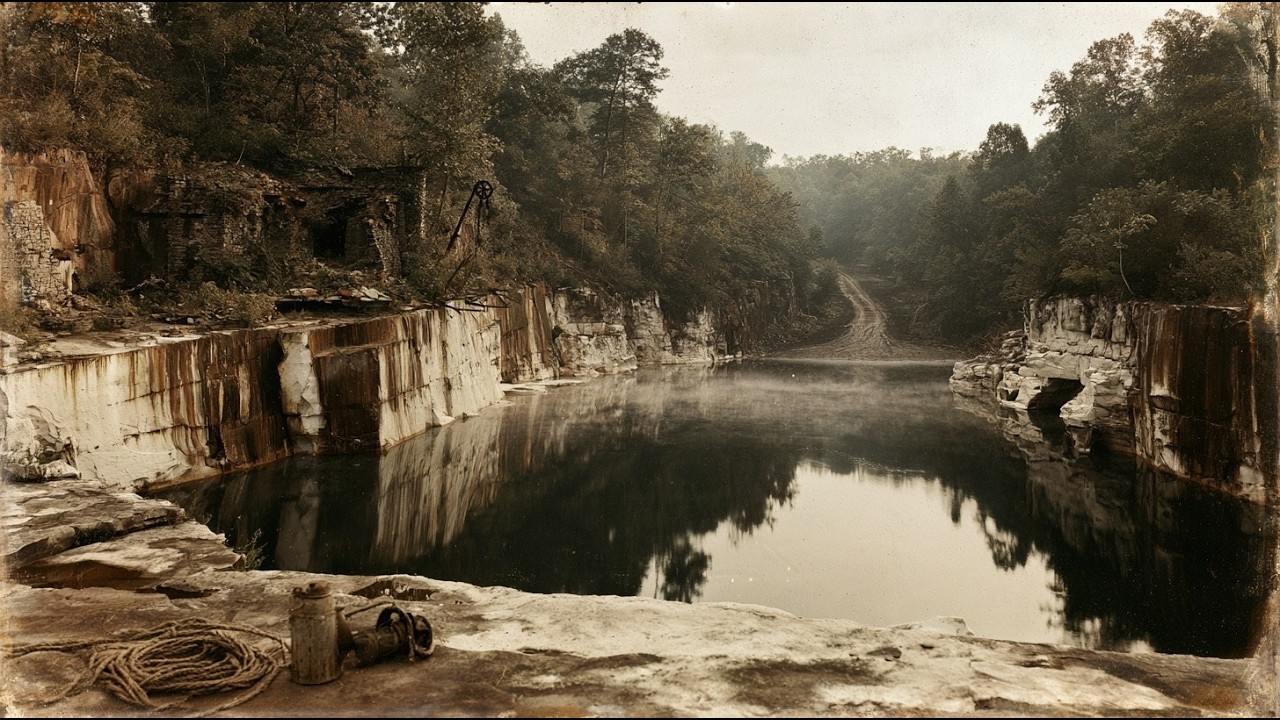
At three in the afternoon of June 29, Sherwin Bragg stood on the north rim of Rose Cut, looking down at water so still it did not look like water at all. It looked like a mirror someone had laid on the ground and forgotten. He had a bad feeling in his stomach. He would tell me later that the feeling had a specific shape.
It was not general unease. It was a particular unease, the kind a man feels when he looks at a room that has been cleaned too well. The Rose Cut mine had been flooded in 1911. It had taken about twelve years to dig, by a company out of Louisville that bought the mineral rights from the Rowe family cheap in 1899.
At the height of the work, forty-two men a day went down into it. They pulled clean building limestone and shipped it north by rail. The mine itself, while in operation, was roughly oval, the size of a small church, cut into the hill from the south face, with a series of dry stepped benches along the walls and a work floor below that, in its final year, lay sixty-eight feet under the rim. There were holes drilled in the floor.
There were crane anchors on the east bench. I was told there was a small stone shed on the west bench where the foreman kept his ledgers and where a man could get out of the rain. In October of 1911, a crew was cutting a seam of clean limestone underground, running under the north wall, following it farther than the company men in Louisville had expected. On one afternoon, around three o’clock, a wall gave way between that seam and an old spring.
Three men had gone down into the quarry that morning. Two came out. The third, a man named Uriah Renfrow, forty years old, the husband of a woman named Ona who lived in the hollow, was never found. The company closed the quarry within a month, pulled out what was left of their equipment, and let the water take the rest.
By 1912 the quarry had filled to within eight feet of the rim. And there it stayed for sixteen years. Poplars grew up along the edge. Deer came down at dusk to drink.
Boys threw stones from the high hills just to hear them hit. Nobody went into the quarry in all that time, because there were no divers in Garren County. There were no divers in the next county either. Sherwin Bragg made three phone calls on the morning of June 30.
One to Frankfort, another to a man he’d known back during the war, and a third to a river salvage outfit in Cincinnati that a friend at the state highway office had recommended. By nightfall he had a commitment. A crew of two, with all their gear, would board train number 805 to Corbin the following morning. From Corbin they’d cover the remaining forty miles by truck.
The senior diver was named Winton Mayberry. Forty-four years old, of medium build and heavier than he appeared, with the powerful arms of a man who had spent a decade hauling himself along a rope hand over hand. His hair had turned gray early. His eyes were a pale gray-green and seemed to blink less often than they ought to.
He had begun his working life on sunken steamboat salvage along the Ohio River out of Cincinnati, and by 1927 he had put in roughly sixteen years on the muddy riverbeds of the South, cutting cables loose from sunken barges and hauling safes up out of wreckage. Once he had raised a woman from the water so that her family could bury her. He wore a plain wool sweater beneath his rig, chewed on a small unlit cigar, and spoke, when he spoke at all, very slowly, picking his words with care. His tender was a younger man, Merle Vestal, twenty-four, lean, with a face that hinted at hard luck, high cheekbones and heavy-lidded eyes.
Vestal was equally quiet, though for another reason. Merle Vestal had been around water work since the age of fourteen. He handled the lines. He ran the pump.
He kept his eyes on the surface. He was the one who noticed things. They arrived in Belcher at ten-thirty on the morning of July 1. Sherwin Bragg met them at the station and drove them directly to the quarry road without pausing to talk.
Winton Mayberry rode with his knees pressed to the dashboard, gazing at the hills through the window in silence. When they came to the rim of Rose Cut, he climbed out, walked to the edge, tucked his hands into his back pockets, and stood there for a long moment. Then he turned and asked Sherwin Bragg the question he had not yet been answered. Bragg said he didn’t follow.
Mayberry said, “You called me rather than a man closer by. You paid the freight in advance. You never asked what I charge. You never asked how long I’d need.
There’s something about this water you haven’t told me.”
Bragg removed his hat. He turned it over in his hands and said, “My missing man never mentioned this quarry in twenty years, except to say it wasn’t a fit place, and he never explained what he meant by that. And I’ve been sheriff here eleven years, and in that time three other men have vanished, last seen in the hollow that runs down to this cut, and not one of them was ever found.
Every one of their records closes with the same words: presumed drowned. I don’t know whether my man is in this water, Mr. Mayberry, but I want somebody down there who isn’t afraid of it.”
Winton Mayberry studied the quarry, drew the cigar from his teeth, and set it back again.
“We go in at first light,” he said. “And if we come across something that’s been down there a long while, we’ll bring that up as well.” Bragg nodded once. That was the agreement.
That evening, at Virba Ash’s kitchen table, Sherwin Bragg wrote down in a small brown notebook the names of the other three missing men. Elroy Fisk, born 1921, thirty-eight years old, had gone up the hollow with a hunting rifle to shoot crows and never returned. His rifle was discovered leaning against a birch tree fifty yards from the water. Old Man Chapel Munsey, born 1916, sixty-one years old, had gone up to check on a still he was said to keep, and had not come home.
His still was there. He was not. And a railroad surveyor by the name of Idus Coye, born 1908, twenty-nine years old, sent to map a line across the top of the hill, whose transit was found exactly set on its tripod at the hollow’s edge, still level, still pointed at the far wall, as if he had stepped away from it for a moment and then never returned. Add Coburn Ash, and that made four.
When Sherwin Bragg told Winton Mayberry this at six-thirty the following morning on the rim of Rose Cut, the diver listened without breaking in. Then he asked one question. “Was there a fifth?” Bragg said, “Not that I’m aware of.”
Mayberry said, “That will change.”
He placed the mouthpiece between his teeth, and Merle Vestal lowered him into the water at 6:07 on the morning of July 2, 1927. On that first day they found nothing. That isn’t quite accurate.
Winton Mayberry surfaced at nine o’clock, again at two in the afternoon, and a third time at four-thirty. Each time he had a small thing to report and a small thing to hand to Merle. In the morning, a length of quarry chain, as thick as a man’s wrist, still bolted to a rusted piece of what had once been a crane. In the afternoon, a mule shoe, still nailed to a scrap of hoof, that had lain down there so long the iron was thin as piecrust and crumbled between the fingers.
On the day’s final dive, a brown whiskey bottle, corked, containing dark water and something else not yet examined. “We mark the spot and go back down,” he said. What he told Sherwin Bragg that first evening, seated on the shelf rock with his boots off and his hair still wet, was that the shape of Rose Cut was not the shape of a flooded quarry. A working quarry, he said, once the water takes it, tends to hold its shape through the early years.
The benches are still there. The floor is still there. The tool marks on the walls are still there, legible as handwriting to a man who knows how to read them. This quarry, he said, was not like that.
The east benches were in place, the crane bolts still set where the company left them in 1911. But the north wall, he said, was wrong. The north wall ran too straight in some places and too rough in others. The tool marks sat at the wrong depth.
There were spots where the stone had been cut with precision and spots where it looked chewed. And along the foot of the north wall, at roughly fifty feet, there was a shelf that was, by his judgment, neither natural nor quarry-made. It looked planned. Sherwin Bragg wrote in his notebook on the night of July 2 that Winton Mayberry had told him the water in Rose Cut was not ordinary flooded quarry water.
The water was colder than it had any right to be at that depth. A current ran through it, though nothing visible moved. And once you dropped below roughly twenty feet, visibility vanished entirely. Not the murky nothing of churned-up silt, but a blackness black as ink.
He claimed he had spent his whole life working muddy river bottoms and had never been in water this black. He said that at fifty feet the lamp on his helmet gave him about eighteen inches of light and then simply quit. The beam did not fade the way a light beam is supposed to fade in dark water. It cut off all at once.
As though a wall of black air stood just past his hand where water ought to have stayed water. On the second day they brought up the first of the cans. It surfaced at 11:00 on the morning of July 3. Merle Vestal hauled it over the rim and set it on the flat rock they were using as a work table.
It was an old-style milk can, the tall twenty-inch sort, dented along one side, stamped near its lower edge with the name of a creamery in Danville, Kentucky. It was heavy. When Merle tipped the can, Sherwin Bragg heard something shift inside that was not the slosh of milk or water. A rope was wound three times around the can’s neck and knotted at the handle.
At the rope’s other end, ten feet away, lay a lump of limestone about the size of a man’s head, drilled and weathered. Someone had deliberately anchored this can to the quarry floor. Winton Mayberry arrived just then. He had been circling the spot Merle had marked.
He rose out of the water, unlatched his helmet, and set it aside. He studied the can for half a minute before he touched it. Then he said, “Sheriff, do you want to open it here, or at the courthouse?” Sherwin Bragg said, “Open it here.
“
They cut the rope. They pried off the lid with a screwdriver. It came open with a sound like a mouth being opened. Inside the can lay a folded square of oilcloth, black with age, wrapped tightly around something small.
Mayberry took it out. Unwrapped it slowly. Laid its contents on the rock. There was a man’s pocketknife, closed.
There was a leather bootlace, coiled. There was a small tin matchbox with a name scratched into its lid. And there was a single brass button, of the kind used to close a station agent’s coat. The name on the matchbox was Idus Coye.
Sherwin Bragg had already written that name in his notebook. He turned the notebook to the page. He read it aloud. Then, very carefully, he sat down on the rock and put his head between his knees, because his ears had begun to ring and his hands to shake and he did not want anyone to see.
Idus Coye had gone up that hollow nineteen years before and never walked out. His transit was found where he set it. His body was never found. And here, in Sherwin Bragg’s hand on July 3, 1927, was a matchbox scratched with his name, placed inside a milk can, weighted with a stone, and thrown into water that had been thirty feet deep on the day Idus Coye reached it.
Winton Mayberry did not sit down. He looked at the can. He looked at the water. Then he looked at Sherwin Bragg and said, “Sheriff, that can wasn’t put down there when Idus Coye got here.
” Bragg said, “What do you mean?” Mayberry said, “That rope on the can’s neck is new. Five years old, no more. Six at the outside.
Whoever put that can there did it after 1921.” Bragg said, “And the name on the can?” Mayberry said, “Older. Much older.
The scratches are dark all the way through. The metal has eaten around them.”
They stood in the white hot sun on the flat white rock. Somewhere in the trees above the cut, a crow began to call and did not stop.
They came back with the dawn on the fourth. A light mist hung over the water when they reached the rim that morning, a thin white mist that lay on the surface without touching it, rising from among the trees along the east edge, and it did not move even when a light breeze came and stirred the branches. Merle Vestal would tell his nephew, years later, that the mist over the water at Rose Cut in the morning did not behave like ordinary mist. It stayed still.
It waited. It kept its shape. Winton wanted to sweep the area east of the marked point. Merle laid out a grid line across the shelf where the first can had come up.
He counted the knots on the line as Winton went down and paid it out. Sherwin Bragg stood on the rim and had not slept well the night before and would not sleep well on any night of that week. The second can came up at ten o’clock on the morning of July 4, Independence Day, and no one at the quarry noted the holiday. It was smaller, ten inches.
The kind a farm wife sends up to the crossroads store for cream. The rope was the same, with the same knot, the same stone weight, the same ten-foot length. Inside the second can was another folded square of oilcloth. Inside the oilcloth were three things.
A briar pipe, the bowl chewed almost through. A pair of wire-rimmed spectacles, one lens cracked in a spiderweb pattern. And a sheet of folded paper so brittle it had to be handled with the point of a knife, written on in faded ink with the name Chapel Munsey and the date August 7, 1916. Sherwin Bragg read the paper.
He did not sit down this time. He only said, “That was his hand. I saw it on the bill of sale for his mule.”
The third can came up in the afternoon of the fifth.
This one was full-size, twenty inches long and heavy. When they set it on the rock, water was already seeping from a small hole in its bottom. Winton opened it quickly. Inside were four things wrapped in oilcloth.
A hunting knife, still sharp, with the letters E. F. scratched into the wood of its handle. A shotgun shell, twelve gauge, brass base, never fired.
A silver pocket watch on a broken chain, stopped at 2:18. And a small square of paper with the name Elroy Fisk and the date October 9, 1921. Sherwin Bragg looked at the watch a long time. He turned it over.
On the back, scratched into the metal, were the words: “To Elroy from his father.” He had seen that watch on Elroy Fisk’s wrist dozens of times before Elroy headed up the hollow with his rifle and never returned. He laid the watch on the rock and said, “Gentlemen, there is something wrong here.” Winton Mayberry said, “We haven’t found your foreman yet, Sheriff.
” Bragg said, “I… I…” He fell silent. That night, at the county hotel in Belcher, Winton Mayberry sat on the edge of the porch and told Sherwin Bragg something he had been turning over all afternoon.
He had pulled off his boots and propped his feet on the rail, a small cigar between his teeth, unlit. A moth was worrying at the porch light. Somewhere down the street a piano was being badly played by someone who had had two drinks too many. And Winton Mayberry, who had said little all week, said this: “I’ve been down in this water three days now, and I have not seen the bottom once.
” Bragg said, “But you found the shelf.” Mayberry said, “I found a shelf. It’s at fifty-two feet. It’s about the width of two barns, and I don’t know how far it runs back under the north wall.
That’s where the cans are, Sheriff. On that shelf. In a row.” Bragg said, “A row.
” Mayberry said, “A row. Evenly spaced. Like fence posts.”
Bragg looked at him.
Mayberry said, “Whatever is down there goes deeper than that shelf, Sheriff. There’s a slope behind the shelf and I haven’t measured it. I’ve gone past a hundred feet and felt no bottom, and the sounding line comes back without any silt on it.” Bragg said, “What do you mean, whatever is down there?
” Mayberry looked at his cigar and did not answer for a while. Then he said, “Sheriff, the cans on that shelf were placed there over the years. I can tell you that from the rope alone. Some of that rope is fifteen years old, some of it five.
Someone comes to this quarry and puts a can on that shelf, now and again, for a long time. And every can we’ve opened so far carries a name. And every name we’ve opened so far belongs to a missing man of this county. So I would ask you, Sheriff, to consider that whoever put those cans there may still be doing it.
”
Bragg did not answer. He went to his room and sat by the window and watched the moon come up over the hill and did not sleep. On the morning of July 6, Winton Mayberry did something he had not done in eleven years of water work. He asked Sherwin Bragg to bring another man to the rim.
He said, “Sheriff, I want someone here who knows this ground well, someone who was here before the flood, old enough to tell the truth without caring who hears it.” Bragg thought for a moment, then said, “That’s Loyal Bedgood.”
Loyal Bedgood was seventy-eight years old. He had been the county surveyor from 1878 until 1914, when his eyesight failed.
He lived alone in a white house on the edge of Belcher, reading newspapers through a magnifying glass, and spoke to almost no one. But Sherwin Bragg had known him for thirty years, and when Bragg drove up to Loyal Bedgood’s front porch that evening and told him what they had brought out of Rose Cut, Loyal Bedgood did not need to hear it twice. He said, “I want to come up there.”
He was at the rim of Rose Cut by four in the afternoon, seated in a folding chair that Merle Vestal brought him, a water gourd in one hand and his old brass level in the other, though there was nothing to level.
He looked at the three opened cans on the rock. He looked at the pipe, the spectacles, the pocketknife, the watch, the matchbox, the bootlace. Then he said, “Boys, I have to tell you something I have never told anyone in this county before, because there was never a good reason for it.”
He said, “In 1893, a mining engineer came through here from a company in Louisville.
He was going to survey the Rose Cut ground for an expansion. His name was Ulysses Astor, and he was thirty-one years old, and he boarded in my house four nights because there was no nearer hotel. He was a quiet, courteous man, no drink, no tobacco. And he sat at my kitchen table every evening after supper, drawing in a leather-bound notebook by oil lamp light.
On the third of his four nights, he told me at supper that he had gone down into the cut earlier that day in the dry season, when they were still working the dry seam, and that he had seen something in the wall of the cut he did not know how to describe. He said there was a borehole cut into the north wall of the quarry, small, barely wide enough for a man to crawl into, and old, much older than the quarry itself. He said the tool marks on it were not the tool marks of any tool he knew. They were not pick marks.
They were not drill marks. They were not the kind left by wedge and hammer. He said the stone around the mouth of the borehole was polished, as though something had gone in and out of it many times over many years, and he said that when he reached it and put his lamp inside, he saw that it did not stop. It went back.
As far as his lamp reached, it went back. It was level. It was straight. It did not slope up or down.
He said it was cut with a hand and a purpose. He said he came out of there and never went back in and never told the foreman. “Ulysses Astor left this county on August 7, 1893. I saw him onto the wagon myself.
Six weeks later, the company in Louisville wrote to ask if I knew what had become of him. He never reached Louisville.”
Bragg said, “Lord.” Bedgood said, “If the flood came in 1911, that borehole is under the water now.
” Winton Mayberry said, “On the north wall.” Bedgood said, “Yes.” Mayberry said, “Sheriff, the shelf is on the north wall.” Bragg said, “Lord.
”
Bedgood looked at him and said, “Sherwin, I have kept that story to myself since I was forty-four years old, and I have never told it because the name of a man who was never named should not be named. But you have four men now, one of them a road man for thirty years. Ulysses Astor makes five. And if what you say is true, that there are cans down there with names on them, I will bet you a month of my pension that if you find another can, his name will be on it.
”
Sherwin Bragg gave no reply. He made his way to the water’s edge and peered down into it. That evening they hauled up the fourth can. It surfaced at 7:06 on the evening of July 6.
A little ten-inch can, a stone for a weight, a ten-foot length of rope, the identical knot. Within, resting on a square of oilcloth so brittle it crumbled to flakes when Winton unfolded it, lay four items. A brass compass, heavily corroded, with a scratch on its lid: U. Astor, Louisville, 91.
A pen nib. A brass button. And a slip of paper bearing the name Ulysses Astor and the date August 9, 1893. Loyal Bedgood was still seated in his folding chair up on the rim.
He studied the compass. He studied the paper. He studied the button. He gave a single slow nod, the way a man does when he is confirming a diagnosis he had already reached in his own mind.
Then he removed his hat. And he cried. Quietly, in the manner of an old man weeping over a heavy burden he has borne for thirty-four years. He set his hat back on his head and asked Merle Vestal to drive him home.
He never came back to Rose Cut. He lived six more years in the white house at the edge of Belcher and never once spoke Ulysses Astor’s name to another living soul. When he passed away in the winter of 1933, Sherwin Bragg came upon a leather-bound notebook among his belongings, filled in a small neat hand. On the final page, in ink still soft, was one sentence: “I should have told him not to go back in.
That was the 6th. ”
On the seventh, they turned up nothing new. Winton Mayberry descended at dawn, surfaced at nine, went down once more at ten, and came up at noon. He reported that the shelf reached back farther than he had first believed.
He reported that the line of cans stretched out in both directions from where they had first entered. The deeper he went, he said, the older the ropes on the cans grew, and the nearer the edge, the newer they were. Whoever had been setting them down had begun at the rear of the shelf, closest to the borehole in the wall, and had worked outward year after year across the decades. He said there was a fresh can at the far end of the row, its rope newer than any other rope, its sinker stone newer, placed a little apart from the remainder.
He said, “That one is for your foreman, Sheriff. ” Bragg said, “Bring it up. ” Winton Mayberry said, “Tomorrow. ” Bragg said, “Why not now?
” Winton Mayberry said, “Because I want daylight for the one after it. ”
That was the afternoon of July 7. Sherwin Bragg headed back to town and sat at the drugstore table on Main Street and drank three cups of coffee without eating a thing. Then he returned to the hotel at nine-thirty and sat on the porch alongside Winton Mayberry, and for a long while neither of them spoke.
Then he said, “Mr. Mayberry, I have a question. If I follow you rightly, whoever has been lowering those cans down there has been at it for at least thirty-four years, from 1893 right up to now. That is longer than any one man’s lifetime.
So there is more than one of them, isn’t there. There has to be. ” Winton Mayberry did not reply straight away. He drew the cigar from between his teeth, examined it, put it back, and said, “Sheriff, in my line of work you learn early that water can do things you would not credit.
It holds things, conceals them, shifts them from where they belong when nobody is watching. I have known rivers that handed me back a horseshoe on a Tuesday and the very same horseshoe on a Friday, three miles apart, with the current dead still. I once recovered a lantern in Cincinnati that was still warm. I once brought up a woman from a drowned silo in Indiana whose hands were clasped over a Bible that her father’s family had owned since 1840.
That Bible could never have reached her hands beneath thirty feet of still water, and nobody in that town could tell me how. In Rose Cut I have spent six days, and I will tell you what I can say honestly. The ropes on those cans are not all the same age, judging by their position on the shelf. Some of the newer ropes sit farther back than they ought to, and some of the older ropes sit farther out.
And there is a spot near the borehole in the wall where the rope is so new I could have bought it at the general store this morning, and I did not bring it up. ”
Bragg said, “Why not? ” Winton Mayberry said, “Because I did not want to know the name on it yet. ” Bragg said, “Whose do you reckon it is?
” Winton Mayberry made no answer. Bragg said, “Mr. Mayberry. ” Winton Mayberry looked at him and said, “Sheriff, I have been diving for twenty-two years.
I have never once had to talk myself into going back into any place in the water. I have had to talk myself into it four times this week. Tomorrow at first light we bring up the fresh can from the far edge. That one is your foreman.
And if the sheriff and the divers and old Loyal Bedgood are in agreement, we bring up the fresh can from near the borehole after that. And after that, if anything remains, we decide what to do. ” Bragg said, “Agreed. ”
Winton Mayberry rose and went into the hotel.
He did not sleep either. July 8, 1927, was the hottest day that summer in Garren County. By ten in the morning the water of Rose Cut gave off a smell of metal, a smell that had not been present on any other day. The black mosquitoes rose out of the ferns in such swarms that Merle Vestal had to tie a wet bandana over his nose and mouth.
Winton Mayberry entered the water at 6:17. He remained below for forty-one minutes. He surfaced slowly, too slowly for Bragg’s liking, but he had told them from the outset that this water did not care for haste. When he broke the surface he held a rope in his hand and was dragging something up behind him.
He brought it to the rock. Merle helped him hoist it. It was a milk can, twenty inches long. The rope about its neck was so new the cut ends still shone bright.
They cut the rope. Winton opened the lid. Within lay a folded square of oilcloth, thick as a saddle blanket, heavy for its size. Winton set it on the rock and unfolded it.
Within were four items. A small closed pocketknife, with the letters C and a period scratched into its wooden handle with a nail. A key ring holding two keys, the smaller of which fitted the lock of Coburn Ash’s barn door. A metal star, of the sort a man might carry as a luck charm, with no marking upon it.
And a folded square of paper, written in faded ink with the name Coburn Ash and the date June 29, 1927. Sherwin Bragg sat down on the rock. He had known this would happen since Winton Mayberry said it the night before. He had known since Loyal Bedgood said it two days before.
But he had told himself, all the way from Belcher that morning, that he might be wrong. And now he was not wrong. He sat on the rock and did not speak. Winton Mayberry gave him a minute.
Then he said, “Sheriff? ” Bragg said, “Yes? ” Mayberry said, “The ink on this paper is dry. ” Bragg said, “Of course it is.
” Mayberry said, “No, Sheriff. Look. It is not just dry. It is old.
This ink was put on this paper years before this one. Look how it has soaked into the paper. Look at the color. ”
Bragg looked.
The ink had faded to a light brown. The edges of the paper were yellowed the way a page yellows when it has lain in a dresser drawer for several winters. The name Coburn Ash and the date of his disappearance had been written on that paper before he disappeared. Bragg said, “Mr.
Mayberry? ” Mayberry said, “Sheriff? ” Bragg said, “Mr. Mayberry, this is not possible.
” Mayberry said, “No, sir. It is not possible. ”
They stood on the rim of Rose Cut in the hot metallic air, the black mosquitoes crawling on the backs of their necks. And Winton Mayberry, who had been diving for twenty-two years, who had never, he said, had to talk himself into going back into any place in the water, turned to Sherwin Bragg and said, “Sheriff, with your permission, I would like to go down again this afternoon.
” Bragg said, “You said tomorrow. ” Mayberry said, “Yes. ” Bragg said, “And now? ” Mayberry said, “And now I have changed my mind.
I want to bring up the fresh can from near the borehole. And then I want to leave this water. ” Bragg said, “Go. ”
Merle Vestal lowered Winton Mayberry into the water of Rose Cut at 1:02 on the afternoon of July 8, 1927.
He stayed under for fifty-three minutes. Then he came up with a rope in his hand. At the end of the rope was a small milk can, ten inches long, weighted with a stone. The rope around its neck was new, and so was the stone.
The lid of the can was sealed shut, its edge sealed with a black wax that Winton said was not tar and not pitch and smelled like neither. Winton brought the can to the rock, but he refused to touch it further. He said, “Sheriff, this is your decision. I have brought up six cans from that water in seven days, and every one of them had a name on it I did not want to read.
I will not be the one to open this one. ” Bragg said, “All right. ”
Bragg took the screwdriver from Merle. He worked at the wax, and it came off in one long dark curl.
Then he opened the lid and set it aside. Inside the can was a folded square of oilcloth. Bragg lifted it out and spread it on the rock. There was nothing wrapped in it but a folded square of paper in the middle of the cloth.
A sheet of bright white paper, not yellowed. He picked it up. He opened it. On it was a date: July 23, 1927.
There was no name on it. Sherwin Bragg stared at the paper for a long time. Winton Mayberry looked at Sherwin Bragg. Merle Vestal, sitting on the rock with the wet bandana tied over his nose and mouth, looked at the water.
It was July 8, a Friday. July 23 was two weeks and one day away. Bragg folded the paper again. He put it in his shirt pocket.
He said, “Mr. Mayberry. ” Mayberry said, “Sheriff? ” Bragg said, “I want you and Mr.
Vestal to go home tonight. I want you on train 805 out of Corbin in the morning. I will pay your fares both ways, and half your fee for your silence. And I want your word that if anyone ever asks you what happened at Rose Cut, you will say only that a search was made and the supervisor was not found.
” Mayberry said, “Sheriff, are you sure? ” Bragg said, “Yes. ” Mayberry said, “And the newspaper? ” Bragg said, “That is my affair.
”
Mayberry looked at him a long time. Then he took the cigar from between his teeth, put it in his shirt pocket, shook Sherwin Bragg’s hand, and did not say another word. Merle Vestal loaded their gear onto the truck. Sherwin Bragg drove them to Belcher and paid them out of the county strongbox.
They were on the train by eight o’clock the next morning. Winton Mayberry never returned to Garren County. I was told that Merle Vestal left the diving trade in 1931 and moved to Oregon, where he worked the rest of his life in a sawmill, and spoke of what he had seen in the Kentucky water only once, near the end of his life, to a nephew who wrote it down in a private notebook I was not allowed to read. On the ninth day, July 9, 1927, Sherwin Bragg went back to Rose Cut alone.
He did not go into the water, for he had no means to do so. He stood on the rim for an hour in the bright morning light, holding his notebook and a can of coffee between his boots. Then he drove back to town and did three things. The first was that he filed with the Belcher court a report in his own handwriting stating that a search of Rose Cut had been made for the missing road supervisor, Coburn Ash, over a period of nine days, that the search had produced nothing, and that Coburn Ash was presumed drowned.
That report is now in the records of Garren County. It is the report that was shown to Virba Ash three months later when she came to the sheriff to ask what he could tell her, and it is the only report the state of Kentucky ever received on the matter. The second was that he went to the drugstore on Main Street and bought a small brown envelope. At the drugstore, on a folded sheet of paper, he wrote out the following words: “To whoever finds this in 1950 or after.
On July 8, 1927, at Rose Cut, Garren County, Kentucky, a can was found containing a paper dated July 23, 1927, with no name. I will watch the county on that date. I will record what happens. ” The paper was signed Sherwin Bragg, Sheriff.
He put that paper and the paper that had been inside the can into the small brown envelope. He sealed it. He wrote on its face: “To be opened in 1950 or after. ”
He returned to the courthouse.
He put the items into the red-thread cabinet, in the box marked “Ash.” After that he drove out to the edge of Rose Cut carrying the six cans, the fresh can, the pipe, the pocketknife, the compass, the shotgun shell, the watch, the spectacles and the bootlace — every small heavy object they had drawn up out of the water, now folded into a clean cloth. He walked down to the waterline and flung the whole bundle in. He later told Loyal Bedgood that he had turned that decision over in his mind for the rest of his life.
He said he was not sure it was the correct one. He said he could never settle in his own mind whether he was giving the things back to the water to appease whatever had held them there, or whether he simply wanted the proof of what those cans had contained to remain somewhere no living person would ever lay eyes on again. On July 23, 1927, in Garren County, Kentucky, nothing happened at all. Nothing.
The sheriff’s log for that date, written out in Sherwin Bragg’s own hand, says: “Quiet day, no incidents, clear weather.” In his personal notebook that night he set down that he had sat in his truck at the mouth of Truman Hollow from six in the morning until nine at night and had watched no one enter the hollow or leave it all day. On July 24, 1927, Virba Ash did not wake up. Her sister, who had traveled from Louisville to visit, found her in her bed at nine-thirty that morning.
She had not been sick. She had gone to bed the previous night at her customary hour. Her doctor drove over from Belcher and pronounced that her heart had stopped while she slept. A woman of fifty-one whose husband had vanished under strange circumstances is a woman whose heart bears a heavy load, he said, and such things happen, and there was no cause to inquire further.
They buried her on the twenty-sixth in the family cemetery, next to a headstone carved with the name Coburn Ash, so that at least his name would rest somewhere in the soil of the county where he had lived out his years. The date the sheriff had carried in his shirt pocket was the twenty-third. Virba Ash died on the twenty-fourth. He pondered that for the remainder of his life.
Three years afterward he told Loyal Bedgood that he could not tell whether the paper had been a day off, or whether he was meant to grasp that what got counted was not always a man walking into a hollow. Sometimes it was a woman in her bed. And maybe the water had been tallying different things from the start. Sherwin Bragg stayed on as sheriff of Garren County until 1939.
Across those last twelve years, three more men were lost, their final known walks traced into Truman Hollow. Merritt Cullins, a saw-filer, in 1931, aged forty-six, had gone up the hollow to inspect a fallen poplar and never returned. Otway Krebs, a veterinarian from close to the Tennessee line, in 1934, aged fifty-one, had gone up the hollow with a rifle and a blanket to hunt turkey and never returned. And a man I was asked to describe no further, a man of sixty-three, loved and respected, who stepped off a country dance porch at ten o’clock to smoke and never came back inside.
Sherwin Bragg did not go back to Rose Cut for any of these cases. He filed every report the same way: presumption of drowning. He wrote no more notes about them and placed no more envelopes in the red-thread cabinet. He died in 1952 at his sister’s house in Frankfort, of a stroke, aged seventy-three.
His sister said that he spent the final three weeks of his life sitting on her porch, gazing east toward the mountains, and spoke of just one thing, in a low voice: “I should have gone back up there.” On his last night he said it once more. The red-thread envelope was opened at the Belcher courthouse in 1954, while a new county clerk was inventorying the sealed materials. She came upon the paper, read it, and brought it to the sheriff at the time, a man called Barlen Toll, thirty-eight years old, who had never heard the name Coburn Ash.
Later she showed it to the county historian, the man who in the end told me the story, and who gave me, out of his personal collection, a folded scrap of yellowed paper bearing faint brown ink, the date July 23, 1927, and no name. I keep that paper in my desk drawer as I write this. I have held it under good light more often than I ought to. I took it to a friend at the university, who said the ink was of a sort used in this country from roughly the 1860s to roughly the 1920s, and that the paper was rag paper of about the same era.
And the handwriting… whoever made it was no careful hand, whatever the age. There is nothing impossible on that paper. Only what surrounds it.
I have not gone back to Garren County. I have not gone to Rose Cut. A man who fishes that part of Kentucky told me the quarry is still there, still flooded, and that a fence went up around it sometime near 1960, put there by the state as a general precaution, for no other reason, as anyone will tell you. He told me the boys in the county still pass it among themselves that there is something at the bottom of it that has been keeping count of the county for a long time.
He told me that when he was a boy in the 1940s he threw a stone from the hill above and heard it strike the water, and waited, and never heard it strike the bottom. He said, “That water is deep.”
He told me one other thing, and I will hand it on to you to decide what to make of it. He said that now and then, about once in every seven or eight years, a person disappears in Garren County in a way that makes no sense.
Not a runaway, not a drowning anyone witnessed. A person goes to bed at the usual hour, or steps out to check the barn, or walks down to the crossroads store for a pound of coffee, and does not come back. He said the sheriff’s office, whoever happens to be in charge that year, files the case the way every sheriff’s office in the county files it: presumed drowned. He said, “Even when the person was nowhere near water.
” He said, “It doesn’t always happen in Truman Hollow anymore. But it always happens.”
And you, listening to me now, what do you think?
Is this a case that ended when the newspaper said it ended, or is it the kind that only ends when whoever does the counting decides it does?
