In the autumn of 1952, residents of Floyd County, Virginia, began reporting strange echoes moving through the mountain valleys after sunset. The sounds were described as whistles and calls that mimicked local birds, but with something wrong about them, patterns too coordinated for animals, a sense of deliberate communication passing from ridge to ridge. The Floyd County Times published a small article on October 23rd under the heading “Mountain noises puzzle locals,” quoting a store owner who had lived in the hills for 67 years and said she had never heard anything like it. A retired coal miner likened the calls to the way sound travels in a mine, seeming to come from everywhere and nowhere at once, but carrying an unmistakable structure: three short whistles, a long low one, then two short again, repeated and answered from a distance in a higher pitch.
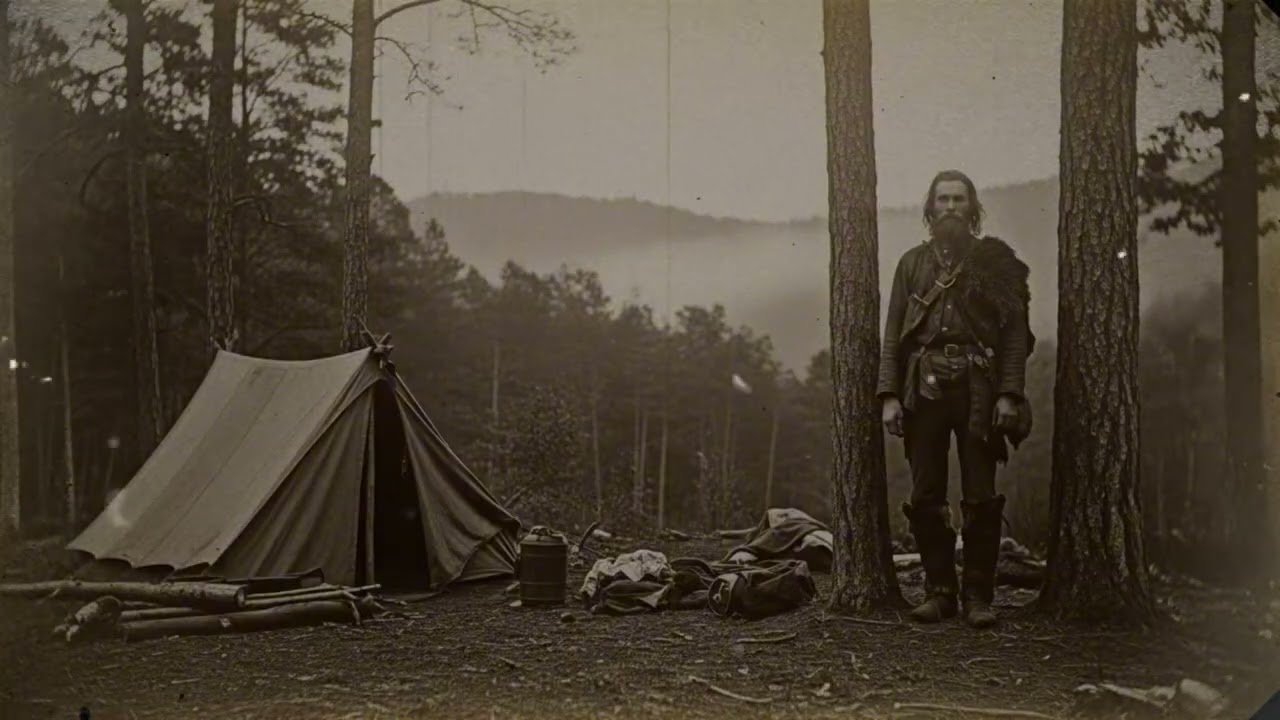
Forest Ranger Leonard Pritchard, who had served the area for nearly two decades, began documenting the reports in his monthly logs. Night patrols in November 1952 confirmed the sounds but could not locate their source. When Pritchard and his deputy closed within an estimated half mile, the calls ceased. Then they found a shelter built into a ravine roughly three miles from the nearest road, crude but carefully concealed, with a fire pit that still held warm ashes.
The interior was larger than it appeared from outside, as though whoever built it had hollowed out part of the hillside. There were symbols scratched into the dirt floor, storage areas dug into the walls containing dried plants, some recognized as medicinal herbs, a collection of small animal bones cleaned and sorted, and tools made from stone, wood, and animal parts in designs neither man had seen before. A flat stone marked with what appeared to be a lunar calendar lay inside. The deputy later said it was clear whoever used the shelter was intelligent and organized, not a random drifter.
In late November, a hunter named Elmer Radford, tracking a wounded deer about four miles from the nearest road, stumbled upon a series of small shelters built against a rock face and partially underground. He found evidence that someone had been observing him from a spot on the ridge while he field-dressed his kill, watching every move he made. His cigarette butts had been collected into a small pile. Around the camp hung small figures made of twigs and vines, some resembling stick people, others animals, arranged in a perfect circle facing inward toward where he had been standing.
Radford left the deer and did not go back for it. When a deputy returned with him three days later, the entire area had been cleared of any sign that structures had ever existed. In the observation spot, the deputy found a small carved wooden figure, roughly six inches tall, depicting a human form with exaggerated ears and eyes. It had been placed exactly where Radford had felt someone watching him, as though whoever had been there wanted to be acknowledged on their own terms.
Local historian Amelia Carrington, whose research later documented these traditions, connected the figures to pre–Civil War mountain folklore. The carved sentinels, as they were known among the most isolated communities, were believed to watch over their makers. A circuit preacher’s letter from 1823 described finding crude wooden figures at the edges of clearings, their unseeing eyes conveying an uncanny sensation of observation. Local residents treated them with a mixture of respect and wariness, sometimes leaving offerings of tobacco or salt beside them.
When questioned, they said simply that the sentinels kept watch for those who dwelled deep in the hollows. The sounds diminished through the winter, and by spring 1953 local authorities concluded that a transient individual had temporarily taken up residence in the deep woods and moved on. That comfortable explanation collapsed in May, when two experienced hikers, James Whitaker and Thomas Caldwell, failed to arrive at a scheduled checkpoint near Rocky Knob. A weeklong search involving forest rangers, local volunteers, and state police found no evidence of foul play or accident.
Tracking dogs refused to enter the deeper ravines east of the main trail, hackles raised, tails tucked, one German Shepherd that had served in Korea snapping at its handler. Search teams found stone piles and branches bent and tied into shapes that unsettled the local guides, one of whom refused to go further, saying they were crossing into territory they should not be in. Oddities accumulated: the men’s tent was positioned in a depression offering poor visibility, their belongings arranged with unusual precision, and no track evidence led away from the camp despite soft ground from recent rain. Symbols had been scratched into tree trunks surrounding the clearing, forming a perimeter unlike any standard trail marking.
A journal belonging to Whitaker described nights of strange noises, a glimpse of a tall figure watching from the ridge, a stone arrangement he had kicked over in anger, and a growing sense that they were not alone. One entry described a primitive trail not on any map and a clearing with a deliberate circle of stones that produced an overwhelming feeling of trespass. The final entry ended mid-sentence with the word “illegible. ”
Three weeks later, Caldwell emerged from the woods nearly forty miles from where the search had concentrated.
He was severely dehydrated, malnourished, and suffering from exposure, but he insisted he had only been lost for two days. His physical condition contradicted that claim: beard growth and nail length indicated nearly three weeks without grooming. He had minor lacerations arranged symmetrically, precise incisions on his forearms that appeared deliberate, several fingernails that had been removed and partially regrown, and an intricate pattern of scarification on his upper back that distressed him intensely when questioned. His blood contained unidentified alkaloid compounds with no match in the university laboratory.
When told that Whitaker remained missing, Caldwell repeated the phrase, “He watches from the trees,” and largely stopped speaking. A nurse’s aide later reported that during semi-consciousness he had said he and Whitaker were separated after an argument, that Whitaker had kicked over some stones arranged near the camp, and that that night someone came. He described a man who moved without making sound and could speak with the birds. The man had taken Whitaker first, then came back for Caldwell.
Caldwell described being brought to a place where he could see everything but not be seen, tunnels that went on forever, and rooms full of items collected from hikers over many years, watches, compasses, cameras, arranged carefully like a museum. He said the man had marked him so he would always know where to find him. He had asked a nurse why the figure in his drawing faced him from the front when the watcher had been behind him the whole time. Pritchard’s journal, discovered hidden in the wall of the Rocky Knob Ranger Station during a renovation in 1968, revealed that he had met with Caldwell before his discharge.
Caldwell spoke more clearly than the official report suggested and described a tall, gaunt man with a long gray beard and clothing made partially from animal hides, a description matching stories locals told of a figure they called the old man of the mountain. The sheriff advised keeping the information confidential to prevent panic. Pritchard researched county historical archives and found letters from early settlers describing solitary mountain dwellers who lived by their own laws in the deepest hollows, marked their territory with stone arrangements and carved figures, and collected small objects from travelers as a form of fair exchange for safe passage. Those who disturbed the markers often became lost, sometimes for days, with no clear memory of the experience upon return.
County death records from the mid-1800s listed causes of death as “taken by the mountain” or “lost to the deep hollow. ”
Pritchard began conducting his own unofficial investigation. In September 1953 he found a shelter built into a rock outcropping, with warm ashes, handmade tools, and a stick map scratched onto bark marked with symbols matching those found at the Whitaker-Caldwell campsite. Nearby was a circular clearing with a central stone cairn, animal bones, feathers, and man-made objects that clearly belonged to hikers: watch faces, compass needles, and knife handles, separated from their housings and arranged with evident purpose.
On his way back, he felt watched, heard movement parallel to his path, and heard two whistles exchanged between ridges. When he reached his vehicle, he found a small pouch of unidentified dried herbs on the driver’s seat of his locked truck. A botany professor identified most of the herbs as common medicinal plants, but one specimen matched nothing in the university’s collection. Pritchard brewed tea from the known herbs and found it produced a calming effect.
He believed the gift was intended as acknowledgment rather than threat. After leaving tobacco and salt at the edge of a clearing as an elderly local advised, the disturbances around the ranger station ceased. The old mountaineer, Harlon Willis, later explained that the mountain had watchers older than the trails or the roads, and that those who went too deep into the wild began to change, becoming more like the mountain itself. According to the old stories, these were usually men who had suffered some terrible experience in the world of people and retreated to the deepest hollows to escape.
Stay long enough, and the mountain changed them: they learned to move differently, to understand the patterns of the forest in ways ordinary people could not, and some were said to live for extraordinary lengths of time at the cost of becoming less human. Between 1953 and 1956, four more hiking groups reported unusual experiences in the same region. Each reported strange calls, a sense of being watched, and small items missing from their camps. In one case, a group of university students found a circle of small stones arranged around their campsite during the night, with an opening in the circle pointing east toward the trail.
When they tried to photograph it, piercing whistles came from the ridge, answered from the opposite direction, followed by the sound of someone running through the underbrush toward their camp. They fled, leaving gear behind. When a guide returned with rangers later that day, everything was gone, the equipment and the stone circle alike, all evidence removed. The guide insisted they had not been threatened but introduced to the territory.
He said they should have left something behind, tobacco or food or a small personal item, as a way of acknowledging that they were visitors in someone else’s domain. Park Service records from the period show a quiet shift in trail management. Certain backcountry campsites were closed or relocated away from specific hollows and valleys without public announcement. One maintenance log noted that a trail section was rerouted to maintain a minimum five-hundred-yard distance from an eastern ravine system, per superintendent directive, with no explanation.
A former trail worker recalled that local men refused to venture into those ravines even in daylight. He described finding a small arrangement of sticks and stones built like a doorway against a rock, poking at it, and having it collapse. That night the locals were jumpy, hearing the calling throughout the afternoon. By morning his boots were gone, replaced by a small figure made of twigs and plant fiber.
A foreman told him he had been marked and needed to leave an offering where he had found the structure. He hiked back with a pouch of tobacco and a silver dollar, and his boots were returned the next day, sitting in the middle of the trail. Caldwell was released after a week of observation, sold his property, and moved to Arizona. His medical records show he continued psychiatric treatment for years, insisting on the literal truth of his encounter.
He reported hearing the calling sounds despite being more than two thousand miles from Virginia. He found small stone arrangements outside his home, covered his mirrors, and claimed the scars on his back changed position while he slept. In September 1957 he arrived for a session in a highly distressed state, carrying a small wooden carving similar to the figures described in his original account. He said he had found it inside his locked home, placed on his pillow.
There was no sign of forced entry. Whitaker was officially declared missing, presumed dead in December 1953. His family erected a small memorial stone at the Rocky Knob Overlook, which remains there to this day.
The case was filed away, and for decades the events remained buried in local folklore and obscure county records, documented only in Pritchard’s hidden journal and the accounts of those who had been marked by the mountain and would not speak of it again.
