On July 2nd, 1874, fourteen locomotives, each loaded with thirty tons of coal and water, crept onto the steel arch bridge at St. Louis. Four hundred twenty tons of concentrated weight bore down on a structure that European engineering schools had declared mathematically impossible. Crowds lined the riverbanks, and engineering observers from across America had gathered, many expecting to witness a collapse that would vindicate every warning issued against the project.
The bridge did not shudder. The chrome steel arches absorbed the weight, and measurements showed deflections within the calculated limits. The man responsible, James Buchanan Eads, had staked his reputation and nearly his fortune on the belief that an untested alloy and an untried construction method could span the most dangerous waterway in America. The year 1867 had marked a turning point for the commerce of St.
Louis. The city’s merchants watched with growing alarm as cargo tonnage shifted north to Chicago, where railroad networks promised faster and more reliable transport than the unpredictable Mississippi steamboats. St. Louis faced an existential choice: build a railroad bridge across the Mississippi or surrender forever its position as the gateway to the American West.
The engineering challenge seemed insurmountable. At St. Louis, the Mississippi presented a five-hundred-twenty-foot-wide death trap for bridge builders. The current raced at twelve and a half feet per second, fast enough to destroy any construction scaffolding.
Federal navigation requirements demanded fifty feet of clearance above high water, forcing any bridge to soar higher than most buildings. The required span strength of three thousand pounds per foot exceeded anything ever attempted in American engineering. European expertise offered little hope. London-trained engineers, drawing on decades of bridge construction across the Thames and the Rhine, declared steel spans exceeding five hundred feet mathematically impossible.
Carbon steel, they insisted, lacked the tensile strength for spans approaching six hundred feet. Even if the materials could theoretically support the weight, thermal expansion and contraction across such distances would tear any structure apart within months. Andrew Carnegie’s Keystone Bridge Company dominated American steel construction, and Carnegie himself preferred proven wrought iron methods. His furnaces produced reliable, tested materials that had built dozens of successful railroad bridges across Pennsylvania and Ohio.
He viewed experimental alloys and untested construction methods as dangerous gambles that could bankrupt both builders and clients. Into this landscape of established expertise stepped James Buchanan Eads, a man whose credentials defied conventional wisdom. At forty-seven, he had built his fortune salvaging wrecked steamboats from the Mississippi’s muddy bottom, diving in primitive diving bells to recover cargo and machinery from vessels claimed by the river’s treacherous currents. His engineering education came not from European schools but from twenty years of examining structural failures firsthand, understanding exactly how materials behaved under extreme stress and how construction shortcuts led to catastrophic collapses.
Eads had proven his unconventional methods during the Civil War, when the Union Navy commissioned him to build seven ironclad gunboats in just sixty-five days. Working from his own designs, he delivered the vessels on schedule and under budget, each one armor-plated and armed according to his precise specifications. The gunboats performed flawlessly in combat. For the St.
Louis bridge, Eads proposed a revolutionary design. Three massive steel arches using an untested chromium steel alloy manufactured by the Chrome Steel Company of Brooklyn. The central arch would span five hundred twenty feet, longer than any steel structure ever attempted. Instead of traditional wrought iron, Eads specified tubular steel construction, with each arch built like barrel staves, allowing the structure to distribute loads more efficiently than solid beams.
The St. Louis Democrat praised the project as the most glorious bridge and the finest engineer in the world. Eastern engineering establishments responded with undisguised skepticism. Carnegie’s engineers questioned both the untested steel alloy and Eads’s tubular arch design.
European-trained consultants warned that thermal expansion alone would destroy such a long span within the first winter. Railroad executives worried that the experimental bridge might collapse under the weight of their locomotives. The financial reality proved even more daunting than the engineering challenges. Initial cost estimates of four million dollars, equivalent to roughly two hundred eighty million today, soon ballooned to over ten million as the true complexity of the project became apparent.
The Chrome Steel Company demanded premium prices for their experimental alloy, and Eads’s insistence on individual testing of every structural component added months of delay and millions of additional expense. Early material disasters threatened to validate the skeptics. First, steel samples from partner foundries cracked spontaneously in the fabrication shop, revealing that standard carbon steel lacked the molecular structure necessary for Eads’s tubular arch design. The brittleness that made carbon steel predictable in smaller applications became a fatal weakness when scaled to unprecedented dimensions.
Traditional welding and riveting techniques proved inadequate for joining the tubular sections, requiring Eads to develop entirely new connection methods. As 1868 progressed, the project faced a crushing ultimatum. Either Eads would solve the fundamental steel problem, creating a material strong enough and reliable enough to span the Mississippi, or St. Louis would lose its commercial future to Chicago forever.
By 1870, Eads had made the most expensive decision in American bridge building history. He abandoned carbon steel entirely and committed his project to the Chrome Steel Company of Brooklyn’s proprietary alloy. Eads’s obsession with material integrity drove him to implement a testing protocol unprecedented in construction history. Every single steel stave destined for the bridge arches would undergo individual failure testing, a requirement that astonished Carnegie and horrified cost-conscious investors.
Where traditional bridge builders tested random samples and extrapolated results across entire shipments, Eads demanded that each component prove its individual strength before installation. The testing process required custom machinery capable of measuring steel deflections to one two-hundred-thousandth of an inch. The Chrome Steel Company delivered one hundred trial staves for destructive testing in the spring of 1870. Eads’s testing machines subjected each piece to progressively increasing loads until the steel failed, documenting exactly how much stress each stave could withstand before breaking.
The ultimate tensile strength requirement of sixty thousand pounds per square inch exceeded anything demanded in American construction, forcing the Brooklyn foundries to refine their chromium blend through dozens of experimental batches. Testing revealed remarkable differences between chrome steel and traditional materials. Where carbon steel samples showed brittle failure patterns under extreme loads, the chrome steel maintained structural integrity even when stressed beyond normal operating limits. The chromium alloy absorbed energy more efficiently during thermal expansion and contraction, reducing the internal stresses that destroyed conventional bridges during seasonal temperature changes.
Most importantly, the chrome steel demonstrated consistent performance across all one hundred trial staves. The financial implications alarmed investors and city officials. The Bridge Company’s stock price reflected growing market skepticism. Bank loans originally secured on four-million-dollar cost projections faced renegotiation as testing expenses pushed total project costs toward unprecedented levels.
Yet the testing program yielded one crucial result that justified every expense: zero component failures during fabrication. Traditional bridge construction typically experienced five to ten percent material failure rates during assembly. Eads’s individual testing eliminated these field surprises. Carnegie’s resistance intensified as Eads’s success with chrome steel threatened the established order.
If individual component testing became the industry standard, traditional mass production advantages would disappear. By 1871, Eads had proven that American precision manufacturing could exceed European theoretical standards through empirical testing rather than mathematical calculations. The construction challenge that awaited Eads in 1871 defied every conventional approach. Traditional methods required extensive scaffolding across the entire span, but the Mississippi’s federal navigation requirements made such scaffolding impossible.
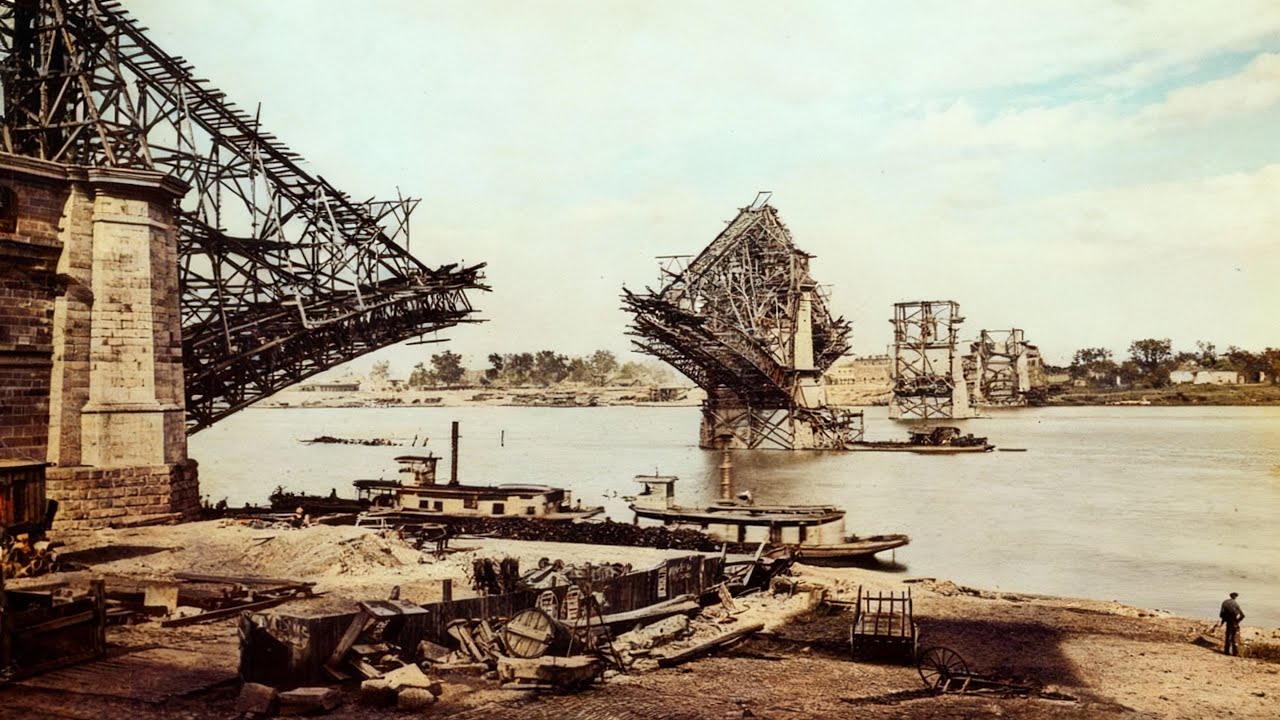
River commerce could not be interrupted, and the twelve-and-a-half-feet-per-second current would destroy any temporary supports within weeks. Eads needed to build his massive arches while keeping the shipping lanes completely open. The solution emerged from studying ancient Roman construction techniques combined with cutting-edge engineering principles. Eads would build each arch outward from the stone piers using the cantilever method, the first major application of this principle in American bridge construction.
Each arch would grow simultaneously from both sides of the river, extending piece by piece into empty air until the two halves met at the center span. The method required extraordinary precision, since eight separate tubular ribs per arch had to align perfectly when they finally connected, with tolerance margins of no more than one-sixteenth of an inch. Construction began with wooden towers rising one hundred twenty feet above each stone pier. These towers functioned as construction platforms and anchor points, housing the steam-powered machinery that lifted each chrome steel stave into position.
William Chauvenet’s mathematical precision proved crucial as construction progressed through 1872. His calculations determined exactly how much weight each partially completed arch could support before the cantilever principle reached its limits. Henry Flad’s expertise in pneumatic caisson construction became essential as foundation work progressed beneath the river’s surface. The stone piers had to be anchored one hundred twenty-three feet below the Mississippi surface, deeper than any previous American construction project.
By September of 1873, the eastern arch approached its moment of truth. Two hundred fifty feet of steel extended from each pier, reaching toward the center span where the final connections would prove whether Eads’s calculations could achieve the impossible. The successful closure of the eastern arch on September fourteenth marked a triumph that reverberated throughout American engineering circles. The five-hundred-two-foot span held its own weight plus the construction equipment without deflection beyond calculated limits.
Church bells rang across St. Louis as citizens celebrated the visible proof that their city would have its railroad connection. Yet two more arches remained unfinished, and the final connections would test whether Eads’s revolutionary methods could be replicated consistently across the entire span. The disaster that nearly destroyed Eads’s reputation struck during the final arch closure attempts in May of 1874.
After months of meticulous cantilever construction extending from both piers of the western span, the center tubes refused to align. Measurements revealed a catastrophic miscalculation. The final steel staves were two and a half inches too long to fit together, creating an impossible gap that threatened to invalidate three years of revolutionary engineering work. The construction crews stood helplessly on their wooden platforms one hundred twenty feet above the Mississippi, staring at chrome steel components that had cost thousands of dollars and months of precision manufacturing but could not complete the arch.
St. Louis newspapers, which had celebrated the eastern arch’s success eight months earlier, turned viciously against the project. The St. Louis Republican published scathing editorials declaring Eads’s entire approach fundamentally flawed and calling the incomplete bridge Eads’s folly, a monument to American engineering arrogance.
The financial consequences proved even more devastating than the engineering humiliation. Bridge Company stock crashed as investors fled a project that appeared doomed to remain forever incomplete. Major banks that had financed the project faced potential collapse. Carnegie and the Keystone Bridge Company watched the crisis with grim satisfaction.
The steamboat lobby launched a coordinated campaign to capitalize on Eads’s difficulties, arguing that the incomplete bridge proved railroad crossings were inherently unsafe. Yet Eads refused to accept defeat. While critics celebrated the apparent vindication of European engineering superiority, he studied the measurement discrepancies with characteristic obsession. The two-and-a-half-inch error reflected thermal expansion calculations that had proven slightly inaccurate across the massive scale of the bridge spans.
But the chrome steel itself had performed exactly as specified. The problem lay not in the materials or construction methods, but in the unprecedented precision required by tubular arch design. Working with Chauvenet and Flad, Eads developed a solution that would have been impossible with traditional bridge materials. Instead of scrapping the expensive chrome steel components, he proposed cutting the oversized tubes in half and rejoining them with custom couplings that would eliminate the excess length while maintaining structural integrity.
The approach demanded metallurgical techniques that had never been attempted on such massive structural components. Chrome Steel Company engineers worked with Eads to develop joining techniques that would create connections stronger than the original continuous tubes, using precisely machined sleeves and advanced welding methods. Critics dismissed the coupling approach as desperate improvisation that would create weak points destined to fail under load. European engineering theory suggested that joined steel components could never match the strength of continuous pieces.
Construction resumed in late 1874 as Chrome Steel Company delivered the custom couplings and specialized welding equipment necessary to complete the arch closures. As the coupled steel components moved into final position during the winter months, the chrome steel demonstrated exactly the performance characteristics that had justified Eads’s enormous investment. The joined tubes aligned perfectly, creating structural connections that exceeded the strength specifications of continuous components. The most unconventional test in engineering history began on June 14th, 1874, when a traveling circus elephant named Bolivar became the first living creature to cross the completed bridge.
Popular folklore held that elephants possess supernatural instincts about structural safety, refusing to walk across bridges that might collapse under their weight. As Bolivar’s massive feet touched the chrome steel deck and began the five-hundred-twenty-foot journey across the Mississippi, half of St. Louis gathered along the riverbanks to witness what they believed would be the ultimate validation of American engineering. Crowds cheered as the elephant completed his crossing without incident.
But Eads demanded more rigorous proof of his bridge’s capabilities. On July 2nd, 1874, he orchestrated the most demanding structural test ever attempted in American construction. The fourteen locomotives, each weighing approximately thirty tons empty and brought to sixty tons with coal and water, crossed the bridge simultaneously. The combined weight of four hundred twenty tons represented three times the normal traffic capacity that railroad companies expected bridges to handle.
Engineering observers from across America gathered to witness the test. Carnegie’s representatives attended with particular interest, hoping to document the failure of precision manufacturing approaches that threatened mass production dominance. European publications had sent correspondents to record what they anticipated would be the spectacular failure of American engineering arrogance. As the fourteen locomotives moved slowly across the spans, precise measurements revealed deflections within calculated limits.
Chauvenet’s mathematical calculations proved accurate as the bridge demonstrated exactly the load-bearing characteristics that his equations had predicted. July 4th, 1874, marked the bridge’s official opening with ceremonies that celebrated both St. Louis’s commercial future and American engineering achievement. President Ulysses S.
Grant attended the dedication ceremonies while General William Tecumseh Sherman drove a golden spike to commemorate the completion of the railroad connection that would transform St. Louis from a riverport into a transcontinental transportation hub. The festivities attracted over five hundred thousand spectators who witnessed fifteen miles of parades. Modern engineering analysis would eventually reveal the fundamental superiority of Eads’s chrome steel over contemporary materials.
Testing conducted in 1988 demonstrated that the original chrome steel retained structural characteristics superior to modern galvanized beams, despite inadequate chromium content by current metallurgical standards. The irony became apparent as twentieth-century bridges required replacement every seventy-five years, while Eads’s 1874 experimental structure remained functionally unchanged after more than a century of continuous service, proving that American precision manufacturing had achieved results that mass production methods could not match.
