In the basement of an old school, a room that once held a boiler stands empty. The ceiling is low. The walls are blackened. Pipe hangers remain bolted into the brick, and a cast-iron radiator still sits beneath a shattered window, heavy as a safe, fed by lines far larger than a single room should ever need.
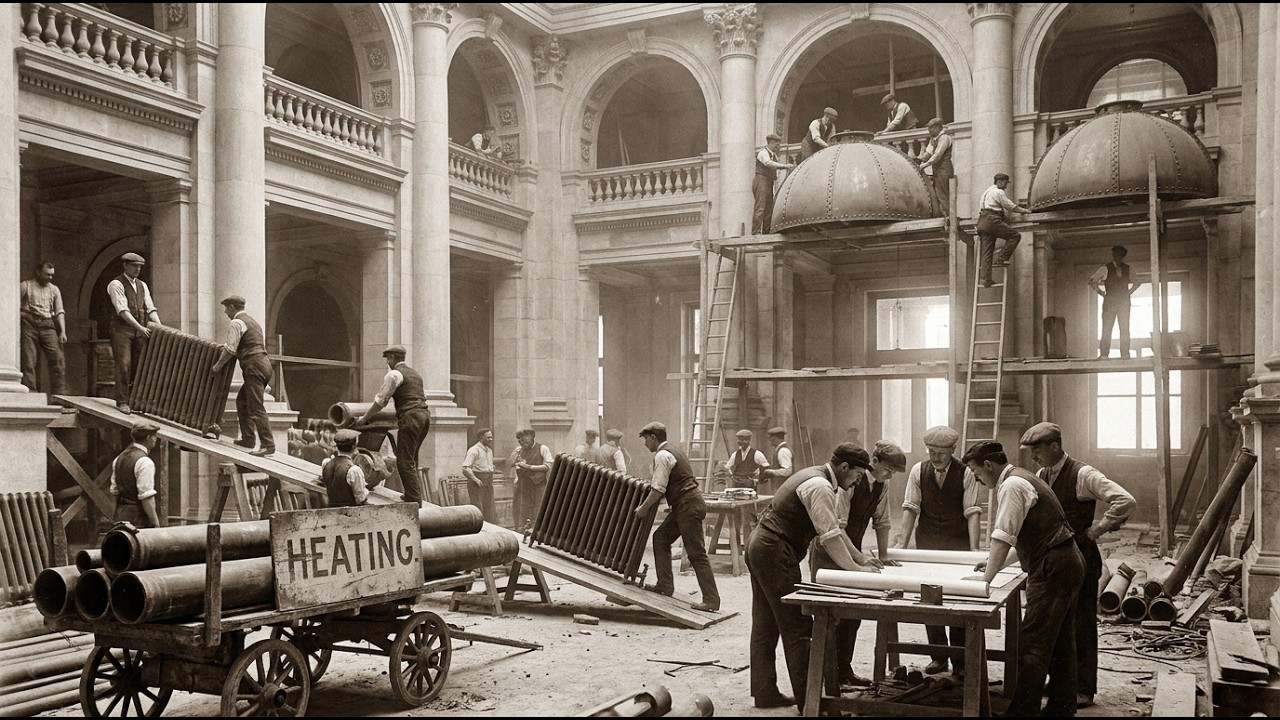
The boiler is gone. The coal chute is sealed. The gauges were ripped off years ago. And yet the geometry of the building still points back to heat, as if the structure was designed around an invisible current that was once expected to arrive every winter without question.
The object is familiar. The scale is not. The accepted explanation is straightforward enough. Nineteenth-century America learned to heat large buildings with steam and hot water.
First came institutional systems, then commercial district systems, then the great age of boilers, radiators, and return mains. Inventors refined pressure, piping, and metering. By the late nineteenth century, central plants were serving clusters of buildings, and later entire downtown districts. In that account there is no mystery.
There was coal, there were boilers, there were engineers. Then newer equipment arrived, older hardware wore out, and the old systems were replaced piece by piece by whatever came next. But that explanation begins to thin out when you follow the physical record instead of the summary. Why were so many buildings laid out for heat that originated somewhere else?
Why do historic plans and utility records keep leading back to central plants, tunnel routes, and supply-and-return logic rather than to isolated stoves or one-off furnaces? And why do so many surviving radiators feel less like optional appliances and more like terminals in a larger network? Once you look closely, the old story of individual buildings heating themselves starts to break apart. The pipes are too systematic.
The footprints are too consistent. The pattern repeats. The hidden theory is not that America possessed some magical lost machine. It is more unsettling than that, because it is ordinary enough to be missed.
The theory is that by the late nineteenth century, much of America had begun to treat heat not as a scarce luxury generated inside each building, but as a distributed utility, often so cheap at the margin that it could feel almost free. Heat was captured centrally, pushed through buried mains, drawn off through cast iron, and folded directly into architecture. Then, over the next decades, that logic was dismantled. Not always by plot, and not all at once, but by fuel markets, rebuilding cycles, new codes, air conditioning retrofits, fragmented ownership, and the simple bureaucratic habit of removing what no longer fit the category of modern.
What changed was the explanation. The record begins earlier than most people realize. In 1853, the United States Naval Academy built what one detailed historical study describes as the first true district heating system in the country, heating multiple buildings from a single plant. That detail matters because it shifts the timeline backward by decades.
This was not an improvisation of the Gilded Age. It was a working institutional model in the early 1850s. The idea was simple and powerful. Do not put a separate fire in every structure if one plant can serve them all.
But once that principle exists, architecture changes, campuses change, maintenance changes. The building is no longer a sealed thermal island. It becomes a node. Then came formal engineering.
In 1877, Birdsill Holly’s system in Lockport, New York established the first successful commercial district steam heating network in the country. A central boiler plant sent steam through insulated supply and return mains to surrounding buildings. Customers were metered by the water of condensation. That last detail matters.
Metering means this was not a crude experiment. There was a utility model designed for billing, expansion, and routine service. By the end of the century, the ASME records district heating companies that had formed in a number of cities. This was not heat as a household secret.
It was heat as public infrastructure. And the scale widened with astonishing speed. A historical survey of American district heating systems identifies 160 commercial systems built between 1877 and 1900 alone. New York, Philadelphia, smaller industrial cities.
Utility companies discovered that once electric generating plants were running steam engines, the exhaust steam could be distributed to nearby buildings. In other words, a large part of the thermal value was already there. The electricity was the headline product. The heat was the byproduct.
In that context, free heating does not mean heat appearing from nowhere. It means that once the plant was operating for another reason, the extra heat could be sold, shared, or delivered at a marginal cost so low that the economics looked radically different from room-by-room combustion. This is where the old buildings start to look strange. The ornate radiator beneath the school window is not just a heater.
It is the visible end of a buried system. Preservation guidance from the National Park Service treats radiators, grills, and related components as significant elements of historic mechanical systems, and specifically recommends reusing radiator networks with new boilers whenever possible. That recommendation only makes sense because so many important buildings were designed around these systems in the first place. The hardware was not incidental.
It was integrated into walls, floor plans, service spaces, and decorative interiors. Remove the heat plant, and the building still remembers the path it once took. The stone remembers. A fair objection has to be acknowledged here.
No, America did not literally give every private house unlimited free warmth before 1900. Steam heating did not become the dominant residential system everywhere. Even contemporary histories note that many homeowners saw it as complex, noisy, and potentially dangerous. Coal had to be mined, delivered, burned, and managed.
Boilers failed, pipes leaked, district systems lost heat. The mainstream explanation is correct about all of that. But it still fails to explain the larger pattern. If these systems were merely awkward dead ends, why did they spread so quickly across institutions, business districts, and major public buildings?
Why did engineers keep improving vacuum return, condensate handling, and network distribution? Why did entire downtowns and campuses accept buried steam as normal? The official explanation describes the machinery. It does not fully describe the ambition.
And that ambition shows up again and again when the scale widens. New York Steam began service in Lower Manhattan on March 3, 1882, in what Con Edison now describes as the largest district steam system in the country. On federal ground, the logic reappeared in the capital complex, where planners concluded that individual power plants in separate buildings were less efficient than a central plant serving the group. Across universities, hospitals, military facilities, and civic centers, the same thermal grammar appears.
One plant, many buildings, buried distribution, visible terminals. Different owners, different dates, same solution. So why does the system feel lost? Not because someone needed to erase every document.
Much of the documentation survived. The quieter answer is more believable. Mechanical systems age. The National Park Service notes that they often face major upgrading or replacement within 15 to 30 years.
Owners change comfort, marketability, energy standards, new tenants, cooling loads, and new equipment categories. Forced air requires ducts. Air conditioning requires chilled water, compressors, shafts, and controls. Fuel regimes shift from coal to oil to gas to electricity.
One generation removes a boiler to solve a maintenance problem. The next seals a tunnel because liability is expensive. The third forgets what the capital pipe once served. Infrastructure does not have to be censored to become invisible.
It only has to be recategorized. There is another reason the story went quiet. Modern energy culture teaches people to think in single buildings, single meters, single appliances, single bills. Nineteenth-century thermal systems often violated that mental map.
They were hybrid systems. Utility steam tied into electric generation. Central plants served multiple structures with one labor force, one fuel chain, one repair culture. Heat could be a secondary product, an incentive, an institutional service, an accounting category hidden inside a larger operation.
When later historians sorted the past into neat shelves, electricity here, heating there, architecture somewhere else, the older integrated model became harder to see. Not mysterious. Just badly filed. Once you see that, you understand that the phrase “they ripped out the system” stops sounding exaggerated.
In many places, they did. They removed radiators during renovations. They cut off steam mains. They abandoned central plants or converted them so completely that their original logic disappeared beneath new equipment.
Preservation specialists now warn against exactly this kind of loss, urging owners to retain and adapt historic radiators and mechanical elements whenever possible. That warning exists because the damage is common. The old heating network was not always replaced by something better in principle. It was often replaced by something easier to finance, easier to classify, or easier to market to a new occupant who no longer understood the old thermal world.
So the deeper claim is not that America once possessed a supernatural source of warmth. It is that the country built, far earlier than most people understand, a serious culture of centralized heat distribution, sometimes local, sometimes urban, sometimes institutional, sometimes tied directly to the waste steam of power generation, and then allowed that culture to fragment until the surviving hardware looked anomalous, even impossible. What remains is a landscape of clues. Capped penetrations in basement walls.
Cast-iron radiators in buildings with no visible furnace. Tunnel plans. Boiler houses stranded behind redeveloped campuses. City steam still rising from a few streets while the broader historical memory collapses around it.
The theory sounds strange only because the surviving pieces are now separated from the system they once belonged to. And that leaves one final reframing. What if the lost system was not hidden because it was too advanced? Maybe it was hidden because it was too practical, too infrastructural, too embedded in brick basements, utility corridors, engineering patents, and maintenance ledgers to look dramatic.
The old networks did not vanish in a single purge. They were thinned, compartmentalized, upgraded, privatized, demolished, ignored, and remembered only in fragments. But the fragments still align. The old buildings were telling the truth.
The pipes were telling the truth. The utility records were telling the truth. The real question is not whether the theory sounds strange, but whether anyone with the tools to verify it has seriously looked.
