On the night of the fourteenth of March, 1912, Getner awoke in the darkness with a sensation of absence so profound that he thought he had gone deaf. For nearly a year the singing had filled his farmhouse, rising steadily from a murmur to a presence that passed through walls and entered the barn sixty meters distant, a sound that had become as constant as his own heartbeat. Now there was nothing. He lay for several minutes listening to the silence before he got up and went to the girls’ room.
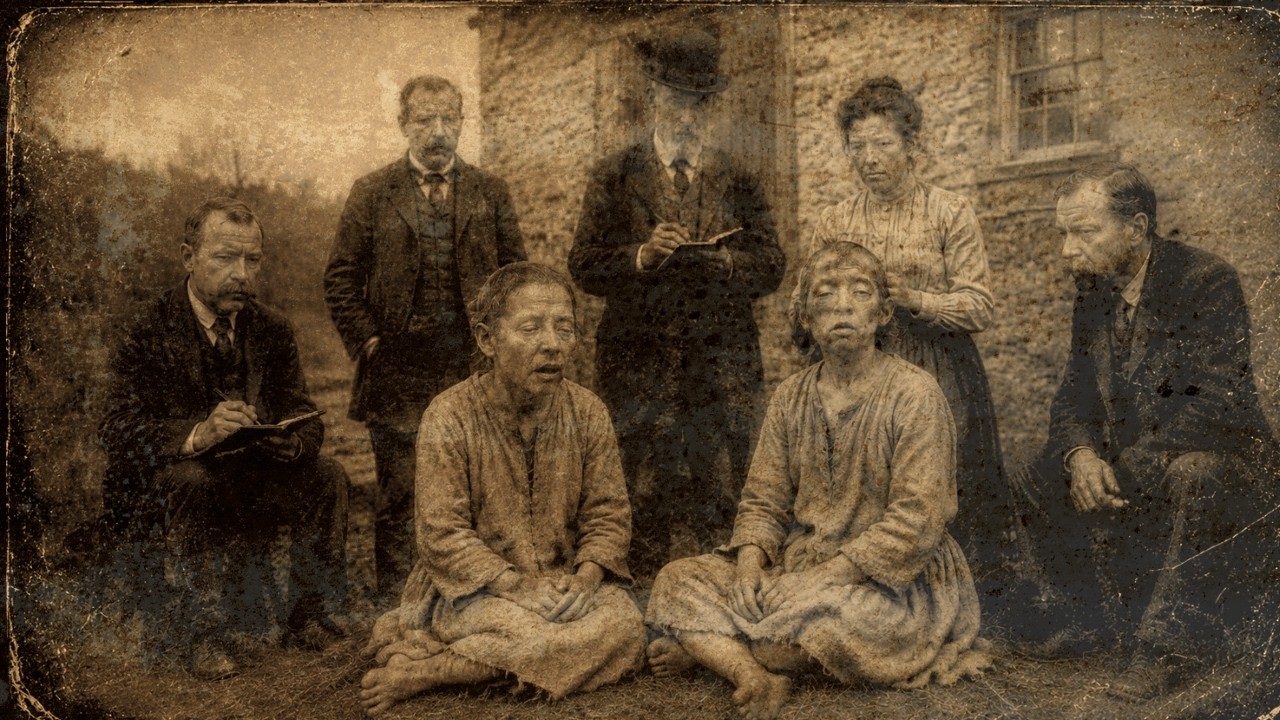
The bed was neatly made. The window was closed and latched from the inside. The door was closed and latched from the inside. The girls were gone.
They had first appeared on the twenty-second of April, 1911, at dawn, at the edge of his grazing land on the northern edge of the Halbeck Valley in the easternmost reaches of the Prussian province of Silesia. Getner heard them before he saw them. He thought at first it was a hymn carried from some distant church service, but the melody did not resolve the way hymns do. It circled, it repeated, it folded back on itself with a patience that unsettled him before he could name the reason why.
When he came over the ridge he found two girls sitting cross-legged in the wet grass. They were barefoot, their clothing handmade from undyed wool stitched in a style no one in the surrounding villages could place, their hair shorn close to the scalp, their hands stained with the deep brown residue of walnut husks. They appeared to be somewhere between nine and thirteen years of age. They had no documents, no possessions, no verifiable names, and from the moment he found them they would not stop singing.
He stood and watched them for nearly ten minutes before he approached. They did not look at him, did not stop. Their voices moved together in a parallel harmony, not quite unison, not quite counterpoint, something that sat between those two ideas in a way that Getner, who had no musical training whatsoever, described simply as wrong-sounding. Not ugly, not dissonant, just wrong, the way a door is wrong when it opens into a room that should not be there.
He brought them to his farmhouse. His wife gave them bread and warm milk. They ate without hesitation, without suspicion, without gratitude or resistance, the way animals eat, not with greed but with a mechanical certainty, as though eating was simply what a body did when food appeared. Between bites they sang under their breath in fragments that rose and fell with a rhythm his wife later said reminded her of breathing during sleep, a rhythm that did not belong to waking life.
The district constable arrived within hours. A translator was summoned from Breslau within three days. Within two weeks the case had drawn the attention of linguists, folklorists, neurologists, and ecclesiastical authorities from four institutions across the German-speaking world, because the language the girls were singing in could not be identified. Not by any scholar who heard it, not by any catalog of known or dead languages held in any European archive, not by comparative phonetic analysis, not by root morphology, not by tonal structure.
By nothing. The first official report was filed on the twenty-ninth of April by the district magistrate, Friedrich Loewe, a man not given to speculation. His records show a career of meticulous, almost aggressively ordinary administrative work spanning nearly two decades in the Silesian civil service. He documented tax disputes, adjudicated water rights, cataloged property transfers with handwriting so precise that his clerk once remarked the letters looked printed rather than written.
Yet in his initial report Loewe used a word that appeared nowhere else in any document he ever produced. He called the singing unheimlich. He chose that word deliberately, passing over simpler descriptions, and he used it in the older German sense: uncanny as in belonging to a home that is not this one. His report laid out the basic facts with his usual precision.
Two female children of unknown origin. No signs of malnourishment, illness, or physical abuse. No identifying marks, scars, or deformities. Clothing of homespun undyed wool, seams stitched with a technique the local tailor described as consistent with methods predating the mechanized loom by at least two centuries.
No shoes, but the soles of their feet were thickly calloused in a pattern suggesting years of walking on stone rather than soil. They sang continuously in a language that Loewe, who spoke German, Polish, and passable Czech, could not identify even in fragments. The sounds contained vowel clusters that did not correspond to any Slavic, Germanic, or Romance phonetic system he was aware of. The melody did not follow Western tonal conventions.
It did not resolve to a tonic, did not follow a recognizable scale. It moved in intervals that shifted according to rules he could not determine, as though the music itself obeyed a grammar rather than a key. Within a week Loewe contacted three authorities. The provincial office of child welfare dispatched an inspector who examined the girls, confirmed they were physically healthy, and promptly declared the case outside his jurisdiction.
The University of Breslau sent a young lecturer named Hinrich Dresser, who had recently published a monograph on extinct Lusatian dialects. And Loewe wrote to the office of the bishop of Breslau, because for all his bureaucratic sobriety he had begun to suspect the singing might be liturgical. Something about the cadence, the way phrases repeated at fixed intervals, the way the two voices moved against each other in patterns that felt ceremonial rather than spontaneous. He noted in a margin annotation, later struck from the official copy of his report, that the sound reminded him of matins.
Not any specific matins he had attended, just the idea of matins, the form of it, the gravity. Dresser arrived in Halbeck on the seventh of May with a phonographic recording cylinder, a transcription notebook, and a reference collection of over three hundred phonetic samples from languages spanning the Indo-European family. He stayed eleven days. His working hypothesis was straightforward: the girls were speaking a degraded or archaic dialect of one of the Slavic languages common to the Silesian border region.
The area had been a linguistic crossroads for centuries. Polish, Czech, German, Sorbian, Moravian, and a handful of smaller vernaculars had left traces in the local speech. It was entirely plausible that two children from an isolated community might preserve in song a dialect so old or so localized it had escaped formal documentation. Linguists found such relics all the time.
He set up his equipment in the parlor of Getner’s farmhouse, arranging the phonographic cylinder on a small table and positioning the recording horn as close to the girls as he dared without disturbing them. They sat on a bench by the window, morning light falling across their faces, their eyes fixed on something that was not in the room. They did not object to his presence. They did not seem to notice it.
They sang. Dresser recorded. He filled page after page with phonetic notation for six hours on the first day, and by the end of those six hours he had begun to suspect his hypothesis was wrong. The problem was not that the language was unfamiliar; he had expected that.
The problem was that it was unfamiliar in the wrong way. A degraded Slavic dialect, no matter how archaic, would retain certain structural features: palatalization patterns, specific vowel distributions, consonant clusters that appear with statistical regularity in every recorded Slavic language from Old Church Slavonic to modern Serbian. Dresser found none of them. He tried Germanic roots, nothing.
Romance roots, nothing. He ran the transcriptions against his reference samples for Baltic, Uralic, and Finno-Ugric languages. Nothing matched. He could not even determine with confidence where one word ended and another began.
The language flowed and elided, consonants melting into vowels and vowels into consonants in ways that made segmentation nearly impossible. On the third day he stopped trying to identify the language and started trying to describe it in purely structural terms. And here he began to notice something that disturbed him. The language had structure.
It was not random, not glossolalia, which typically shows no consistent internal grammar. The girls’ singing showed clear evidence of recursive patterning. Phrases appeared, reappeared, and modified according to rules. Certain sound clusters always appeared in certain positions relative to other sound clusters.
There were what appeared to be morphological inflections suggesting grammatical function, tense perhaps, or case. The language behaved like a language. It had grammar, syntax, rules. But the rules did not match anything in the known inventory of human linguistic structures.
Dresser sent his preliminary findings to three colleagues in a letter dated the fourteenth of May. The letter survived only in fragmentary form in the archive of the Breslau Philological Society; the full text was apparently removed at some point between 1913 and 1919, during a period when several documents related to the case were either lost, reclassified, or deliberately destroyed. What remains includes Dresser’s assessment that the language represented, in his words, either a previously undocumented isolate of extraordinary antiquity or something for which the existing frameworks of comparative linguistics had no adequate category. That second phrase was the one that mattered.
Dresser was not a sensationalist. For him to suggest, even tentatively, that a language might exist outside the known categories of human speech was an extraordinary admission. Within three weeks two additional linguists had traveled to Halbeck. The first was Martha Koselitz, a phonetician from the University of Leipzig who specialized in tonal languages and had done fieldwork in the Caucasus.
The second was Anselm Frier, a comparative philologist from the University of Vienna whose area of expertise was the reconstruction of proto-languages. They arrived within a day of each other in late May, neither having communicated with the other beforehand, both expecting to find an error in Dresser’s analysis. They did not find an error. Koselitz spent her first two days focused entirely on the tonal structure.
She was the first to make a crucial distinction Dresser had only hinted at: the girls were not simply speaking a language and setting it to melody. The tonal component appeared to be integral to the language itself. Pitch was not decoration; it was semantic. Changes in the pitch at which a particular sound cluster was produced appeared to change its meaning.
She recognized the pattern from the Svan language of the Georgian Caucasus, where pitch accent plays a grammatical role, but the system the girls used was more complex than anything she had encountered in Svan or any other living tonal language. She estimated the language employed at least nine distinct tonal registers, each apparently carrying grammatical or semantic weight. Most tonal languages used between two and six. Nine was, in her professional judgment, unprecedented.
Frier approached from a different direction. He attempted to map the grammatical architecture by constructing what linguists call a paradigm, a table of systematic relationships between different forms of the same root. After eight days he produced a partial paradigm suggesting the language employed a grammatical system that combined features never before seen together. It showed evidence of an ergative alignment system, in which the grammatical subject of an intransitive verb is treated differently from the subject of a transitive verb.
By itself this was not unusual; Basque, many Caucasian languages, and several Australian Aboriginal languages use ergative systems. But Frier also found evidence of what appeared to be a fluid system of grammatical gender that was not based on sex, animacy, or any other semantic category he could identify. The gender of a noun appeared to shift depending on its relationship to the speaker in time. Something referenced in the past took one form.
Something in the present took another. Something in the future took a third. And something referenced outside of time entirely, something eternal or recurring, took a fourth form that appeared nowhere in any other language he had ever studied. This temporal gender system was what first led Frier to suspect the language might not be a natural isolate.
Natural languages develop through drift, contact, and evolution, accumulating features over centuries of use by communities of speakers who are born, live, and die within the stream of ordinary time. The features Frier was finding did not look like the products of drift. They looked designed, not in the crude sense of a constructed language like Esperanto, but in the deeper sense of a system organized around principles no ordinary human community would have needed or developed. He did not publish this suspicion.
He barely mentioned it in his private correspondence. But in a notebook recovered from his estate after his death in 1939, a single entry dated the second of June 1911 reads as follows: This language was not made by people who think the way we think. It was made for something we do not do. He underlined the word do three times.
The question of what the girls were actually saying proved even more resistant to analysis. Dresser, Koselitz, and Frier all attempted to extract semantic content. None succeeded. Without a bilingual speaker, without any point of contact between the unknown language and any known language, the meaning of the words remained locked.
They could describe the grammar, map the phonology, identify patterns, but they could not translate a single word. There was, however, one observation on which all three scholars agreed. The singing was not random. It had narrative structure.
New sound clusters appeared, were developed, were set aside, and later returned in modified form. The singing progressed. It told something, a story perhaps, an account, a record, something with a beginning, a middle, and what appeared to be a slowly approaching end. Koselitz noted that the emotional contour shifted in ways that suggested the passage of dramatic events.
Passages of calm regularity were interrupted by passages of rapid, urgent delivery. Certain phrases were repeated with what she described as emphatic insistence, as though the singers were trying to ensure that whoever was listening understood the gravity of what was being communicated. But no one was listening who could understand the message, if it was a message being delivered to an empty room. The girls themselves offered no help.
They did not speak German or Polish. They did not respond to questions in any language that was tried. They acknowledged the presence of the people around them. They ate when fed, slept when it was dark, allowed themselves to be examined, measured, and recorded without complaint or cooperation.
And they sang always. In mid-June of 1911 the case was transferred from the civil authority of the district magistrate to the provincial authority of the Royal Prussian Academy of Sciences in Berlin. This transfer was unusual. Cases involving unidentified children normally remained within the jurisdiction of local welfare and police authorities.
According to surviving correspondence, the transfer was initiated by a request from within the academy itself. Someone there had heard about the Halbeck girls and wanted the case brought under institutional control. The name on the request has been redacted in every surviving copy. On the twenty-eighth of June, Carl Went arrived in Halbeck.
His official title was special commissioner for matters relating to ancient languages. This title appears in no other academy document from the period. It seems to have been created specifically for Went, and the surviving correspondence suggests, though it does not explicitly confirm, that the Halbeck girls were not the first case he had been assigned to. There are references, oblique and carefully worded, to prior assignments, to previous source materials, to earlier containment protocols.
The implication, never stated outright, is that the Prussian Academy had encountered phenomena like this before. Went arrived with a military escort and a team of three investigators, and according to a fragmentary memo recovered from the academy archives in 1971, instructions that included the phrase full containment of source material. He immediately restricted access. Dresser, Koselitz, and Frier were informed that their independent research was being superseded by an official academy investigation and that their transcriptions, recordings, and notes were to be surrendered.
Dresser complied. Koselitz reportedly protested but eventually turned over her materials. Frier refused. He was threatened with professional sanctions and, according to one account, physical removal from the district.
He left Halbeck voluntarily on the first of July, taking his notebooks with him. Those notebooks were not recovered until after his death nearly three decades later. Went’s first act upon taking control was to separate the two girls. They had been kept together since their discovery, sleeping in the same room in Getner’s farmhouse, eating at the same table, singing the same unending song.
Went had them placed in separate rooms on opposite sides of the farmhouse with thick doors closed between them. According to Getner, the effect was immediate and disturbing. When separated, the girls did not stop singing, but the character of their singing changed. Where before their voices had moved together in that uncanny parallel harmony, now each sang alone, and the two songs were different.
The same phonological elements appeared in both, the same tonal patterns, the same recursive structures, but the sequences were different. The phrases came in a different order. It was as though each girl was singing a different part of the same larger composition, as though the full song required both of them, as though separating them had not silenced the music but split it into two incomplete halves. Went found this result significant.
Getner, in a letter to his brother, reported that Went spent an entire evening after the separation experiment sitting in the kitchen with his hands pressed flat against the table, staring at nothing. When Getner asked if the investigation was going well, Went replied with a single sentence Getner recorded phonetically because he did not fully understand it: They are not remembering. They are receiving. Getner asked what he meant.
Went said nothing else that evening. The distinction between remembering and receiving is critical. If the girls were recalling a song they had learned, their separation should not have changed the content; a memorized song is a fixed sequence. The fact that they sang different versions when apart suggested what they were doing was not recall but something that depended on their spatial relationship to each other, something that changed when their proximity changed, something that behaved less like memory and more like reception, like tuning, like two antennas that when positioned together receive one signal and when moved apart each pick up a different frequency of the same broadcast.
Over the following week Went varied the distance between the girls. He placed them in different buildings. He placed them outdoors at measured intervals across an open field. In every configuration they sang, and in every configuration the two versions differed, with the degree of difference correlating with physical distance.
When they were close, perhaps ten or fifteen paces apart, the differences were subtle, slight variations in phrasing, minor shifts in tonal emphasis. When they were far apart, a hundred paces or more, the differences became pronounced. Entire phrases appeared in one version that were absent from the other. And the tempo diverged: one girl sang faster, the other slower.
The rhythmic synchronization that characterized their singing when together broke down at distance, as though whatever mechanism kept them aligned required proximity to function. Went reportedly measured the tempo differential with a pocket watch and recorded the results in a small leather notebook he carried at all times. That notebook, along with everything else Went produced, was taken when the academy team departed and has never been seen since. On the fifth of July Went conducted what Getner described as the strangest of all the experiments.
He brought the girls back together, seated them facing each other at a distance of approximately three feet, and placed a thick velvet cloth between them so they could not see each other. Their singing, which had diverged during the days of separation, immediately began to converge. Within minutes the two voices were moving together again in that same uncanny harmony. Whatever the mechanism was, it did not depend on visual contact.
Proximity alone was sufficient. Getner wrote that he found this deeply unnerving, not because of anything dramatic or frightening, but because of how calmly the girls accepted every manipulation. They did not protest the separation, did not express joy at being reunited, did not react to the cloth. They simply sang, adapted, continued, as though the experiments were irrelevant to whatever purpose the singing served.
As though it was not the girls who were choosing to sing, but the song that was choosing to be sung through them. This is the detail that appears to have most disturbed Went. The surviving memos from his investigation include a passage, partially redacted, in which he writes about the intentionality problem: whether the girls were active agents, conscious performers of a learned behavior, or whether they were passive channels through which something else was expressing itself. He uses the word Leitung, conduit, which carries connotations of a pipe or a wire, something through which a substance flows without the pipe itself having an opinion about the substance.
He does not explicitly state his conclusion, but the direction of his thinking is clear from the questions he asks in the margin. Who taught them? When? How?
And, most prominently underlined in red ink: For whom? The Halbeck girls did not exist in isolation. Their appearance coincided with a cluster of events that, taken individually, might have been dismissed as coincidence, but taken together form a pattern. In February of 1911, two months before the girls were found, railroad workers laying track near the town of Schweidnitz, approximately eighty kilometers south of the Halbeck Valley, uncovered a stone vault beneath the foundations of a medieval church demolished in the 1880s.
The vault contained no human remains, no treasure, no relics. It contained a set of seven stone tablets, each approximately forty centimeters square and five centimeters thick, inscribed on both sides with text in a script no one could identify. The tablets were sent to the provincial museum in Breslau, cataloged, photographed, and filed. A curator noted the script did not resemble any known alphabetic, syllabic, or logographic writing system.
The characters were angular, composed of straight lines meeting at sharp angles with no curves, many appearing composite, built from two or three simpler elements combined into a single glyph. The tablets attracted little attention until late May, when Hinrich Dresser, just returned from his first visit to Halbeck, walked into the Breslau Museum to consult a reference text and happened to see the catalog entry. In a letter to Martha Koselitz dated the first of June, he wrote that upon examining the tablets he experienced what he could only describe as a shock of recognition. Not because he could read the script, which he could not, but because the angular composite characters bore a structural resemblance, a family resemblance, to the phonetic patterns he had spent eleven days transcribing from the mouths of two barefoot girls in a farmhouse kitchen.
The way the characters combined mirrored the way the sound clusters combined in the singing: composite elements joined according to positional rules, function determined by the spatial relationship between components. A system of construction that was not alphabetic, not syllabic, not logographic, but something else, something that encoded information through the way its parts were arranged relative to each other. Dresser spent four days examining the stones, making rubbings, measuring the depth and angle of each inscribed character. On the fifth of June he received a message from the museum administration informing him the tablets had been recalled by the provincial government office and were no longer available for study.
When he attempted to retrieve his rubbings, he was informed those too had been collected. The Schweidnitz tablets were never seen again. They appear in no subsequent museum catalog, no archive of transferred materials. They simply vanished from the institutional record, and the disappearance coincided to within two weeks with the transfer of the Halbeck case to the Prussian Academy and the arrival of Carl Went and his team.
A third event had occurred in March of 1911, one month before the Halbeck girls were found, one month after the tablets were unearthed. A shepherd named Tomas Bernat, working in the foothills of the Owl Mountains approximately sixty kilometers southeast of Halbeck, reported to his parish priest that he had found a cave he had never seen before, although he had grazed his flock across those hills for over thirty years. He described the entrance as narrow, concealed behind a fall of loose shale that appeared freshly broken. Approximately twenty meters inside he found a chamber with smooth walls, not carved smooth but grown smooth, as though the rock itself had been shaped from within.
On the walls he saw characters, symbols, lines meeting at angles, forming shapes he did not recognize, inscribed to a depth of perhaps two millimeters, shallow but precise, arranged in horizontal lines that ran left to right and then at certain points shifted to run right to left, a feature known in epigraphy as boustrophedon writing, which Bernat described simply as the lines going one way and then turning around and going the other way like a plow. At the center of the chamber, in the floor, was a depression approximately two meters in diameter, perfectly circular, perfectly smooth, as though something had rested there for a very long time and had only recently been removed. Bernat’s report was forwarded to Breslau, where, as far as the paper trail is concerned, the matter ended. Except it was not quite forgotten.
In the archive filed next to Bernat’s report there is a second document, a one-page note, undated, unsigned, written in a hand archivists have been unable to match to any known official. The note reads in its entirety: Site consistent with profile 7. Recommend standard protocol. Notify Went.
Whatever these terms meant, they imply a system, a classification scheme, a set of established procedures for dealing with discoveries of a specific type, routine responses to recurring phenomena. The language of bureaucracy applied to the impossible. Went’s investigation in Halbeck continued through July of 1911. The surviving memos from this period are the most heavily redacted of all the academy documents.
A memo dated the twelfth of July contains this sentence: Subjects continue vocalization in pattern consistent with phase 3 output. Phase 3 output, not a description of children singing, but the language of a technical process, of a system with defined stages, of something expected to progress through identifiable phases. Another memo dated the eighteenth of July reads: Tonal register expansion noted in subject B, now employing 12 distinct registers up from 9 at initial contact. Recommend increasing recording frequency to continuous.
The tonal complexity was growing. The language was not static; it was developing, evolving, becoming more complex over time, as though the girls were not repeating a fixed text but generating new material, extending the boundaries of a system still under construction. A third memo dated the twenty-second of July is almost entirely redacted. Only the final sentence survives: Correlation with Schweidnitz material now confirmed at structural level.
Recommend integration of both source streams into unified analysis framework. There it was, the connection Dresser had suspected, formally confirmed by the academy’s own investigation. The language the girls were singing and the script on the vanished tablets were related. Two manifestations of the same underlying system: one in sound, one in stone; one carried by the voices of two unidentified children, the other inscribed on tablets found beneath the foundations of a medieval church.
Two channels for the same message. On the twenty-ninth of July, 1911, the investigation ended, abruptly, completely, without explanation. The academy memos cease on that date. No closing report has ever been found.
The last entry is a supply requisition for packing materials and transport crates. From Getner’s letters, Went and his team left Halbeck on or around the thirtieth of July, taking their equipment, their recordings, their transcriptions, everything they had produced during their five-week investigation. They left no copies, no instructions for the local authorities regarding the girls. They simply departed.
The girls remained. Getner and his wife had cared for them for over three months. His wife had begun to call them Lena and Rei, common diminutives in the Silesian countryside, though the girls never responded to names. The names were acts of kindness, attempts to make them into something recognizable within the ordinary categories of rural life: daughters, orphans, foundlings, children.
But the girls were not ordinary children. They did not play. They did not explore the farm. They did not interact with the animals.
They did not develop language, not German, not Polish, not any of the vernaculars spoken around them. They ate, they slept, they sang. As the weeks passed, Getner noticed something he described with the kind of understated dread only a man of plain speech can convey. The singing was getting louder.
Not dramatically, not a sudden crescendo, but a gradual, almost imperceptible increase in volume that Getner said he only noticed because he had been listening to the same sound for months. Where once the singing had been a murmur, a background texture you could almost forget if you were busy enough, it was now a presence. It filled rooms. It passed through walls.
Getner’s wife said she could hear it in the barn sixty meters from the house, in the root cellar, in the yard. She said it had begun to enter her dreams. Getner wrote to the district magistrate in August requesting guidance. He received no response.
He wrote again in September. Again, no response. In October he wrote to the academy directly, addressing his letter to Carl Went by name. The letter was returned unopened, stamped with a single word: Unknown.
Carl Went, special commissioner for matters relating to ancient languages at the Royal Prussian Academy of Sciences, was unknown. No such person existed in the academy’s records. No such title existed in the academy’s organizational chart. Whatever Went had been, whatever he had done, whatever he had found, the institution that had sent him had erased him as thoroughly as it had erased the Schweidnitz tablets.
By December, Getner wrote, he could hear the singing from his most distant field, a distance of nearly four hundred meters. His neighbors had begun to notice. Some avoided the farm. Others came out of curiosity, stood at the edge of the property and listened.
Most left quickly. One neighbor told Getner the singing made him feel as though he were being watched by something that had no eyes. Another said the sound made her teeth ache. In January of 1912 the parish priest, Father Krauss, visited the farm at the request of Getner’s wife.
She wanted the girls blessed, prayers said over them, the singing explained or, failing that, exorcised. Father Krauss spent an afternoon with the girls. He said prayers, offered blessings, attempted to engage them in conversation. They did not respond.
They sang. His report to his bishop, which survives in the diocesan archive, is a remarkable document. He wrote that the singing did not sound demonic to him. He had read the approved texts on discernment; he knew the signs the church ascribed to diabolical influence.
He found none in the Halbeck girls. They were not aggressive, not blasphemous, showed no aversion to sacred objects, accepted his blessing without reaction as they accepted everything without reaction. But neither did the singing sound holy. It did not sound like prayer, though it had the rhythm of prayer.
It did not sound like praise, though it had the shape of praise. It sounded, Father Krauss wrote, like a report, like someone giving an account of events, like testimony delivered before a tribunal that was not present in the room. The girls were not worshiping, he concluded. They were witnessing to something he could not say.
In the weeks before the end, Getner noticed the girls had begun to sing in a new way. The parallel harmony was still present, but layered on top of it, or perhaps beneath it, was a third line, a vocal element neither girl seemed to be producing consciously, emerging from the interaction of their two voices the way an overtone emerges from two notes played together on a stringed instrument. This third voice, if it could be called a voice, was deeper than either girl could have produced alone. Getner described it as a sound that came from the floor, from the walls, from the air itself.
His wife refused to enter the girls’ room after she first heard it. She said it made her feel as though the house were breathing. Small animals stopped coming near the house. The mice in the walls, the barn cats, the sparrows under the eaves, all gone.
The farm dogs, two old hounds that had slept by the hearth all their lives, took to sleeping in the barn, refusing to enter the house after dark. When forced inside, they pressed themselves against the farthest wall from the girls’ room and trembled. On the night of the fourteenth of March, the singing stopped. The room was empty.
The bed was made. The door was latched from the inside. Getner searched the house, the barn, the yard, the fields. His wife joined the search.
They called the names she had given the girls. The names fell into silence. At dawn Getner walked to the edge of the birch forest where he had found them eleven months earlier. Nothing: no tracks, no signs of passage.
The wet spring earth, soft enough to hold the impression of a deer’s hoof, showed no footprints leading into or out of the trees. The district constable organized a search. It found nothing. No trace of the girls was ever discovered.
No bodies were recovered. No sightings were reported. They had vanished as completely and as inexplicably as they had appeared. The village school teacher, a man named Seidel, recorded in his journal that on the morning of the fifteenth of March several people reported having had the same dream the previous night.
In the dream they stood in a room they did not recognize, with smooth walls and a high ceiling, and somewhere from a direction that could not be identified, two voices were singing. But in the dream, unlike in waking life, the listeners could understand the words. And the words were saying: We have finished. The record is complete.
The account is given. Seidel noted this with a school teacher’s skepticism and a rural villager’s unease. He did not elaborate, did not investigate. He simply recorded the report and moved on to other matters.
The entry is sandwiched between a note about the condition of the schoolhouse roof and a list of students who owed fees for the spring term. The Halbeck girls passed out of living memory within a generation. Getner died in 1924. His wife survived him by three years.
Their letters were preserved by Getner’s nephew, who passed them to a local history society in the 1950s. Father Krauss’s report remained unread in the diocesan archive until a researcher discovered it in 1983. Seidel’s journal was found in the attic of the demolished schoolhouse in 1967. Dresser’s published papers contain no reference to the case, though his unpublished correspondence, preserved at the University of Breslau, now the University of Wrocław, includes the letters to Koselitz.
Koselitz’s own account, a brief note in a phonetics journal published in 1928, attracted no attention at the time. Frier’s notebooks remained in his family’s possession until his death in 1939, were subsequently acquired by an antiquarian book dealer in Vienna, passed through several hands, and were donated to the Austrian National Library in 1962. They were cataloged but not examined in detail until 1989, when a graduate student noticed them in the catalog and requested access. The academy files, the redacted, truncated, gap-riddled files from Carl Went’s investigation, emerged in 1971 as part of a broader release of archival materials by the East German government, motivated by political rather than scholarly considerations.
The East German authorities wanted to demonstrate the failings and secrecy of the Prussian imperial bureaucracy. They did not realize, or perhaps did not care, that among the hundreds of files they declassified was the fragmentary record of an investigation into two girls who sang in a language that should not exist. These scattered sources were brought together for the first time in the late 1990s by a handful of researchers working independently and in most cases unaware of each other. A linguist in Warsaw, an archivist in Berlin, a folklore specialist in Prague, a historian of science in Vienna.
Each stumbled upon one piece of the puzzle. It was not until the early 2000s, when online academic databases made cross-referencing possible, that these researchers discovered each other and realized they were all working on different aspects of the same case. What they reconstructed is essentially this story. But the researchers also found something else, something not visible when the pieces were examined in isolation but unmistakable when assembled into a whole.
The Halbeck case was not unique. In the archives and margins and footnotes of European institutional history there are other cases, not many, a trickle, a thin thread of incidents scattered across geography and time, sharing a set of features too specific to be coincidental. In 1876, a mute child was found in a marsh near the town of Rendsburg in the Duchy of Holstein. A boy of approximately eight years, no identifying features, no known family, no language.
After two weeks in the care of a local pastor he began producing what the pastor described as a continuous low chant in an unidentifiable language. The chant was recorded by a visiting university professor on a phonograph. The recording is listed in the catalog of the Schleswig-Holstein State Archive but has been marked as missing since 1945. In 1893, a fishing crew working off the coast of Gotland pulled their nets and found tangled in the mesh not fish but a girl.
She was alive, conscious, uninjured, dressed in clothing the fishermen described as made from a material they had never seen before, something that felt like silk but was heavier than wool and appeared to be woven without seams. She spoke continuously in a language none of the crew recognized. A school teacher who had studied languages at Uppsala attempted to identify her speech and failed. The girl was placed in the care of a local family.
Within three weeks she stopped speaking entirely and would not resume. She lived in Visby for fourteen years, silent, before dying of pneumonia in 1907. She never spoke again. The school teacher wrote that the language sounded like someone counting, but counting things for which we have no numbers.
The seamless fabric was examined by a physician, whose notes describe a textile that resisted cutting, did not fray when torn, and appeared to be a single continuous piece rather than woven from individual threads. The fabric disappeared from the record. In 1903, a pair of twin boys, approximately twelve years old, were discovered in the cellar of an abandoned textile mill in the city of Łódź in the Russian partition of Poland. They were singing.
A university professor spent two days with them before reporting to the police that their language was, in his judgment, not a language at all, but something that merely resembled one. He could not elaborate. The boys were placed in a state orphanage. According to the records they sang continuously for three months, then stopped on the same day at the same hour without explanation.
They never sang again, never spoke, and were described in subsequent records as profoundly mute. They died within a week of each other in 1915 during an outbreak of typhus. In 1909, two years before the Halbeck girls, a woman of indeterminate age was found walking along a road in the Tatra Mountains on the border of Austria-Hungary and the Russian Empire. She was dressed in white, barefoot, singing.
The local gendarmerie detained her. She did not respond to questions in any language. She sang. The gendarmes described the singing as beautiful but wrong, using almost the same phrasing Powus Getner would use two years later.
She was taken to a hospital in Nowy Targ, where she sang continuously for six days before falling silent, closing her eyes, and dying. The attending physician recorded the cause of death as exhaustion but noted she showed no signs of dehydration, malnutrition, or physical illness. He wrote that she appeared to have simply stopped. There are other cases.
A child found in a bell tower in rural Bavaria in 1862 who reportedly spoke in tones rather than words for three days before being taken to a hospital from which no records survive. A pair of elderly women discovered in a sealed root cellar near Bratislava in 1906 who were humming, not singing, in patterns the attending physician described as mathematically precise. A boy found walking on a frozen lake in Lithuania in 1914 who spoke fluently in a language a local professor of oriental languages said sounded like a corrupted form of something he had once heard in a wax cylinder recording of Sumerian liturgical reconstruction, though he later retracted the comparison under circumstances never explained. The common elements are these.
The subjects are found with no verifiable identity. They produce continuous vocal output in a language no observer can identify. The language shows evidence of internal structure suggesting it is not random. The vocal output eventually ceases, either abruptly or gradually.
After cessation the subjects either vanish, fall silent permanently, or die. And in every case where institutional records survive, the same pattern of bureaucratic response is visible: initial curiosity, escalation to higher authority, restriction of access, seizure of research materials, suppression of findings, erasure of records. The researchers who assembled these cases were careful not to overstate their conclusions. They were academics; they understood the dangers of pattern recognition applied to fragmentary evidence.
But there is one conclusion they could not avoid no matter how carefully they hedged. The institutional response was coordinated. The suppression was not random. The erasure was not the product of individual bureaucrats independently deciding certain cases were unimportant.
The pattern of behavior across decades and borders implied the existence of a network, a system, an understanding shared among certain institutional actors that cases of this type were to be handled in a specific way: contained, controlled, closed. The question is why. The most conservative interpretation is linguistic: these were individuals, possibly from isolated communities, possibly suffering from neurological conditions, who produced complex but ultimately meaningless vocalizations that happened to sound like language. The institutional suppression was motivated not by knowledge of the supernatural but by embarrassment.
This interpretation has the virtue of simplicity. But it does not explain why three independent, methodologically rigorous scholars all failed to identify the language using the comprehensive tools available to them. It does not explain the spatial experiments, which produced results difficult to reconcile with any known neurological condition. It does not explain the confirmed structural correlation between the girls’ vocal output and the inscriptions on the Schweidnitz tablets.
And it does not explain the coordinated institutional response across borders and decades, a response that implies not embarrassment but familiarity. The second interpretation is anthropological: the girls were members of a hidden community that had maintained isolation for centuries, possibly millennia, preserving a language and culture with no contact with surrounding civilizations. But by 1911 the Silesian countryside had been surveyed, mapped, taxed, conscripted, and administered by successive waves of Prussian, Austrian, and earlier medieval bureaucracies. The idea that a community large enough to maintain a distinct language could have remained hidden strains credibility.
And it does not explain the most distinctive feature of the language, the feature that disturbed Frier so deeply: it did not look evolved. It looked designed. The third interpretation begins with Frier’s observation. This language was not made by people who think the way we think.
It was made for something we do not do. What if the language was not human in origin? Not in the sense of science fiction, not extraterrestrial communication, but in the older, deeper sense that the premodern world understood implicitly and the modern world has trained itself to disbelieve: that there are forms of knowledge, systems of encoding, methods of transmission that originate from outside the boundaries of what we currently recognize as human culture. That the world is older than our records suggest.
That certain technologies, not mechanical but informational, technologies of language and inscription, were developed by intelligences or civilizations that left traces in stone and in sound but did not leave traces in the forms of evidence modern scholarship knows how to recognize. The Schweidnitz tablets were found beneath a medieval church, but the church was built on older foundations, and those foundations on older foundations still. The tablets were at the deepest accessible level, placed there by someone who came before. Father Krauss may have come closest to the truth when he wrote that the girls were not worshiping but witnessing.
They were giving testimony, delivering an account, completing a record. And when the record was complete, they were done. The singing stopped. The girls vanished.
The message had been delivered. Delivered to whom? That is the question that remains. That is the question Carl Went was trying to answer in that farmhouse kitchen with his experiments in separation and proximity.
That is the question the Prussian Academy decided should not be answered, or at least should not be answered publicly. That is the question the coordinated suppression across decades and borders was designed to prevent anyone from asking. The record is incomplete. The documents are redacted.
The tablets are gone. The recordings are missing. The witnesses are dead. What remains is a collection of observations made by careful people under extraordinary circumstances that point toward a conclusion none of them were willing to state.
There was a message. It was old. It was complex. It was encoded in a system no living human being could decode.
It was carried by individuals who appeared and disappeared according to a schedule no one controlled and no one understood. And the institutions that encountered it, that had the resources and authority to study it, chose instead to bury it, not because they thought it was meaningless, but because they thought it was dangerous. Went’s question, the one Getner recorded in his letter, was for whom? The implied answer, the answer that everything in the record points toward without ever quite stating, is that they were not singing for anyone who was present.
Not for the farmer, not for the scholars, not for the academy or the church or the district magistrate. They were singing for something else. Something that was listening from a position the listeners could not occupy and the singers could not describe. Something that expected the account.
Something that needed the record. The words in the dream, the dream reported by Seidel’s neighbors on the night the singing stopped, were: We have finished. The record is complete. The account is given.
Those words suggest an obligation fulfilled, a task completed, a transmission received. Received by whom? By what? The record does not say.
The record was not designed to answer that question. It was designed to prevent it from being asked. The Halbeck girls sang for eleven months in a farmhouse in Silesia. They sang in a language no one could identify, let alone translate.
They sang in harmonies that defied the conventions of Western music and in grammatical structures that defied the categories of Western linguistics. They sang in a language that appeared to have been designed rather than evolved, organized around principles no known human culture has ever employed. And when they were done, they vanished neatly, quietly, completely, as though they had never been there at all. The singing stopped on the fourteenth of March, 1912.
The room was empty. The bed was made. The door was latched from the inside. And the silence they left behind has lasted for over a hundred years.
No one has broken it. No one has explained it. No one has answered the question Carl Went asked in a farmhouse kitchen on a summer evening in 1911, the question important enough to underline in red ink and dangerous enough to erase from every official record. For whom?
Two girls singing something in a language no one could identify. And then silence.
