On the morning of 21 December 1989, Nicolae Ceaușescu walked onto the balcony of the Central Committee building in Bucharest to address the crowd below. For twenty-four years, this scene had played out exactly as the regime intended: tens of thousands of workers brought in to listen, to cheer, to confirm the image of a leader adored by his people. The Romanian state television cameras were rolling, broadcasting the rally live across the country. Ceaușescu began to speak in his usual manner.
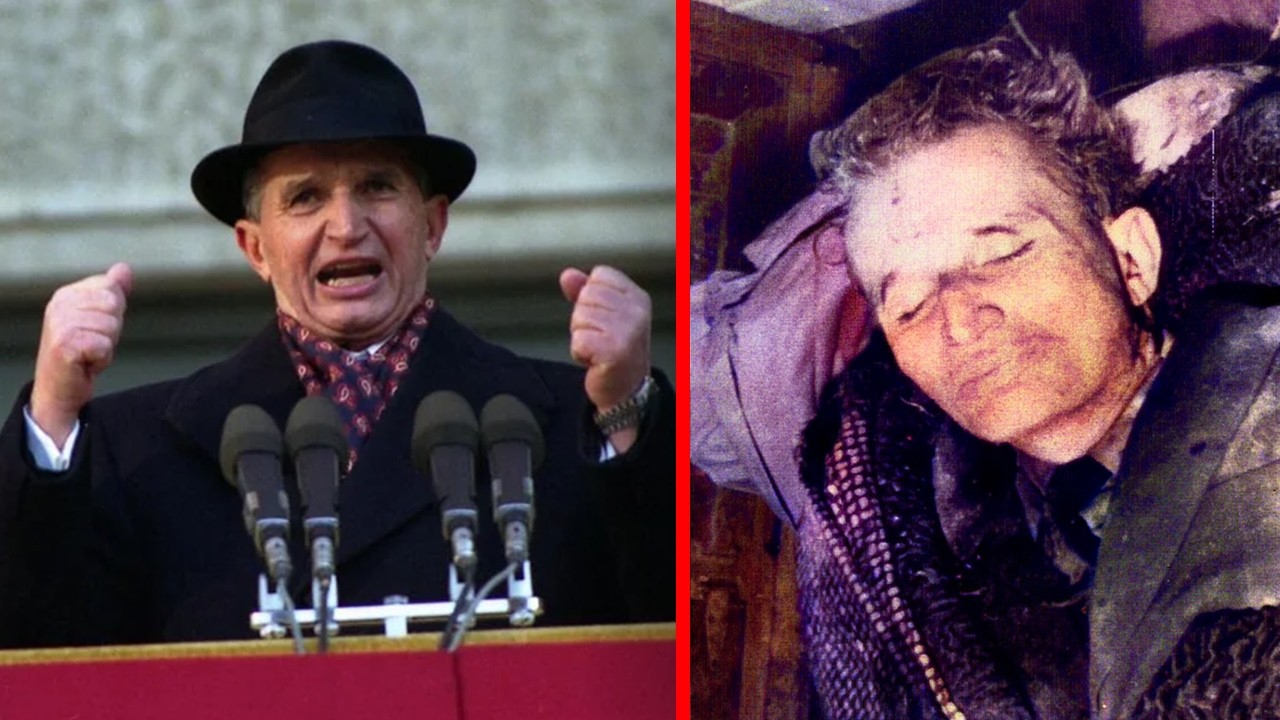
Then, from somewhere in the mass of people below, noise and shouting erupted. The president stopped mid-sentence, visibly confused. For years, the state media had shown him as an unchallenged leader surrounded by devoted crowds. Now, millions of Romanians watching from their homes saw something they had rarely witnessed before: their dictator losing control of the moment.
The broadcast was eventually cut off, but the damage had already been done. By that evening, Bucharest was no longer quiet. Crowds gathered in the city center and refused to leave. During the night, security forces moved against them, and many people were killed, wounded, or arrested.
The violence only pushed more people to stand against the regime. Ceaușescu still did not understand how quickly his position was collapsing. The following morning brought an event whose exact circumstances remain disputed to this day. Vasile Milea, Ceaușescu’s minister of defense, was found dead at around 9:30 a.
m. It has never been established with certainty whether he was killed for refusing to order troops to fire on civilians, or whether he took his own life rather than carry out such an order. Ceaușescu announced that Milea had been a traitor, but that declaration did nothing to restore control. It only added to the anger spreading through Bucharest.
General Victor Stănculescu was then appointed as the new minister of defense. He arrived at the Central Committee building that morning with his leg still in a cast from a recent injury. Within hours, Stănculescu would become one of the central figures in the collapse of the Ceaușescu government. The crowds outside were growing at a frightening speed.
More than a hundred thousand people gathered around the Central Committee building, with large numbers of factory workers joining the demonstrations. The army, which had been used to support the government, was turning against the regime instead. Soldiers increasingly refused to fire on protesters, and in some places they joined them. By the afternoon, protesters were pushing into the Central Committee building itself.
Ceaușescu made one final attempt to address the crowds from the balcony using a megaphone, but the noise below was so loud that his words could not be heard, and the crowds had already stopped treating him as their leader. Inside the building, the situation had become an emergency. Stănculescu organized a helicopter escape for Ceaușescu and those closest to him. As protesters stormed the building, Nicolae and Elena Ceaușescu were hurried to the roof along with senior Communist Party officials Emil Bobu and Manea Mănescu, and two personal guards.
The helicopter was piloted by Vasile Maluțan, Ceaușescu’s personal pilot. The aircraft was so overloaded that there was not enough space for everyone to sit properly, and reports indicate that the mechanic ended up sitting in Ceaușescu’s lap during takeoff. The helicopter lifted off at the very moment the protesters reached the roof. Below, the crowds poured into the building the Ceaușescus had just left.
Communist symbols were torn down, and people began celebrating what seemed to be the collapse of the regime. But the revolution was far from over. The plan had been to fly to Snagov, a town by a lake north of Bucharest where the Ceaușescus had a summer residence. From there, they were supposed to meet other helicopters to continue their escape, but that plan fell apart almost immediately.
Maluțan later explained what happened during the flight. He told Ceaușescu that their helicopter had been detected by radar and might be shot down. That was not true, but the warning frightened Ceaușescu enough that he ordered the pilot to land immediately. Maluțan’s deception worked exactly as intended.
Once they were on the ground, the situation became almost unbelievable for a man who had ruled Romania for twenty-four years. Ceaușescu, Elena, and two security guards stopped a passing car, forced its four occupants to get out, and then drove off in it themselves. Their escape did not last long. They were spotted near Târgoviște, a town about forty-five miles northwest of Bucharest.
Soldiers and local residents surrounded them and took them into custody. By the evening of 22 December, Nicolae and Elena Ceaușescu were prisoners inside a military garrison in Târgoviște. Meanwhile, Bucharest was descending into a new kind of chaos. A new political group called the National Salvation Front, led by former Communist Party official Ion Iliescu, moved quickly to take control of the government.
But the fighting in the streets did not stop. Gunfire broke out between various armed groups, and people were being killed by forces that were often impossible to identify. At the time, the new authorities blamed much of the violence on terrorists loyal to Ceaușescu. But the true identity of those fighters, and how real or misunderstood the fighting was, remains a matter of dispute.
The scale of the violence was enormous. Of the 1,104 people who died during the entire uprising, 942 were killed after Ceaușescu fled Bucharest on 22 December. In other words, most of the deaths occurred after the regime had already collapsed. This created immense pressure on the new leadership to end the confusion as quickly as possible.
And there was one obvious person they could remove to prove the old order was finally finished: Ceaușescu himself. On 24 December, the leaders of the National Salvation Front held a secret meeting, reportedly inside a bathroom in the Ministry of Defense. There they decided that Nicolae and Elena Ceaușescu would be tried before a military court in Târgoviște the next day, Christmas Day. The strange location and the timing of the decision showed how rushed and improvised the entire process was.
General Victor Stănculescu, the same officer who had helped arrange Ceaușescu’s escape from Bucharest two days earlier, was put in charge of what would happen to the couple. The military court consisted of several officers and was presided over by Judge Gică Popa. Two other officers took part in the proceedings, while defense lawyers Nicolae Teodorescu and Constantin Lucescu were assigned to represent the Ceaușescus. But the defense was extremely limited.
As the hearing continued, the lawyers sometimes seemed more like prosecutors than people trying to save their clients. The charges against the couple were extremely serious. They included genocide, based on allegations that 60,000 people had been killed; armed sabotage against the state; destruction of public property; damage to the national economy; and attempting to flee the country while possessing more than a billion dollars in foreign bank accounts. Many of these claims, especially the figure of 60,000 dead, were never properly investigated.
The case was prepared in a few hours rather than through the kind of inquiries normally expected in a major criminal trial. Ceaușescu refused to recognize the authority of the court. He argued that the tribunal had no constitutional basis, and insisted that the new government itself was illegitimate. He also claimed that the entire revolution was in fact a Soviet conspiracy against him.
He said he would only answer before the Great National Assembly, Romania’s official legislature, and denied all charges against him. Judge Popa rejected his argument. At one point, he told Ceaușescu that the real fraud was what Ceaușescu himself had done to Romania during his twenty-five years in power. For decades, Ceaușescu had controlled what the Romanian people could say about him.
Now he sat in a room where a judge could confront him publicly without fear of the old regime. The entire trial lasted about fifty-five minutes. After the arguments concluded, the court left the room to discuss its decision. About ten minutes later, the judges returned.
Judge Popa read the verdict. Nicolae and Elena Ceaușescu were convicted on all charges and sentenced to death. Under the emergency military rules in effect during the revolution, the death sentence could be carried out immediately. According to accounts from the military base, the execution took place only about five minutes after the trial ended.
The firing squad had already been prepared that morning, before the trial began. Eight paratroopers from a military unit based in Boteanu were brought in by helicopter. They were initially told only that they had been selected for a mission of “degree zero,” without being informed what that mission involved. They were chosen from a larger group of soldiers, with the number first reduced from fifty officers to twenty, then to the final eight who would carry out the sentence.
The squad was led by Captain Ionel Boeru and included seven armed non-commissioned officers. Boeru later described seeing Ceaușescu shortly before the trial. The former president looked pale, unshaven, and agitated. Yet he was still wearing aftershave, a small detail that Boeru remembered.
Stănculescu had already chosen the execution site, beside a wall in the courtyard of the military barracks. After the trial, Nicolae and Elena were brought outside with their hands tied behind their backs and placed in front of that wall. The firing squad opened fire almost immediately. A military cameraman was recording the event, but he did not capture the entire execution clearly.
The footage showed mainly the final bursts of gunfire, the smoke, and the two bodies lying on the ground. Some accounts suggest the soldiers fired before the official countdown had even finished. Elena Ceaușescu became the only woman ever executed by the modern Romanian state. Hours after the execution was first announced, official Romanian television broadcast silent footage of Nicolae and Elena being taken from an armored vehicle to the building where their trial had taken place.
As the images were shown, a narrator read the verdict. For many Romanians, this was the first conclusive proof that Ceaușescu had actually been captured. Since 22 December, rumors had spread across the country because no one knew exactly what had happened to him. In part of the footage, Ceaușescu raised both hands in what appeared to be a gesture of surrender.
Near the end, he stood and threw his fur hat onto the table. He seemed to be saying he no longer needed it. The execution itself was not shown during that initial broadcast. The full trial footage, along with images of the couple’s bodies, was handed over to Romanian television shortly afterward, and excerpts were then broadcast around the world.
For viewers who had spent decades watching Communist leaders remain in power or retire quietly, these images were shocking. The bodies were transported to Bucharest under military guard because the streets were still too unstable. The authorities did not want large crowds gathering around the bodies or using them as a focal point for further violence. On 30 December, five days after the execution, Nicolae and Elena Ceaușescu were quietly buried in Ghencea Military Cemetery in Bucharest.
They were placed in two separate unmarked graves, with Elena’s grave located in a highly restricted area behind a marble mausoleum. Ceaușescu’s death brought an end to forty-two years of Communist rule in Romania. Ion Iliescu, who had led the National Salvation Front through the chaotic transitional period, became the country’s new president as the new political system began to take shape. Romania was also the only country in that wave of revolutions where a Communist leader was executed.
In Poland, Czechoslovakia, Hungary, and East Berlin, Communist governments collapsed and their leaders stepped down, retired, or faced legal proceedings later. Romania dealt with its former leader within days, and it ended with a military trial, a firing squad, and a wall in a courtyard.
