In 1953, inside a factory in Port Chester, New York, the air carried two odors that would define the place forever: hot metal and thick bar oil. The floor vibrated from a dozen machines running at once, a low hum that settled in a man’s chest and stayed there through the shift. There was no ear protection yet, so the workers spoke in the shorthand of men who had learned to read lips over the roar of cutting equipment. They were not heroes.
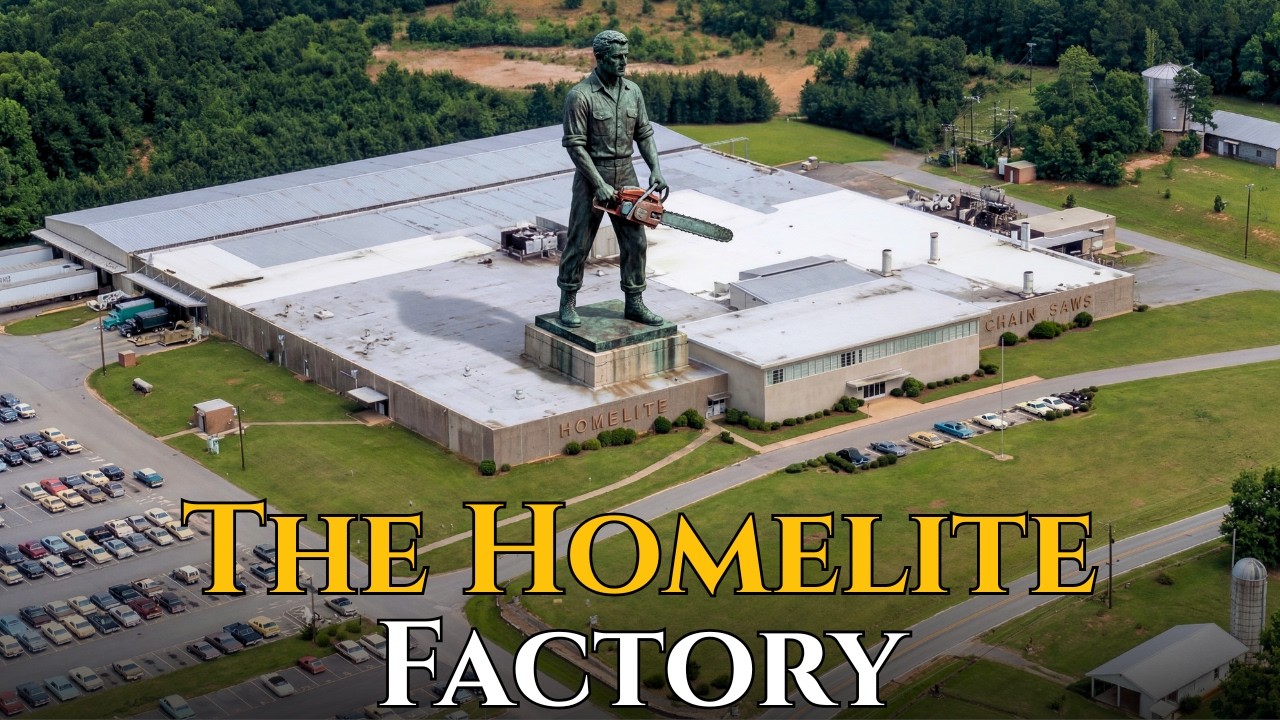
They were men who showed up, built things with their hands, and went home to families in houses they were still paying off. What they were building that morning was a chainsaw, and that chainsaw was going to outlast most of them. Homelite was not supposed to be a chainsaw company. It was founded by Charles Ferguson as a manufacturer of portable electrical generators, a machine built on a single promise: it will work when everything else has stopped.
A generator is bought for emergencies, which means it cannot fail. That engineering culture, the metallurgy choices, the tolerances, the insistence on overbuilding, flowed directly from that commitment. When Homelite moved into chainsaws, it transferred that culture wholesale. Every saw that came off the Port Chester floor carried the genetic memory of a generator.
It was built heavier than necessary. Built to start when needed. Built to be repaired by the man who owned it, not replaced by the store that sold it. In the early 1950s, the American chainsaw market belonged to professionals.
The machines were industrial, heavy, genuinely dangerous, and priced for timber companies and logging crews. A farmer did not buy one. A suburban homeowner never considered it. Ferguson and his engineers saw something the competitors missed: the American landscape itself was creating demand.
Millions of men had moved to suburbs and rural properties. They had land now, and trees on that land, and storms that brought those trees down. They did not need a professional logging saw. They needed something they could start themselves, handle themselves, maintain themselves, and trust when the next storm came through.
Homelite did not build a compromise. A lesser company, run by salesmen, would have built something cheap and called it affordable. Homelite built something genuinely capable and priced it for the man who needed it. The XL series became the backbone of the brand’s reputation, and it achieved something remarkable: professional loggers ran the same saw as farmers and homeowners.
That crossover happened because the saw earned it. The XL had a physical presence, heavier than expected, with a solidity that told your hands the truth before you ever pulled the cord. The controls were simple enough to learn in an afternoon and logical enough that you never forgot them. The engine caught cleanly, with a settled, powerful note, the sound of a machine working within its own capabilities.
By the mid-1960s, Homelite had become something American companies rarely sustain: a verb. In logging camps from the Pacific Northwest to the Appalachian foothills, the act of running a chainsaw was sometimes called “homeliting. ” That is not an advertising claim. It is the kind of linguistic absorption that happens when a product dominates its field so completely that the brand name migrates into the action itself.
The men who used these saws professionally were not sentimental. They developed loyalty because the saw held up, and holding up was the only thing that mattered. A saw that failed in the field cost money. A saw that could not be fixed with tools carried in a truck was a liability.
Homelite saws could be serviced by the men running them. The parts were logical. The design was legible. When something went wrong, the machine told you what was wrong in the language of its own mechanics.
The Charlotte, North Carolina, facility marked the next phase. By the time Homelite moved significant manufacturing there, it had crossed into the general American consciousness. The Charlotte plant was built at a scale that reflected genuine ambition, the kind that requires you to believe the demand will be there for three decades. The culture transferred south recognizably: the smell of the oil, the weight of the castings, the institutional knowledge of what made a saw real rather than a product shaped like a saw.
What Homelite had built by the 1970s was something business schools would later struggle to categorize. They saw market share and price points. What they were actually looking at was a relationship. A load-bearing relationship between a working American man and a machine he trusted with difficult physical work.
A Homelite saw bought in 1968 might still run in 1985, not because it was treated with care, but because it was used hard, and it absorbed that use and continued. The saw accumulated a history: the nicks of particular trees, the storms it had cleaned up after, the fence lines it had cleared. By the time it was old, it was a record of work done. Passing it to a son was the transfer of a specific mechanical biography.
In rural America of the 1970s and 80s, self-sufficiency was an economic necessity. A man who could not keep his own equipment running paid someone else, and that was a budget line many families could not absorb. Homelite’s repairability had real financial consequences. When the saw needed a chain, you ordered it and installed it yourself.
When the carburetor needed cleaning, you cleaned it on your own workbench. The saw fitted into a world where human beings were expected to understand and maintain the machines that served them, and it was designed with that expectation baked in. The Textron acquisition arrived in 1994 with the particular cheerfulness of a corporate transaction that has already decided what it will do. Textron was a conglomerate, and a conglomerate does not love what it buys.
It holds what it buys, optimizes it, and prepares it for the next transaction. The language was the language of synergies and portfolio rationalization. Translated into operational decisions, it described a systematic extraction of cost from a product built on the premise that some costs should never be extracted. The transition was gradual.
You do not swap a magnesium housing for plastic overnight. You do not eliminate the dealer network in one announcement. You do it one quarter’s cost reduction target at a time, one material substitution at a time, one closed parts depot at a time. Each change is individually defensible.
The cumulative effect is a product transformed from the inside out, still carrying the name and shape of what it was while containing almost none of the substance. John Deere acquired the brand from Textron. It understood working equipment and the relationship between a man and a machine that could not fail. But the brand never recovered the integrity it had lost.
A brand repositioned toward a lower price point cannot easily be repositioned back. The dealer network had already thinned. The engineers and machinists who understood what made the original saws what they were had already dispersed. John Deere held the name.
The name was no longer holding the thing it had once meant. Techtronic Industries purchased Homelite in 2001. A Hong Kong–based conglomerate, its business model was organized around power tools at price points accessible to mass retail consumers. The acquisition was not an attempt to rescue an American industrial tradition.
It was the acquisition of a brand name with retail recognition, and the manufacturing infrastructure to fill that name with a different product for a different customer. The remaining American manufacturing was wound down. The saws that carried the Homelite name were built to specifications determined by the retail relationship, not by the mechanical tradition of the men who built the brand. The Home Depot shelf is where the story ends.
The placement of a tool on a retail shelf is not neutral. It communicates the intended relationship between buyer and object. A Homelite saw on a Home Depot shelf in 2005 was a seasonal purchase, priced so that repair was economically irrational. The saw that failed was cheaper to replace than to fix, and so it was designed to be replaced rather than fixed.
Someone in a conference room with a quarterly target decided that the correct future for a tool that had once lasted thirty years was a lifespan measured in seasons. They wrote it into the specifications, built it into the price, and called it a strategy. The rage this generates in the men who remember what the saw used to be is more precise than nostalgia. They are not angry because things change.
They are angry because the decision was not forced on anyone. It was a choice. Someone looked at a tool that had been trusted by working men for forty years, that had been repaired and handed down and kept running through decades of hard use, and chose deliberately to replace it with something not intended to last. A saw that runs for thirty years generates one sale.
A saw that fails in three years generates ten. On a spreadsheet, it is a beautiful transformation. The only thing the spreadsheet cannot fully account for is the object itself. What was lost was a specific model of the relationship between an American working man and the tools he depended on.
A model in which the tool was a capital investment, something that returned its cost across years of reliable service, something that could be understood and maintained by its owner, something that accumulated value through use. The Homelite saw of 1968 was, in a real economic sense, a form of savings. The version on the Home Depot shelf is not a savings account. It is a subscription disguised as a purchase.
The money flows repeatedly toward the retailer and the conglomerate where before it flowed once. The craftsmanship did not vanish like weather. It was removed. There are men still who have the original saws.
You find them at estate sales, in the back corners of barns. A Homelite XL from 1965, properly stored, will still start. It will not start as quickly as a modern saw, and it will not cut as fast, because chainsaw engineering has genuinely advanced. But it will start, and it will run, and it will cut.
The sound it makes, that throaty, confident note of a well-tuned two-stroke engine built to tolerances somebody cared about, is the sound of a different set of decisions. Decisions made by engineers rather than accountants. The weight of that old XL when you pick it up is the weight of an argument, a physical one. Something this heavy, this dense, this deliberately over-engineered for a world that might be rough with it, was built by people who believed the man on the other end deserved a machine that would not let him down when the storm came through and there was work to do.
Somewhere, a man will pull one of those old saws out of a barn this spring. He will check the chain, add bar oil, prime the carburetor three times the way his father showed him, and pull the cord. The engine will catch on the second or third pull, because the old engines were built to catch, not to frustrate. He will run it through whatever needs to be cut, and when he is done, he will clean it and put it back in its place.
He will not think much about the fact that the name on the housing belongs to a Hong Kong conglomerate, or that the thing sold under that name at Home Depot is a different object in every way that matters. He does not need to think about it. He has the real one.
