The floor of the great hall at Erfurt had been carrying a crowd since morning. Every bench was taken, and men stood three deep along the walls in the July heat. The young king of Germany, Henry VI, had called this court day to settle a land quarrel between Louis of Thuringia and the Archbishop of Mainz, and no one of any rank in that part of the country had wanted to be the one who stayed home. Counts and abbots, each with attendants pressing in behind them, filled the hall in the year 1184, packed so tight that the boards beneath them groaned under the weight of the most powerful men in the region.
Somewhere underneath all of that, beneath the floorboards and the ground floor below them, sat the cesspit that served the building. Nobody in the hall was thinking about it. You would not have been either. It went in the afternoon.
The joists were old, the crowd had been standing on them for hours, and at some point they let go. The Royal Chronicle of Cologne, the main account we have, describes the assembled men going down through the hall floor, then through the floor of the room beneath, and into the pit. Plenty of them survived the drop. They died in what they landed in.
Years of human waste, deep enough to close over a grown man, with gas sitting on top of it that took the breath out of anyone who came up thrashing for air. The men still standing on the edges of the collapse could hear the ones in the pit for a while. Then they could not. The chronicle says nothing about how long the digging out took or who did it.
It was surely the townspeople of Erfurt, working with ropes and hooks over days in that heat, pulling up men they would have recognized by their rings and belts and nothing else. Henry VI was in a window seat, an alcove with an iron grille set into the thickness of the wall, and the wall held while the floor around it disappeared. He grabbed the bars and hung there until men came with ladders and pulled him out through the opening. Louis of Thuringia, whose quarrel the gathering was meant to settle, also lived.
Archbishop Conrad of Mainz lived. The Count of Wertheim did not, and neither did Count Heinrich of Schwarzburg, nor Friedrich von Kirchberg, nor Beringer von Melingen. The chronicle puts the confirmed dead at about sixty. Later writers pushed the figure toward a hundred, and any exact number should be held loosely.
The bodies had to be hauled out of sewage and identified by whoever was still upright enough to look. Sixty of the foremost men of Thuringia and Saxony, pulled dead from a latrine in the middle of a royal court session. The whole subject is in that one afternoon. A king’s household, the finest clothes in the region, a formal legal proceeding with clerks taking notes, all of it resting on a few inches of timber above a pit that nobody had emptied in a long time.
Medieval hygiene lived in that gap. The same people who washed their hands before dinner and paid good money for piped water were sitting on top of their own waste and trusting the boards. That was one bad afternoon. Most of the story is slower than that.
The towns came first, where the filth piled highest and where the records survive. A medieval town was built by people who kept animals and made things with their hands, and it filled up with everything that comes out of animals and out of making things. Walk into London in, say, 1340, and the smell would reach you before the walls did. Tanners soaking hides in pits of dog dung and urine.
Dyers boiling their vats. Butchers with blood running out under the stallboards into the gutter and drying black in the sun. Households tipping the contents of chamber pots out of upper windows into a street that had no drain except the slope of the road itself. And under everything, the horses.
A town of forty thousand people ran on horses and oxen, and each animal produced its own pile every day, and the pile sat where it fell until somebody paid a raker to cart it away. The tanners were the trade every town tried to push outside the walls and every town failed. Leather was needed for everything, and the tanner needed water. Tanning starts with soaking a raw hide in a pit of lime to loosen the hair, scraping the hair and fat off with a knife, steeping the hide for weeks in a pit of dog dung mixed with water or stale urine to soften it, and finally months in a pit of oak bark liquor.
The dog dung was collected off the streets by children and old women and sold to the tanner by the bucket. A tannery was a yard full of open pits of rotting animal skin, running off into the nearest stream. Downstream, the water ran brown and smelled of what had been in the pits, and people drank from it. The Fleet is the river to send anyone to first for a feel of London’s relationship with its own waste.
Calling it a river is generous. By the thirteenth century it was a slow ditch running down past the prison of the same name into the Thames, with tanneries on its upper banks and the butchers of Newgate dumping entrails from a bridge that took its name from them. In 1290, the Carmelite friars at Whitefriars sent a complaint upward, saying the stink from the Fleet was overpowering the incense in their church and had killed several of their brethren. Whether or not smell can kill a man, they believed it could, and they had buried enough friars to feel entitled to say so.
The Fleet Prison sits on that bank in the records with a complaint of its own. Prisoners petitioned that the fumes were making them sick, and a prisoner in the Fleet already had enough to worry about. He paid for his own bread and for the straw he slept on. If the money ran out, he lay on the stone next to the wall that the river seeped through.
The other river inside the walls, the Walbrook, was small enough that householders simply built privies out over it, and it silted up with what dropped from them until the city gave up and covered it over. The butchers were the worst of it. Ernest Sabine went through the London records in the 1930s and wrote up what he found in a journal called Speculum, and the picture is of a trade that could not be moved and could not be controlled. Cattle were driven live into the city and killed in the Shambles by St.
Nicholas’s church, close to Newgate, in the open air on the street. The blood went into the gutter. The paunches were slit and the contents dumped. The offal, the guts, the feet, the heads that nobody bought — all of it was supposed to go down to the Thames or the Fleet and be carried away by the tide.
And the tide did not always oblige. The city ordered the butchers to slaughter outside the walls at Knightsbridge or Stratford, and the butchers stayed put. Their customers were inside the walls, and meat would not keep across town in August. Fines were levied.
Nothing moved. The Shambles kept killing where it had always killed, and the smell of it, in the words of one petition, made the air of the whole neighborhood corrupt. Then the pigs. Every town in medieval Europe had pigs in the street, and not just the occasional escaped animal.
Households kept swine and turned them loose to feed themselves, and what a pig feeds on in a street like that is the refuse. The offal from the Shambles, the contents of the gutters, the dead dogs, whatever a child dropped. Pigs are large and fast and will bite anything, and the coroner’s rolls of English towns record infants in cradles killed and partly eaten by loose swine when the mother stepped out. London fined pig owners and empowered the city’s officers to kill any pig found loose and keep the carcass.
The fact that the order had to be repeated every few decades gives a sense of how well it worked. Somebody had to shift all of this, and the men who did it were the rakers. Each ward hired them. They swept the filth toward the laystalls, the official dumping places along the riverbank and outside the gates, and from the laystalls the muck went out by cart or dung boat into the countryside where it was wanted.
The fields around every town depended on it. In principle, it was a system. In practice, the rakers were few, the carts were few, the laystalls filled faster than the boats could empty them, and the muck heaps by the river grew into hills that stood in the sun and cooked. Edward III was traveling through all of that in the autumn of 1357, going up and down the Thames on royal business by water, and he did not enjoy it.
He put his complaint in writing on the 30th of September, and it survives in the city’s letter book. A king personally offended by a smell, putting it in writing. He says that passing along the river he saw dung and laystalls and other filth heaped up on the bank in various places, and that he perceived the fumes and abominable stenches rising from them. He warns of great peril to the people of the city if nothing is done.
He orders the mayor and sheriffs to have the banks cleaned and kept clean, on pain of heavy forfeit, so that the punishment, in his phrase, might cause fear and dread to others. The mayor, John Dody, responded that December with a proclamation. Nobody was to throw rubbish, earth, gravel, or dung into the Thames, the Fleet, or the city ditches. Dung was to be carried off by the rakers and taken away in the dung boats.
Anyone who left filth in front of their own door paid a fine of two shillings, and if the offense was bad enough, went to prison for further handling at the discretion of the mayor and aldermen. Two shillings was real money, a couple of weeks’ wages for a laborer, so the fine was meant to be felt. A generation later, the problem had grown big enough to reach Parliament. In 1388, sitting at Cambridge, the Parliament of Richard II passed a statute against throwing dung, filth, entrails, and refuse into the ditches, rivers, and waters near towns, with a penalty of twenty pounds to the crown.
It is usually described as the first national law against pollution in England. Notice one thing about that run of writs and statutes: they keep getting reissued. A law that works does not need to be passed three times in thirty years. The Thames bank kept stinking, the laystalls kept growing, and the king kept writing letters about it.
York got its own royal letter, blunter than London’s. In 1332, Edward III was planning to hold a parliament there, and before he set out he wrote to the mayor and bailiffs that the city was so foul with dung and filth thrown into the streets and lanes that its air was corrupted and infected, and that the stink of York, in the king’s own phrase, exceeded that of any other town in the kingdom. He ordered it cleaned before he arrived. Somebody had to stand up in front of the Council of York and announce that the king considered their town the worst-smelling place in England, and then go and find enough carts.
The butchers of York had their stalls on a street called the Shambles as well, and their offal went into the river Foss, a dammed, still pool at the edge of the city that also took the waste of the tanneries. The king had a point. Cambridge had a royal complaint of its own around the same time about the King’s Ditch, the defensive channel around the town, choked so full of filth and the carcasses of animals that the townsmen were said to be sickening from it. Anywhere the king went, the king wrote a letter about the smell, and the letters are among the better sources we have.
Paris had it at least as bad, and Paris has the better anecdote. The city’s mud was famous across Europe. The boue de Paris, a black paste of soil and animal dung and household slops and rainwater, churned by hooves and cartwheels until it stuck to everything and by reputation ate through cloth. Philip Augustus’s biographer, a monk named Rigord, tells the story of the young king standing at a window of his palace on the Île de la Cité one day around 1185, looking out when a cart or a horse churned the muck in the street below, and the stench came up through the window and hit him hard enough that he stepped back from it, sickened.
Rigord says the king decided then and there that the main streets of Paris would be paved in stone, and that the work began soon after and went on for years. Whether one whiff at one window really did it is impossible to swear to. But the paving is real, and the reason the biographer gives for it is a smell. That was the surface, the streets and the rivers.
Beneath the streets, under nearly every house, sat the thing that made it possible. A London house of any size had a cesspit. Sometimes it sat under the privy in the yard. Sometimes it was dug right under the house, with the seat above it in a small closet.
The editors of the surviving court records describe the medieval city as honeycombed with these pits, some of them twelve feet across and twelve feet deep. Twelve feet. A hole you could drop a cart into, lined with stone if the householder was careful, and with nothing at all if he was not, filling slowly for years with everything the household produced. A lined pit held its contents.
An unlined pit let them seep out through the earth, downhill, toward whoever lived next door. The city knew this and wrote rules about it. The assize of nuisance was the court where Londoners went to complain about their neighbors’ buildings, and its rules said that a pit walled in stone had to sit at least two and a half feet from the boundary of the next property, and an unlined pit three and a half feet. The case rolls from 1301 onward are full of what happened when people ignored that.
In 1301, a man named William de Betonia complained that his neighbor William de Garton had dug his cesspit so close to Betonia’s cellar that the contents were coming through the wall. The contents themselves. Sewage dripping through the masonry into the room where Betonia stored his goods. Garton’s defense was that the pit had been there a long time.
The court threw that out and told him to move it. Another case from the same rolls has a man named Henry le Palmere complaining that his neighbor William de Halingbury had built a gutter that carried water and, in the phrase of the record, all kinds of refuse from Halingbury’s house onto Palmere’s land, so that his timber and everything else he kept there had rotted. Halingbury said the gutter had stood for sixty years. The court did not care how long it had stood.
Go through enough of those cases and a pattern shows itself. The complaint is almost never about the smell on its own. The smell was ordinary. The complaint is that the neighbor’s filth has physically arrived through a wall or over a boundary and ruined something that cost money.
Only then did a medieval Londoner pay a clerk to draw up a complaint. When a pit filled, somebody had to empty it, and the men who did that work were called gong farmers — gong being an old word for a privy — and later simply rakers or nightmen, from the hours the city made them keep. They came at night with buckets and a cart, lifted the boards, and climbed down. A cesspit several years old is not a pool of liquid.
It is a mass, semi-solid on top where it has dried and crusted, liquid underneath where it has not, and it has been fermenting the entire time. That fermentation produces gas: methane, which you cannot smell, and hydrogen sulfide, which you can until your nose gives up and stops registering it. That is the dangerous moment. A high enough concentration of hydrogen sulfide stops the body’s ability to use oxygen, and a man simply drops.
The gong farmer climbed down into that in the dark, with a candle that could set off the methane, and shoveled the crust into buckets that other men hauled up on ropes. The pay was good, several times a laborer’s daily wage, and it was good for exactly that reason. They were only allowed to work between dusk and dawn, and they were fined if they spilled on the way to the river, and they spilled. A cart full of that on a rutted lane in the dark is not a thing you can keep level.
The route from the pits to the laystall was marked out in the morning by what had dripped from the tailboard, and the neighbors knew who had been emptied by the trail past their door. Richard the Raker did not even get as far as the pit. His death is in the London coroner’s roll for 1326, one line, more or less. He had gone to sit on his own privy at his own house, and the planks of the seat were rotten, and they gave way under him, and he went down into the cesspit beneath and drowned in it.
The clerk who recorded it used a word that later writers have translated as “monstrously. ” Drowned monstrously in his own excrement. His name is given as Richard le Rakiere, so this was a man whose trade was cleaning the city’s filth, who died in the one pit he was never paid to empty. The coroner’s court found nobody to blame.
Rotten wood and a full pit and a man who sat down in the ordinary way and did not get up. The roll gives no age for him and names no wife or children, so he goes into the record as a trade and a manner of death and nothing else. The roll does not describe the death itself, but a cesspit deep enough to drown a man is a pit where the fall takes him under the surface before he can get his feet beneath him. What he goes into is thick enough to hold him and liquid enough to fill his mouth.
He would have fought. The fighting brings up the gas from below, and the gas takes the strength out of his arms before the drowning finishes it. It is over in a minute or two, and somebody in the house eventually notices that Richard has been gone a long time. Up the social ladder, the pits got deeper and the seats got grander, and the principle never changed.
A castle had garderobes, and the name is a small joke of history. A garderobe was originally a wardrobe, a place to keep clothes, and the smell of ammonia rising from the shaft was thought to keep moths off the furs hung nearby. The garderobe was a stone closet built into the thickness of a wall, with a seat over a chute. The chute dropped straight down the outside of the wall, or through it into a pit, or, if the castle had one, into the moat.
The projecting stone boxes on the outside of a keep, with a hole underneath and a long stain running down the masonry below it, can still be seen. The moat took the garderobe’s contents and the kitchen’s waste and the stables’ runoff and whatever the rain washed down, and a moat that is not fed by a running stream is a still pond, and a still pond full of that is a sink. In siege conditions, the garderobe chute was also a way in. A small party of men at Château-Gaillard in 1204 is said to have gone up one and led the attackers into a ward, which meant crawling up a shaft coated with what came down it, in armor, in the dark, and the first man on that rope would not have been envied.
The kings themselves did not care for it either. In 1246, Henry III wrote to Edward FitzOdo, the man in charge of his works at Westminster, about the privy in his wardrobe, the room where his clothes and valuables were stored, saying that it was situated in an undue and improper place and stank, and ordering him to build another somewhere else, with the words, “Even though it should cost £100. ” £100 was several years of a knight’s income. The king of England was prepared to spend that to get his privy moved away from his furs.
Down in the towns, the pressure only grew. Even much later, in 1579, a constable on Tower Street in London counted fifty-seven households holding eighty-five people and found three privies serving all of them. Three seats for eighty-five people, in a street where the houses had been divided and divided again as the city filled. Whoever could not wait used a pot, and what went into the pot went, by custom and against every ordinance the city ever passed, out of the window into the street below, with or without a warning shout to whoever happened to be passing.
The city fined people for it. People went on doing it. In Edinburgh, the shout was “gardyloo,” from the French for “watch out for the water,” and the joke in that word has outlived every one of the people who ever got hit. London’s version of the rule was that nothing at all was to come out of an upper window, and the same court that heard the cesspit cases heard complaints from shopkeepers whose upstairs neighbors’ slops had come down onto the goods laid out on the stall below.
The water people drank came from the same ground all of this went into, and that connection, more than the smell, is the deadliest part of the whole story. A medieval town drew its water from wells, from the river, and, if it was rich enough, from a conduit — a pipe run from springs outside the walls to a public fountain in the marketplace. London had the Great Conduit in Cheapside, built in the thirteenth century, a stone system fed by a pipe from the Tyburn springs to the west, with a tap where the water bearers came with their wooden tankards and filled up and carried water door to door for a fee. The people who could not pay went to the wells, and the wells were dug in the same yards as the cesspits, a few yards apart in the same clay.
The conduit water was so valued that stealing it was a public crime with a public punishment. In 1478, a brewer named William Campion was found to have run a secret pipe from the conduit into his own brewhouse, and the city’s sentence was to set him on a horse and parade him through the streets with a vessel shaped like the conduit fixed on his head, kept full of water with holes in it, so that the water ran down over his face and clothes the whole way, with a crier walking ahead announcing what he had done. The water carriers themselves formed a brotherhood, and their tankards were long wooden vessels holding three gallons, carried on the shoulder from the conduit to the kitchen doors. A household’s water for the day came in on one man’s back and cost a farthing, and whatever the carrier’s hands had been in that morning came with it.
The pit leaked into the ground, the ground fed the well, the well fed the family. Nobody could see the connection. Water that stank was considered bad. Water that looked clear and tasted fine was considered good.
And clear water out of a well six feet from a privy was killing people all year, every year, with fevers that nobody could name. It makes sense, then, that so much of the medieval diet ran on ale. People understood, without knowing the mechanism, that fermented drink did not make you sick the way well water did. Brewing means boiling, and boiling kills what is in the water.
Small beer, the weak stuff with hardly any alcohol in it, was what children drank, what monks drank, what a household drank at breakfast. Water was for the poor and the desperate. The reputation went all the way up. Queen Elizabeth of York is reported to have advised the Spanish court, when Catherine of Aragon was on her way to marry into the Tudor family, that the girl should get used to drinking wine, the water in England, in her words, not being drinkable.
A queen of England said that about her own kingdom with no sense that it was an insult. That was the water and the ground it came out of. Now the bodies that were washed in it, when they were washed at all. Almost every town of any size had a bathhouse, and some had dozens.
In England they were called stews. In Paris, étuves. In the German cities, Badstuben, and a German town of the fourteenth century might have a dozen of them, with set hours and a bell rung in the street when the water was hot. You paid a small coin, undressed, sat in a wooden tub or on a bench in a steam room, and somebody scrubbed you, or bled you, or cut your hair while you sat there.
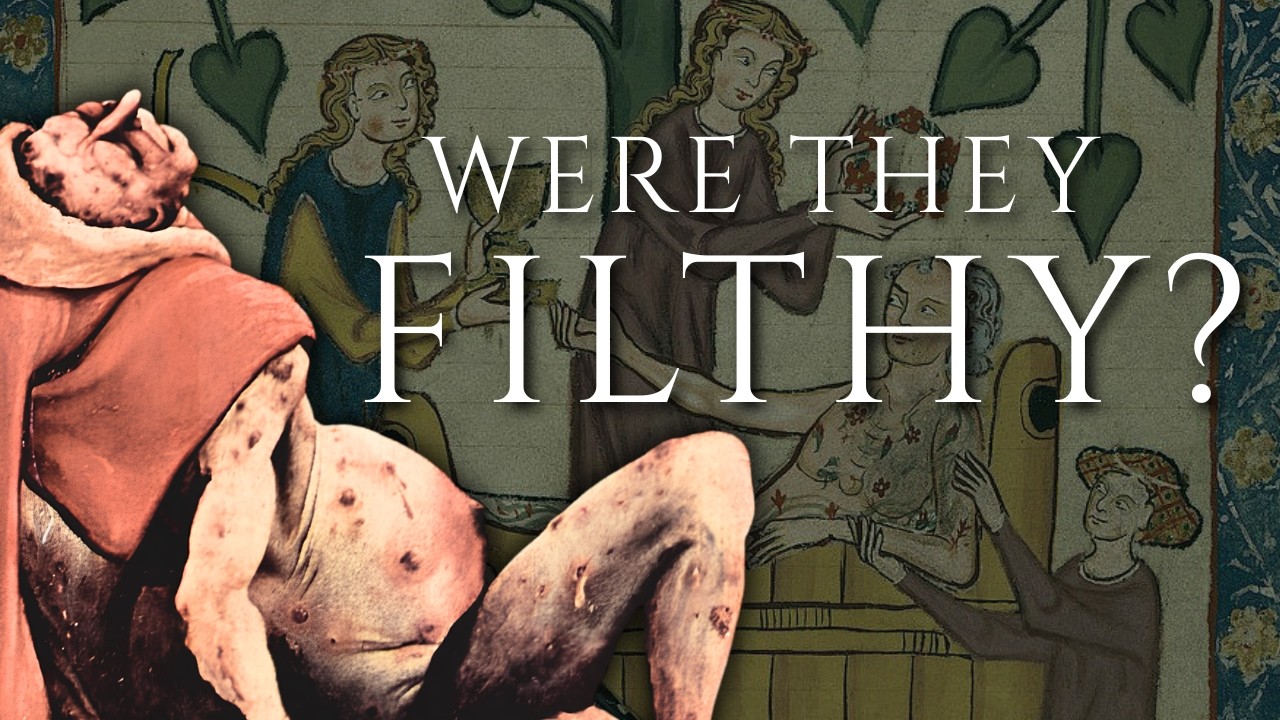
Meals were served in the bath. Music was played. Couples went together. A great deal of surviving art shows men and women in the same tubs, with food laid out on a board across the water, and it is very clearly a social occasion, closer to a tavern than to a modern bathroom.
The problem, from the church’s point of view and eventually from the doctors’, was everything that went along with the scrubbing. In the German towns it went further still. Bathing was a benefit of employment. Journeymen were paid Badegeld, bath money, on top of their wages, and a master who did not hand over the bath money on a Saturday afternoon was breaking the terms of his trade.
The bath attendant himself was a low sort of person, barred from the respectable guilds on account of where his hands had been, and he also let blood and pulled teeth in the steam room, so a man could go in dirty and aching and come out clean, bled, and short a molar in the same afternoon. In the bigger houses, the tubs were set out in rows, and the sexes were meant to be kept apart by a screen. The fines recorded against bath attendants who skipped the screen come up often enough to suggest the screen was mostly decorative. London’s bathhouses stood mostly across the river in Southwark, on the Bankside, on land that belonged to the bishops of Winchester.
Henry II had granted the bishop the manor there in 1161, and the same year produced a set of ordinances for the stewholders of Southwark, regulating what were already, in plain terms, brothels. Eighteen licensed houses by the later counts, with something like a thousand women working in them at any one time, nicknamed “Winchester geese” after the bishop whose rents they paid. The stews themselves took their name either from the fish ponds on the bishop’s land where he bred his carp, or from the stoves that heated the bathwater, and either origin describes the neighborhood well enough. You could get a bath there.
You could also get everything else, and the bath was frequently the pretext. The ordinances themselves are oddly careful. A woman could leave the house when she wished. Married women were barred from working there, and so were pregnant ones.
The stewholder could sell neither food nor drink, which kept the customers moving. Constables were to inspect the houses regularly. The rules exist, and between the lines of them you get a good sense of what was going on that made them necessary. Southwark was outside the city’s jurisdiction, so the city’s own bans on brothels did not reach it, and London’s men simply crossed the bridge.
What closed the stews in the end was disease, the new one. Syphilis arrived in Europe in the 1490s, spreading out from the French army’s siege of Naples in 1495, and it moved through the bathhouses of Europe the way a sexually transmitted disease moves through buildings whose business is sex. The early strain was ferocious, far worse than the disease later became. Pustules covered the body from the scalp to the soles.
Boils ate through to the bone. Faces collapsed as the cartilage of the nose rotted away, and pain in the joints and long bones kept people screaming through the night. Within a decade, the bathhouses of Germany were shutting. Henry VII ordered the Southwark stews closed in 1506.
They opened again, money being money. John Stow, writing his Survey of London at the end of that century, records that the number of licensed houses was cut from eighteen to twelve. On the 13th of April 1546, Henry VIII finished the job by royal proclamation. Stow has the proclamation made by sound of trumpet through the streets, ending, in the king’s language, the toleration of the dissolute and miserable persons who had been suffered to dwell in the common open places called the stews, and their abominable and detestable sin.
The houses shut. The women inside them were put out. And Stow’s remark on what happened next is that the trade moved into the open streets and the alleys, where there was no bishop’s constable at all. The bathhouse was one thing, and the bath at home was another, and here the royal accounts are the best guide we have.
Kings kept receipts. King John, whose reputation has taken a beating for other reasons, traveled with his own bath, a wooden tub carried from castle to castle, and with a man to run it. The household rolls name him as William, sometimes William Aquarius, William the Waterman, and they record payments to him for the king’s baths often enough that historians who have gone through the rolls think John bathed roughly once every three weeks. He also kept a washerwoman named Florence, paid to launder the royal linen, and her name is in the accounts as well.
Edward III, a century and a half later, went further. In 1351 his accounts show payment for taps of hot and cold water piped directly to his bath at Westminster, in a room set aside for it with a boiler behind the wall. That is a bathroom in every sense that matters. Going back further, Charlemagne loved the water.
Einhard, who knew him and wrote his life, says the emperor built his palace at Aachen around the hot springs there and swam constantly, and that he would invite his sons to bathe with him, and his nobles and his friends, and sometimes his bodyguard, so that a hundred men might be in the water at the same time. A hundred men — a king holding court in a hot spring with the water up to his chest and the whole political class of the Frankish Empire around him, naked, and it was a normal afternoon. Monks bathed on a schedule, and the schedule was cautious. The Benedictine rule allowed baths to the sick as often as needed, and to the healthy rarely, and the customaries of the big English houses fixed a few baths a year, before the great feasts, in a bathhouse with wooden tubs, the water heated by a lay brother, and a monk assigned to make sure nobody lingered or talked.
Washing was a service to the body, and the body was not supposed to enjoy itself too much. Hands and faces were washed daily at the lavatorium, the long stone trough with taps that stood in the cloister outside the refectory, and feet got a formal washing every Saturday, with the abbot doing it for the brothers on Maundy Thursday, as Christ had done. The unwashed monk of the old jokes turns up mostly in later writing, and the plumbing in a great abbey was the best in the kingdom. Water was also medicine, in the right place.
At Bath, the hot springs the Romans had built over were still bubbling up through the mud, and in 1174 a hospital of St. John was founded beside them, so that the poor and the sick could soak. People with skin diseases and stiff joints and worse came from across the kingdom to sit in the steaming pools, the lepers alongside the rest, in water that the town had been using as a sewer upstream. Then came the Black Death, and the doctors turned against water.
The medical theory of the time held that plague traveled in corrupted air, miasma, and that it entered the body through the pores. A hot bath opened the pores. So a hot bath in a plague year was a door left unlocked. Physicians advising the king of France in 1348, and the city councils of Italy in the years after, all said some version of it: avoid the baths, keep the skin closed.
The advice outlived the epidemic and hardened into a habit. Over the next two centuries, the idea that washing was dangerous spread from the doctors into ordinary life, the bathhouses closed for disease and for sin together, and Europe’s relationship with water changed. The same Europe that heated water by the tubful in 1300 was being told by its physicians two hundred years later to leave it alone. Teeth are where the skeletons start talking, and they are a surprisingly hopeful part of this.
Dig up a medieval graveyard and look at the mouths, and the teeth are worn down and full of gaps, but they are not rotten the way a Victorian’s teeth are rotten. Sugar was an import and a luxury, and without sugar, the bacteria that eat holes in enamel do not get fed. A study of a medieval cemetery in the south of France, at Vilarnau, looked at nearly 1,400 teeth from fifty-eight adults buried between the twelfth and fourteenth centuries and found decay in about 12 percent of them. Every single adult had worn teeth.
Medieval bread was ground between stones, and the flour carried grit, and every mouthful of bread for a lifetime was a little sandpaper on the enamel. A man of forty had teeth flattened to the dentine, the softer stuff underneath, and once the dentine was open, the nerve was near the surface and the pain began. A gap in the front teeth by thirty was ordinary. An abscess is what happens when the bacteria reach the pulp.
The tooth dies, the root fills with pus, and the pus has nowhere to go except into the jawbone and then out through it. The face swells, the skin over the swelling goes shiny and hot, and eventually the abscess breaks through — sometimes into the mouth, sometimes through the cheek, a hole in the face that drips. Skulls from medieval cemeteries show these little round holes drilled through the jawbone by pressure, and the people they belong to walked around with them for months. Some died of it when the infection went to the blood or spread into the neck and closed the throat.
Most just lived with it for years and got on with the harvest. The cleaning was better than you would guess. People rubbed their teeth with a rough linen cloth, and they made powders for it: sage ground up with salt, rosemary stalks burnt to charcoal and pounded fine, pepper ground with rock salt, cinnamon and cloves for the wealthy. The same spices that made a dish expensive made a tooth powder expensive too.
Chewing a green twig of hazel or a sprig of mint freshened the breath, and a dozen recipes survive for mouthwashes of wine boiled with herbs. When a tooth was past saving, it came out, and the man who took it out was a barber, or a traveling tooth drawer set up on a stool in the market with a string of pulled teeth around his neck as an advertisement, or, in a village, the blacksmith who owned the pliers. A hand on the forehead and a pull, no anesthetic, and the root often broke and had to be dug for. Richard III, when they found him under the car park in Leicester, turned out to have had bad teeth, worse than the peasants in most of the cemeteries, and the best guess is that a king ate more sugar.
Toothache itself had an explanation, and the explanation was a worm. The idea went back to Babylon and lasted into the 1700s: a small worm lived in the tooth and gnawed, and the pain was the gnawing. The remedy was to smoke the worm out. The patient held his open mouth over a bowl of hot coals onto which henbane seed had been thrown and breathed the fumes.
Afterward, in the ash, the practitioner would show him the tiny worms that had fallen out — which were in fact the sprouted seeds of the henbane — and the patient, being by then thoroughly drugged on henbane smoke, felt a good deal better and went home satisfied. Lice lived on everyone. It is one of the few things here that cut straight through the classes. A queen had lice.
A bishop had lice. Nit combs, the fine double-sided combs of bone or boxwood dragged through hair to scrape the eggs off the shafts, turn up in every excavation of every period, in castles and in hovels, and some of them still have the eggs stuck between the teeth seven hundred years later. Fleas were worse. Fleas bite, and they breed in the rushes on the floor and in the fur of every dog that slept in the hall, and a medieval bed with its straw mattress and wool blankets was a flea’s idea of a good home.
The best account of vermin on a human body comes from Canterbury, from the evening of the 29th of December 1170. Thomas Becket had been cut down in his own cathedral that afternoon by four of the king’s knights. The top of his skull was sliced off, and one of the party ground the brains out onto the stone floor with the point of his sword. The monks who came to prepare the body for burial were already working with something that had been butchered.
They began to undress him. Over the top, the archbishop’s outer robes, then a surplice, then a lamb’s wool coat, and more woolen coats under that, and the black robe of a Benedictine monk, and a shirt, and then, against the skin, a hair shirt, coarse goat hair worn as a penance. And the hair shirt was alive. The chroniclers who were there, or who spoke to men who were there, described the lice in it boiling over like water in a simmering pot as the body cooled and the vermin, sensing the heat going out of it, started to leave.
The archbishop had worn that thing next to his skin under all those layers every day, and it had been crawling every hour of that time, and nobody at court had known. The monks looked at it and, by their own account, wept and laughed at the same time, because to them it was proof. A man who suffered that in secret was a saint. The lice were the evidence of his holiness, and the story of them went out through Christendom and helped make him one.
The monks kept the hair shirt, along with the hair drawers he had worn under it, among the relics shown to pilgrims at Canterbury for the next three hundred years. For everyone who was not trying to be a saint, lice were simply a fact to be managed, and the managing came down mostly to cloth. One piece of medieval hygiene takes longer to appreciate than the rest. What you wore against your skin was linen — a shirt for a man, a chemise for a woman, and under the shirt for a man, linen drawers called braies.
Over the linen went the wool, the tunics, and the hose. The wool was almost never washed. Washing wool shrinks it, and it takes a week to dry. The linen was washed constantly.
Linen soaks up sweat and grease, and the medieval understanding, laid out by Katherine Ashenburg and by Virginia Smith in their histories of cleanliness, was that clean linen pulled the dirt away from the body, and changing it was itself the act of getting clean. A rich man changed his shirt daily and considered himself washed. The laundress did the actual work, and it was a real trade, with tubs and beating paddles on the riverbank, and with lye. Lye is the thing to know about.
Take wood ash, run water through it, and you get a caustic liquid that dissolves grease, and mixed with animal fat and boiled, it makes soft soap, gray and hard on the skin. Soap boilers were a recognized trade in most towns, pushed to the edges of town, because nobody wanted the smell of boiling fat and ash beside the market. The good soap, hard white bars made with olive oil rather than tallow, came up from Spain and Italy — Castile soap — and cost enough that it was for faces and for the rich. The other cleaning agent was urine.
Stale urine is mostly ammonia, and ammonia cuts grease better than lye, so households kept a pot for collecting it, and the fullers came to buy it. Fulling is the process that turns loosely woven wool into felted cloth, done in a trough of stale urine and water, with men standing in it up to their knees, treading the cloth for hours in a building that smelled the way you would expect. Laundresses used it too, for the worst stains, and a fine gentleman’s spotless linen might well have been soaked in a stranger’s piss and beaten on a rock, and he would never have known. For smell, people used what they could.
Pomanders, little pierced balls of silver or wood filled with ambergris or musk or cloves and worn on a chain, held to the nose when the street got bad. Sweet herbs strewn on the floor — lavender and meadowsweet — rose water on the hands. The wealthy scented their gloves. The poor had none of it and smelled of what they were, and the sources hardly ever complain about ordinary body odor.
A town stank of tanneries and dung. A man stank of sweat and wool. That was what a man smelled like, and it was the stink of rot and sickness that people wrote about, since that was the smell that meant something. Beds were shared, and bedding was where the vermin bred.
A bed in an inn held strangers, two and three to a mattress, and a traveler carried home in his shirt whatever had been living in the straw of the last man. Bed bugs, by the usual account, came in with the cloth trade, and they got their English name from exactly this. Scabies was everywhere — the itch — a mite that burrows under the skin and lays its eggs in the tunnels, and the scratching opened the skin, and the open skin went septic, so a bad case of the itch was a body covered in weeping sores from the wrists to the knees. Ringworm ate bald patches out of children’s scalps.
The barber sold ointments for all of it, sulfur in pig fat, and for the persistent, mercury — and the mercury worked slowly, on the mite and on the patient both. Hair was washed, though rarely, in warm water with lye or with a paste of ash and herbs, then rinsed with vinegar or rosemary water and left to dry by the fire, and the physicians warned against doing it too often. A wet head let the cold in. A woman of standing might wash her hair once a fortnight and comb it daily, and the combing did the actual work.
The comb got the lice out; the water did not. Men were shaved by the barber twice a week, and their hair cut in a bowl crop that kept it off the neck and out of the collar, where the lice gathered. A man who let his hair grow long was making a statement, usually about his rank and his ability to pay someone to deal with what lived in it. Women’s bodies got their own literature, and the best of it comes from Salerno in southern Italy, where a woman named Trota practiced medicine in the twelfth century, and where a collection of texts on women’s health that later went under her name, the Trotula, was copied and carried across Europe from Spain to Poland.
Monica Green spent a career on those texts, and her translation is the one to trust. They cover menstruation, conception, childbirth, contraception, and what we would call cosmetics — hair dye and remedies for bad breath — and they treat all of it as ordinary medicine. For monthly bleeding, a woman used cloths, washed and reused, or pads of absorbent moss. The medical advice around it comes out of the humoral theory that ran all medicine, so a woman bleeding too heavily was told to bind salted bacon dusted with coriander and wormwood over her navel and loins to draw the excess back.
The mind is a strange organ, but the fat and the salt were doing nothing at all. Childbirth was the thing that killed women, and it killed them in a specific way that the sources describe without understanding. A midwife attended. The room was kept hot and dark, full of women, and the birth itself, if it went badly, went badly in the ways births still go badly — a child stuck, or a bleed that would not stop, and the woman laboring for two or three days until she died with the child still inside her.
If the birth went well, the danger was not over. Three or four days afterward, some women developed a fever. It came with a foul discharge and a pain that no position eased, and the belly swelled and went hard, and the fever climbed, and the woman died in a week or so, often lucid until near the end. Childbed fever.
Now we know it is an infection of the womb, usually carried in on the hands of whoever attended the birth, and nobody in the medieval period knew that, or could have known it, so the same midwife who had just laid out a corpse came straight to the next labor with the same hands. The Trotula recommends drugs to ease the pain of childbirth, opiates in wine, and that recommendation ran against the churchmen who held that pain in labor was Eve’s inheritance and was to be borne. Trota, or whoever wrote that passage, took the woman’s side. The church had one further demand of the midwife, the part of her work hardest to think about.
An infant who died without baptism was, by the teaching of the time, lost. So a midwife was required to know the words of baptism, and to say them over a child that was not going to live, in the birthing room, with the water from the basin. And if the mother died in labor with the child still inside her, the midwife was expected to cut. The bishops’ instructions to parish priests spell it out: open the dead woman, take the child out, and baptize it if it breathes.
Midwives were doing it with a kitchen knife on a woman who had died an hour before, in the hope of a few seconds of life for the child and a soul saved. Sometimes the child lived. The surgical texts of the period note it without comment as a thing that happened. A woman who came through it was by custom unclean for forty days.
She stayed in the birthing chamber, out of church and out of company, and at the end of the forty days she went to the church door veiled and was blessed by the priest and admitted back — the churching. Only then did she go out into the town again. Come down from the castle and the townhouse now, to where nine people in ten actually lived. A peasant house in most of northern Europe was one room, or one long room with a partition, and the family lived at one end and the animals at the other.
The cow, the pig, the hens, whatever they owned, brought inside for warmth and for safety, standing in their own droppings on a floor of beaten earth. A fire burned in the middle of the floor with no chimney, only a hole in the thatch, and the smoke filled the room to head height and hung there, so that the timbers of every surviving medieval cottage roof are black with it. A child born in that room drew its first breath in that smoke. People slept on straw pallets on the floor or in a box bed with a wool blanket, and the straw was where the fleas bred.
In the longer houses, the family end and the animal end were separated by a cross passage with a door at each side, and the floor of the byre was dug a little lower than the floor of the house, with a drain cut down the middle to carry the animals’ water out through the wall. In a wet winter, the drain backed up, and the whole floor was a slurry. The heat off three or four cattle kept the house warm through January. So did their breath and their smell, and the smell was the price of not freezing, and nobody who lived that way thought it strange.
Outside the door sat the midden, the family dung heap. Everything from the byre and the privy and the kitchen piled up to rot, and in spring was forked onto the fields. A peasant’s own waste was the only fertilizer he had, and the village smelled of it from March to May. The night soil went out in buckets and came back in as bread.
The village water came from a well, or a stream, or a pond, and the pond was shared with the cattle, who stood in it in summer up to their bellies, and with the geese, and with whatever the women rinsed in it, and children drank from it with their hands. A village that had a spring was lucky, and the spring was usually the reason the village was there. Most did not. In a dry August, the entire community was drinking from a shrinking brown pool with the cows, and the flux went through the cottages one after another, and the parish register, where one exists, shows the burials clustered in late summer year after year, in a rhythm that the people living it would have known by heart and could do nothing about.
Inside the great houses, the floors were no better, and for that we have Erasmus, who visited England several times around 1520 and wrote to a physician friend about what he had seen. The floors of English houses, he says, are commonly of clay strewn with rushes, and the rushes are renewed on top from time to time, but the bottom layer is left, and under it lies undisturbed an ancient collection of beer, grease, fragments of food, bones, spittle, the excrement of dogs and cats, and everything that is nasty. Twenty years, he thought, in some houses. He blamed the sweating sickness on it.
Whether he was right about that, the picture is hard to argue with. A great hall was where the household ate, where the dogs ate what fell, where men spat and pissed in corners when the garderobe was too far, and where fresh rushes went down over all of it, so it looked and smelled sweet for a day. The lords themselves were attended at every function, including that one. A close stool was a padded box with a lid and a pewter pot inside it, kept in the bedchamber for a great man’s private use.
In the Tudor court, the servant who attended the king while he used it, who handed him the cloth and took the pot away, held the office of Groom of the Stool, and became, through sheer daily intimacy with the monarch, one of the most powerful men at court. Being on hand while the king emptied his bowels put you closer to him than any minister. Under Henry VIII, the groom kept the king’s private accounts and controlled who got in to see him. The office started in the plainest possible sense, with a pot.
Back out in the town, food is where the courts got theatrical, and the London records preserve the punishments with the names attached. Selling bad meat was a public offense, and the public got to watch the sentence. A man named William Spalding was put in the pillory at the Stocks Market for selling putrid beef, and the carcasses he had been selling were burnt underneath him while he stood there, locked by the neck and wrists, breathing the smoke of his own rotten meat for an hour, with the crowd in front of him. A fishwife named Margery went into the thewe, the women’s version of the pillory, for selling putrid soles, and the soles were burnt in front of her nose.
The logic is easy to follow. If the smell was the crime, the smell was the punishment. Wine got the same treatment. In 1364, a taverner named John Penrose was convicted of selling wine that was unsound, and the court sentenced him to drink a draft of his own bad wine in public, and then have the rest of it poured over his head.
The crowd almost certainly enjoyed that one more than the taverner did. Bakers were the group the city watched most closely. Bread was the food, the thing everyone lived on, and its price and weight were fixed by law under the assize of bread, which went back to around 1266 and tied the size of a penny loaf to the price of wheat. A baker who cheated on the weight was set on a hurdle and dragged through the streets to the pillory, with the short loaf hung around his neck.
In 1327, the city caught a ring of them at something cleverer. Customers brought their own dough to the bakehouse to be baked, and the bakers had cut a small hole in the molding board where the dough was set down. Under the board, a man crouched, and while the customer was distracted, he reached up through the hole and pinched away a fistful of dough from every loaf. The bakers involved were pilloried with lumps of the stolen dough hung about their necks.
Another, Richard Hayne, was drawn on a hurdle to Newgate for putting sand in his bread, with the loaf carried in front of him on a lance while the crier called out his offense. All that lore around food sits oddly beside the old story that medieval cooks buried rotting meat under spices. The people who could afford pepper and cloves were the people with the freshest meat in the kingdom, with their deer parks and their fish ponds. The people eating meat on the turn could not have bought a pinch of saffron with a week’s wages.
Spice was a display of money and a matter of taste, and bad meat was a crime you could be smoked for. What people did eat, and how, is the more revealing side. Everyone at a table shared. The cup went round.
Two diners ate from one dish and off one trencher, a thick slice of stale bread that took the place of a plate and soaked up the juice and was then handed to the poor. Knives were personal. Forks did not exist, and food went from the dish to the mouth by hand, so the hand mattered, and handwashing before a meal, with a ewer and basin brought round by a servant, was a fixed ceremony in any household of standing. The books written to teach manners to boys entering great households tell you, by what they forbid, what people actually did.
The Babees Book and the Boke of Courtesy, both English, both from the fifteenth century, and Erasmus’s guide for boys from 1530, between them tell the young man to keep his nose off the tablecloth, to spit somewhere other than across the table, to leave a gnawed bone out of the common dish, to keep his hands out of his hair at table in case something fell out of it, to keep his knife out of his teeth, to turn his head before he belches, and to find somewhere other than the hall to relieve himself. Erasmus, being Erasmus, adds that if you must break wind, cough to cover the sound. Every one of those rules got written down after somebody did the thing often enough to need telling. From the table to the gut, and to the diseases, and a great deal of what medieval people put in their mouths came back out of them in blood.
The bloody flux was the disease of the age. Dysentery. The name covers a few different infections, but the common thread is bacteria or amoebae that get into the lower bowel through contaminated water or unwashed hands and tear up its lining. What comes out then is not diarrhea in the ordinary sense.
It is blood and shreds of the gut wall itself, twenty or thirty times a day, with cramps that fold a man in half and a fever, and within a few days the body has lost so much fluid that the eyes sink and the pulse flutters. In a camp with no clean water to replace what is being lost, people die of it in a week, sometimes faster. It spreads through a crowd living close together, with nowhere to dig latrines that will not seep into the water. And that description is every army that ever besieged anything.
Henry V landed in Normandy in August 1415 with something over eleven thousand men and sat down in front of Harfleur. The ground he sat down on was marsh, low and wet, with the river Lézarde dammed by the defenders, so that the whole plain in front of the walls flooded. The English pitched camp in the mud. They dug their latrines in the same mud, and the water they drank came out of it too.
It was August, and in a few weeks the flux was going through the army. The priest who traveled with it and wrote up the campaign blamed, among other things, the unripe fruit the men were eating off the trees — partly right, though the water would have done it on its own. Men who had marched off the ships strong enough to haul cannon were lying in their tents in their own filth, and the tents themselves became the problem. A sick man cannot walk to the latrine thirty times a day, and the ground around every tent was fouled, and the flies moved from that to the food.
The king did what he could. He had the worst cases carried to the ships and sent home, and the ships that had come over full of archers went back full of men lying in the hold in their own mess, dying on the crossing, and were unloaded at Southampton and Portsmouth into towns that did not want them. The chroniclers put the losses at around 2,200, most of it disease, and some estimates run up toward 5,000 dead or sent home too weak to stand. Richard Courtenay, the bishop of Norwich, a friend of the king’s, died of it on the 15th of September, and Henry is recorded sitting with him at the end.
Michael de la Pole, the Earl of Suffolk, died three days after. The town surrendered on the 22nd, and the king marched on toward Agincourt with an army that had been cut by a quarter before an arrow was loosed. The disease took the king himself in the end. In the summer of 1422, Henry was besieging Meaux, east of Paris, in another wet camp, and he picked up the flux there and grew weaker through July, and was carried by litter to the castle at Vincennes, where he died on the 31st of August, thirty-five years old — the most feared soldier in Europe, dead of what had killed his bishop and his earl.
By some accounts, the body was boiled to strip the flesh from the bones for the journey home. Two centuries earlier, King John had died that way, at Newark in October 1216, in the middle of a civil war, and the chroniclers pinned the flux on a surfeit of peaches and new cider. Whether or not the peaches did it, he spent his last days in that condition, in a castle, in a bed, and the men around him took what they could carry from the treasury before he was cold. The crusaders knew the flux long before Harfleur.
Outside Antioch in the winter of 1097, the army of the First Crusade sat in a wet camp for seven months, and the men who were there described the horses being eaten, and after the horses, the leather of the shields, and the sickness going through the tents faster than the hunger did. Fulcher of Chartres, a priest with the army, says the dead were carried out of the camp every morning and that the survivors were too weak to bury them decently. A camp that cannot bury its dead is a camp where the dead are fouling the water that the living drink. Something like a third of that army died at Antioch without a battle being fought.
Fifty years later, on the Second Crusade, the German emperor Conrad lost most of his men in Anatolia to the same sickness and to thirst, and came into Constantinople with a fraction of the force he had marched out with. The chroniclers set down the Latin words for it, fluxus ventris, the flowing of the belly, and they put it beside the word for famine every time, since the two always walked in together. Rye brought a different horror, and the horror had a saint’s name on it. Across the wet parts of northern Europe, the bread grain was rye, and rye in a damp season grows a fungus in the ear — a purple-black spur where the grain should be — and ground into the flour.
The spur brings with it a set of alkaloids that do two things to a human body. The first form of the sickness constricted the blood vessels. It began with a burning in the hands and feet, an unbearable heat under the skin that people described as fire, and then the fingers went cold and white and finally black, and the toes and the feet, and the flesh died on the bone and dried and shrank, and eventually the dead parts came away. Fingers fell off.
Feet fell off at the ankle. A man could lose both legs below the knee and live, the dry rot of that gangrene not always poisoning the blood. People survived as trunks in agony throughout, and the sources describe the limbs coming off without a wound and without much blood. The second form went to the brain: fits, seizures, the whole body arching and jerking, and hallucinations, visions, people running through the streets screaming at things nobody else could see.
The first great outbreak that can be dated well hit Aquitaine, in the southwest of France, in 944 and 945, and killed, by the chronicler’s reckoning, tens of thousands of people. A French historian named Mézeray, writing much later about a tenth-century outbreak, said that the cries of those in pain and the shedding of the burned-up limbs alike excited pity, and that the stench of the rotten flesh was unbearable. Nobody knew it was the bread. The sickness came in waves, whole villages at once, and it looked like a judgment.
The order that took its name from St. Antony began in the 1090s in the Dauphiné, after a nobleman named Gaston and his son were said to have been cured of the burning by praying at the saint’s relics, and they vowed a hospital in thanks. The hospital grew into an order with houses all over Europe, hundreds of them, each one a place where a man with black stumps for feet could be carried in and fed and prayed over until he died or sometimes got better. The bread in the hospital was made from clean grain, and the monks did not know that either.
It got the name St. Antony’s fire, and the order’s hospitals hung the amputated hands and feet of the sufferers at the shrine as offerings. A pilgrim walking into one of those chapels walked in under a row of dried human limbs. Leprosy occupied a place in the medieval mind that no other disease came near, and the disease and the ritual around it were terrible in different ways.
Start with the body. The bacterium that causes it grows slowly over years and it likes the cooler parts of a person — the skin of the face and hands, and the nerves close to the surface. The early signs are patches of skin that have lost their feeling. Then the skin thickens.
Nodules form on the face and the ears until the features coarsen and the brow bulges, and the cartilage of the nose softens and collapses inward, so the face flattens. The voice goes as the throat is affected. The eyes cloud, and many went blind. The nerves die, and a hand that cannot feel gets burnt and cut without its owner noticing, and the fingers are lost one joint at a time, absorbed and eventually gone, and the feet ulcerate and the ulcers go to the bone.
A leper in the late stages was a person with a swollen, collapsed face, stumps for hands, open sores on the feet, and a smell from the sores that people wrote about, who had been that way, getting slowly worse, for a decade or more. The church decided what to do about it in 1179 at the Third Lateran Council, which ruled that lepers were to live apart, with their own chapels and their own priests and their own burial grounds, and the leper houses went up across Europe. In England alone, something over 320 of them were founded between the late eleventh century and 1350. The oldest that can be dated is St.
Mary Magdalene outside Winchester, where excavated skeletons showing the bone changes of the disease have been dated to somewhere between 960 and 1030, so the house was taking in the sick before the Conquest. They stood outside the town walls, on the roads, and the name that stuck was lazar house, after Lazarus. The ritual is what people remember, and the ritual comes mostly from France. Some dioceses there used a rite of separation, one of the strangest pieces of liturgy known.
The leper was brought to church. A mass was said for him — the mass for the dead. He was then led out to the churchyard, where a grave had been dug, and he stood in it, or knelt at its edge, while the priest threw earth on him and said, in Latin, “Be dead to the world and alive again to God. ” Then the prohibitions.
Churches, markets, mills, and bakehouses were closed to him for the rest of his life. Streams and springs where others drew water were off limits. If he wished to buy something, he pointed at it with a stick. He went shod always, in a distinctive cloak, and he carried a clapper or a bell to warn people of his approach.
And having been buried in every way but the last, he was walked to the leper house and the door closed. What historians who have gone through the English records have found complicates that picture, and Carole Rawcliffe is the one to follow here. The rite of separation is a French document, and no evidence has turned up that the ceremony was ever performed in medieval England. The English rite for removing a leper from the community does not appear in the records until 1531, long after the disease had nearly vanished from the island.
And the lazar houses, when you look at where they were built, sit on the busiest roads into the biggest towns, at bridges and crossroads. A bridge is the last place you would put people you wanted out of sight. They were there so the inmates could beg. Many of the houses were religious communities that the sick chose to enter, with a rule and a habit and prayers, and being a leper in one of them meant being prayed for by a whole town on the way to market.
Both pictures are in the sources: the grave in the churchyard, and the beggar at the bridge with his clapper. Inside the houses, the regime was a monastery’s — prayers at set hours, a ration of bread and ale, on good days meat, a bed in a shared hall, and a rule against leaving without permission. A leper who broke it too often was put out to fend for himself on the road. The ones on the road were the ones people feared, and the fear had an edge of something else in it.
The disease was widely believed to be caught through sex and to be a mark of lust, so a man whose face was collapsing was assumed to have earned it. In some places, the parish church had a slit cut through the wall at an angle, so that the lepers standing outside could see the altar at the moment the host was raised without setting foot in the building. A few of those slits, traditionally called leper squints, are still there in English churches, at about the height of a kneeling man. The parasites nobody could see were in everyone, and we know that from what they left behind.
The most famous single object in this field of study is a piece of human excrement. In 1972, during the excavation of the Coppergate site in York, under what was going to be a branch of Lloyd’s Bank, archaeologists lifted a fossilized human stool out of a latrine deposit from the ninth century, from the Viking town — about eight inches long, whole, preserved by the wet ground. They sliced it and put it under the microscope, and it was full of eggs — several hundred of them — from whipworm and from maw worm, the big roundworm, which meant that whoever produced it had an intestine crawling with both. Andrew Jones, the specialist who worked on it for the York Archaeological Trust, told a reporter from the Wall Street Journal in 1991 that it was the most exciting piece of excrement he had ever seen, and the trust insured it for $39,000.
It sits in a case in the museum in York now, with a label, and school groups file past it. In 2003, a visitor knocked it over and it broke in three, and they glued it back together. Piers Mitchell at Cambridge has spent years on medieval latrine deposits across Europe, and the finding is the same everywhere — whipworm eggs and roundworm eggs — in the cesspits of London and Lübeck, in monasteries and in townhouses, in such numbers that heavy parasite loads were simply the medieval condition. A roundworm is a pale thing the thickness of a pencil and up to a foot long, and it lives in the small intestine, and a person could carry dozens.
They came up in vomit. They came out the other end. Children with a heavy load were potbellied and thin in the limbs and slow, the worms having taken the food. And the same children drank from wells fed by the pits where the worms’ eggs were waiting for the next host, and the circle never broke.
In the latrines of Lübeck on the Baltic, Mitchell’s team also found the eggs of fish tapeworm, from eating salted or barely cooked herring, and a fish tapeworm can grow to thirty feet inside a person and live for years, shedding segments, while the person feels tired and hungry and is otherwise unaware that a thing the length of a rope is coiled in their gut. Nobody in the Middle Ages could have seen an egg. They saw the worms when a big one came up, and they had names for them and remedies, and the remedies did not work. Then, in the autumn of 1347, twelve Genoese galleys put in at Messina in Sicily, and the men on them were dying of something that nobody in Europe had seen.
By the time the harbor authorities understood that and drove the ships back out to sea, it was already ashore. The Black Death took about four years to cross the continent and, by most reckonings, killed somewhere between a third and a half of everyone in it. Everything before this in the story is the ground it grew in. The rats in the grain stores, the fleas in the bedding, the bodies packed together in the towns, the water — all of it was waiting for exactly this.
The people living through it could not see how it moved. The plague lived in the black rat, and the black rat lived in the thatch and the grain store of every town in Europe, close to people in the walls. When the rat sickened and died, the fleas on it went looking for a warm body, and the nearest warm body was the family sleeping on the floor beneath the thatch. A flea that has fed on a plague rat has its gut blocked by the bacteria, so it is starving, and it bites over and over trying to feed, and vomits a little of what is blocking it into every bite.
So it went from the rat to the child on a night when the rat had gone quiet in the wall and nobody had noticed. From the child, it went to the mother in the same bed, and if it reached her lungs, she coughed it into the air of the room. And the room was one room, and everyone in it breathed. The symptoms were described by people who had them and by people who watched, and the descriptions agree: a fever, then swellings in the groin and the armpit where the lymph nodes are, the size of an egg at first, in some the size of an apple, hard and so painful that people could not bear the weight of a sheet on them.
Some burst and ran with a black pus. Blotches came out on the skin, dark purple, black from bleeding under it, and those were held to be the death sign. In the form that got into the lungs, people coughed blood and died in a day or two, sometimes between morning and night. The dying stank.
The chroniclers say that over and over — that the breath and the sweat and the discharge of the sick had a smell that made healthy people turn away. A great many of the healthy simply left, and the sick died alone in shuttered houses and were found by the smell days later. Agnolo di Tura kept the chronicle of Siena, and his entry for 1348 is the one to put in front of anyone who thinks numbers can hold this. He says the victims died almost at once, that they swelled under the arms and in the groin and fell dead while talking.
“Father abandoned child,” he writes. “Wife abandoned husband. Brother abandoned brother. The disease seeming to pass through the breath.
Nobody could be found to bury the dead for money or for friendship. Family members carried their own dead to a ditch as best they could, without priest and without prayers. ” Then he says that great pits were dug and piled deep with the multitude of dead, that they died by the hundreds day and night and were thrown into the pits and covered with earth, and that when the pits were full, more were dug. Then the line he sets down without any more emphasis than the rest: “And I, Agnolo di Tura, called the Fat, buried my five children with my own hands.
” He adds that many of the dead were covered so thinly that the dogs dragged them out and ate them through the city. His wife, Nicoluccia, is thought to have died too. He kept writing. Boccaccio was in Florence, and the opening of the Decameron is a report from the middle of it.
One detail he gives, and says he saw himself: the rags of a poor man who had died of the plague had been thrown into the street. Two pigs came along and did what pigs do, rooted in the rags with their snouts, and took them in their teeth and tossed them about. And within a short time, in his words, after a few turns, they both fell down dead on the rags they had been worrying, as if they had eaten poison. Whatever was in the rags killed two pigs in the time it takes to tell it.
The people of Florence were breathing it. Boccaccio also describes the men who did the carrying, the becchini, the gravediggers drawn from the lowest people in the city, who for a fee would come and take a body out of a house and carry it to the church or to the pit on a board — two or three bodies stacked on the same board, so that a bier that went out with one corpse came back for more, and the priest saying the office over it did not know how many he had buried. They demanded to be paid, and they were, and some of them went into houses where the dying could not stop them and took what they wanted. And Boccaccio says the survivors did not so much as follow the dead to the grave, since following meant walking in the street.
Avignon, where the pope lived, had it as badly as anywhere, and a musician in a cardinal’s household there, Louis Heyligen, wrote home to Flanders in April 1348 with the count as it stood. Half the city dead, he thought. The cemeteries full inside a month, so that the pope had bought a field and consecrated it, and 11,000 bodies had gone into it in six weeks. When the field was full, Clement VI consecrated the river.
He blessed the Rhône so that the dead could be thrown into it and it would count as burial in holy ground, and the bodies went down with the current, past the towns below where people drew their water. Clement himself sat between two roaring fires in his chamber through the summer, on his doctor’s advice, who held that fire burned the corruption out of the air — and it very likely kept the fleas off him. He lived. His physician, Guy de Chauliac, the most respected surgeon in Europe, stayed in the city when most of the doctors ran, and caught it.
He wrote afterward that he had been in continual fear, that the disease had come at him with a fever and a bubo in the groin, and that he had lain sick for six weeks and had been given up, and then the swelling had ripened and broken, and he had lived. He set down as clearly as anyone did the two forms of it — the one in the lungs that killed in three days, and the one in the glands that took five or six — and he said that the doctors were useless and ashamed. He was one of them, and he said it anyway. Paris got it in the summer of that year, and a Carmelite friar named Jean de Venette watched it from inside the city and set down what he saw.
The Hôtel-Dieu, the great hospital beside Notre-Dame, filled and emptied, and he says that on some days five hundred bodies were carried out of it to the Holy Innocents to be thrown into the pits. The nuns who nursed there kept nursing, and he makes a point of it — that the sisters of the Hôtel-Dieu did not fear death, and that so many of them died that the house had to be filled with new ones, and they died too. Down in Florence, the chronicler Giovanni Villani was keeping the record of the year and wrote that the plague had lasted until — and left a space for the date it ended and never filled it in. He died of it.
The chronicle stops mid-sentence, with the blank still there. London opened new cemeteries, since the parish churchyards were full within weeks. One of them, at East Smithfield just east of the Tower, was bought by a group of citizens in 1348 and was dug up by the Museum of London in 1986 and 1988, and it is one of the best-studied plague burials anywhere. They found 759 skeletons out of an estimated 2,400 in the ground.
The surprise, for anyone expecting heaps, was the order of it. The bodies lay in long trenches in rows, heads to the west, as the church required, stacked as many as five deep, but laid with care. Someone had taken the trouble. One woman went into the ground still wearing pouches on her belt with 181 coins in them.
Nobody had wanted to touch her to take them, and in a year when 181 coins would have kept a family through the winter, that is a measure of the fear. The city’s own losses are guessed at somewhere between a third and a half of perhaps eighty thousand people, and a guess is all there is, the men who kept the records having died with everyone else. Robert of Avesbury, a clerk in the archbishop’s household, recorded that more than two hundred bodies a day were carried into that one cemetery at the height of it. Two hundred a day, for months, in one burial ground in one corner of one city, is the plague.
The other emergency ground was bigger. Sir Walter Manny, one of the king’s soldiers, bought thirteen acres of a field called Spittle Croft, north of the walls near Smithfield, and had it consecrated in 1349, and the bodies from the city were carted out through Aldersgate and laid in trenches there for the rest of the year. Stow saw a stone inscription in the chapel later built on the ground, and the inscription claimed that more than fifty thousand bodies had gone into that one field in that one year. Fifty thousand is more than the city could have lost, and historians treat the number as a memory of horror rather than a count.
But the ground was real, and when the Charterhouse was built on top of it a generation later, the monks were living on a floor of plague dead, and the excavations under the square there in the 2010s found them still in their rows. Out in the English countryside, the priests died with everyone else. A priest went to the sick to hear confession and take the last breath, and in January 1349 the bishop of Bath and Wells sent a letter round his diocese saying that so many parishes had no priest left that the dying were to confess their sins to a layman if no priest could be found, and if no layman, to a woman. To a woman.
A bishop of the medieval church wrote that down and sent it out, and it is the clearest measure of how far the ordinary order of things had gone. In London, the streets themselves recorded it. In 1349, with the plague still in the city, the king wrote to the mayor complaining that the streets and lanes were so full of filth from the houses, day and night, that the air was poisoned and the pestilence made worse. The explanation the city gave back was that the rakers were dead.
The men who carted the dung had died with everyone else, and nobody had been hired to replace them. Anyone healthy enough to shovel could earn more elsewhere, in a town that had just lost a third of its labor. So the muck lay where it fell through the worst year in the city’s history, and the survivors walked through it to the pits. The cities learned faster than the doctors.
Pistoia in Tuscany passed a set of ordinances in May 1348, while the plague was still on its way, and they are the beginning of public health as a thing governments do. Travel to Pisa or to Lucca, where it already was, was forbidden. Cloth from outside was turned back at the gates. The dead were to be buried in a wooden box nailed shut, at least two and a half arm-lengths deep, and carried through the streets only with the lid closed.
No one was to go into a house where a corpse lay, and the bells were not to be rung for the dead, so that the town would not have to hear how many. Butchers were to slaughter only certain animals and to deal with the guts away from the market. Ragusa on the Dalmatian coast went a step further in 1377 and ordered that anyone arriving from an infected place wait on an island outside the harbor for thirty days before entering the city, and Venice in the next century made it forty — quaranta giorni, quarantine — and built a hospital for it on an island in the lagoon, the Lazaretto Vecchio, where the sick from the ships were kept and the dead were buried in trenches. When those trenches were opened in the 2000s, the archaeologists found 1,500 skeletons from a few years of pits.
Some had been thrown in with lime on top. Some had a coin in the mouth. Some had gone in so fast they still had their shoes on. The doctors had a theory, and the theory explained everything and cured nothing.
Sickness came from the air. Corrupt air, miasma, rising from marshes and dung heaps and rotting bodies and carried on the wind, and you could tell it by the smell. So a bad smell was itself a danger, and a good smell was a protection. Under that sat the older idea that the body ran on four humors — blood, phlegm, and the two biles — and that illness was one of them getting the upper hand.
The treatments followed. Too much blood? Open a vein and let some out, a pint at a time, into a bowl, and a barber would do it for a penny. Cupping, where a heated glass was set on the skin to draw the bad humor to the surface in a purple welt.
Purges to empty the gut of what was corrupting it. And the physician’s great diagnostic instrument, a glass flask of the patient’s urine held up to the light and studied for its color and its sediment and, yes, its taste. A medieval doctor’s portrait nearly always shows him holding a flask of piss, since that was his stethoscope. Bleeding was done to more people, more often, than any other treatment in the period, and it went like this.
The barber tied a cord round the upper arm, had the patient grip a stick to raise the vein, and opened it at the elbow with a small blade called a fleam, and let the blood run into a bowl marked with lines to measure. A pint was ordinary. The idea was that the body made more blood than it needed and the surplus went bad, so healthy people were bled on a schedule, in spring and autumn, with the almanac open to a drawing of a man covered in lines showing which vein to open for which complaint and which days of the moon were safe. Sick people were bled harder.
A man with a fever, already dehydrated and already losing blood into his gut from the flux, was bled to bring the fever down. It did bring it down, in the way that everything comes down in a body with too little blood in it, and some of the deaths in every chronicle are the doctor’s doing. Cupping was the gentler version. The leech was the gentlest: a black river leech set on the skin and left to fill until it dropped off, and a physician was called a leech in English for four hundred years without anyone thinking that odd.
Against the plague, the advice ran to smell. Carry a pomander. Burn juniper and rosemary in the sick room. Hold a posie of herbs to the nose in the street.
If you were rich, a sponge soaked in vinegar. Keep the windows shut against the south wind. Do not bathe. Do not exercise — exertion opening the pores.
Avoid sorrow and fear, the passions weakening the body — advice easier to give than to follow in Siena in 1348. The health handbooks that circulated among the literate, the Regimen of Salerno in its rhyming Latin and the illustrated Tacuinum Sanitatis out of Italy, laid all this out as a way of living — what to eat in each season, when to sleep, how to keep the humors level — and much of it is sensible, and some of it would get you killed. The beaked mask and the waxed leather coat that everyone pictures on the plague doctor belong to a later century, the 1600s, in Paris and Rome. The physicians of the Black Death wore their ordinary gowns, and most of the honest ones admitted in writing that they had nothing.
Surgery was a separate and lower trade, done by barbers, and it is where the blood is in this business. A barber-surgeon pulled teeth, opened veins, lanced boils, set bones, stitched wounds, and cut. The striped pole outside the shop stood for the bandaged arm of a bled patient, and the bowl of blood was set in the window afterward to advertise. He learned by apprenticeship, not from books, and he had no more idea than the physician why a clean wound healed and a dirty one turned green.
But he had seen a great many more wounds. Now the monks, who had the best plumbing in Christendom and the sense to write it down. Around 1160, someone at Christ Church Priory in Canterbury drew a plan of the monastery’s entire water system on two pages of a psalter, and it survives, and it is astonishing. Water came in by pipe from springs three-quarters of a mile away, passed through a series of settling tanks that let the sediment drop out, and ran in metal pipes to the kitchen, the brewhouse, the bakehouse, the lavatorium where the monks washed, the infirmary, and the fish pond.
At the end of the run, it flushed the reredorter, the great communal latrine that ran along the back of the dormitory. A reredorter was a long stone building with a row of seats over a channel, and the channel had a stream running through it, diverted from the water system or from a river, so that what the monks left was carried off continuously rather than sitting in a pit. Fountains Abbey in Yorkshire and Kirkstall outside Leeds built theirs over the river on arches so that the current did the work. Sixty men could use a reredorter at once, and the building did not smell, or not much, and rainwater from the roofs was gathered to scour the drains.
The monks bathed rarely, but they bled themselves on a schedule, four or five times a year, in the warming house, with a few days of meat and rest afterward to recover. A monastery with a good infirmary and running water and a diet with vegetables in it was about the safest place in the kingdom to grow old. Hospitals were another matter. The word meant a house of hospitality — a religious foundation that took in pilgrims and the poor and the sick together.
The sick got prayer first, nursing second, and medicine a distant third. St. Bartholomew’s in London, founded in 1123 by a courtier who had seen a vision of the saint, did real good for eight centuries and still does. The Hôtel-Dieu in Paris stood beside Notre-Dame on the island in the Seine, the oldest hospital in the city and by the late Middle Ages one of the largest in Europe, and its wards were long halls holding eighty or a hundred beds each, and the beds were shared — two to a bed, three more in a bad season, with no regard to what anyone had.
So a woman with a fever lay against a man with a suppurating leg and a child with the flux. The nursing sisters did what they could, and there were never enough of them. The dead were not always noticed at once, and the saying that stuck to the place was that every bed held three: the sick, the dying, and the dead. Women in childbirth were put in with the rest, and in a bad season, by the accounts that survive, the new arrivals were laid on straw between the beds.
A patient who went in with something curable came out, if at all, with whatever the bed had given him. Its death rate is reckoned at around one in five of everyone admitted, and that likely undercounts, since the people who went there had nowhere else. The sisters washed the hospital’s linen in the Seine, standing on a wooden platform built out below the building, so the sheets from the plague wards went into the same river the city drank from, and that river carried the hospital’s refuse down past the Louvre. The dead had to go somewhere, and in a medieval town they did not go far.
The parish churchyard was small — a few hundred square yards inside the town walls — and it had been taking bodies since the church was built, so the ground was full. What the sexton did was reuse it. He dug a new grave through an old one, and the bones that came up went into a charnel house, a stone building or a vaulted room under the church, where they were stacked — skulls in one heap and long bones in another, for the resurrection to sort out. In Paris, the great cemetery of the Holy Innocents in the middle of the market district handled the dead of twenty parishes and the hospital and the unclaimed from the streets, in common pits that held 1,500 bodies each, and when a pit was full it was closed and an old one opened, and the bones from it went into the charnel galleries built around the cemetery walls in the 1400s, stacked in the open behind arches.
People shopped there. The stalls of the market backed onto the galleries. You bought your cloth or your bread with several thousand skulls looking down at you over the arcade, and the smell in summer from the open pit was part of the price of the district. Inside the churches themselves, the wealthy were buried under the floor, and a church with a few dozen recent burials under its flagstones smelled in warm weather of exactly what was under it, and the incense was partly for that.
Dogs got into the churches too, since dogs went everywhere their masters went, and they fought in the nave and fouled the floor and lifted a leg against the font. The larger churches employed a man with a whip whose whole job was to drive them out during the service — “dog whipper” is the title in the accounts, and the office survived into the 1800s in some parishes. The dogs, by all accounts, never really left. Some of the dead were kept on show.
A man hanged for robbery on the road might be left on the gibbet in chains until the birds and the weather took him apart, a process that ran for months and that travelers on the road had to pass. Traitors got worse. After the hanging and the quartering, the head was parboiled in salt water and cumin to keep the birds off it and set on a spike over the gatehouse of London Bridge, where it stayed until it fell or was pushed off to make room. A visitor to the bridge in the 1590s counted more than thirty heads up there at once.
Every person coming into the city from the south walked in under them, and the boiled, rotting faces of the kingdom’s enemies were the first thing London showed a stranger. Prisons were where filth and death met most efficiently, and Newgate, the city’s main jail, had no sewer. The pits under it were emptied when someone remembered. The prisoners paid the jailer for everything — for bread, for a place away from the seep, for the removal of their irons — and those who could not pay lay on the floor in the wet.
In 1414, a fever went through the place and killed the jailer and sixty-four of the prisoners in the space of weeks, and Ludgate lost prisoners to it that year as well. Jail fever, they called it, and much later it would be identified as typhus, which lives in body lice and passes from one body to the next in a crowd that cannot wash. A prison was the perfect engine for it. Judges caught it from prisoners brought up to the dock.
The stink of Newgate reached the street outside, and people crossed to avoid it. Richard Whittington, the mayor, left money in his will to have the whole place pulled down and rebuilt, which was done in the 1420s, and within a generation it was as bad as before. Whittington’s other legacy is the most telling building of the whole period. In 1421, with money from his estate, the city built a public latrine on the Thames, at the Vintry, downstream from the bridge, and it was enormous: sixty-four seats for men, sixty-four for women, in two long rows over the river, with rooms for the poor above it.
All of it was flushed by the tide. Twice a day the river came up, ran under the seats, and took away what was there. A wall ran between the men’s side and the women’s, and that was the extent of the privacy. They called it the Long House, or Whittington’s Long House, and it stood for two hundred years.
One hundred and twenty-eight people sitting side by side over the Thames is either a triumph of civic engineering or something else entirely. The city had at least thirteen public latrines by then, most of them over the river or over the Fleet, and when the tide was out, what lay in the mud beneath them was there for everyone to see. The city did try, in fits. Stow records that in 1502 the whole course of the Fleet was scoured out from the Thames up to Holborn Bridge, so that boats laden with fish and fuel could once more row up it, and the phrase Stow uses is that this was “as in times past” — which nobody then living had seen for themselves.
The river had been solid with filth for so long that a boat on it was news. Wounds are the last thing on the body, and for one of them the record is unusually precise, because the surgeon who treated it wrote it up. In 1403, at the Battle of Shrewsbury, the sixteen-year-old Prince Henry, later Henry V, took an arrow in the face. It went in beside the nose, under the left eye, and drove into the bone at the back of the skull, six inches deep.
The shaft was pulled out, but the iron head stayed in. He was carried to Kenilworth. A London surgeon named John Bradmore was sent for, and Bradmore later described what he did in a treatise he called Philomena. He made probes of dried elderwood, wrapped in linen and soaked in rose honey, and over several days he pushed them into the wound, each one thicker than the last, to widen the track without tearing it.
Then he had a tool made — a pair of hollow tongs with a screw thread inside — and he worked it down the track until the jaws closed on the socket of the arrowhead and turned the screw so the tongs gripped and drew it out. Then he washed the cavity with white wine and packed it with wads of flax soaked in a cleansing ointment of bread, barley, honey, and turpentine oil, and changed the packing daily. In twenty days, the prince was healed. The wine was alcohol on an open wound.
The honey, as we now know and Bradmore did not, kills bacteria. The prince lived to fight at Agincourt with a scar down his cheek, and the fact that he lived at all is one of the great pieces of luck in English history. Nearly everyone who took an arrow to the head in that period died of the infection within a fortnight. Most wounds were not treated by John Bradmore.
They were treated by a barber in a tent, or by nobody. A sword cut or a spear thrust got the dirt of the field into it — the mud and the fragments of cloth driven in by the blade — and within two or three days the edges swelled and the wound began to weep and later to stink, and the stink was the sign. A wound that smelled was a wound with the rot in it. Surgeons washed with wine when they had it, and cauterized when they did not — an iron heated in the fire and pressed onto the raw flesh to sear it closed, with the patient held down and a strap between his teeth, and the smell of it was the smell of cooking.
When the rot went into a limb and the flesh went black and the smell got worse and the fever came, the limb came off. Amputation was a race. The surgeon cut through the skin and the muscle with a knife, fast, and through the bone with a saw, faster, the patient screaming and thrashing and liable to die of the pain. Then the stump was seared, or the vessels tied, and the stump bound up.
About half the men who went through that died anyway, of the shock or of the infection that had already got a head start on the knife. The mass grave dug up at Towton in Yorkshire, from the battle fought there in 1461, held men who had died of their wounds in the ordinary way, with skulls opened like eggs, and on the bones of some of them are the marks of earlier wounds that had healed badly years before. A soldier who had lived through one battle carried the scars of it into the next, and the healed ones were the lucky ones. Set against all of that, the towel.
The medieval household of any standing owned a ewer and a basin, and at the start of a meal a servant came round with them and poured water over each diner’s hands, and another servant followed with a towel, and the hands were clean before the bread was touched. The ewers were often shaped like animals — lions and knights on horseback — and they are called aquamaniles, and they turn up in museums and in rivers where they were dropped. A guest who did not wash was noticed. A host who did not offer was disgraced.
Barbers were everywhere, and a barber’s shop was where a man was shaved twice a week and had his hair cut and his nails pared and his teeth scraped and his blood let. The linen was changed. The rushes were renewed on top. Rooms were swept and tables scrubbed.
And the moralists who complained about the filth of the towns were measuring it against a standard that sat higher than the filth. Cleanliness was a virtue in every text of the period that mentions it. The rosewater and the cesspit sat six feet apart, and the same hands went from one to the other, and nobody had any way of telling which part of all that filth was doing the killing. Two new sicknesses turned up at the very end of the period.
In the autumn of 1485, in the weeks after Bosworth, a fever broke out in London that nobody had seen before, and it killed fast. A man could be well at dinner and dead by morning. It began with a shivering, then a burning heat, and a sweat that soaked the bedding through, then a hammering of the heart and a great thirst and a stupor, and within a day either the sweat broke and he lived, or it did not and he died. Two mayors of London died of it in a single week.
It came back in 1508 and 1517 and 1528, and each time it emptied the court and sent the king to the country, and nobody then or since has settled what it was. Erasmus, who had watched it, wrote to his physician friend that the fault lay with the English houses — the rush floors he had described, and the windows that did not open, and the salt fish and the beer — and his prescription was air and cleaner rooms. He may have been nearer the mark than the men with the urine flasks. Then, in 1489, the Spanish army besieging Granada, the last Muslim city in Spain, lost 17,000 men to a fever in the camp, while losing 3,000 to the enemy.
The soldiers who brought it had come from fighting in Cyprus. It began with a fever and a rash across the chest that spread to the limbs, and after that the mind went — a stupor, with muttering — and the smell of the sick room was described as the smell of mice. In the second week, the patient either came back or did not. It was typhus, the disease of lice, and it passes from one body to the next in the droppings of a louse that has fed on the sick, rubbed into a scratch.
So it needs a crowd that cannot wash and does not change its shirt, and a siege camp in a Spanish winter was that crowd. It stayed. For the next four hundred years, typhus went through every army and every prison and every besieged town in Europe, and it was still killing soldiers in the trenches of the twentieth century. A shared bed and a shirt that never came off, and the physicians blamed the air.
The last piece of it, chronologically, is the trumpet. On the 13th of April 1546, the king’s proclamation went through the streets of Southwark, and the men proclaiming it stopped at the corners and blew a trumpet before each announcement, so all of Bankside heard it. The stews were closed. The houses that had stood on the bishop’s land since Henry II, with their signs painted on the river wall so that boatmen could find them from the water — the Cardinal’s Hat and the Boar’s Head — were to shut their doors, and the women in them were to leave.
Nobody recorded where they went. Stow, sixty years on, says only that the trade moved out into the lanes and alleys, without a constable to inspect it or a bishop to take the rent. The bathhouses were gone, and the baths with them, and for the next two hundred years the people of England were told by their physicians that water on the skin would let the sickness in. Stow adds one more thing about the women of the Bankside.
Under the old rules of the bishop’s manor, a woman who had worked in the stews was refused Christian burial. If she died in the trade, she could not be laid in the churchyard of the parish with everyone else. So, he says, they had a plot of their own, called the Single Women’s Churchyard, apart from the church, unconsecrated, on a piece of ground at the back of the Bankside. Nobody wrote down where it was exactly.
It is out there, under the streets somewhere on the south side of the river, a few hundred yards from the bathhouses those women worked in, with whatever is left of them still in it.
