In October 1962, at the Earls Court Motor Show, Colin Chapman unveiled a car that would define his company for a generation. The Lotus Elan was tiny, weighing around 1,500 pounds, less than many family saloons of the day. It rode on a folded steel backbone chassis with a fiberglass body, and it drove like nothing else on the road. The steering felt wired straight into the driver’s hands, and the little car changed direction as though it had read the driver’s mind.
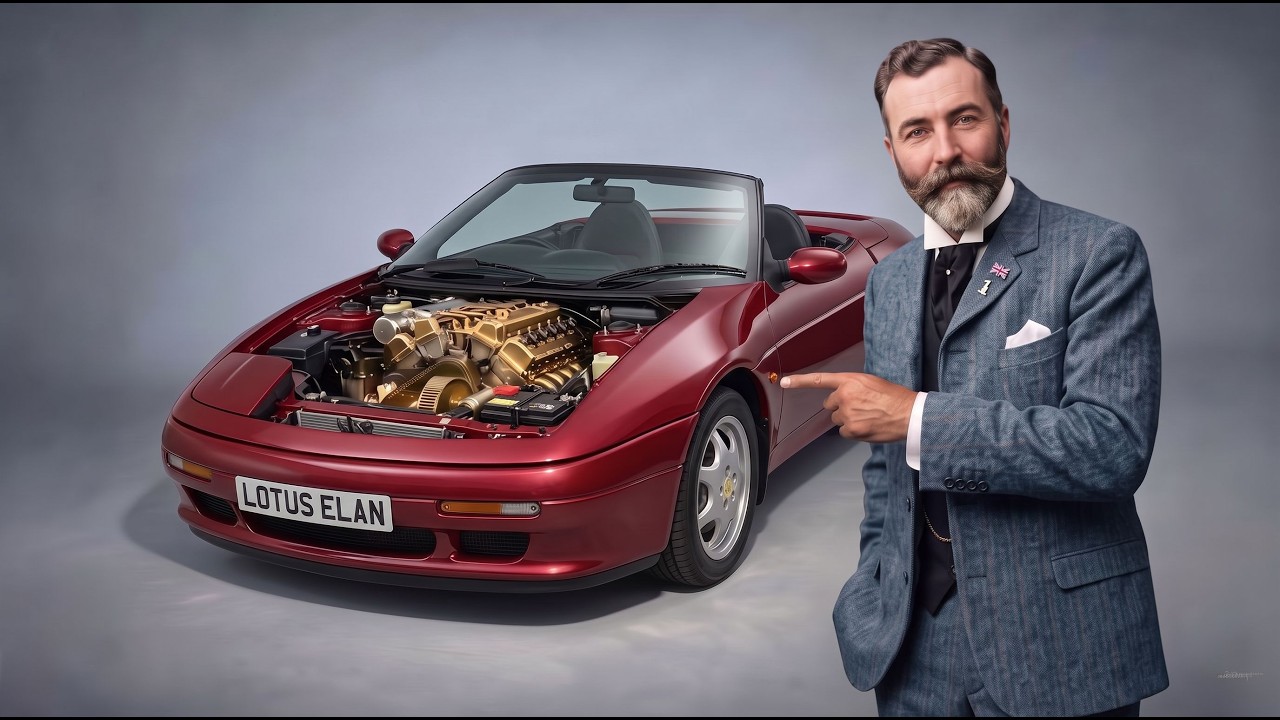
Chapman’s philosophy was simple: simplify, then add lightness. Remove the weight and speed, handling, economy, and delight followed almost for free. The Elan became famous. In 1965, Diana Rigg drove a Lotus Elan through the color episodes of The Avengers, and millions of viewers watched a clever, capable woman throw the little British roadster around the screen.
Jim Clark, twice a Formula 1 world champion and widely regarded as the greatest driver alive, ran an Elan as his own road car. The Elan stopped being merely a fast car. It became a symbol of style, independence, and the conviction that the future was going to be lighter, quicker, and more fun than the past. But success changed the company.
Chapman moved Lotus upmarket through the 1970s, building grand tourers aimed at the same showrooms as Porsche and Aston Martin. The affordable little roadster went out of production in 1973 with no ceremony. There was no funeral. The company had bigger plans.
But a gap had opened, a Lotus-shaped hole in the world roughly the size of a light two-seater an ordinary enthusiast could actually afford. For more than a decade, nobody filled it. Then the trouble came from every direction at once. The oil shocks and recession of the late 1970s left the small company badly exposed.
In 1980, Lotus built just 383 cars in the entire year. Chapman went looking for a clever way out. Early in 1982, he struck a deal with Toyota, trading Lotus engineering genius for Japanese parts. Then on 16 December 1982, Colin Chapman had a heart attack and died.
He was 54. At the same time, a scandal broke around his entanglement with John DeLorean, whose Belfast-built sports car had swallowed tens of millions of pounds of British public money, much of which had gone missing. A decade later, Lotus’s former finance director was convicted of fraud, and the judge said Chapman, had he lived, would very likely have gone to prison for around ten years. Lotus had lost its founder, was hemorrhaging money, and saw its reputation stained.
A rescue consortium kept the company upright, but a small, wounded, world-famous engineering firm rich in talent and poor in cash does not stay independent for long. In January 1986, General Motors paid £22. 75 million for 58 percent of Lotus. To GM, it was small change, roughly a single day’s cash flow.
The Americans were not villains. GM bought Lotus to use it, pouring in resources and setting the Norfolk engineers to work on projects like the Corvette ZR1 V8 and the Lotus Carlton. Years later, engineers would call GM’s ownership a golden period. And it was GM’s money that finally made possible the return of the Elan.
Fourteen years had passed since the last one rolled out of Hethel. The name had transformed from car into legend. Now Lotus committed to spending more on this one car than on any car in its history. Everything was in place.
But salvation had come with strings. When Toyota walked away, it took its engines with it, and the plan to build the new car around a Toyota twin-cam heart went out the door. Nowhere in the entire General Motors empire was there a small, sporting, rear-wheel-drive engine of the kind a Lotus had always used. The engineers went shopping in the only cupboard open to them.
Inside the GM empire sat Isuzu, which made a twin-cam 1. 6-liter engine with one defining characteristic: it was built to drive the front wheels. The Lotus men reworked the exhaust, intake, mountings, and electronics, hung a turbocharger and intercooler on it, and produced a genuinely fine little engine. But it was a front-wheel-drive engine, and so the new Elan would drive its front wheels.
The most fateful decision in the modern history of Lotus was not a free creative choice. It was a consequence of who owned the company and what happened to be lying in that owner’s parts bin. The men at Hethel did not merely accept the situation. They resolved to build the finest front-wheel-drive car the world had ever seen, and they very nearly did.
Chief engineer John Miles believed in the choice. On ice and snow, front-drive cars outperformed rear-drive cars. Front-wheel drive was safer in the hands of ordinary drivers, and GM wanted Lotus to become a world authority on making front-drive cars handle. The Elan was to be a rolling showcase for a consultancy business.
The engineering was extraordinary. The engineers mounted the suspension on separate subframes cushioned from the body, dialing out torque steer and bump steer while preserving the supple, talkative ride that was the Lotus birthright. Over two years, 42 development cars covered close to a million miles, from the deserts of Arizona to the ice of the Arctic Circle. Lotus poured around £35 million into the car, more than it had ever spent on development.
The dashboard alone reportedly cost more to develop than the entire production line of the Excel that had been keeping the company alive. When production began, every single car was driven some 30 miles around the old bomber runways before being allowed near a customer. The result was a car of extraordinary ability. Autocar called it the quickest point-to-point car money could buy in Britain.
It won a British Design Council award. By every objective measure, Lotus had done the impossible. And none of it mattered. In casting out the demons of front-wheel drive, they had engineered away the very thing a Lotus buyer came for.
In 1990, Car Magazine ran a famous group test that the Lotus actually won, but the great motoring essayist LJK Setright delivered a devastating counterblast, calling the steering debased and the driving nasty. One detractor dismissed the car as an Airfix kit. A Lotus chassis man explained that the car had been signed off so that 90 percent of drivers could use 90 percent of its performance 90 percent of the time. But the people willing to pay a premium for a handbuilt Lotus roadster were not the 90 percent.
They wanted the final 5 percent of feel, the private conversation between palm and tarmac that the clever engineering had so carefully smoothed into silence. While Norfolk was building the future, Hiroshima was quietly rebuilding the past. The Mazda MX5 began with an American journalist who had fallen in love with small British roadsters of the 1960s and spent years telling anyone at Mazda who would listen that somebody ought to build one again. Mazda’s engineering chief backed the idea, and a small team studied the classics with reverence, keeping original Lotus Elans on hand throughout development.
They chose deliberately a classic front-engine, rear-wheel-drive layout. They had a phrase for what they were chasing: horse and rider as one. They were building the exact car that Lotus had just decided not to build. The MX5 broke cover in February 1989, months before the new Elan appeared.
It was small, pretty, rear-driven, and cost around $14,000, a fraction of what the Lotus would ask. Demand made a mockery of forecasts. In Germany, the entire national allocation of 2,000 cars sold out in days. Mazda had beaten Lotus not with superior technology but with nostalgia, reliability, and a price ordinary people could reach.
The first generation sold over 400,000 units, and by 2000, Guinness World Records certified it the bestselling two-seat sports car in history. The formula Lotus invented in 1962 and abandoned in 1989 became the most successful roadster the world has ever known, wearing a Japanese badge the entire way. The new Elan was launched in the autumn of 1989, at the same Earls Court hall where the original had appeared. The base car cost £17,850, and the turbocharged version that almost every buyer wanted was £19,850.
By 1990, on-the-road prices climbed past £20,000. Set against a Mazda that undercut it by more than £5,000 and drove the way a Lotus was supposed to drive, the true shape of the disaster came clear. The Elan was not competing with the MX5 so much as making the case for it. Lotus had pinned real hope on America, with a target of 3,000 sales a year and a third meant to cross the Atlantic.
But the car sailed straight into the recession of 1990 and 1991. In the United States, it ended up priced at around $40,000, the money a buyer would spend on a Corvette, for a two-seater that drove its front wheels. Only about 550 found American homes. Then Isuzu ceased production of the 1.
6 twin-cam, leaving no possibility of a second wind. The car was orphaned before it died. In 1991, Lotus laid off around a fifth of its workforce, some 300 jobs. Then the company simply stopped the line for five weeks because it could not sell the cars it was already building.
It ended in July 1992. General Motors drew the line after just 3,855 cars had been built, against hopes of 6,000 or more in barely two years. Nearly every one sold at a loss. Only around 130 were the plain non-turbocharged version.
The chairman who had steered the company through the rescue years delivered the epitaph: Lotus had thought it could walk on water, and it had convinced General Motors that it could too. But not many people can do that. Left to him, he said, the Elan would never have been built at all. It had provided nothing but heartache.
General Motors resolved to sell. In August 1993, Romano Artioli, the Italian entrepreneur who owned the revived Bugatti marque, bought Lotus for around £30 million. He inherited a stockpile of unused Isuzu engines, and waste offended him. He sanctioned the Elan Series 2, a run of just 800 cars slightly de-tuned for emissions rules, each with a numbered plaque on the dashboard.
It was less a new model than a dignified way of using up what was left in the store. By 1995 it was over. But Artioli’s true legacy was the car that replaced it. Under his ownership, Lotus built the small, light, rear-wheel-drive roadster it perhaps ought to have built all along, named after his young granddaughter: the Elise.
It arrived in 1996 and saved the entire company. Light in a way that would have made Chapman weep for joy, rear-driven, alive in the hands, it was everything the Elan’s critics had begged for and been refused. Lotus found its soul again by returning to first principles. The problem with the Elan was never that Lotus had lost its way.
Hethel knew exactly how to build a proper Lotus. It was simply prevented from doing so for one car by an engine bay that could only face one direction. Artioli’s revived Bugatti collapsed into bankruptcy in 1995, and the failure drained the resources he needed to keep Lotus afloat. In 1996 he sold the company to Proton of Malaysia, and Lotus passed later into Chinese ownership, surviving each transition.
And then came the final indignity. The tooling for the Elan was crated up and shipped to South Korea, where from 1996 the firm of Kia built the car as the Kia Elan, assembling each one by hand. Around a thousand were made, every one left-hand drive, and not one ever officially sold in Britain or America. Production stopped around 1999, caught up in the Asian financial crisis that swept Kia into the arms of Hyundai.
Britain’s greatest roadster ended its days as a handbuilt curiosity in a Korean factory that was itself going under. The M100 Elan was the first front-wheel-drive car Lotus ever built. It was also the last. Every Lotus since has gone straight back to rear or mid-mounted drive, back to Chapman’s old faith, as though the entire front-drive experiment had been a fever.
The Elan stands alone in the whole history of the marque. And yet, ask the people who truly know these cars today, and a strange verdict emerges. The M100 is now widely reckoned to be very possibly the finest handling front-wheel-drive car anyone has ever built. The engineering that damned it in 1990 has redeemed it in the years since.
The men at Hethel had been right about the car all along. They had only been wrong about the world it was born into. The values are climbing now as the faithful come round at last to the thing they spurned when it was new. Lotus survived.
The Elan did not. They built it too well in the wrong way at the wrong time, and in the end, the world bought the tribute instead of the truth.
