Maria Mandal’s father refused to let her through the front door. It was July of 1945, the war was over, and the full scope of what had happened inside the concentration camps was beginning to spill out into the world’s newspapers. His youngest child had come home to the farmhouse in Münzkirchen where she had grown up, hoping for shelter. Franz Mandal, the shoemaker who had quietly opposed the Nazi party from the very beginning, closed the door in her face.
She was still accompanied by her lover, Commandant Walter Adolf Langleist, and a Jewish prisoner known only as Mo, whom the pair had kept with them apparently as a form of insurance against what was coming. Turned away by her own father, Maria found shelter for a short time at a farm belonging to one of her siblings, where the three of them stayed for approximately three days. She would later allege in her post-war defense that Mo betrayed her and Langleist during this period, claiming he wanted revenge for harm caused by other people. In August of 1945, Langleist was arrested by American military police after being identified by a survivor named Max Katler.
Maria Mandal was arrested shortly afterward, found hiding at Langleist’s own home in the town of Hof. The woman who was taken into custody that day had sent an estimated half a million women and children to their deaths at Auschwitz-Birkenau. Survivors called her the Beast. Münzkirchen sits in the rolling green hill country of Upper Austria’s Innviertel region, a farming village so small that in the early twentieth century most families knew each other’s business as a matter of course.
It was here, on the 10th of January 1912, that Maria Mandal was born, the fourth and youngest child of Franz Mandal, a shoemaker who ran his own workshop in the village, and his wife Anna, born Anna Stribbel, a housewife. The family farm was said by locals to be the largest in the entire municipality, a mark of relative prosperity in a place where most families scraped by on subsistence agriculture. Maria had three older siblings: Georg, Anna, and Aloisia. The household into which she was born was devoutly Catholic and politically aligned with the Christian Social Party, a conservative movement that stood in direct opposition to the rising tide of national socialism sweeping across the border in Germany.
Franz Mandal was by every surviving account not merely indifferent to the Nazis but actively opposed to them. The woman who would become one of the most feared women in the entire concentration camp system did not grow up steeped in fascist ideology at her family’s dinner table. She grew up in a home that rejected it. Anna Stribbel suffered from what family accounts describe as depressive episodes, including at least one significant nervous breakdown during Maria’s childhood.
Life on an Austrian farm in the years following the First World War was not easy, and the psychological toll on a mother raising four children while managing a working household appears to have been considerable. Maria herself was pulled out of school at the age of twelve in July of 1924, before she had completed her final examinations, so that she could help with labor on the family farm. In 1927, at fifteen, she was sent to a Catholic boarding school in the nearby town of Neuhaus am Inn, from which she eventually graduated. A former classmate named Paula Bower would later describe the young Maria as cheerful and very nice.
Words that sit uneasily alongside everything the world would come to know about her. When a documentary crew returned to Münzkirchen decades later to interview residents who remembered the family, the village’s former mayor, Martin Zer, described the Mandals simply as a good Catholic family, one that was, in his words, definitely against the Third Reich. After graduating in 1930, Maria struggled to find steady work in her home village, a common problem for young Austrian women during the economic devastation of the interwar years. She moved to Brig, Switzerland, where she found work as a housekeeper and cook, a position she held for thirteen months before homesickness drew her back to Münzkirchen and her parents.
In 1934, she took a position as a chambermaid at a private villa in Innsbruck. But by 1936 she had returned home once again, this time because her parents’ health had begun to decline and the family needed her closer. That same year brought a turning point that in hindsight reads almost like a cruel irony. Maria found steady employment at the local post office in Münzkirchen, and she became engaged to a soldier serving in the German Wehrmacht.
For a young woman from a respectable rural family, this represented exactly the kind of stable future that was expected of her. But history intervened. When Nazi Germany annexed Austria in the Anschluss of March 1938, Maria’s engagement collapsed and she lost her post office job in the same stroke. Her fiancé, now serving a regime he hoped to build a career within, calculated that his family’s connection to a household openly associated with the Christian Social Party could damage his own standing and his prospects for future employment in the civil service.
He broke things off. It was a devastatingly ordinary act of political self-preservation, the kind that played out in households across the newly absorbed Austria. And it left Maria Mandal without a job, without a fiancé, and without a clear path forward in a country that had just been swallowed by a regime her own father despised. In September of 1938, Maria moved to Munich to live with an uncle who worked as a police officer, hoping he might help her secure a position on the force.
No vacancies were available. Instead, within weeks, she found herself directed toward a very different kind of employment, one the SS was actively recruiting for as it expanded its camp system: the role of Aufseherin, a female overseer in the concentration camps. On the 15th of October 1938, Maria Mandal reported for duty at Lichtenburg, an early women’s concentration camp in the province of Saxony. She would later claim during post-war interrogation that she had been drawn to the position primarily by the higher salary it offered compared to domestic work, and that she had little real understanding of what the camp system actually was.
Whatever her original motivations, the woman who arrived at Lichtenburg in the autumn of 1938 was, by all family accounts, a product of a normal, loving, politically conservative Catholic household. The woman survivors of Auschwitz would come to know only a few years later bore almost no resemblance to that description. In May of 1939, Mandal was transferred along with other Lichtenburg staff to the newly constructed Ravensbrück concentration camp near Berlin, where she was quickly promoted to Oberaufseherin after joining the Nazi party in April of 1941. At Ravensbrück, she oversaw daily roll calls, training programs for incoming female guards, and worked directly alongside Dorothea Binz in the camp’s notorious punishment block.
Survivors would later testify to beatings, floggings, and a level of casual brutality that marked her out even among a guard corps that was almost by definition selected and trained for cruelty. Her final and most infamous promotion came on the 7th of October 1942, when she was transferred to Auschwitz-Birkenau and appointed Schutzhaftlagerführerin, the camp leader of the women’s camp, serving directly under Commandant Rudolf Höss. It was here that Maria Mandal earned the nickname that would follow her name into every history book written about the Holocaust: the Beast. At Birkenau, survivors described a woman who stood at the camp gate watching incoming lines of prisoners and who would order anyone who dared to meet her eyes pulled from the line and killed.
She used a cane to test returning work details, holding it fifty centimeters off the ground and forcing exhausted women to jump over it, sending those who failed straight to the gas chambers. She created the women’s orchestra of Auschwitz, forcing musicians to play as columns of prisoners marched to their deaths, as selections were carried out, and as executions were staged. She personally signed inmate transport lists that historians estimate sent close to half a million women and children to the gas chambers of Auschwitz I and II. For her service, in November of 1944 she was awarded the War Merit Cross, Second Class, an official Nazi decoration for wartime contribution.
And through it all, she remained in periodic contact with her family back in Münzkirchen. Survivor testimony would later reveal one of the most chilling details of her entire case. When new prisoners arrived at Birkenau, Mandal used a cane to extract jewelry and valuables that women had hidden inside their bodies in a desperate attempt to keep something, anything, from the SS. She reportedly took these stolen items home with her on visits to Münzkirchen, hiding them in a drawer inside her family’s farmhouse.
Whether her parents ever knew precisely what those items were or where they had come from remains one of the darker unanswered questions of the entire Mandal family story. The women’s orchestra that Mandal personally established illustrates the deeply contradictory nature of her character that survivors and historians alike have struggled to fully explain. Musicians conscripted into the orchestra, including Anita Lasker-Wallfisch, later described a woman capable of moments that almost resembled patronage or protection toward the very musicians she otherwise ruled over with total arbitrary terror. Mandal was known to personally select talented musicians for positions within the orchestra, occasionally sparing them from transports or work details that would very likely have killed them, seemingly out of a genuine, if entirely selective and unpredictable, appreciation for their musical ability.
This same woman who could order a prisoner’s death for the simple act of making eye contact with her at the camp gate could in the very next hour take a personal interest in ensuring a particular violinist or cellist survived long enough to keep playing. By November of 1944, as the Red Army closed in on occupied Poland, Mandal was transferred away from the collapsing Auschwitz complex to the Mühldorf subcamp of Dachau. Elisabeth Volkenrath, a woman whose own story we will return to, took over leadership of what remained of the women’s camps at Auschwitz. In April of 1945, with Germany’s defeat now only weeks away, the United States Air Force bombed the Mettenheim camp where Mandal was stationed, and a ground invasion followed.
On the 1st of May, Mandal fled amid gunfire alongside Langleist and Mo. The three of them hid in the woods before taking shelter for a couple of weeks in Mandal’s own home region of the Innviertel. Then came the return to the farmhouse, and the closed door. Interrogations by American authorities revealed a woman investigators described as highly intelligent and disturbingly dedicated to her work in the camps, showing little of the remorse one might expect from someone facing the full weight of what she had done.
Her interrogation transcripts reveal a woman who spoke of her administrative role at Birkenau with the same procedural detachment she might once have used to describe her work at the Münzkirchen post office. She was held for a time at Dachau, where she was recorded on film occupying a cell alongside another female guard named Elisabeth Ruppert. In November of 1946, American authorities handed Maria Mandal over to the newly established People’s Republic of Poland, where a tribunal was preparing to try dozens of former Auschwitz staff for their roles in the camp’s operation. She was transported to Kraków and held at Montelupich prison, sharing a cell with fellow accused Therese Brandl, a former secretary in the Auschwitz women’s camp administration.
There is one member of the Mandal family who never lived to see any of this unfold. Maria’s mother, Anna Stribbel, died in 1944 while her daughter was still stationed at Auschwitz and still, as far as the outside world knew, a loyal and decorated servant of the Reich. According to accounts gathered by researchers who later reconstructed the Mandal family story, Anna attended mass every single day in the final years of her life, and she was said to have prayed specifically for her daughter’s eternal soul. We do not know exactly how much Anna understood about what her youngest child was actually doing in occupied Poland.
Wartime censorship, distance, and the family’s own limited contact with Maria during her postings make it difficult to say with certainty how much information ever reached the farmhouse. The image of a devout Catholic mother, already worn down by decades of depressive episodes, spending her last years in quiet, desperate prayer is one of the most quietly devastating threads running through this entire story. Anna Stribbel didn’t live to see her daughter arrested, tried, or executed. Her husband Franz would not be so fortunate.
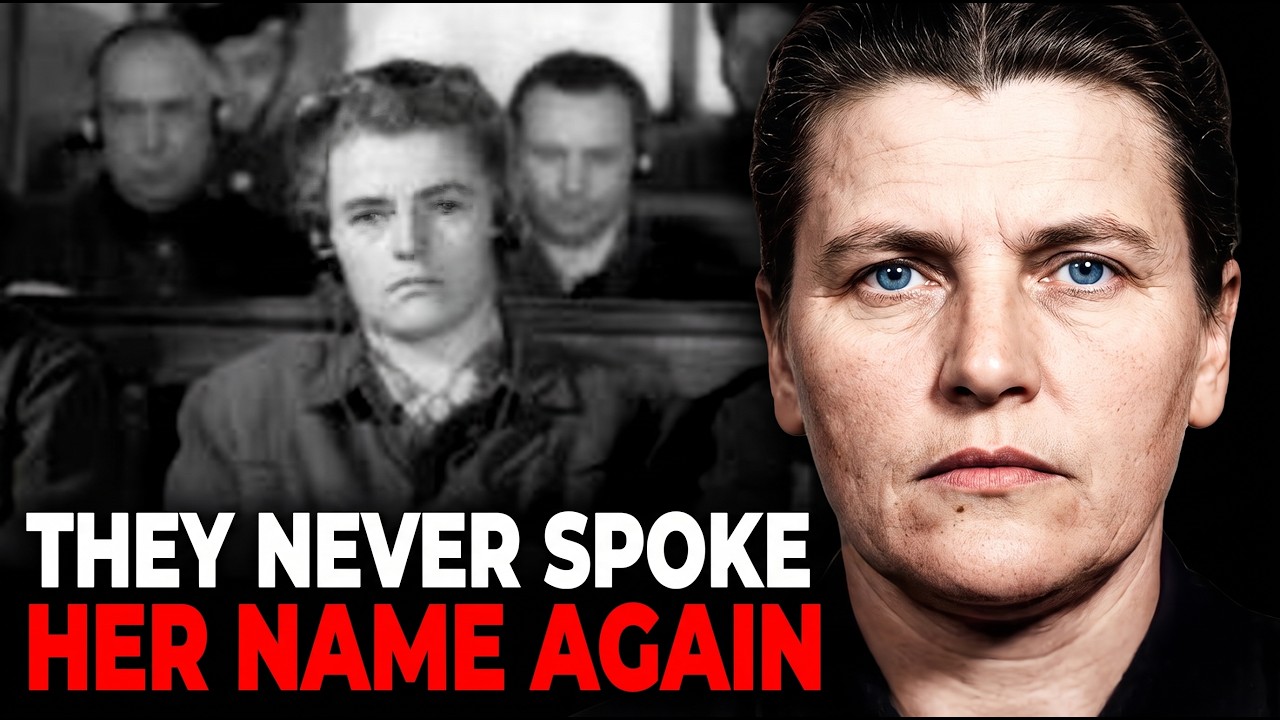
The trial that would determine Maria Mandal’s fate opened in Kraków in November of 1947, part of what has become known to history as the Auschwitz trial. Mandal stood accused alongside Rudolf Höss and numerous other former camp staff of crimes against humanity connected to her role overseeing the deaths of hundreds of thousands of women and children. The trial drew international press attention, and it was here, in a Kraków courtroom surrounded by journalists and by survivors who had traveled from across Europe to testify against her, that the full scope of Maria Mandal’s crimes was laid out in exhaustive, horrifying detail. In her own defense, written partly in documents she penned in her prison cell, Mandal attempted a justification that historians have since found chillingly familiar among mid-level camp perpetrators.
She argued that as a chief guard, her priority had simply been to create order and discipline among the prisoners. She even claimed, astonishingly, that she believed she had been helping the women under her authority by imposing that order. The court was not persuaded, based on the sheer volume of death lists bearing her signature and on the direct testimony of survivors who described her personal role in selections, beatings, and the operation of the camp’s machinery of murder. Maria Mandal was convicted of crimes against humanity and sentenced to death by hanging.
While awaiting execution, Mandal shared a cell with Therese Brandl, and the two women were watched over by a Polish interpreter named Stanisława Raszewa, herself a former Auschwitz prisoner who had survived under Mandal’s own administration before being imprisoned again after the war by Poland’s post-war communist authorities on suspicion of anti-communist activity. Raszewa, who spoke fluent German, later recalled that in the final days before their execution, both Mandal and Brandl asked her for forgiveness. It is impossible to know how sincere that final request truly was, coming as it did only once every legal avenue had been exhausted and death was no longer a distant possibility but a scheduled certainty. On the 24th of January 1948, at the age of thirty-six, Maria Mandal was hanged.
Therese Brandl would be executed four days later, reportedly going to the gallows with defiant final words. Mandal’s body did not return to Austria. In a detail that speaks to the particular scientific and legal culture of post-war Poland, her remains were sent in the hours following her execution to the Jagiellonian University Medical College, where they were made available to medical students for a period of roughly six weeks. Only after this did her body receive burial on the 6th of March, in a wooden box placed in an unmarked spot at the Rakowicki Cemetery in Kraków, a city she had once ruled over the fates of hundreds of thousands of women from behind the wire of a death camp less than seventy kilometers away.
There would be no return home, no family plot, no headstone bearing her name anywhere near the green hills of the Innviertel where she had been born. And that absence was not an accident of circumstance. According to records later uncovered by researchers, Franz Mandal never requested that his daughter’s remains be repatriated to Austria for burial. He had been fully aware of the atrocities his daughter had committed, and he made the deliberate choice not to bring her home, even in death.
To this day, the Mandal family tomb in Münzkirchen does not carry Maria’s name. Anyone who walks through that quiet village cemetery today, past the graves of the family’s other three children, will find no trace of the daughter who became one of the most notorious women in the history of the Holocaust. It is one of the starkest examples in the entire historical record of a family drawing a hard, permanent, physical line between themselves and a relative’s crimes. That did not mean Franz Mandal disappeared from public life himself.
In the years following the war, as Austria worked through its own complicated process of denazification and political reconstruction, Franz served on his local party’s district council, a position that reflected his long-standing allegiance to the conservative anti-Nazi political tradition of the Christian Social Party and its post-war successors. In a village where everyone would have known exactly whose father he was and exactly what his daughter had done, Franz Mandal continued to participate in local civic life. Whether his neighbors ever raised the subject of Maria directly, whether it hovered unspoken over council meetings and church services for years afterward, is something the historical record does not fully capture. The silence surrounding Maria Mandal in her home village did not lift easily, and in some ways it has never fully lifted.
For decades after her execution, the story of what she had done at Auschwitz received remarkably little attention in the Austrian press or in Münzkirchen itself. It was not until 2014 that a documentary filmmaker named Christian Strasse produced a film titled Piece of Darkness: The Life of Maria Mandel, finally bringing sustained public attention back to the case within Austria itself. It was for this documentary that former mayor Martin Zer gave his now widely quoted description of the Mandal family as good Catholic people who had been definitely against the Third Reich. A description that captures the almost unbearable dissonance at the heart of this entire story.
How does a family raise a daughter in an atmosphere of explicit anti-Nazi sentiment and watch that same daughter rise to become one of the highest-ranking women in the entire machinery of the Holocaust? Perhaps the strangest and most bureaucratically bizarre chapter in the entire post-war story of the Mandal family unfolded decades later, in a paperwork error that would take more than four decades to correct. In November of 1975, a death certificate bearing Maria Mandal’s name was recovered, issued originally by the District Court of Ried im Innkreis. Astonishingly, this official Austrian document did not record her as a convicted war criminal executed for crimes against humanity.
Instead, it stated that she had died in a concentration camp as a prisoner, and it formally classified her as a victim of National Socialism. The woman who had overseen the murder of hundreds of thousands of women and children at Birkenau, who had been convicted at an international tribunal and hanged for her crimes, was on paper officially recognized by the Austrian state as one of the regime’s victims rather than one of its chief perpetrators. For years, this error sat largely unchallenged in the archives. It took the determined efforts of an Austrian lawyer named Robert Eiter, working alongside the Austrian Mauthausen Committee, an organization dedicated to preserving the memory of Nazi crimes and confronting historical distortions, to finally force a correction.
To understand how such an error could have persisted for more than four decades, it helps to understand the broader political context of post-war Austria itself. Unlike Germany, Austria spent much of the post-war period embracing what has become known among historians as the victim theory: the idea, formally endorsed in the Moscow Declaration of 1943 and eagerly adopted by Austrian politicians across the political spectrum after 1945, that Austria itself had been the first nation conquered by Hitler’s aggression rather than a willing and often enthusiastic participant in Nazi crimes. If Austria as a whole understood itself primarily as Hitler’s first victim, it becomes considerably less surprising, though no less grotesque, that a single clerical error could misfile one of its most notorious war criminals under precisely that same victim classification. It would take until the 1980s and 1990s, spurred by controversies such as the Kurt Waldheim affair, for Austria to begin more seriously confronting this victim narrative on a national scale.
A shift in public consciousness that helped create the conditions under which Eiter’s petition to correct Mandal’s death certificate could finally succeed. On the 6th of April 2017, sixty-nine years after Maria Mandal’s execution and more than four decades after the erroneous certificate first surfaced, the Ried im Innkreis Regional Court finally amended the document to accurately reflect her actual role in the Holocaust. And what of Maria’s siblings, Georg, Anna, and Aloisia? Here the historical record grows considerably thinner, and that thinness is itself worth noting.
Unlike their sister, none of the three appear to have sought any kind of public profile before or after the war, and none left behind memoirs, interviews, or significant documented statements about their relationship with Maria or their feelings about her crimes. What we do know is that it was to one of these siblings’ own farms that Maria fled in the desperate summer of 1945, seeking three days of shelter alongside Langleist and the prisoner Mo before her final capture. That sibling, whichever of the three it was, chose to take her in, if only briefly, even after their own father had refused to open the family’s front door. It is a small human detail buried inside an otherwise monstrous story.
A reminder that even at the edges of the worst crimes in modern history, ordinary family loyalty, however brief and however conflicted, did not simply vanish. Whether that sibling ever spoke publicly about the decision, whether they faced consequences from neighbors or authorities for having briefly sheltered a wanted war criminal, is not recorded in any source that has survived to the present day. Susan Eischeid, an American academic and professional oboist who spent two decades researching Maria Mandal’s life for what became the first full-length biography of the Auschwitz overseer, titled Mistress of Life and Death, drew on interviews with survivors, with perpetrators, and crucially with members of Mandal’s own community and family circle in Münzkirchen. Eischeid’s research reinforces the picture that has emerged from every other source.
A woman regarded locally, in her own words, as a nice girl from a good family, who nonetheless came to embody some of the very worst crimes of the twentieth century. That single phrase might stand as the entire tragedy of the Mandal household in miniature. It was precisely because Maria Mandal came from an ordinary, loving, and even anti-Nazi home that her transformation into the Beast of Auschwitz remains so difficult to fully explain, and so uncomfortable for historians, for her surviving relatives, and for the village of Münzkirchen itself to sit with even eight decades later. But was the Mandal family’s experience unique among the households that produced the women of the SS camp system?
As it turns out, it was not. Across Germany and Austria, other families found themselves forced to confront the same impossible question in the aftermath of the war. What do you do when someone you raised, someone who sat at your table and slept under your roof, turns out to have been one of the architects of mass murder? Some families, like the Mandals, responded with silence, distance, and erasure.
Others responded very differently, clinging to denial, defending their relatives publicly, or in some cases building entirely new post-war identities that hid the truth from spouses and children alike for decades. To understand just how varied, and in some ways how universal, the experience of these families truly was, it is worth turning next to the household of a woman whose name would eventually become just as infamous as Mandal’s own. A woman whose children would carry the weight of her crimes in ways that led, in more than one case, to tragedy of their own. Margarethe Ilse Koch was born on the 22nd of September 1906 in Dresden, into a working-class Protestant household that could not have been more different, at least on the surface, from the Catholic farm family that produced Maria Mandal.
Her father worked as a factory foreman, and by most accounts young Ilse was remembered by teachers as a polite and reasonably happy child. After completing basic schooling, she trained at a commercial school and found work first as a bookkeeper and later as a secretary. She joined the Nazi party in April of 1932, a full year before Hitler was appointed chancellor. Through her social connections with local SA and SS men in Dresden, she met a rising SS officer named Karl Otto Koch in 1934, and the two were married in May of 1937 in a torch-lit, quasi-pagan SS ceremony held in an oak grove.
Karl Koch’s career took the young couple first to Sachsenhausen concentration camp, where he served as commandant, and then, beginning in August of 1937, to a newly established camp on the Ettersburg mountain outside Weimar: Buchenwald. The family, which would eventually include three children born on the actual grounds of the camp starting in October of 1937, lived in a three-story commandant’s villa built essentially inside the perimeter of a facility designed for suffering and death. SS officers Theodor Eicke and Richard Glücks were frequent visitors to the Koch household, and on at least one occasion Heinrich Himmler himself came to call. It was within this deeply surreal domestic arrangement, a family home perched atop a machine of atrocity, that Ilse would earn her own infamous nickname among the prisoners forced to labor nearby: the Witch of Buchenwald, sometimes rendered as the Bitch of Buchenwald or the Red Witch, depending on which survivor account one consults.
Unlike Maria Mandal, Ilse Koch held no official rank or formal position within the SS hierarchy for much of her time at Buchenwald. This did not stop her from becoming, in the eyes of camp prisoners and later in the eyes of the world, one of the most notorious figures associated with the entire Nazi camp system. She was accused of riding her horse through the camp and ordering the whipping of any prisoner who dared to look at her. Of using money looted from prisoners to construct a lavish indoor riding arena costing over 250,000 Reichsmarks.
And most infamously, of selecting prisoners bearing interesting or unusual tattoos to be killed so that their skin could be fashioned into lampshades, book covers, and other household items. This last allegation, more than any other, would come to define Ilse Koch’s post-war reputation around the world, even though the actual legal record surrounding it proved far murkier than the popular myth suggests. In August of 1943, both Karl and Ilse Koch were arrested on the orders of the SS’s own internal investigators, charged with private enrichment, embezzlement, and the murder of prisoners to silence potential witnesses against them. An SS judge named Konrad Morgen, known within certain circles as the bloodhound judge for his dogged pursuit of corruption within the camp system, led the investigation.
Karl was found guilty and executed by the SS itself in April of 1945, just weeks before the war’s end. Ilse, held in custody through much of this period, was acquitted by the SS’s internal tribunal in 1944 for lack of sufficient evidence. By the time American forces liberated Buchenwald in April of 1945, she was living with her three children in Ludwigsburg near Stuttgart. She would not remain free for long.
On the 30th of June 1945, Ilse Koch was recognized on a street in Ludwigsburg by a former Buchenwald prisoner and arrested by American occupation forces. What followed was one of the most sensational war crimes trials of the entire post-war period. In 1947, she stood as the only female defendant in the Buchenwald trial before an American military tribunal at Dachau, seven months pregnant at the start of proceedings. Survivors testified in vivid detail about the human skin lampshades, book bindings, and other grisly artifacts allegedly produced at Koch’s direction.
Testimony that captured headlines around the world and cemented her image as perhaps the most monstrous woman associated with the entire concentration camp system, surpassing even figures like Maria Mandal in the popular imagination of the era, despite the fact that Mandal’s actual documented death toll was almost certainly far higher. On the 29th of October 1947, while the trial was still technically ongoing, Ilse Koch gave birth to a fourth child, a son she named Uwe Köhler, while incarcerated. She refused to name the child’s father, and rumors swirled for years afterward, with some sources suggesting an American soldier and others pointing to a fellow German internee at the camp, a possibility later research would identify as likely being a man named Fritz Schäffer. The baby was taken from her almost immediately and placed under the supervision of Bavarian child welfare authorities.
On the 17th of August 1947, the Buchenwald trial concluded with several death sentences handed down to other defendants, while Ilse herself received a sentence of life imprisonment at hard labor for having beaten prisoners and singled others out for execution. Crucially, the tribunal found insufficient proof to convict her of the lampshade allegations specifically, despite the international notoriety those claims had already generated. The story did not end there, and what happened next would trigger one of the largest public controversies of the entire early Cold War period in the United States. In June of 1948, General Lucius D.
Clay, the American military governor overseeing occupied Germany, reviewed Koch’s case and controversially commuted her life sentence to just four years, a decision based on his conclusion that much of the evidence against her, including the lampshade allegations, amounted to little more than hearsay that could not withstand serious legal scrutiny. The American public reacted with fury. Newspapers ran outraged editorials. The United States Senate opened a formal investigation into Clay’s decision.
The West German government, watching this controversy unfold, moved quickly. The moment Ilse Koch’s American sentence expired and she walked free, West German authorities immediately rearrested her. This time, charging her with crimes against German and Austrian citizens rather than the war crimes covered under her original American conviction. Hundreds of witnesses were heard in a new trial that opened before the District Court of Augsburg in November of 1950 and stretched on for seven weeks.
On the 15th of January 1951, the West German court delivered its verdict, convicting Koch and sentencing her once again to life imprisonment. This second sentence would prove to be the one that finally held. Ilse Koch spent the remainder of her life at Aichach Women’s Prison in Bavaria, filing repeated petitions for pardon or for her conviction to be overturned, all of which were rejected by the Bavarian Ministry of Justice. She even appealed unsuccessfully to the International Human Rights Commission.
It was during these long years of imprisonment that the story of her family took its darkest and most tragic turns. Of Ilse and Karl Koch’s three older children, the middle child, a daughter named Gisela, born in April of 1939 on the grounds of Buchenwald itself, largely succeeded in disappearing from public view as an adult, living out a private life away from the scrutiny that had followed her family name, and passing away in 2018. Her younger sister Gudrun was not so fortunate, even in childhood. Born in December of 1940, also inside the Buchenwald commandant’s villa, Gudrun was doted upon by her parents and by a nanny who was, in one of the more darkly ironic details of this entire story, Ilse Koch’s own sister.
Gudrun died of pneumonia at only four months of age in February of 1941, a family tragedy that occurred years before either of her parents would face any legal reckoning for their crimes. It was the eldest child, a son named Artwin, born in 1938, whose story would come to symbolize the generational toll of his parents’ crimes most powerfully. Growing up in the shadow of his mother’s international infamy, Artwin attempted as an adult to build something resembling a normal life. He married a woman named Maria and fathered two children of his own, apparently hoping to construct a stable, ordinary post-war existence for his own family, one entirely disconnected from the horrors associated with the Koch name.
But the weight of what his parents had done proved too much for him to carry. On the 1st of January, in either 1964 or 1967, depending on which historical source one consults, at the age of twenty-eight or twenty-nine, Artwin Koch took his own life. Contemporary accounts attributed his suicide directly to what one source described as the shame of his parents’ crimes. And then there was Uwe, the son born in prison, the child Ilse Koch had refused to name a father for, handed over to Bavarian welfare authorities within days of his birth in October 1947 and raised in complete ignorance of his true parentage inside a foster home elsewhere in Bavaria.
According to Uwe’s own later account, he first glimpsed his mother’s actual identity at the age of eight, when he happened to see her name listed on his own birth certificate, a detail he would later say he simply never forgot. Eleven years after that first glimpse, by chance, he came across a newspaper article about the notorious Ilse Koch and made the connection between the woman described in the press and the mother’s name he had carried quietly in his memory since childhood. During the Christmas season of 1966, by then a young man working as an insurance salesman, Uwe Köhler traveled to Aichach prison, describing the experience afterward as approaching the visit with what he called a creepy feeling. What followed, by his own description, was a joyous reunion.
Mother and son began meeting regularly after that, once a month, in keeping with the prison’s visitation rules, a routine that continued for roughly nine months. It ended abruptly. On the 1st of September 1967, just three weeks before her sixty-first birthday, Ilse Koch hanged herself in her cell at Aichach Women’s Prison using bed sheets. In the years leading up to her death, prison staff and fellow inmates had noted increasingly disturbing signs of psychological deterioration, including delusions that surviving concentration camp prisoners were plotting to abuse or attack her inside the prison itself.
She left behind a suicide note addressed directly to Uwe, the son who had only recently found his way back into her life after a childhood spent in complete ignorance of who she truly was. The note read in its entirety that there was no other way, and that death for her represented a release. Uwe arrived for his scheduled monthly visit the following day and was informed that his mother had died the night before. Rather than retreating from public association with his mother’s notorious legacy, Uwe Köhler did something few children of Nazi perpetrators ever attempted.
In 1971, at the age of twenty-three, he launched an active public campaign seeking his mother’s posthumous rehabilitation. He approached major international outlets, including reportedly the New York Times, arguing that the Witch of Buchenwald nickname amounted to little more than wartime propaganda, and pointing out, with some legal accuracy, that three separate courts across two different legal systems had never actually succeeded in convicting Ilse Koch of the most serious capital allegations against her, including the infamous lampshade accusations. His campaign gained little public traction, unsurprisingly, given the scale of documented testimony against his mother regarding beatings, selections, and prisoner deaths, even setting aside the more sensationalized and less legally substantiated claims. But Uwe’s determined, decades-spanning effort to defend a mother he barely knew as a child stands as one of the more psychologically complex postscripts in the entire history of Nazi perpetrator families.
Ilse Koch’s body was buried in an unmarked and largely untended grave in the cemetery at Aichach. A fate that in its own way mirrors the anonymous burial the Mandal family arranged, or rather refused to arrange, for Maria in Kraków. Two families separated by very different circumstances, backgrounds, and crimes arrived at strikingly similar final resting places for their most notorious members. Graves without names, without markers, without any physical claims staked by the surviving relatives who might otherwise have been expected to honor a family member in death.
Moving now to a very different kind of post-war story, one that unfolded not in the ruins of occupied Germany but in the quiet, unremarkable streets of a New York City borough, we come to the family built by a woman named Hermine Braunsteiner, a former guard at both Ravensbrück and Majdanek, whose case would eventually make legal history in the United States, and whose own husband would spend years defending her innocence to any reporter who would listen. Hermine Braunsteiner was born on the 16th of July 1919 in Vienna, the youngest of seven children in a strictly observant Roman Catholic working-class family. As a young woman, she dreamed of training as a nurse, but economic circumstances made this impossible, and she instead attempted domestic service work, traveling with one of her sisters to the Netherlands in search of employment that likewise failed to materialize. In the early 1940s, while working at a Heinkel aircraft factory in Berlin, Braunsteiner was selected for training as a concentration camp guard and sent to Ravensbrück, where she quickly earned a reputation among prisoners for stomping and kicking elderly inmates.
A brutality that would later earn her the nickname the Stomping Mare once she was transferred in October of 1942 to the Majdanek death and concentration camp near Lublin in occupied Poland. At Majdanek, Braunsteiner was promoted to assistant wardress under Oberaufseherin Elsa Erich, one of five other women serving alongside her in the camp’s female guard hierarchy. Survivors would later testify that she personally participated in the selection of women and children for the gas chambers, and that she seized children by their hair and threw them onto trucks bound for the killing areas. She was also documented as having personally beaten women to death using a whip, and witnesses recalled a pair of steel-studded jackboots she wore specifically to deliver blows to prisoners during roll calls and work details.
In January of 1944, she was transferred to the Genthin subcamp of Ravensbrück, where she was promoted again, this time to camp leader, overseeing a contingent of roughly fourteen female SS guards. As the Red Army advanced in May of 1945, Braunsteiner fled the camp system entirely, returning first to Vienna before quickly deciding to leave again, later claiming there simply was not enough food available in the Austrian capital in those desperate immediate post-war months. Braunsteiner’s initial brushes with post-war justice in Austria proved remarkably inconclusive. She was arrested by an Austrian court in May of 1946 and imprisoned until April of 1947.
She was arrested again in April of 1948, this time on charges connected to killings, infanticide, and manslaughter at Ravensbrück, though notably none of these charges made any reference to her far more extensive crimes at Majdanek. She was released once more in November of 1949, and the Austrian government, in a decision that reads with grim irony given everything that would follow, granted her amnesty and formally promised not to pursue any additional charges against her. Free of legal jeopardy in her home country, Braunsteiner spent the following years working in hotels and restaurants. And it was during this period that she met an American serviceman, Russell Ryan, a mechanic with the United States Air Force stationed in Germany.
The two were married in October of 1958, initially in Austria, before immigrating together, first briefly to Nova Scotia, Canada, and then in April of 1959 into the United States itself. She became a naturalized American citizen on the 19th of January 1963. The couple settled first in Elmhurst in the Borough of Queens, in Russell Ryan’s own childhood home, before purchasing a house of their own at 52-11 72nd Street in the neighborhood of Maspeth in 1964. There, by every account of neighbors who knew her, Hermine Braunsteiner Ryan became a scrupulously neat, friendly, entirely unremarkable suburban housewife, married to a construction worker, living out exactly the kind of quiet, ordinary immigrant success story that post-war America told about itself.
The couple had no children of their own. The illusion held for years, until an almost accidental discovery set in motion one of the most significant developments in the entire history of post-war Nazi war crimes prosecution. The famed Nazi hunter Simon Wiesenthal, while in Tel Aviv, happened to receive a phone call at a restaurant that led, through a chain of conversations with Majdanek survivors present that same evening, to information suggesting that a former camp guard named Hermine Braunsteiner might now be living in the United States under a married name. Wiesenthal traced her path from Vienna through Halifax and Toronto and eventually to Queens, New York.
And in 1964, he alerted the New York Times to the possibility that she might be found living in the Maspeth neighborhood under the name Mrs. Ryan. The paper assigned a young reporter named Joseph Lelyveld, who would go on to become the paper’s executive editor, to track her down. Lelyveld found her by simply going door to door asking for women named Mrs.
Ryan. And when he finally located the right house, Hermine Braunsteiner Ryan reportedly greeted him at her own front doorstep with the words, My God, I knew this would happen. You’ve come. Her husband Russell Ryan’s response to the revelation of his wife’s past would become one of the more memorable, if ultimately futile, defenses offered by any spouse of a convicted Nazi war criminal.
My wife, sir, wouldn’t hurt a fly, Ryan told the reporter, insisting there was no more decent person on earth, and that whatever she had done during the war amounted to a kind of compulsory service she had simply been forced to perform. Braunsteiner herself, for her part, initially claimed she had only spent a single year at Majdanek, and that eight months of that time had been spent recovering in the camp infirmary rather than actively serving as a guard, a claim that survivor testimony would later thoroughly contradict. In 1968, American authorities moved to strip Braunsteiner Ryan of her citizenship, citing her failure to disclose her prior Austrian convictions when she applied for naturalization. And by 1971, the denaturalization process was complete.
What followed was a lengthy legal battle that would ultimately make Hermine Braunsteiner Ryan a historic figure in American jurisprudence for reasons entirely separate from her wartime crimes. On the 22nd of March 1973, she was taken into custody to await deportation, held first at Riker’s Island and later at the Nassau County Jail. Over the following year, in a United States District Courtroom in Queens, she and her husband together sat through extensive survivor testimony describing whipping, beatings, and killings. Testimony that Russell Ryan, by all accounts, endured at his wife’s side throughout the proceedings.
On the 1st of May 1973, a judge certified her extradition. And on the 7th of August that year, Hermine Braunsteiner Ryan became the first Nazi war criminal ever extradited from the United States. She stood trial in West Germany alongside fifteen other former SS men and women who had served at Majdanek, in what became known as the Majdanek trial, held before the District Court of Düsseldorf and stretching on from November of 1975 all the way to 1981, making it the longest and most expensive war crimes trial in West German history up to that point, ultimately costing more than eight million dollars. Over the course of the six-year proceeding, evidence was heard from more than three hundred witnesses across 474 separate court sittings, thirty of which were conducted abroad in order to accommodate elderly survivors unable to travel to Germany.
The court ultimately found that Braunsteiner Ryan had personally selected at least fifty Jewish women to be gassed and had sent at least twenty Jewish children from the Warsaw ghetto directly to the gas chambers. On the 30th of May 1981, at the age of sixty-one, she was sentenced to life imprisonment for her role in the deaths of some 250,000 inmates at Majdanek. In her own final statement to the court, she offered what has become one of the more chillingly familiar refrains among convicted Nazi perpetrators. It was war, she said, and everyone had to stick it out where they were put.
Describing herself as only a small cog in a machine too large for her to break, and whose operation she had been powerless to halt, she denied only the specific accusation of having personally killed anyone, while acknowledging that she had contributed, in her words, to the immeasurable suffering of the camp’s inmates. Throughout the entirety of this six-year ordeal, Russell Ryan remained by his wife’s side, posting bail for her at one point after she was remanded into custody in Düsseldorf in December of 1977 for allegedly attempting to intimidate witnesses, a violation that kept her jailed until January of 1978. He told reporters after the final verdict that he had expected an acquittal. A statement that, whatever one makes of his personal conviction in his wife’s innocence, illustrates just how completely a spouse can construct an alternate reality around a partner’s past when confronted with evidence that the rest of the world finds overwhelming and conclusive.
Unlike the Koch and Mandal families, the Braunsteiner Ryan household never produced children who would have to inherit and process this legacy directly. But Russell Ryan’s own unwavering public loyalty to a woman convicted of participating in the murder of a quarter of a million people stands as its own kind of case study in the psychology of denial among the spouses and relatives of Nazi war criminals. Hermine Braunsteiner Ryan was ultimately released from Mülheimer Women’s Prison in 1996, after complications from diabetes led to a leg amputation, and she died in Bochum, Germany on the 19th of April 1999 at the age of seventy-nine. Her extradition and prosecution would go on to have lasting institutional consequences in the United States, prompting the creation in 1979 of the Department of Justice’s Office of Special Investigations, a unit specifically established to identify, denaturalize, and deport Nazi war criminals who, like Braunsteiner Ryan, had managed to rebuild entirely new lives on American soil.
Three families then, and three profoundly different post-war experiences. The Mandals, who erased Maria’s name from their own family grave and never spoke of her again. The Kochs, whose children were scattered by adoption, marked by early death, and in one devastating case driven to suicide under the weight of their inheritance. And the Ryans, in which a husband spent decades defending a wife’s innocence against evidence that a West German court, after six painstaking years, found utterly overwhelming.
But there is a fourth pattern still to examine. One embodied by a woman whose own marriage took place almost unbelievably on the actual grounds of Auschwitz itself, within sight of the crematorium chimneys, and whose swift execution left behind almost no time at all for any post-war family story to unfold in the first place. Elisabeth Volkenrath was born Elisabeth Mühlau on the 5th of September 1919 in the small village of Schönau an der Katzbach, the sixth child of Josef Mühlau, a forest worker, and his wife. She had at least five sisters, growing up in a household of modest means where higher education and vocational training were simply not on offer for a young woman of her background.
She attended the local village school from the age of six until fourteen, and afterward cycled through a series of jobs typical for young working-class German women in the 1930s, working as a nanny, a hairdresser, and a kitchen hand before being conscripted into a munitions factory in 1939 as wartime labor demands intensified. Restless in that position, she volunteered instead to become a camp guard. And in October of 1941, she began training at Ravensbrück, studying directly under the notoriously sadistic supervisor Dorothea Binz, the same woman with whom Maria Mandal had also worked closely during her own time at that camp. In August of 1942, Volkenrath transferred to Auschwitz-Birkenau, where she took on duties nearly identical to those she had performed at Ravensbrück.
And it was there that she met an SS Rottenführer named Heinz Volkenrath, who had served at Auschwitz as a block leader since 1941. Their romance culminated in a wedding held in 1943 on the actual grounds of the camp complex, complete with an SS honor guard in formal attendance. Accounts from those who witnessed the ceremony describe the almost unbelievable scene: guests celebrating a marriage, while in the background the crematorium continued to belch smoke into the sky, with the confetti and celebratory debris of the wedding party mingling in the air with the ashes of murdered prisoners. It is difficult to imagine a more grotesque illustration of how thoroughly the machinery of mass murder had become simply the unremarkable backdrop of daily domestic life for the SS personnel stationed there.
Elisabeth Volkenrath rose steadily within the camp hierarchy over the following two years. In November of 1944, she was promoted to Oberaufseherin, taking charge of all of the female camps within the broader Auschwitz complex, a position that placed her functionally in a role similar to the one Maria Mandal had held before her own transfer away from the camp earlier that same month. In this capacity, survivors testified that Volkenrath personally participated in selections for the gas chambers and personally oversaw at least three hangings carried out within the camp. As Soviet forces closed in during January of 1945, she accompanied evacuated prisoners on the brutal death march to Bergen-Belsen, resuming her duties there as Oberaufseherin until British forces liberated the camp in April of 1945.
Volkenrath was arrested by the British army almost immediately following the liberation, and she stood trial that same year in what became known as the Belsen trial, a British military tribunal that also prosecuted Irma Grese, Josef Kramer, and numerous other former camp staff. Throughout her testimony, Volkenrath maintained a posture of near total denial, claiming that she had only ever slapped prisoners with her hands, that any resulting injuries or deaths were essentially the prisoners’ own fault for failing to follow camp rules, and most remarkably, that she had merely been present during selections for the gas chambers to help maintain order, without any real understanding of what those selections were actually for. The British court reportedly found this claim so implausible that the presiding officers directly asked Volkenrath whether she seriously expected them to believe it. She held to her story regardless.
The court was not persuaded, and Volkenrath received a death sentence. On the 13th of December 1945, at the age of just twenty-six, Elisabeth Volkenrath was hanged at Hameln prison by the British executioner Albert Pierrepoint, becoming, according to several historical accounts, the first woman executed by hanging at that particular facility, carried out only shortly after Pierrepoint had executed Irma Grese earlier that same morning. Her body, like those of the other executed prisoners, was initially buried within the prison courtyard before later being relocated decades afterward to the Am Wildgarten Cemetery near Hameln. Unlike Maria Mandal, whose trial took place two full years after the war’s end and who had time to write lengthy self-justifying defenses from her prison cell, or Ilse Koch, whose legal battles stretched across multiple trials and more than two decades of imprisonment, Elisabeth Volkenrath’s entire post-war legal ordeal, from arrest to execution, unfolded within a span of only about eight months.
There was almost no time for any extended family story to develop at all. Her husband, Heinz Volkenrath, the SS block leader she had married amid the smoke of the crematorium, disappears from the historical record almost entirely following the collapse of the Reich, with no substantial documentation of what became of him. Volkenrath’s own family of origin, the Mühlaus of Schönau an der Katzbach, left behind no significant public record of how they responded to her crimes or her execution. An absence of information that stands in sharp contrast to the extensively documented Mandal and Koch family stories, and which may simply reflect how quickly her case moved through the machinery of post-war justice, leaving little time for public attention, journalistic investigation, or family testimony to accumulate before the matter was quite literally closed.
Part of the answer to why we know so much more about what happened to Maria Mandal’s family or to Ilse Koch’s children than we do about Elisabeth Volkenrath’s own relatives lies simply in the passage of time. Mandal and Koch both survived for years after the war’s end, giving journalists, lawyers, and eventually historians and documentary filmmakers ample opportunity to track down surviving family members, conduct interviews, and piece together detailed post-war narratives. Volkenrath, executed within months of Germany’s surrender, offered no such window. Not every woman who served in the highest ranks of the SS camp system met her end at the gallows, however.
The story of Johanna Langefeld offers a striking contrast, precisely because she managed to escape a fate similar to Maria Mandal’s, the woman whose own position at Auschwitz she had held before Mandal succeeded her in October of 1942. Langefeld had served as the first SS Lagerführerin of the women’s camp at Auschwitz-Birkenau, and by most survivor accounts she was regarded as considerably less brutal than the women who would eventually succeed her, including Mandal herself. This relative reputation for comparative decency would prove to have extraordinary consequences for her own post-war fate, and by extension for her family. On the 20th of December 1945, Johanna Langefeld was arrested by the United States Army.
And in September of 1946, she was extradited to Polish authorities who were then in the process of preparing the same broader Auschwitz trial that would eventually convict and execute Maria Mandal. But on the 23rd of December 1946, in one of the more remarkable escapes recorded in the entire history of post-war Nazi war crimes prosecution, Johanna Langefeld broke out of her Polish prison. According to multiple historical accounts, her escape was actively assisted by Polish staff working within the prison itself, individuals who, based on their own firsthand knowledge or on testimony from survivors who had experienced her relatively less brutal treatment of inmates compared to other camp officials, apparently believed she deserved a chance at freedom that women like Mandal would never be granted. Following her escape, Langefeld found refuge inside a convent, where she lived and worked quietly for years, eventually taking a position in a private home under circumstances that allowed her to remain hidden from post-war authorities entirely.
Sometime around 1957, more than a decade after her original escape, Johanna Langefeld made the decision to return illegally to Germany, settling in with her own sister in Munich. She would live out the remainder of her life there in relative anonymity, a former Auschwitz camp leader who had once held direct authority over the same women’s camp system that Maria Mandal would go on to command with such notorious cruelty, quietly residing in a German city for close to two decades without ever facing the kind of international tribunal, extensive press coverage, or family reckoning that defined the post-war experiences of Mandal, Koch, and Braunsteiner Ryan alike. Johanna Langefeld died in Augsburg, Germany on the 26th of January 1974 at the age of seventy-three, having successfully evaded any further legal consequences for her role in the camp system for the final twenty-seven years of her life. No family story connected to Auschwitz, however, illustrates the long generational reach of a perpetrator’s crimes more powerfully than that of the man who was Maria Mandal’s own direct commanding officer throughout her time at the camp: Rudolf Höss, the longest-serving commandant of Auschwitz, and the family he built inside its walls.
Höss married a woman named Hedwig Hensel on the 17th of August 1929. And between 1930 and 1943, the couple had five children together: two sons named Klaus and Hans-Jürgen, and three daughters named Heidetraut, Inge-Brigitt, and Annagret, the last of whom was born at Auschwitz itself in November of 1943. The family lived in a spacious villa situated just outside the camp’s perimeter, an arrangement made famous decades later by the Academy Award-winning film The Zone of Interest, which depicted this family’s domestic life continuing in almost total normality, gardening, swimming, celebrating birthdays, mere meters from the machinery of mass murder. Survivor testimony and Hedwig Höss’s own recovered writings confirm that she was fully aware, at minimum, that the family enjoyed clothing, furs, and household goods looted directly from murdered prisoners, with one especially chilling detail describing her trying on a fur coat taken from a woman who had been killed in the gas chambers her own husband commanded.
As Allied forces closed in during the final months of the war, Hedwig and the children went into hiding, eventually taking refuge with the family’s former governess in the town of St. Michaelisdonn, while Rudolf Höss, on Himmler’s own advice, adopted the alias Franz Lang and worked as a gardener nearby. He evaded capture for nearly a year. It was Hanns Alexander, a German-born Jewish Nazi hunter working for the British Army’s war crimes investigation team, who finally tracked the family down in 1946.
When British soldiers, several of them Jewish themselves, arrived at the household and began interrogating Höss’s daughter Brigitt, she initially refused to give up her father’s location. According to Brigitt’s own later account, the soldiers then began beating her brother Klaus, and it was this that finally led Hedwig Höss to disclose her husband’s whereabouts. Rudolf Höss was handed over to Polish authorities, and on the 16th of April 1947, he was hanged on a specially constructed gallows erected directly in front of the crematorium at Auschwitz. Executed at the very site of his crimes in a way that neither Maria Mandal nor any of the other perpetrators discussed here would experience.
Unlike Maria Mandal, Rudolf Höss left behind an extraordinarily detailed written record of his own crimes and his own state of mind, having composed a lengthy memoir while awaiting execution in his Polish prison cell. In a farewell letter written to his wife Hedwig on the 11th of April 1947, just days before his execution, Höss wrote that based on his knowledge at that point, he could see clearly, severely, and bitterly that the entire ideology he had believed in so firmly and unswervingly had rested on completely wrong premises, and that his actions in service of that ideology had therefore been entirely wrong, even though he had faithfully believed the underlying idea to be correct at the time. It is a remarkable, if arguably self-serving, document, offering a level of direct first-person reflection from a perpetrator that historians studying Maria Mandal’s own comparatively sparse prison writings can only wish existed in her case as well. Höss’s memoir would go on to become one of the single most important primary sources historians possess for understanding the internal machinery of the Holocaust from the perspective of one of its chief architects.
And it was this very memoir that his own son Hans-Jürgen would only bring himself to read in full some seven decades later, during the filming of the documentary that finally forced the family’s confrontation with its own history into the open. The fate of the five Höss children afterward offers one of the most detailed generational case studies available anywhere in Holocaust history, largely thanks to the efforts of Rudolf’s own grandson, Rainer Höss, who eventually broke decades of family silence to research and publicize the family’s history. As the widow of a convicted and executed war criminal, Hedwig Höss received no government pension and struggled financially for years, though Rainer would later speculate that she survived on undisclosed support from what he called the old Nazi network that continued to flock around her even after the war’s end. Hedwig herself gave brief testimony as a witness at the Auschwitz trials held in Frankfurt during the mid-1960s, after which she largely disappeared from public documentation.
She died in September of 1989 at the age of eighty-one, in the Washington DC home of her own daughter Brigitt. Klaus, the eldest son born in February of 1930, immigrated to Australia in the mid-1960s alongside his German wife, reportedly financed in part by a substantial sum the family raised specifically to help him leave Germany and its associations behind. He settled in Sydney, worked as a baggage logistics specialist for airlines including Pan Am and Qantas, and had one daughter before eventually divorcing. According to Rainer’s later recollections, Klaus was a warm, physically affectionate presence, entirely unlike his own more distant father, though he also battled serious alcoholism, reportedly starting his mornings by brushing his teeth with whiskey.
Klaus Höss died in 1986 at around the age of fifty-six, from liver cirrhosis brought on by decades of heavy drinking. Heidetraut, the eldest daughter, born in 1932, lived much of her later life in northern Germany, eventually suffering from dementia before dying of cancer sometime in the years before 2020. Inge-Brigitt, known within the family as Brigitt or Püppi, born in 1933, left Germany for Spain during the 1950s, where she worked for several years as a model for the Balenciaga fashion house. There she met an Irish-American engineer, and the couple married in 1961 before eventually settling in Washington, DC, where Brigitt worked for thirty-five years at a Jewish-owned women’s fashion salon.
An occupational detail that adds yet another layer of almost unbearable irony to this family’s story. She revealed her father’s true identity to her husband early in their relationship, and he later told an interviewer that after an initial shock, he came to see her as a victim of circumstance in her own right, much like anyone else touched by the tragedy. Brigitt and her husband divorced in 1983. In a documentary filmed shortly before her death, an interviewer pressed the elderly Brigitt about her father’s crimes, and she remained visibly evasive, unwilling or unable to directly confront the scale of what he had done, even at the very end of her own life.
It is Hans-Jürgen, born in May of 1937, and his own son Rainer, born decades later, whose stories most directly illustrate how the psychological legacy of Auschwitz rippled forward across not two but three generations of the Höss family. Hans-Jürgen grew up, largely indoctrinated in his own son’s later assessment, into a defensive, denial-oriented view of his father’s legacy, insisting for most of his life that Rudolf Höss had been a kind, gentle parent who could not possibly have known the true scale of what was happening just beyond the garden wall of their Auschwitz villa. It was only in his later years, participating in the documentary The Commandant’s Shadow alongside Auschwitz survivor Anita Lasker-Wallfisch and her own daughter, that Hans-Jürgen finally read his father’s own prison memoir in full for the first time. An experience he described as deeply shocking, and he began, visibly on camera, to reassess a lifetime of inherited denial.
Hans-Jürgen’s elder son, Rainer Höss, took an entirely different, though far more publicly controversial, path. Rainer positioned himself for years as a researcher determined to expose his own grandfather’s crimes, giving lectures, writing books, and speaking to students and audiences around the world about the dangers of hatred and historical denial. But his public activism was complicated, and in the eyes of many observers ultimately undermined, by a pattern of serious legal trouble, including reported convictions on thirteen separate occasions, most recently for fraud in August of 2020, connected to allegations that he had defrauded families of Holocaust victims and misrepresented his own authorship of a book published about his life. Rainer has also spoken publicly about severe estrangement within his own immediate family, describing how relatives who remained devout Catholics effectively cut ties with his father Hans-Jürgen after his father’s later conversion to a different faith tradition, layering yet another rupture of familial silence and rejection onto a family already defined by generations of secrecy surrounding its most infamous member.
Hans-Jürgen’s younger son, Kai, Rainer’s own brother, chose a markedly different path, becoming an evangelical pastor who has spoken publicly, though far more quietly than his brother, about confronting his family’s legacy and standing firmly against antisemitism and hatred in his ministry. Kai Höss, now living in Germany and serving as a pastor at an English-language church with a substantial American congregation, has described his own approach as rooted in trying to model quiet accountability rather than public spectacle. Rather than avoiding public engagement with his family’s history or actively profiting from it, Kai has spent years building genuine, sustained relationships with descendants of Holocaust survivors, including participating alongside his own father Hans-Jürgen in the documentary that brought them face to face with Anita Lasker-Wallfisch. Lasker-Wallfisch’s daughter Maya, a psychotherapist specializing in transgenerational trauma, has spoken publicly about the importance of exactly this kind of direct encounter between the descendants of perpetrators and the descendants of victims, arguing that such meetings, however difficult and however incomplete, offer one of the few genuinely constructive paths forward for families on both sides of the Holocaust’s enormous historical divide.
Annagret, the youngest of Rudolf and Hedwig’s children, born at Auschwitz itself in November of 1943, was, according to Rainer’s own account, the one child who seemed least burdened or infected by the family’s ideological legacy, going on to live a life as a devout Catholic largely outside of public scrutiny. What makes the Höss family story so uniquely valuable to any examination of what happened to Maria Mandal’s own relatives is the direct professional link between the two households. Rudolf Höss was Mandal’s superior throughout her entire tenure as Schutzhaftlagerführerin at Auschwitz II-Birkenau. He signed off on the broader operation of the camp system that Mandal administered on a daily basis within the women’s section.
Their two families, the Mandals of rural Münzkirchen and the Hösses of the SS villa just outside the Auschwitz perimeter, existed within entirely different social and geographic worlds during the war itself. One, a modest Austrian farming household that rarely saw its youngest daughter. The other, a household of relative SS aristocracy living in literal walking distance of the gas chambers. And yet, in the post-war decades, their respective strategies for confronting, or more often refusing to confront, the crimes committed by their most notorious family member ended up rhyming with each other in ways that are genuinely striking.
Franz Mandal removed his daughter’s name from the family tomb and never requested her body be returned home. Hedwig Höss spent decades deflecting any serious conversation about her husband’s crimes, reportedly telling her own grandson Rainer that the war years were simply hard times better left forgotten. Both responses amounted to the same underlying strategy: silence as a survival mechanism, deployed by families that had no legal culpability of their own, but who nonetheless understood at some deep instinctive level that the only way to continue living inside their own communities was to build a wall of quiet around the crimes of the relative who had brought the family’s name into infamy. But where the Mandal family’s silence appears to have held largely unbroken for eight decades, punctuated only by the 2014 documentary and the 2017 death certificate correction, the Höss family’s silence eventually cracked open dramatically, thanks almost entirely to the determined, if personally troubled, efforts of a single grandson determined to force his relatives to reckon publicly with what their patriarch had done.
It raises a genuinely difficult question. Is it better, from a historical and moral perspective, for a perpetrator’s family to maintain permanent protective silence as the Mandals did, denying the public any window into their internal reckoning, but also refusing to profit from or exploit their connection to atrocity? Or is it better for family members to speak publicly as Rainer Höss chose to do, even when that public reckoning becomes entangled with the speaker’s own subsequent legal troubles and accusations of exploiting Holocaust memory for personal gain? There is no comfortable answer.
Both paths carry their own form of moral hazard. What all of these family stories share, whether we are talking about the Mandals of Münzkirchen, the Kochs of Buchenwald, the Ryans of Maspeth, Queens, the largely undocumented relatives of Elisabeth Volkenrath, Johanna Langefeld’s protective sister in Munich, or the sprawling, fractured Höss family tree that now spans Australia, Spain, the United States, and Germany, is the fundamental unresolvable difficulty of separating an ordinary family structure, parents, children, siblings, spouses, from an individual member’s participation in industrialized mass murder. None of these relatives pulled the lever, signed the transport lists, or stood at the gates of Birkenau deciding who would live and who would die that day. And yet every single one of them was forced, in ways ranging from a father’s refusal to open his own front door to a grandson’s decades-long public campaign, to construct some kind of relationship with that legacy for the rest of their lives.
Some, like Franz Mandal, chose erasure. Some, like Russell Ryan, chose denial. Some, like Uwe Köhler, chose posthumous defense. And some, like Rainer Höss, chose public reckoning, however imperfectly and however compromised that reckoning ultimately became by his own subsequent conduct.
Returning finally to where this story began, it is worth sitting for a moment longer with the particular tragedy of the Mandal family’s specific choice. Unlike the Höss children, who at least had the chance, however delayed and however painful, to eventually confront their father’s memoir, visit Auschwitz themselves, and in Hans-Jürgen’s case, sit down face to face with a survivor to hear her testimony directly, the Mandal family appears to have made a different calculation entirely. They chose to close the book completely, to remove Maria’s name from their family history as thoroughly and as permanently as they removed it from their family tomb. There would be no documentary participation from surviving Mandal relatives, no public reckoning, no grandson stepping forward decades later to dig through boxes of personal effects and publish what he found.
What we know about the family’s internal experience comes almost entirely from the outside. From a former village mayor’s comments to a documentary crew, from a lawyer’s decades-long fight to correct a single piece of misfiled paperwork, and from a determined American academic who spent twenty years piecing together fragments of testimony from neighbors and distant acquaintances willing to speak, even as the family itself remained silent. It is worth noting before moving forward that not every perpetrator’s story produces a family narrative at all. Dorothea Binz, the deputy chief wardress at Ravensbrück who trained many of the very women who would go on to staff Auschwitz and other camps, and whose sadism was documented by survivors in stomach-churning detail, never married and had no children.
She had a wartime relationship with an SS officer named Edmund Brüning, with whom she reportedly took romantic walks around the camp, specifically to watch prisoners being flogged before strolling away laughing together. But the couple separated when Brüning was transferred to Buchenwald in late 1944, and no lasting family unit ever formed around her. Captured by British forces in Hamburg in May of 1945, tried at the Ravensbrück trial and hanged at Hameln Prison on the 2nd of May 1947 by the same executioner Albert Pierrepoint who had carried out Elisabeth Volkenrath’s sentence roughly a year and a half earlier, Binz left behind no spouse, no children, and consequently no family post-war story. Her case is a reminder that the question of what happened to a perpetrator’s family sometimes has the simplest answer of all: there was no family left behind to carry the weight, because none had ever been formed in the first place.
Hana Börmann, another guard whose path through the camp system directly intersected with Maria Mandal’s own, tells a remarkably similar story. Born in East Prussia in 1893, considerably older than most of the other women profiled here, Börmann had originally trained for missionary work before joining the auxiliary SS in 1938, explaining at her own trial that she had done so simply to earn more money. She served under Mandal’s own supervision at Auschwitz-Birkenau, earning the nickname the Woman with the Dogs for her practice of unleashing trained German shepherds on helpless prisoners. And she was ultimately hanged at Hameln Prison on the same day as Elisabeth Volkenrath and Irma Grese, the 13th of December 1945, going to the gallows at approximately 10:38 in the morning as the third of the three women executed that day.
Like Binz, no historical record documents any husband or children left behind by Börmann. A meaningful number of the women who staffed the SS camp system, women recruited specifically because they were young, unmarried, and available for demanding live-in camp postings, simply never built the kind of family structures whose post-war fate this story has spent so much time exploring. For every Maria Mandal whose father closed a farmhouse door against her, or every Ilse Koch whose children scattered into grief and secrecy, there was, it seems, an unknown number of women whose personal lives left behind no such reckoning at all. Eight decades on from Maria Mandal’s execution in that Kraków prison yard, the village of Münzkirchen remains, in its own way, exactly as it decided to be in the immediate aftermath of the war: quiet about its most infamous daughter.
The Mandal family tomb still stands without her name carved into it. The farmhouse where she grew up, where her father once refused to let her cross the threshold in the desperate summer of 1945, remains part of the same landscape of rolling green hills and modest Catholic farming households that produced her in the first place. And the question that Susan Eischeid’s biography, the 2014 documentary, and this very story have all circled without ever fully resolving continues to hang over the entire narrative. How does a nice girl from a good family become the Beast of Auschwitz?
There is no single satisfying answer, and perhaps that is the most important, if uncomfortable, lesson this particular case has to offer. It is worth pausing to consider the sheer difficulty of the research project that eventually produced most of what we now know about the Mandal family’s internal experience. Eischeid has described in interviews the painstaking, often frustrating process of trying to locate anyone in Münzkirchen still willing to discuss the family even so many decades after the war’s end. Villagers who had grown up alongside Maria or who remembered her parents and siblings from church services and market days were often reluctant to speak on the record, understandably wary of reopening a chapter of local history that the community itself had spent generations trying to quietly close.
Eischeid’s persistence in tracking down these fragmentary, often reluctant testimonies, piecing together a family portrait from secondhand memories, archival records, and the occasional surviving document, illustrates just how much effort it can take to recover even a partial picture of a perpetrator’s domestic life once that family itself has made the deliberate choice to remain silent. Where the Höss family eventually produced its own internal historian in the person of Rainer Höss, digging through his own grandfather’s recovered trunk of personal effects, the Mandal family produced no such figure. Everything we know about the internal emotional world of Franz Mandal, of Anna Stribbel, and of Maria’s three siblings comes from outside observers, painstakingly reconstructing a story the family itself chose never to tell. This raises one final genuinely difficult question.
Is a family that maintains total silence about a relative’s crimes, refusing all public reckoning, engaging in no interviews, participating in no documentaries, and erasing even a name from a headstone, morally superior to a family that speaks, however imperfectly or self-servingly, about that same legacy? There is a case to be made that the Mandals’ silence represents a kind of dignified restraint, a refusal to profit from or exploit Maria’s notoriety in the way that arguably Rainer Höss’s own subsequent legal troubles suggest he may have done with his grandfather’s legacy. There is an equally compelling case to be made that this same silence deprived history of testimony that might have helped later generations better understand exactly how an ordinary, loving, anti-Nazi household could produce someone capable of the crimes Maria Mandal committed. Neither Franz Mandal nor his three older children left behind any explanation for their choice.
And so this question, like so many others raised by this family’s story, must remain permanently, perhaps appropriately, unresolved. Maria Mandal was not raised by fanatics. Her father actively opposed the party she would go on to serve with such horrifying dedication. Her mother spent her final years in church, praying not for the Reich, but for her own daughter’s soul.
Her siblings, whatever their private thoughts, offered her brief shelter even after their own father turned her away, suggesting that whatever bonds of ordinary family loyalty still existed had not been entirely severed by the scale of what she had done, at least not immediately, not before the full horror of Auschwitz had fully registered even among people who loved her. It would be far more comforting, in a strange way, if Maria Mandal’s story fit neatly into a narrative about fanatical ideology passed down through generations, about a household that groomed a monster from birth. It does not fit that narrative. Ordinary economic desperation, a broken engagement, a lost job, an ambitious uncle with police connections, and a system actively recruiting young women desperate for stable income and social status.
These were the actual mundane ingredients that transformed a farm girl from the Innviertel into one of the most feared women in the entire history of the Holocaust. Any family in the right circumstances might have produced a Maria Mandal. That is the genuinely uncomfortable truth her story leaves behind. And it is worth returning one final time to the detail of Maria Mandal’s mother, Anna Stribbel, dying in 1944 while attending mass every single day and praying specifically for her daughter’s soul.
There is something almost unbearably human in that image. A mother who may never have fully understood the scale of what her child was doing in occupied Poland, but who understood enough, sensed enough, to spend her final years in quiet, desperate supplication on her daughter’s behalf. Anna Stribbel didn’t live to see the trial, the conviction, the hanging, or the decades of silence that followed. In some sense, she remains the family’s only fully undocumented reaction to what Maria became.
The one relative whose internal reckoning we can only guess at, filtered through the simple, devastating fact of daily prayer. Franz Mandal’s choices were concrete, documented, and permanent: a closed door, an unmarked grave, a name absent from stone. Anna’s response, cut short by death before the worst was even fully known, remains the family’s single most human and most unknowable mystery. The correction of Maria Mandal’s Austrian death certificate in April of 2017, sixty-nine years after her execution, stands as a fitting final image for this entire story.
For more than four decades, an official document in the country of her birth misidentified one of the Holocaust’s most notorious perpetrators as one of its victims. An error that sat quietly in Austrian archives until a determined lawyer and a historical memory organization forced its correction. It is a small, almost absurd bureaucratic footnote when set against the scale of Mandal’s actual crimes, the deaths of hundreds of thousands of women and children she helped orchestrate at Birkenau. But it also captures something essential about how imperfectly, how slowly, and how incompletely, even the most basic facts about individual culpability sometimes make their way through the machinery of post-war memory and recordkeeping.
It took the Austrian state sixty-nine years to correctly label the daughter of Münzkirchen’s respectable anti-Nazi shoemaker as what she actually was. Not a victim of the Third Reich, but one of its most dedicated and effective instruments of mass murder. Today, visitors to Münzkirchen who know the story can walk past the Mandal family plot in the village cemetery and see, in the deliberate absence of a single name, the entire weight of a family’s post-war reckoning, carved not into stone, but into the stone’s very silence. No date of birth, no date of death, no acknowledgement in the place where a family traditionally honors its own that Maria Mandal ever existed at all.
It is in its own quiet way one of the most complete rejections any family has ever offered to a relative’s memory. A final, permanent statement made not through public testimony or documentary interviews, but through simple, deliberate, decades-long absence. Before closing this story, it is worth considering one final case, precisely because it stands in such total contrast to everything that came before it, and because it illustrates just how many former camp guards managed to avoid the kind of extended, documented family reckoning that defines the Mandal, Koch, and Braunsteiner Ryan stories entirely. Herta Bothe was born on the 3rd of January 1921 in the small town of Teterow in the Mecklenburg-Schwerin region of Germany, the daughter of a woodworker.
As a teenager, she helped out in her father’s small carpentry workshop, worked briefly in a factory, and then trained as a hospital nurse, a background that once again reads as entirely unremarkable for a young German woman of her generation. In September of 1942, following a brief four-week training course, she became an SS Aufseherin at Ravensbrück before being transferred to the Stutthof camp near Danzig, where her brutal treatment of prisoners earned her the nickname the Sadist of Stutthof. In January of 1945, she led a death march of women prisoners from central Poland to Bergen-Belsen, briefly passing through Auschwitz itself along the way, before ultimately taking up a position at Bergen-Belsen, where she was serving when British forces liberated the camp in April of 1945. At the Belsen trial, the same proceeding that convicted and executed both Irma Grese and Elisabeth Volkenrath, Bothe was characterized as a ruthless overseer and sentenced to ten years in prison, specifically for using a pistol against prisoners, a considerably lighter sentence than the death penalties handed down to some of her fellow defendants.
Survivor testimony against her included an account from one Bergen-Belsen survivor who witnessed Bothe beat a Hungarian Jewish woman named Eva to death with a wooden block, and another from a teenage survivor named Wilhelm Grünwald who testified to watching her shoot two exhausted prisoners who had briefly set down a heavy food container to rest. Bothe herself admitted to striking prisoners with her hands for infractions like theft, but insisted throughout her trial that she had never used a stick or rod and had never killed anyone, a claim survivor testimony directly contradicted. She was released early from prison on the 22nd of December 1951, as an act of leniency by the British government, having served barely six years of her original ten-year sentence. What followed represents perhaps the starkest possible contrast to every other story in this narrative.
Herta Bothe married after her release and adopted her husband’s surname, becoming known simply as Herta Lange, and she proceeded to live out the rest of her life in quiet, undisturbed anonymity in a modest community in northeastern Germany, entirely outside the reach of any further legal proceeding, journalistic exposure, or documentary film crew for nearly five full decades. It was not until 1999, when she was recorded for a television interview that would not actually air until years later, that Bothe broke her silence at all. And when she did, she offered no expression of remorse whatsoever. Asked directly whether she believed she had made a mistake by choosing to serve as a camp guard, she responded with words that have since become one of the most quoted and most chilling self-justifications offered by any surviving perpetrator of the entire camp system.
What do you mean, did I make a mistake? No, she said, the mistake was that it was a concentration camp, but I had to go to it. Otherwise, I would have been put into it myself. That was my mistake.
Herta Bothe-Lange died on the 16th of March 2000 at the age of seventy-nine, having spent almost exactly as many years living freely and anonymously after her release as Maria Mandal had spent alive in total. The contrast between these two women, both born within a decade of each other in similarly modest German-speaking households, both recruited into the same brutal guard system through broadly similar combinations of economic necessity and wartime conscription, could hardly be more extreme. Maria Mandal was hanged at thirty-six. Herta Bothe-Lange lived to seventy-nine, married, built a private life under a new name, and when finally confronted decades later, showed no discernible remorse for what she had done.
There is no comfortable moral lesson to draw from this disparity beyond the uncomfortable truth that the post-war reckoning with Nazi perpetrators, and by direct extension the experience of the families connected to them, was never applied evenly or consistently. Geography, timing, the specific camp one served in, the nationality of the tribunal one happened to face, and simple chance all played enormous roles in determining who was executed within three years of the war’s end and who quietly built a new domestic life that lasted into the twenty-first century. Of the roughly 55,000 people who served as concentration camp guards across the entire Nazi system, historians estimate that only around 3,700 were women. And of those thousands, only a small fraction ever faced any legal consequence at all, let alone the kind of extended, internationally covered trial that defined Maria Mandal’s final months of life.
This uneven reckoning extended naturally to the families connected to these women as well. The Mandals endured decades of quiet shame, a documentary crew showing up on their doorstep, and a lawyer’s decades-long fight over a single misfiled certificate. The relatives of Herta Bothe-Lange, whoever and wherever they were, appear to have faced none of this at all. Protected by the simple historical accident of a ten-year sentence rather than a death penalty, and by the additional protection of a changed surname that allowed an entire community to live alongside her for decades without ever fully reckoning with who she had once been and what she had once done.
In each case, the family members left behind, the fathers, mothers, siblings, spouses, and children of these Nazi perpetrators, were themselves innocent of the underlying crimes. Franz Mandal never set foot inside Auschwitz. Hedwig Höss did not personally select prisoners for the gas chambers, whatever her documented awareness of and complicity in benefiting from her husband’s crimes. Russell Ryan never lifted a hand against a single Majdanek prisoner.
And yet, every one of these relatives found their own lives permanently reshaped, their own names forever linked in the historical record to atrocities they did not personally commit. This is, in its own way, one of the most enduring and least frequently discussed legacies of the Holocaust. The way its violence rippled outward across generations and across entire family trees, touching people who bore no direct legal responsibility whatsoever, yet who nonetheless spent the rest of their lives, and in some cases passed on to their own children and grandchildren, the psychological weight of a crime committed by someone they had once simply called father, mother, sister, or wife. Maria Mandal’s own family, in choosing near total silence over any form of public reckoning, may have found the only response that felt survivable to them in the specific, suffocating circumstances of post-war rural Austria.
Whether that choice served history well is a separate question entirely. Maria Mandal was one woman among an entire system of thousands, and her family’s specific response, silence, erasure, a name struck permanently from a headstone, was only one possible reaction among many that ordinary German and Austrian households adopted in the face of an unthinkable revelation about someone they loved. Some families denied everything outright, insisting for decades that a father, mother, or sibling could not possibly have done what the historical record clearly showed. Others, like the Höss family in its more recent generations, eventually found ways to speak, however imperfectly, about what had happened, sitting down with survivors, reading long-buried memoirs, and trying to reconcile childhood memories of a loving parent with adult knowledge of monstrous crimes.
Still others, like the families of Dorothea Binz and Hana Börmann, simply never existed in a form that could carry the burden forward at all. Maria Mandal’s own family chose the path of the closed door, the unmarked grave, and the tomb without a name. A path that protected the living from public scrutiny for the better part of eight decades, at the cost of leaving history to reconstruct their story entirely from the outside, fragment by fragment, decades after the people who lived it had themselves passed into their own silence. What happened to Maria Mandal’s family after the Second World War?
In the end, they did precisely what so many families confronted with the same impossible burden have done throughout history. They tried as best they could to disappear, to fold themselves back into the ordinary rhythms of rural Austrian life, and to let the passage of time do what direct confrontation with the truth apparently never could: quietly, permanently close the book on the nice girl from a good family who became, for two terrible years at Birkenau, one of the most feared women in the entire history of human cruelty.
