The stair was the bottom one, left side. He said it in the spring of 1911, into a wax cylinder, and he said it clearly enough that even with the crackle and the half-lost words, the man who restored the cylinder could hear it. But the courthouse steps in Marobe were rebuilt in 1962, the county records say so, and the old stone steps are still under the concrete. I have written to the county to ask whether someone might be allowed to look.
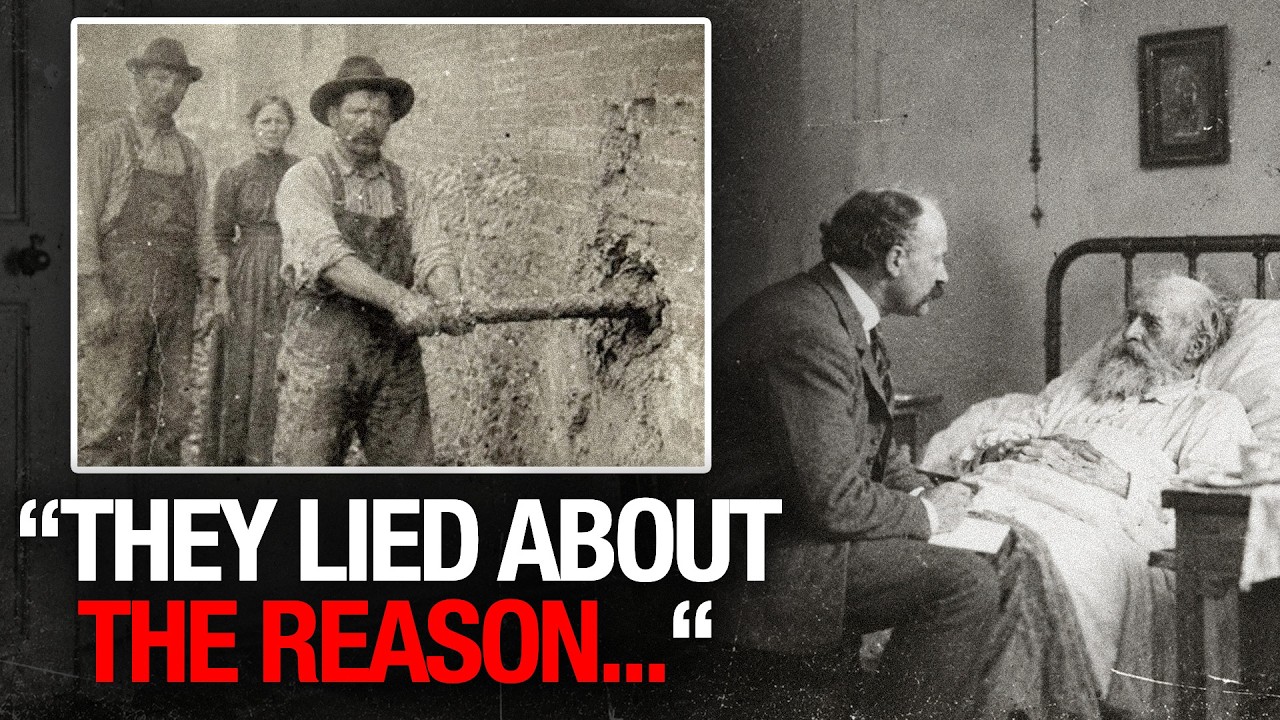
I have not heard back. And there is a brass plate somewhere under there, or maybe not, and I know which step to start with. The story begins in 1911, with an old man and a young schoolteacher. The man was Amos Pel, 87 years old, and the teacher was Adelaide Voss, 24, who taught at a one-room school outside a town called Marobe.
In that spring of 1911, the county asked her to collect memories for its old settlers society, which was putting together a history for the town’s anniversary. The society lent her an Edison photograph, and her job was to find the oldest people in the county and record them talking about the early days. She found Amos Pel. The recordings were made on seven wax cylinders.
Six of them still play. The seventh is cracked almost all the way through. They were packed in straw in a pine crate under the back stairs of a farmhouse in southern Indiana, in cardboard tubes labeled in pencil with a number and the same two words: Pel 1911. Tucked down the side of the crate was a letter, folded into quarters, written by Adelaide to her sister.
She never sent it. For more than a century, the letter sat next to the cylinders she had promised to protect. The first cylinder opens with Adelaide’s voice, young and very formal, stating the date, April 9th, 1911, and asking the old man to give his name and tell her when he came to Marobe. There is a pause, a scrape as he leans toward the horn, and then Amos Pel begins to talk.
He says his family came down the river on a flatboat in the autumn of 1831, when he was seven. His father had signed a paper with a land company in Cincinnati promising a free town lot to any family willing to settle and put the place to rights. Nobody explained what that meant until they arrived. He describes coming around a bend in the river and seeing the town for the first time.
His voice slows down here, and on the cylinder his words come carefully. There were streets laid out straight as a ruled page. There were brick buildings three and four stories tall, a courthouse with a dome, a row of shopfronts with iron columns. And every one of them was sunk.
The whole town looked like it had been set down into the ground up to its knees. Gray silt filled the streets and ran in through the ground floor windows and stood level with the sills of the second floor, dried hard and cracked like a riverbed in August. Adelaide asks him how many people were living there when they arrived. He says none.
About 40 families came down with them on the company boats, and there was not one soul already in the town. No dogs, no chickens, no smoke from any chimney. His mother cried when she saw it, and his father told her to hush because the company man was listening. Then he says the line that the restorer played over the phone three times.
It was already waiting for us. That’s the part nobody wants to put in the book. We didn’t find a town. We found one that was waiting.
The second cylinder is about the digging. The company gave every family a building instead of a lot, and the deal was simple: you cleared it, you kept it. The children did most of the work at first because they could fit through the upper windows and drop down onto the silt and start shoveling it out through the openings while the men hauled it away in carts. Amos remembers the silt as fine as flour when it was dry, gray with a faint blue shine.
It smelled of salt when it got wet, and that bothered his father more than anything else. They were hundreds of miles from any ocean. Then his account turns strange. When they finally dug down to the ground floors, the rooms were furnished.
Tables, chairs, iron stoves, shelves with dishes still stacked on them. There was no sign that anyone had packed up and left. He found a coat hanging on a peg behind a door, and when he touched it, it fell apart into threads. Adelaide asks if they found anyone, any remains.
He says no, and firmly. In two years of digging across the whole town, they never found a single grave, a single bone, or a single piece of writing. Then he describes the rods. They ran up through the walls of the larger buildings, set inside the brick itself, iron rods about the thickness of a man’s thumb.
They came up from somewhere under the floors and ran all the way to the roofs, where they ended in a kind of cap he couldn’t describe except to say it looked like a closed flower. The courthouse had dozens of them. The company men told the settlers to cut them out wherever they could reach them and bring them to the landing, where they were weighed and loaded onto boats as scrap iron. Families were paid by the pound.
Amos asked his father what the rods were for. His father said it didn’t matter because the company wanted them gone and the company was paying. The rods were cold. Even in summer, even in the sun, they were cold to the touch, and the rooms where they ran were always the coolest rooms in the house.
After they cut them out, those rooms were ordinary rooms again. By the third cylinder, Adelaide starts asking different questions. The first two cylinders sound like a teacher doing a job. By the third, she’s leaning in.
She asks him who named the town Marobe. Amos says the company did. Above the courthouse doors, carved into the stone lintel, there had been a name already, a long one in letters he didn’t recognize. He was seven, he couldn’t read yet, but he remembers that some of the letters looked like the ones he later learned, and some looked like nothing at all.
In the first spring, a stone cutter came up from Cincinnati on a company boat, put up a scaffold, and chiseled the old name flat. Then he carved Marobe and the year 1832 into a new block and set it into the wall beside the door. Adelaide asks if anyone objected. On the cylinder comes a short dry laugh, the only time he laughs across all the recordings.
Objected to what? The settlers had been given brick houses with iron stoves for the price of two summers of shoveling. Nobody was going to argue with the company about the name over the door. Then he tells her about the school.
In the second year, when there were enough children, the company sent a teacher, and the first thing the children learned was the history of Marobe. The town had been founded in 1832 by the settlers who came down the river, who built it with their own hands in a few hard summers. They recited it. Within ten years, the children who had been too small to dig believed it completely.
Within twenty years, some of the adults did too. Adelaide asks him quietly whether he believed it. He says he kept one thing. When they were clearing the courthouse cellar, he found a small brass plate on the floor about the size of a playing card, with the same kind of letters that had been carved over the door.
He put it in his shirt and never gave it to the company men. He looked at it most nights for nearly 80 years. What happened to that plate is on cylinder 7, and cylinder 7 is the broken one. Before listening to the rest, the owner of the crate drove to Marobe to see if anything he described was still there.
The courthouse is still standing. It’s been renovated so many times that the dome is new and the doors are new, but the stone block beside the entrance says Marobe 1832, exactly as Amos said it would. The lintel above the doors is completely plain in a building where every other piece of stonework has some kind of molding or trim. The front steps are the other thing.
You walk down into the building, not up. The main entrance sits about five feet below the level of the square, reached by a short flight of steps going down, with a retaining wall holding back the street. There’s a small plaque explaining that the street was raised in the 1840s to protect the town from river flooding. She read it twice.
Then she walked around the side of the building and counted the rows of brick between the ground and the first window ledge on the upper floor. The brick below the old silt line is a darker red and laid in a different pattern. It’s not subtle once you see it. At the county library, she found the official history published in 1912, the year after Adelaide made her recordings.
It says Marobe was built by 41 families in the summers of 1832 and 1833. It lists their names. The Pel family is on it. It says nothing about silt, rods, a carved lintel, or a town that was already there.
She did the arithmetic sitting in the library parking lot. 41 families, most of them farmers, two summers, a domed courthouse, three and four story commercial blocks with cast iron fronts, and a street grid over half a mile across. Not a historian, but she grew up on a farm, and she knows what a family can build in a summer. The fourth cylinder is the one Adelaide seems to have been most afraid of.
It starts partway through a sentence, as if she stopped the machine and started it again. She is asking him about the people who lived in the town before, where they went. Amos says something unexpected. The grown-ups never asked that question.
Not once, not out loud. It was like a rule nobody had told them, but everybody knew. Then he tells her about the woman. In the third summer, an old woman walked into town from the east.
She didn’t come on a company boat. Nobody knew where she’d come from. She was very tall and very thin, and she spoke English slowly, like it was her second or third language. She walked up and down the streets for most of a day, stopping in front of buildings and saying words to them.
Amos followed her because he was ten and she was the strangest thing he had ever seen. She stood in front of the courthouse and said a word he couldn’t repeat, and then she said in English: This was where the water was made quiet. She put her hand flat on the brick where one of the rods had been cut out and held it there for a long time. Then she started to cry.
By that evening, two company men had come up from the landing. They took her by the arms and walked her down to the river very politely, and put her in a boat going south. He never saw her again. His father told him that night that she was a mad woman from the hills, and he was to forget her.
I didn’t forget her, Amos says on the cylinder. I’m 87 years old and I haven’t forgotten one thing she said. Adelaide asks him what he thinks she meant. The water made quiet.
He is silent for a long time. The cylinder hisses. Then he says he thinks the rods had something to do with the river, and that the town was built to sit next to it without fear, and that once the rods were gone, the river started coming up again. The flood of 1847 took the lower end of Marobe, and nobody could understand it, because the old people in the town before had built right down to the waterline and the water had never touched them.
The fifth cylinder is shorter and moves the story beyond Marobe. Amos says that in his twenties, he and his father hired out as diggers. The same land company and others like it were sending settlers to towns up and down the Ohio and along the rivers that fed into it. They were paid by the building and went where the work was.
He names three towns. Two of them can be found on old maps. One seems to have been renamed twice. He says every one of them was the same.
The same straight streets. The same gray silt standing at the same height, just below the second floor sills, as if it had arrived everywhere at once and stopped everywhere at the same line. The same cold rods in the walls. The same company men waiting at the landing to weigh the iron.
Adelaide asks him how many towns he dug out in his life. He says 11. His father dug out more. By the time he was 40, he says, he had stopped thinking of them as towns that had been buried and started thinking of them as towns that had been put to sleep and handed to strangers with instructions to wake them up and not ask what they had been dreaming.
People online call this the mud flood, the idea that in the 1800s, cities across the world were found half buried in mud and dug out and quietly claimed by people who never built them. Most of what is written about it is photographs and guesswork. What Amos Pel gave Adelaide was different. He was describing his own childhood in his own voice, and he had no idea there would ever be a word for it.
The sixth cylinder is Amos explaining why he agreed to be recorded. He says he is the last of the diggers from the boats of 1831 still alive. His sister died that winter. The old settler society history is going to be printed the next year, he says, and he knows what it is going to say because it is what the school taught, and he doesn’t want to die with the only true version living in his own head.
Then he asks Adelaide to promise him something. He asks her to keep the cylinders somewhere the society can’t reach them. She laughs a little nervously and says the society owns the photograph. He tells her it doesn’t own the wax.
The letter explains the rest. Adelaide wrote it to her sister in June of 1911. She delivered typed transcripts of all seven cylinders to the society’s board as she had been asked to. A week later, the board president returned them to her with a single line written across the top page: An old man’s confusion, not to be included.
He asked her to bring him the cylinders so they could be reused for other recordings, because wax was expensive. She told him she had broken them by accident carrying them home. She hadn’t. She put them in the crate, packed them in straw, and carried them to her own family’s farm.
At the end of the letter, she writes that Amos died in August of that year, and that she had gone to the courthouse square the week after his funeral and stood in front of the smooth lintel for an hour, and that she didn’t know what she had been hoping to see. The letter was never mailed. It stayed in the crate for more than a century next to the cylinders she promised to protect. Cylinder 7 is cracked almost all the way through.
When the crate was first opened, a piece of the wax had come loose inside the tube. The restorer spent five weeks on it, and told her more than once that he might not get anything at all. In the end, he recovered 38 seconds. It is hard to listen to.
The sound drops in and out, and half the words are lost under the crackle. But Amos is talking about the brass plate. He says he had kept it for nearly 80 years and that he didn’t want it buried with him and that he didn’t want it in a drawer for somebody to throw out. And then clearly, for about eight seconds, you can hear him say this.
I put it back where it came from under the courthouse step left side the bottom one. I dug it in deep. If nobody’s taken that step up, it’s still there. And whoever finds it can read what I never could.
Then the wax breaks and the sound stops. The courthouse steps in Marobe were rebuilt in 1962. The county records say the old stone steps were cracked and dangerous, and a new flight was poured in concrete right over the top of them. The original stone steps are still under there.
Amos Pel spent nearly 80 years looking at a brass plate he couldn’t read, and then he gave it back to the building that was waiting for him when he was seven years old. Nobody knows what is written on it. Nobody knows if it is still there.
But the step to start with is the bottom one on the left side, and underneath it, deep, something may still be waiting.
