The dull, wet sound of metal entering flesh cut through the morning air. Benjamin Parker, who had walked out through the open gate of Fort Parker under a white flag to speak with the approaching warriors, fell to the ground. From inside the stockade, nine-year-old Cynthia Anne Parker watched it happen. She did not yet understand what she was seeing, only that the adults around her had suddenly begun to scream.
The morning had started like any other. The soil was damp, a thin mist hung over the cornfield, and the sun had not yet fully cleared the horizon. Chickens clucked somewhere, a cow lowed. Fort Parker was not truly a fortress, just a handful of family homes enclosed by thick log walls, a small community founded by her grandfather, Elder John Parker, where relatives lived close together.
The gates stood open because no one expected a threat. The day was assumed to be ordinary. Then dust appeared on the horizon. Far away, a cloud rose into the sky, and at first glance it could have been a herd or a dusty wind.
But the colors became distinct: red painted faces, feathers, the glint of metal at the tips of lances, the pounding of hooves. A force of around six hundred Comanche, Kiowa, and allied warriors approached under a white flag. A sign of peace, or so everyone assumed. Inside the fort, Cynthia Anne stood near her mother, holding a container, perhaps milking, perhaps just puttering around.
That part of the memory was blurry, because no one yet knew what was coming. Benjamin Parker walked out through the gate in good faith, probably to talk, perhaps to offer food or livestock. The girl watched. Her heart was not even beating faster yet, because she was not afraid yet.
Maybe she noticed the tension on the faces of the adults but could not put a name to it. That is how children recognize fear, by first reading it in the bodies of grown-ups. Then everything happened at once. The sound of the lance, the dull, wet sound of metal entering flesh, cut through the air.
Screaming began, not hers at first, but her mother’s, her aunts’, then everyone’s. Horses whinnied. Hooves tore up the earth. The dust cloud engulfed everything, and sunlight turned crimson within it, as if the sky itself had been painted with blood.
The smell of gunpowder, of horse sweat, and then a smell she would never forget: blood, warm like iron, filling the air. She was nine years old, in the place she considered the safest in the world, and everything collapsed within seconds. Her father, John Parker, tried to gather her into his arms in a protective reflex, but he too was cut down. Scalps were taken.
She was forced to watch it in real time, second by second, unable to escape. Her grandfathers and grandmothers fell to the ground. Some women were wounded by lances. Some managed to flee toward the fields, burying themselves among the wheat stalks.
There were screams, the whinnying of horses, the sound of doors breaking. Then a short, terrible silence. Someone grabbed her by the arm and lifted her up. The smell of earth filled her nose, mixed with blood, horse sweat, painted leather.
She was thrown onto the back of a horse, held tightly in front of a warrior. Her breath was knocked out of her. She took one last look at what remained: her home, her family’s bodies, everything. Other captives were with her: her young cousin John Richard, her aunt Rachel Plummer and her small son, and another woman, Elizabeth Kellogg.
Then the horses broke into a gallop, and she left behind the world she had known as Cynthia Anne Parker. That is what history books summarize as the Fort Parker raid. One sentence, one date. But she had been there, and for her it was not a sentence.
It was the moment her life split in two. In popular memory, the story is usually told like this: an innocent white girl kidnapped by savage natives suffered for years and was finally rescued. A clean, comforting narrative full of heroism. But the truth was not so clean.
In 1836, the Texas frontier was a bloody intersection of two worlds: the expanding frontier of Anglo settlers and the Comanche Empire, which had been the true owner of those lands for centuries. For the Comanche, this was not just a raid. It was a deep-rooted tradition of warfare involving the capture of land, horses, women, and children, part of their own strategies for survival, their way of sustaining their population. For the white settlers, this was savagery.
But the Anglo settlers had also seized the same lands with the same violence and ruthlessness, both before and after. Villages burned, hunting grounds occupied, horses stolen. The violence was not one-sided. Only the memory of it was written one-sided.
The winners wrote the history, and the dead of Fort Parker were told as victims of a savagery that needed to be civilized, while on the other side of that same frontier, generations had endured similar suffering. The tragedy of Cynthia Anne Parker is not the moment she became a victim. It is the moment she stopped being a victim and became an entirely different person, and then had that new identity forcibly stripped from her. What happened to the others taken with her?
Her aunt Rachel Plummer was made to work like a slave for months, beaten, and came close to death twice. After eighteen months she was ransomed and freed, but her health and spirit were so broken that she died shortly after her return, at only twenty-one years old. Elizabeth Kellogg was sold within a few months, changed hands, and was eventually recovered. Little John Richard followed a path similar to Cynthia Anne’s: he became integrated into Comanche society, became a warrior, and refused to return to the Anglo world for years.
Captivity was not a single story. Not everyone shared the same fate. For some, it was an unbearable cruelty and remained so. For others, over time, it became something different.
In her first days and weeks in the Comanche camp, everything was foreign. The language sounded jingling, fast, incomprehensible. The food was foreign: bison meat, dried meat, roots, sometimes raw liver. The smell inside the tepees was foreign: smoke, fat, animal hide, dried herbs.
The nights were cold, the blanket thin, and there was no familiar face beside her. She cried, of course. She was nine years old and had lost her entire world. At night, while everyone slept, she whispered her mother’s name into the darkness.
During the day, she went to the edge of the camp and looked east toward where her home had been, tracing with her eyes a path that was not there. For a child, this is the purest form of pain: knowing there is a place to return to, but not knowing how to get there. But in Comanche society, captive children, especially the very young, were mostly not kept as slaves but adopted into the tribe. This was not merely an act of kindness.
Epidemics and wars had significantly reduced the Comanche population, and incorporating children was a strategy for survival. The result for the child was a chance at life. Cynthia Anne was adopted by a Comanche family, and over time she moved out of captive status and became a genuine member of the community. The brain of a nine-year-old child, while processing trauma, also adapts in order to survive.
She began learning the new language: first a few words, then sentences, until eventually she started dreaming in it. She learned about horses, how to ride them, how to care for them, how to build trust with an animal. She learned to work leather, to string beads, the rituals of the bison hunt, the rhythms of nomadic life. She learned to sleep under the stars, to read the direction of the wind, to sense the coming of rain from the smell of the earth.
A year passed, then two, then five. The English words in her memory gathered dust, replaced by new sounds. She was no longer the kidnapped white girl. Her hands no longer trembled while working leather.
Her eyes, when looking at the horizon, carried familiarity instead of fear. She grew from a child into a young girl, then into a woman. There is no strong evidence that she ever tried to escape. On the contrary, the testimonies of white traders, travelers, and even members of the Parker family searching for their relatives, who saw her in later years, describe her as appearing content with her Comanche life, staying of her own free will.
In the 1840s, when white traders and officials found her and tried to buy her back for ransom, she refused to go. On one occasion, when a delegation of traders arrived at the camp, she refused even to show herself or speak. Another woman spoke on her behalf and said that she wished to stay. She was given a choice, and instead of returning to her old world, she chose her new family, her new life.
Her name became Nadua, a Comanche name meaning something like “one who belongs to someone,” a beloved person. The memory of Cynthia Anne Parker still existed somewhere like a dream, but it was no longer at the center of her identity. Her voice, her walk, the way her hand held leather, all of it was now Comanche. Then she met Peta Nocona.
The name meant Lone Wanderer, and he was a powerful warrior, a chief, a leading figure of the Nokoni band. History is silent on how they met, and perhaps that silence is right, because this was not the historian’s story. But it is known that she married, and that the marriage was not an ordinary arrangement. Many testimonies say there was a genuine bond, a genuine love between them.
Peta Nocona, a warrior of a status that could traditionally take more than one wife, took only Nadua as his wife. This was a rare mark of loyalty for that era and culture, and perhaps the quietest proof of the depth of the bond between them. She had children. Her first son received the most well-known Comanche name in history: Quanah, meaning Fragrance or Blowing Wind, possibly given during a season when wild flowers bloomed on the prairie.
Then another boy, Pecos, and a girl, Topsana, Prairie Flower, whose very name showed how deeply that land had seeped into her bones. Inside a tepee, in the dim light of the fire, she nursed her baby. Outside, the wind rippled across the prairie. The horses’ breath turned to steam in the night air.
Somewhere, a wolf howled in the distance. Her husband came in carrying the day’s exhaustion and sat beside her. The children were asleep. The fire crackled.
In that moment, she was no longer that nine-year-old whose family was slaughtered. She was a mother, a wife, part of a community. Perhaps she was happy. Trauma shaped her, but it did not destroy her.
She survived, and beyond survival she built a new life. The years flowed by: seasons, migrations, hunts, births. Quanah learned to ride, made his first bow, went hunting alongside his father. One spring day, the camp was set up by a riverbank, women stretching hides together, children playing in the water.
She sat with the other women working beads, joking with one another, maybe about her accent, maybe about a hunter’s clumsiness. No one looked at her as a captive anymore. She was one of them. In autumn, the great bison hunt began.
The whole camp was on the move: tents dismantled, horses loaded, children scurrying about with excitement. She tied her load onto her own horse, knew how to take down and rebuild her own tepee, sensed an approaching storm from the smell of the wind. This knowledge belonged to her. No one could take it from her.
Or so she thought. In December 1860, a cold, sharp wind cut across the Texas plains. She was thirty-three years old. Her camp was set up along the banks of the Pease River.
It was a small group, mostly women, children, and the elderly, because most of the warriors were out hunting or elsewhere. This itself was a sign that Comanche power had weakened. Bison herds were dwindling, disease was ravaging the people, and white settlers were pushing deeper every year. Early morning, the fog had not yet lifted, hanging over the prairie like a thin veil.
Then, again, dust. This time, those on horseback were Texas Rangers, a unit under Colonel Lawrence Sullivan Ross, reinforced with Army soldiers. What history would record as the Battle of Pease River was less a battle than a raid on an undefended camp, just like at Fort Parker twenty-four years earlier, except this time the roles were reversed. Gunfire ripped through the air.
Screams. Horses bolting in every direction. She grabbed her baby, little Topsana, into her arms and tried to flee. Her heart pounded like a drum in her chest.
Her breath came out in clouds in the cold air. Her feet slipped on the ground. The horse was tired or wounded, or there was simply no luck. They caught her.
A soldier, as he seized her, noticed her blue eyes. This set her apart from the others: a dirty, sunburned woman in Comanche clothing, but with blue eyes. A white woman. Someone shouted.
And in that moment, she was no longer Nadua. She became Cynthia Anne Parker again, not by her own will, but by others defining who she was without ever asking for her own decision about her identity. Peta Nocona is believed to have been killed in this attack, though some historians argue he actually died much later. Most painfully, her two sons, Quanah and Pecos, were not in the camp that day or managed to escape.
She would never see them again. Soldiers wrapped her in a blanket and placed Topsana beside her. She did not know what to say. The English words left a strange taste in her mouth, a language she had not used in years, like a rusted tool.
She only cried, or perhaps she could not even cry, because the shock was beyond tears. The newspapers announced her recovery as a great triumph: the lost white woman finally found, as if a twenty-four-year life could simply be erased overnight and she should return to the identity she was born with. But the truth was the exact opposite. When they took her to the home of her uncle Isaac Parker, she no longer spoke English, or remembered very little of it.
At first she refused to wear white clothing. She refused to eat western-style food. She kept trying to escape, this time truly and repeatedly, because the place she wanted to return to was now Comanche territory beside her own children. Once, when she was caught trying to mount a horse and flee, she was never allowed to ride a horse again.
As if she were an animal that needed to be controlled to prevent it from escaping. She sat in a room wearing fabrics that felt foreign, a tight, suffocating dress that left a strange sensation on her skin, surrounded by people who saw her as rescued, smiling, congratulating her, shaking her hands. She barely understood their language. And inside her burned a single thought: my sons.
Where are my sons? Why aren’t they here? Why isn’t anyone bringing them too? Those who once wept over her being taken captive were now celebrating as a rescue what was, to her, being torn away from her real home by force.
She was kidnapped twice. Only the second time, her captors said they were doing it because they loved her. And perhaps that made it even more painful, because even objecting was considered meaningless. She was told, “You’re lucky.
You’ve been saved. ” While she tried to mourn the sons she would never see again, and a husband who was dead or missing, the legislature, having once declared her a victim of savagery, granted her a pension and a piece of land, as if money could compensate for the twenty-four years, the husband, the sons she had lost. Journalists showed up at her door wanting to see her, to curiously examine the white woman who had lived among the savages. She became news material, a cautionary tale, a frontier legend.
But no one actually asked her, “How are you? What do you want? ” The only question she was constantly asked was, “How much did you suffer while living among the Comanche? ” And whenever she tried to tell the truth, “No, I had a family there.
I was loved there,” people did not want to hear it, did not believe it, or thought she was confused, that the savages had brainwashed her. They were not ignoring her pain. They were trying to fit her pain into the story they had already decided to tell. They wanted to imagine her as a victim waiting somewhere to be rescued, constantly suffering, because that made what they did into an act of heroism.
But she did not fit that mold. Her little daughter Topsana was with her, her only comfort. Perhaps a small hope sprouted inside her that one day Topsana would remember her mother’s language, her mother’s real family, and become a bridge between the two worlds. But in 1863 or 1864, sources disagree on the exact date, influenza took her little girl too.
Her fever would not break. Her cough grew heavier by the night. She sat beside her for nights on end trying to cool her forehead with cold cloths. But nothing she had was enough.
One morning, that little chest no longer rose and fell. Having already lost her husband, her two sons, her entire former life, she now lost the one child she had left. Testimonies describe that in the period that followed, she refused to eat, that she cut herself and opened wounds, as was done in Comanche mourning traditions, that she regularly sat looking toward the prairie horizon as if waiting for her sons to return. According to some accounts, she would routinely cut her chest in mourning, because this was the mourning practice of the culture she had learned and internalized, a practice the white Texans did not understand and found savage.
But for her, this was the only way to express her deepest pain. Words were not enough. Only the pain of the body could express the pain of the soul. Her relatives tried to have her live in different homes with different family members, hoping she would heal, hoping she would adjust.
But she never took root anywhere. She would look out windows, scanning the horizon, as if one day two young men on horseback would appear, as if her sons would come to get her. That day never came. In 1870, some sources say 1871, she passed away.
The official records say pneumonia or influenza, but many historians, and what her grandson recounted, say this actually stemmed from grief, from starvation, from the exhaustion of the will to live. She was forty-three or forty-four years old. She died suspended between two worlds, never fully belonging to either. Neither as Cynthia Anne Parker nor as Nadua.
Just lost. Just a shattered woman. Her son Quanah grew up on Comanche land after his mother’s abduction, survived after his father’s death, became a warrior, and in time became the last great war chief of the Comanche people. In 1874 to 1875, in the Red River War, he was a leader of the resistance against the US Army.
He stood out as a young warrior in the great attack at Adobe Walls, standing tall on his horse amid enemy bullets. But defeat was inevitable. The bison herds had been slaughtered, the Comanche people’s source of survival systematically destroyed. The army’s strategy was clear: kill the bison, starve the Comanche, break the resistance.
After surrendering, Quanah underwent a striking transformation. He adapted to reservation life, formed partnerships with white businessmen, negotiated with railroad companies, became a spokesman for the Comanche people, and even took his surname from his mother’s family, becoming Quanah Parker. He became a man who managed to build a bridge between two worlds, something his mother never managed to do, perhaps restoring on her behalf the balance she had lost. Quanah never forgot his mother.
He repeatedly wrote letters to white officials trying to find her, asked questions, followed leads. Years later, he had her grave found and had her remains moved to Oklahoma, to his own land beside her family. Because he knew where his mother’s true home was: not the white world, not her relatives in Texas, but the Comanche lands beside her children. When Quanah died in 1911, he too was buried beside her.
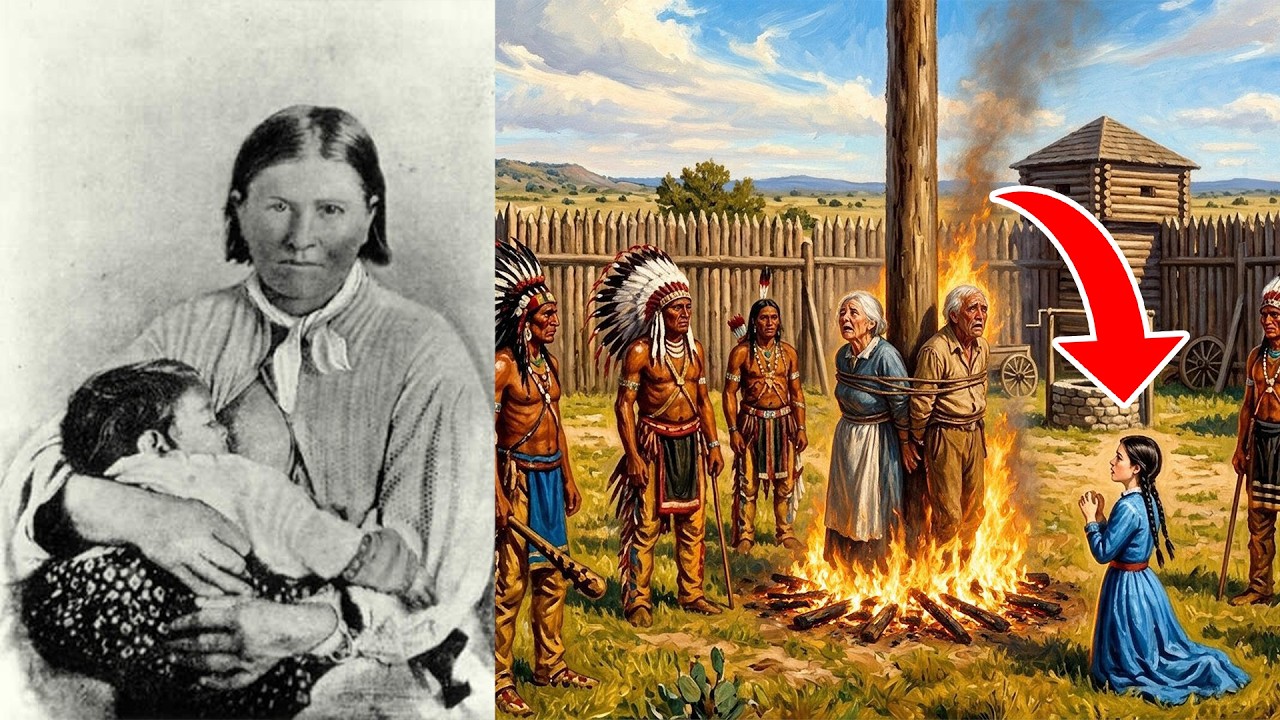
Mother and son, fifty years later, were finally together again. But only beneath the ground, only in a quiet cemetery of stones, names, and what history had written. In 1861, a year after being taken back, they took her to a photographer’s studio. Little Topsana was in her arms, her chest bare because she was nursing the baby, as was Comanche custom, without shame.
The photographer perhaps wanted to present this as proof of savagery, or maybe just as a document of the era, presenting her like an exhibit to curious gazes. But she looked into the camera. In that photograph, there is something in her eyes. Loss, resistance, something that cannot fully be named.
Perhaps just the silent way of saying, “I am here, but I am not here. ”
That photograph still exists, the only real image history has left of her. Today, there is a county in Texas that bears her name, Parker County. There are historical plaques, museum corners, academic articles mentioning her name.
But none of them can truly convey what turned inside her as she was wrapped in that blanket on that cold December morning. None of them can truly carry the peace she felt while nursing her baby inside the tepee, or the silent, endless pain that gnawed at her as she looked at the prairie waiting for her sons. History remembers her as Cynthia Anne Parker. But she perhaps felt herself most of all as Nadua, the beloved one, the one who belongs to someone.
And perhaps the real tragedy is that the world never once left her to simply be herself. She was always forced to be part of someone’s story. For whites, a rescued victim. For the Comanche, a lost mother.
For historians, a frontier legend. But for no one, simply herself.
