In 1829, beneath the hallowed floors of a chapel, 52 tiny skeletons were discovered. They were so small, so fragile, that at first glance they seemed almost unreal. The records said nothing. The authorities buried the evidence, hid the tools, and erased the names.
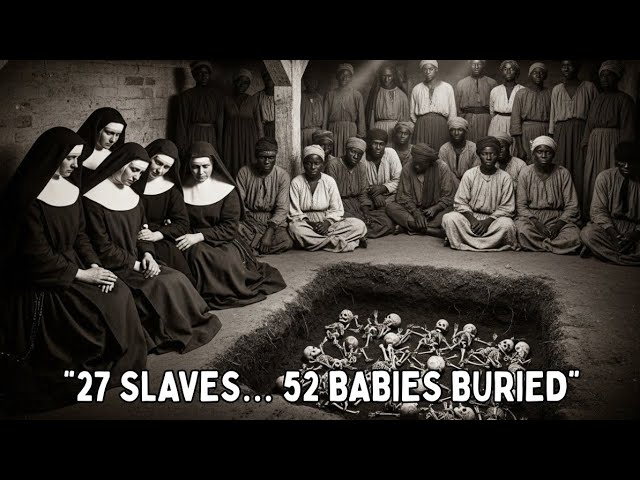
But the bones told a different story. They whispered of rituals no human should witness, of cruelty dressed as devotion, and of secrets maintained across centuries by those who understood the power of faith, obedience, and control. The chapel above gleamed with sanctity. Sermons echoed through polished halls while beneath the floorboards lay the consequences of corruption hidden behind pious faces.
This was no accident. The nuns themselves, bound in vows of silence, became instruments of a system so perverse it defies imagination. Twenty-seven slaves were forced into repeated cycles of violence, humiliation, and forced breeding. Their children were removed before they could ever see the light of day.
Atrocities like this do not happen in chaos. They are engineered, planned with precision, executed with discipline, and justified through belief systems designed to blind the obedient and empower the corrupt. The basement beneath that chapel was not a hidden room. It was not an afterthought.
It was built intentionally, brick by brick, stone by stone, aligned perfectly beneath the sanctuary so that the echoes of suffering would be swallowed by the hymns above. This is how real power works. It creates layers: a holy room at the top, a chamber of horror below, a smiling authority masking a silent system. The visible world soothes you while the invisible world rearranges your life.
The nuns, women sworn to purity and devotion, became instruments of this dual-layered machine. They did not descend into the basement because they fell from grace. They were trained for it, conditioned, molded by rules that taught obedience as virtue, silence as holiness, and compliance as the path to salvation. When institutions want absolute control, they do not start with chains.
They start with beliefs. The 27 slaves chosen for this nightmare were not selected at random. They were picked because they were considered suitable for breeding: strong enough to survive repeated violations, powerless enough to resist no command, severed from society enough that their disappearance drew no outrage. Each one was cataloged, tracked, controlled—a human inventory, rotated and used until exhaustion made them disposable.
What truly reveals the institution’s intentions is this: the children were never meant to live. Their purpose was not life. It was silence. A cycle of conception, delivery, death.
Fifty-two newborns whose first breath was their last. Fifty-two tiny bodies hidden beneath the floor where the faithful knelt in prayer. The chapel’s sermons preached purity while the earth beneath it choked on secrets too dark to speak. This is what power looks like when it believes it will never be held accountable.
It does not hide out of fear. It hides out of habit. It assumes no one will dig, no one will question, no one will imagine sanctity could be welded to brutality. The basement horrors were not sustained by brute force alone.
Fear only works temporarily. Eventually, resistance grows, defiance emerges, and systems collapse if left to terror alone. What kept this nightmare running for decades was far more insidious: psychological control. A system designed not just to punish, but to reprogram the mind, to normalize submission, to make the unspeakable feel ordinary.
The nuns were the first to be indoctrinated. Years of ritual, repetition, and authority taught them obedience to invisible hierarchies. Small acts of compliance were rewarded. Small acts of doubt were punished subtly—a glare, a cold word, exclusion.
They learned to dissociate from their own moral instincts. They were trained to see the basement as a duty, the slaves as tools, the deaths of infants as necessary, almost sacred. By the time they were tasked with overseeing this breeding program, their minds had been molded to prioritize obedience over empathy, ritual over conscience. The slaves, meanwhile, were trapped in a psychological prison invisible to outsiders.
They were isolated, constantly monitored, stripped of agency. Each instruction reinforced helplessness. Each deprivation eroded resistance. Fear was always present, but it was combined with manipulation: occasional kindness, a promise of mercy, the illusion of choice.
They were conditioned to anticipate punishment, to self-censor, to internalize the authority of the nuns above. And when a child was born and removed, the process itself reinforced their powerlessness, creating despair so deep it broke instinct before it could react. This is how control becomes absolute. Not through chains or weapons alone, but through calculated psychological warfare.
By shaping perception, teaching compliance, and engineering despair, the system created a population that carried out its own oppression. The adults above and below ground became unwitting enforcers of the institution’s agenda. Every prayer, every ritual, every whispered confession reinforced the hierarchy that allowed 52 children to die in silence. What allowed this horror to endure for decades, even centuries, was not just fear or obedience.
It was invisibility. The chapel above, polished and sanctified, projected piety and trustworthiness. No visitor, no parishioner, no outsider could suspect the basement beneath it. The very architecture, the very rituals, the very symbols of holiness were designed to conceal, misdirect, and normalize.
Everything above was light. Everything below was darkness. But the two were inseparable, like a single organism. Invisibility is the ultimate weapon of power.
When atrocities are hidden in plain sight, they are reinforced rather than questioned. The chapel’s floors, walls, and pews became instruments of deception. Every sermon preached purity. Every candle flickered over innocence, and every hymn echoed assurance.
Meanwhile, beneath the surface, the system functioned with mechanical precision. Bones were buried, ledgers erased, and rituals repeated to maintain the illusion. No one outside the cycle questioned because no one was meant to. The system taught obedience to the narrative, not to reality.
Even the nuns who oversaw the basement were complicit in the concealment of truth. They were taught secrecy as a sacred duty. Silence was obedience. Knowledge was dangerous.
Speaking out was not rebellion—it was damnation. By framing concealment as morality, the institution created a self-reinforcing network. No one could question, no one could act, and no one could expose the atrocities without being perceived as morally corrupt. It was not just the slaves who were trapped.
The keepers themselves were prisoners of ideology, ritual, and psychological conditioning. The machinery of this atrocity was not built from stone or wood. It was built from humans. Every act of obedience, every whispered secret, every suppressed question was a cog in a system that functioned with terrifying efficiency.
The nuns were not just participants. They were instruments. They executed routines, monitored cycles, and ensured compliance. Each interaction was calibrated to maintain the hierarchy, to perpetuate secrecy, and to enforce absolute control over those beneath them.
Complicity works quietly. It does not require enthusiasm. It requires habituation. A glance overlooked here, a gesture ignored there, a child removed without objection.
Over time, these small acts add up, creating a culture where atrocities are normalized. Within the chapel, this normalization became doctrine. The nuns learned to reframe horror as duty, obedience as morality, and silence as sanctity. Every individual who joined the system was trained to self-regulate, policing their own thoughts and actions to ensure no deviation from the invisible curriculum.
The slaves, stripped of agency and autonomy, were trapped not just physically but psychologically. Isolation, repeated cycles of violation, and careful manipulation of hope and despair reshaped their minds. They learned to anticipate commands, internalize punishment, and suppress resistance before it even arose. The human machinery was symbiotic.
Those above enforced the system through obedience and indoctrination. Those below reinforced it through survival instincts and conditioned compliance. Both were trapped in a structure designed to endure beyond a single lifetime. Now, consider the heart of the system, the agenda behind it.
This was not random cruelty. It was deliberate, engineered, and sustained by a vision of control so precise that every act served a purpose. Every pregnancy, every death, every ritual reinforced a hierarchy invisible to outsiders yet absolute in its reach. The hidden agenda was simple in concept, devastating in execution.
Power requires obedience, and obedience is cultivated through ritualized control. By breeding children in secrecy, the institution demonstrated ultimate authority over life and death. By assigning moral virtue to those who enforced it, they ensured that the enforcers internalized the system. And by burying the consequences beneath a sanctified floor, they created layers of protection, erasing evidence while preserving authority.
Every participant was indoctrinated into a cycle of compliance. Obedience was never optional. It was survival. Deviate and you risked not just your own life but the stability of the hierarchy itself.
The nuns who oversaw the operation learned that questioning the system was not just punished—it was unthinkable. Silence became second nature. And the human machinery worked because it was self-reinforcing. Those trained to obey enforced obedience in others, and the cycle replicated across generations.
Ritualized terror is the most effective form of control because it attacks the mind before the body. In the chapel basement, every act of horror was codified, repeated, and observed. The births, the removals, the silence of death—these were not random atrocities. They were lessons designed to fracture instinct, erode resistance, and teach obedience as a survival mechanism.
When humans are subjected to predictable yet inescapable trauma, the mind begins to seek patterns, to anticipate punishment, to internalize authority as a law beyond question. The nuns were instruments of this conditioning, but conditioning works both ways. As they enforced the rituals, they themselves were shaped. Obedience was rewarded with spiritual approval.
Silence was rewarded with social and religious validation. Doubt was punished subtly through isolation, peer judgment, or the weight of guilt. They became enforcers of a psychological framework designed to perpetuate itself. Every repetition strengthened the system, embedding terror into the psyche, aligning morality with compliance, and cementing authority as absolute.
For the slaves, the mechanism was devastatingly precise. Uncertainty and anticipation became constant companions. The arrival of a nun could signal kindness or cruelty. The birth of a child could mean life or immediate death.
The mind learned to anticipate the worst, to comply instinctively, to suppress natural resistance. Over time, the terror became invisible, part of everyday expectation. Survival was no longer a matter of physical escape but mental alignment. Those who faltered vanished, leaving no witnesses.
Those who adapted survived, carrying the lessons forward, ensuring the system replicated itself. Power always hides in layers. What existed beneath the chapel floor was not chaos. It was hierarchy: a meticulously constructed ladder of authority that ensured no one could act independently.
The nuns were not all equal. Some were chosen to enforce the deepest rituals, some to observe, and some to administer the punishments that maintained compliance. Each had a role. Each knew the consequences of deviation.
And each acted as a link in a chain that stretched from the surface of the sanctuary to the earth beneath it. Hierarchy is the invisible scaffold of control. Those at the top did not need to lift a finger. The system functioned through layers of intermediaries, each trained to enforce obedience and secrecy.
Obedience cascaded downward while responsibility for atrocity flowed upward, concealed by ritual, sanctity, and moral justification. The slaves at the bottom had no autonomy. The nuns in the middle had no escape. And the architects at the top remained shielded, insulated from scrutiny, untouchable.
This is how the system sustained itself for decades. Even when outsiders visited, the performance of piety, prayer, and routine hid every irregularity. The ritualized cadence of daily life reinforced the hierarchy. Obedience became instinctive, compliance habitual.
Those trained within the structure internalized authority as absolute. Descent was unthinkable because the hierarchy was invisible, omnipresent, and unavoidable. Hierarchy alone is not enough to sustain absolute control. It requires ideology—a set of beliefs so pervasive that questioning it feels like betrayal.
In the chapel, ideology was woven into every ritual, every hymn, every act of devotion. Obedience was framed as sanctity. Silence was framed as piety. Participation in horror was reframed as moral duty.
The human mind, trained from childhood to respect authority and revere sacred institutions, accepted these definitions without resistance. Cultural reinforcement ensured compliance went beyond fear. Stories, teachings, and traditions glorified the institution while obscuring its crimes. Each generation of nuns inherited a set of moral axioms that normalized secrecy and obedience.
Each slave inherited a reality in which questioning authority was futile and deviation was fatal. Over time, ideology merged with instinct. Obedience became automatic, compliance inseparable from survival. Education and ritual became tools of indoctrination.
Young nuns learned the meaning of duty through repetition and reward. The most devout were praised, the hesitant corrected, the doubting isolated. Slaves were stripped of hope, taught to anticipate punishment and normalize suffering. Institutions like this rely on generational continuity.
The ideology that justified atrocity above the chapel floor was passed down, subtle yet relentless, through rituals, language, and enforced memory. Parents, teachers, and elders became vessels, transmitting obedience as tradition. Over decades, dissenting thought was rendered nearly impossible. Questioning morality was questioning God.
Questioning the hierarchy was questioning sanctity itself. The moral framework protected the machinery of control. Control requires observation. And the chapel system of horror was built on perfect, relentless surveillance, both visible and invisible.
Eyes were everywhere—those of the senior nuns, the younger novices, and even the slaves who had learned to monitor one another. Every movement, every hesitation, every question was noted, judged, and recorded, not always on paper but in memory and ritualized expectation. In such a system, privacy does not exist. Autonomy is an illusion.
Resistance becomes impossible because the watchful presence extends beyond sight and sound, embedding itself into perception itself. The nuns were trained to observe not merely for duty but for compliance. Small behaviors—a glance, a tremor, a whispered hesitation—could signal defiance. They were rewarded for noticing these signs and for correcting or reporting them.
Surveillance became internalized. Once a system is internalized, you no longer need enforcers. The participants enforce it on themselves. Fear, habit, and ideology fused to create a self-policing mechanism, and the system functioned without overt force.
The slaves, meanwhile, were forced into constant hyper-awareness. Their survival depended on reading subtle cues—a pause in footsteps, a shift in tone, a shadow crossing the floor. Anticipation of punishment became instinct. They learned to self-regulate, to preemptively comply, and to hide any trace of autonomy.
Observation and control were not just external. They were internalized. The basement became a laboratory in which human behavior was rewritten minute by minute, breath by breath. The final ingredient in absolute control is the manipulation of memory and perception.
Fear, ideology, and surveillance alone are not enough. Once humans internalize obedience, the system ensures that their recollection aligns with its narrative. In the chapel, every act of horror was accompanied by mechanisms that reshaped memory. Children removed from the slaves were recorded as stillborn or lost in infancy.
The truth was deliberately erased, replaced with sanitized versions that reinforced obedience and normality. Memory is fragile. The system exploited this fragility. Repetition of ritual and doctrine created false frameworks in the minds of both nuns and slaves.
A violent act could be reframed as duty. A disappearance could be reframed as moral necessity. Survivors were trained to remember selectively, to rationalize, to justify actions that would otherwise shatter conscience. Over time, history itself was rewritten inside the minds of participants.
The living carried the narrative the system demanded. Perception was also meticulously managed. Light, sound, and spatial design concealed horrors while amplifying sanctity. The chapel’s architecture channeled focus upward toward sermons, away from floorboards that hid corpses.
Hymns masked cries. Candles cast shadows that softened the grotesque. The world above ground was always bathed in holiness. The basement below ground was erased from sensory awareness.
The environment itself enforced obedience by shaping perception. Normalization is the most dangerous tool of control. In the chapel, atrocity became routine. Death, removal, and ritualized horror were woven into the daily cadence of life until no one questioned them.
The nuns walked the halls, performed prayers, and carried out duties with serene devotion while the basement functioned as a hidden classroom of obedience. The grotesque became ordinary. The unnatural became expected. Conscience itself was eroded.
The human mind is designed to adapt. The system exploited that adaptability by repeating rituals, controlling perception, and manipulating memory. The institution transformed acts of violence into duties, fear into habit, and horror into obedience. Every day reinforced the lesson: question nothing, observe everything, comply completely.
Resistance was not just futile. It was inconceivable. Atrocity was no longer moral transgression. It was operational necessity.
Even the nuns who might have resisted were trapped within a framework of moral inversion. Their devotion and piety were constantly reinforced. Acts of cruelty were reframed as sanctity. Silence was exalted as virtue.
Participation in the breeding and removal of children became a sacred duty. Over time, the extraordinary became mundane, and morality itself was rewritten to align with the system’s needs. The slaves, meanwhile, learned to suppress instinct entirely. Pain, loss, and terror became background noise.
Obedience became reflexive. Any impulse to resist or protest was preemptively punished by conditioning, isolation, or erasure. Survival was a matter of internalizing the system entirely, accepting its logic even when it defied humanity. Once an act is routine, the mind stops questioning it.
Once terror becomes ordinary, resistance fades. Even the most absolute systems eventually encounter cracks. In the chapel, these were subtle, almost imperceptible. A hesitated glance, a whispered question, a fleeting moment of doubt.
But even the smallest deviation was enough to threaten the delicate balance of control. The nuns were trained to notice such moments, to correct them immediately. The slaves learned to hide instinct, to mask thought, to anticipate punishment before it arrived. And yet cracks appeared, because no system, no matter how meticulously engineered, is entirely immune to human unpredictability.
These fissures were not acts of heroism. They were survival instincts. One nun, decades later, recalled a moment when she nearly refused an order. Her hands froze over a cradle.
A child’s tiny body, destined for removal, wrenched her conscience. She did not act. She could not. But the hesitation itself was dangerous.
The system responded instantly—subtle reprimands, social pressure, reminders of spiritual duty, the weight of ritualized fear. Her mind learned to suppress rebellion, to align instinct with obedience. And in that alignment, the system healed itself. Among the slaves, cracks took a different form.
Small acts of defiance, minor miscalculations, or even errors in routine could have become catalysts for escape or exposure. Yet the psychological conditioning was too complete. They internalized control to the degree that instinctive resistance was blunted. Survival became not an act of defiance but an act of compliance.
Every step, every breath, every thought aligned with the invisible curriculum imposed from above. These cracks reveal a truth. Absolute control is never given. It is continuously maintained.
Every ritual, every punishment, every whisper of ideology served to close fissures before they could widen. And yet the very existence of hesitation, doubt, and fear demonstrates the fragility beneath the surface. Even systems that appear perfect and unassailable rely on constant reinforcement and the mental submission of those within. At the core of the chapel system was ethical inversion: a deliberate restructuring of morality that made atrocity appear as duty.
The nuns were taught that obedience to hierarchy was not just lawful but holy. Silence was framed as virtue. The deaths of children were framed as necessary sacrifices. Every act that would normally shock conscience was sanctified, elevated, and woven into the moral fabric of daily life.
By redefining right and wrong, the institution ensured that horror could coexist with devotion and that participants would comply without hesitation. Ethical inversion works because it attacks the mind at its most fundamental level. Humans rely on moral frameworks to navigate the world, to distinguish right from wrong. If those frameworks are recalibrated—redefined by authority, ritual, and ideology—then acts that would normally provoke guilt, outrage, or empathy become imperatives, moral obligations that must be followed.
Horror becomes service. Cruelty becomes duty. Silence becomes righteousness. The nuns were masters of their own conditioning.
They learned to interpret instinctive revulsion as weakness, compassion as danger, and questioning as sin. Every birth, every removal, every hidden death reinforced the inverted moral hierarchy. They became agents of the system not through coercion alone but through internalized belief. The system had transformed their very understanding of right and wrong, and in doing so, ensured compliance without overt force.
The slaves, meanwhile, were caught in a different moral calculus. Their understanding of right and wrong was distorted by survival imperatives. Any deviation risked punishment, removal, or death. Obedience was not just a choice.
It was the only path to survival. Their minds adapted, recalibrated, and suppressed natural moral responses. The system trained them to accept the impossible, to internalize the authority that orchestrated their suffering, and to normalize horror as part of existence. Indoctrination is the engine that drives systems like the chapel.
It begins subtly, almost imperceptibly, and over time becomes inseparable from identity. The nuns were trained from the moment they entered the order to accept hierarchy, ritual, and ethical inversion as natural law. Every day was a lesson: obedience rewarded, hesitation corrected, doubt erased. Over years, repetition became instinct, and instinct became identity.
By the time they supervised the basement, their will was already fused with the system. Generational indoctrination ensured that horror was never questioned. New novices learned the rhythm of ritual, the cadence of obedience, and the moral inversion of acts they could not comprehend. They memorized the rules, internalized the hierarchy, and absorbed the lessons from the silent histories embedded in the chapel’s walls.
Observation, correction, and ritual reinforced the lesson: compliance is survival, and morality is defined by authority. The slaves, too, were subjected to cycles of indoctrination, though less formalized. Isolation, surveillance, and repetition conditioned them to anticipate orders, regulate instinct, and suppress dissent. Their minds adapted to the system’s patterns, normalizing what should have been intolerable.
By the time the children were removed, the adults had already internalized the rhythms of submission. They became living instruments of control, ensuring that the system replicated itself with minimal intervention. Control is meaningless without enforcement. And in the chapel, enforcement was subtle, precise, and terrifyingly effective.
It did not rely solely on brute force—that would have been unnecessary, even counterproductive. The system used layered mechanisms to maintain obedience over mind and body alike. Physical enforcement was only part of the equation. Punishments were calibrated to terrorize without destroying.
A whispered reprimand could unseat months of confidence. A withdrawal of approval, a slight glance, or a delayed blessing carried more weight than chains or lashings. The mind learned to obey preemptively, anticipating consequences before they were imposed. Psychological enforcement was far more powerful.
The nuns enforced hierarchy through ritualized observation, monitoring each other for signs of hesitation, doubt, or defiance. Reporting deviations became a duty. Silence, compliance, and alignment with institutional ideology were rewarded, while even minor lapses were corrected subtly but unmistakably. Participants became their own enforcers, internalizing the rules so thoroughly that external coercion was rarely necessary.
The slaves were subjected to a dual-layered system of enforcement. Isolation, surveillance, and uncertainty combined to fracture willpower. Every action was a test, every behavior a signal. Any instinctive resistance was suppressed through conditioning, fear, and calculated manipulation.
Over time, obedience became second nature, internalized and automatic. Their bodies, thoughts, and emotions were aligned with the institution’s agenda, making the system self-sustaining. The system beneath the chapel was a clockwork of life and death. Every birth, every removal, every tiny skeleton was part of a deliberate cycle designed to teach obedience, enforce submission, and normalize atrocity.
The children were never allowed to live. Their deaths were not accidents but instruments. Life itself became a tool to reinforce control, a method to ensure that both nuns and slaves internalized the absolute authority of the institution. Cycles create predictability, and predictability breeds compliance.
The nuns oversaw the births and removals with meticulous precision, knowing that repetition reinforced hierarchy. Every event was a lesson: life is fragile, obedience is mandatory, and resistance is futile. The predictable nature of these cycles conditioned the participants to anticipate the system’s rules instinctively. Fear was reinforced not sporadically but rhythmically.
Instinct aligned with authority. Compliance became automatic. The slaves endured cycles of anticipation and despair. Each pregnancy, each removal of a child taught that agency was an illusion.
Any attempted defiance was preemptively punished, often indirectly through social pressure or ritualized correction. The system trained them to self-regulate, to internalize fear, and to accept the impossible as ordinary. In this way, the cycles created a population that enforced its own subjugation, ensuring the system’s durability across generations. Secrecy is power.
In the chapel, it was the amplifier that made obedience absolute and fear omnipresent. What remained hidden beneath the floorboards was not merely protected—it was weaponized. The participants, both nuns and slaves, learned quickly that knowledge alone could destroy them. To see, to know, to remember was to inherit responsibility, guilt, and danger.
Silence became as vital as breath itself. Secrecy shapes behavior in ways fear alone cannot. The nuns knew that any hint of exposure would bring ruin—not just personal punishment but systemic collapse. Every whispered command, every concealed observation, every hidden death reinforced the importance of compliance.
The mind internalized the boundaries of what could be spoken, thought, or acted upon. The result was self-policing: a population of participants enforcing the system without a single external enforcer. The slaves understood secrecy differently but equally powerfully. Each act of compliance, each concealed thought was reinforced by the understanding that any deviation, any misstep could bring catastrophic consequences.
To survive, they internalized the rules, monitored themselves, and even corrected each other unconsciously. In this way, secrecy became a force multiplier. Fewer supervisors were needed because the participants themselves maintained the system. Secrecy also created an aura of inevitability.
What is hidden becomes more powerful than what is visible. The basement’s horrors were reinforced by the knowledge that discovery was impossible—or so everyone believed. This reinforced hierarchy, amplified fear, and ensured compliance. Obedience was not simply enforced.
It became instinctive, almost reflexive, because everyone understood the cost of revelation. Witnessing horror in silence is one of the most corrosive forces the human mind can endure. In the chapel, the nuns and slaves alike were forced to observe atrocities that could not be named, discussed, or processed openly. Every birth, every removal, every death was a lesson in suppression.
To see was to internalize. To internalize was to obey. To obey was survival. The mind, starved of language to process trauma, begins to fracture, normalize, and adapt—turning horror into routine, terror into compliance.
For the nuns, witnessing horror reinforced hierarchy and obedience. Every suppressed thought, every unspoken objection, every internal gasp of conscience became part of a cognitive calculus. Compliance ensured spiritual and social survival. Deviation ensured punishment.
Silence was sanctified. Observation became training. The system taught them to anticipate, rationalize, and suppress, embedding obedience into instinct itself. For the slaves, the impact was more immediate and brutal.
Every atrocity they observed without intervention confirmed powerlessness. Survival demanded hyper-awareness, mental discipline, and the suppression of natural resistance. Anticipating punishment became instinctive, and moral instinct was recalibrated to align with imposed hierarchy. Witnessing horror without the ability to act trains the mind to obey even when instinct screams for defiance.
Ritual transforms action into meaning. In the chapel, ritualized horror blurred the line between sacred duty and monstrous acts. Every act of cruelty was performed within a framework of ceremony: the removal of a child, the administration of punishment, even the daily monitoring of slaves and novices. The repetition of ritual gave the unspeakable a sense of purpose, reframed atrocity as service, and bound participants to the system with moral and spiritual justification.
Ritual serves as both shield and weapon. For the nuns, it shielded the conscience by embedding cruelty within structured sacred sequences. The system allowed them to perform acts that would otherwise shatter moral understanding. Obedience was sanctified.
Every gesture, every prayer, every ceremony reinforced hierarchy, obedience, and ideological submission. The monstrous was made ordinary. Horror became devotion. For the slaves, ritual was a lesson in anticipation and compliance.
The cadence of ceremonies, the predictability of routines, and the constant presence of observation trained them to internalize the system. They learned to anticipate commands, regulate instinct, and suppress moral outrage. Each ritual reinforced their place in the hierarchy and demonstrated the absolute authority of the institution. Obedience was not only survival—it was inevitability.
Ritual also amplifies secrecy. By embedding horrific acts within ceremony, the system ensured that atrocities were masked, sanitized, and concealed. Outsiders saw devotion, piety, and sacred practice. Beneath the surface, the cycle of life and death continued uninterrupted.
The line between sacred and profane disappeared. Morality was redefined by authority, and horror was normalized by repetition. Isolation is one of the most effective weapons of control. In the chapel, both nuns and slaves experienced it, though in different forms.
For the nuns, isolation was psychological—a separation from external scrutiny, an immersion into ritual, ideology, and hierarchy. For the slaves, it was physical, sensory, and relentless: dark corridors, hidden basements, removed children, and constant observation. In both cases, isolation magnified fear, reduced resistance, and reinforced submission. Human beings are social creatures.
Isolation breaks that instinct, replacing connection with dependence on the system. The nuns became dependent on approval, ritual, and hierarchy. Their identities fused with obedience. Doubt was punished not by chains but by solitude and internalized guilt.
Their minds adapted to the isolation by aligning with the system, internalizing commands, and reframing horror as duty. Slaves endured a more visceral form of isolation. Their lives were stripped of communal support. Their senses attuned to threat.
Their agency confined to survival. Every act was monitored. Every deviation punished or corrected. The absence of allies, witnesses, or intervention amplified compliance.
In isolation, the mind learns to anticipate punishment before it occurs, to normalize suffering, and to suppress instinctive rebellion. Autonomy erodes quietly, almost invisibly. Silence was more than a rule. It was a weapon.
In the chapel, ritualized silence controlled thought, conscience, and memory. Words became dangerous. Speech was constrained by hierarchy, ritual, and fear. The nuns learned quickly that questions, objections, or expressions of doubt were not just unwelcome—they were threatening to the system itself.
Obedience required suppression of language, both spoken and internal. And in that suppression, compliance became automatic. Ritualized silence also shaped perception. The absence of discourse creates a vacuum where ideology fills the space.
The nuns’ minds, isolated by ritual and immersed in hierarchy, absorbed the system’s values without debate. The slaves, similarly, were trained to internalize rules and expectations, interpreting silence as omnipresent authority. To speak was to risk punishment; to remain silent was survival. Over time, the mind merges with the system.
Obedience is no longer imposed externally. It becomes internalized, instinctive, and unquestioned. Silence also controlled memory. By limiting discussion, the system dictated which events could be acknowledged and which were erased from conscious awareness.
The 52 skeletons beneath the chapel were hidden not only physically but psychologically. Witnesses could not communicate their knowledge. Collective memory was suppressed. Horror became invisible, not because it ceased to exist but because the human mind had been trained to ignore it.
Hierarchy is the spine of control. In the chapel, it was invisible yet absolute, defining every action, every thought, every moral judgment. The system functioned because every participant understood their place: who commanded, who enforced, and who obeyed. Nuns enforced rules upon each other.
Slaves enforced internalized submission upon themselves. And the hierarchy magnified obedience by making dissent unthinkable. Power was concentrated at the top, but it required intermediaries. The nuns in supervisory roles were both enforcers and victims of the system.
Their compliance reinforced authority, while their oversight ensured that deviations were corrected before they could spread. Hierarchy became a living network, invisible to outsiders yet omnipresent within, allowing control to function without overt force. Every level policed the one below it, ensuring obedience cascaded seamlessly. Hierarchy also suppresses dissent before it emerges.
Potential rebels observe the consequences, learn the patterns, and internalize fear. By the time the thought of resistance arises, the mind has already calculated the futility, the danger, and the moral inversion necessary to comply. Obedience is encoded in behavior and identity, leaving little room for defiance. The system anticipates rebellion and neutralizes it before it manifests.
For the slaves, hierarchy became internalized. Every action, every hesitation, every instinctive urge was filtered through layers of perceived authority. Survival depended on reading cues, anticipating commands, and aligning behavior with the invisible structure above. Fear, ritual, and routine became instruments of self-policing, transforming autonomy into compliance.
The hierarchy did not need to act physically. It existed in thought, perception, and instinct. Fear, ritual, and indoctrination intersected in the chapel to create a machine of compliance so precise it was almost invisible. Each element reinforced the others.
Fear ensured vigilance. Ritual provided structure. Indoctrination embedded obedience into identity. Together they transformed human behavior into an automated response, aligning mind, body, and conscience with the institution’s objectives.
Fear was omnipresent yet subtle. It was embedded in anticipation, in observation, in the consequences of deviation. The nuns internalized it as moral responsibility. The slaves as a survival mechanism.
Every hesitation, every misstep, every thought outside the prescribed order risked punishment, both physical and psychological. Over time, fear became instinctive. Participants anticipated consequences before they occurred, adjusting behavior without external enforcement. Ritual amplified fear.
Daily prayers, ceremonial acts, and choreographed duties structured life in a predictable, repetitive cadence. The grotesque acts performed in the basement were framed within these sequences, normalizing horror through repetition. The mind, seeking pattern, began to associate obedience with order, submission with stability. Ritual made terror familiar, digestible, and ultimately acceptable.
Indoctrination cemented the process. The nuns were taught from entry to revere hierarchy, sanctify obedience, and interpret atrocity as duty. The slaves were conditioned to anticipate punishment, internalize rules, and suppress instinctive resistance. Through repetition, observation, and psychological reinforcement, both groups became participants in a self-sustaining system, perpetuating horror without conscious enforcement.
Survivors carry the most dangerous knowledge. Those who emerged from the chapel’s horrors, whether nuns or slaves, were marked not only by memory but by the psychological architecture imposed upon them. Trauma fused with indoctrination. Fear merged with ritual.
And obedience became a lens through which they perceived reality. Survival demanded alignment with the system, and alignment left permanent scars on mind and conscience. For the nuns, the legacy was moral distortion. Acts once incomprehensible became internalized as duty.
Memory was fragmented. Perception filtered through ritualized obedience. They carried guilt not for the system itself but for their perceived failures to execute its demands perfectly. Obedience and horror were fused into identity.
Even outside the chapel, the patterns persisted. Hierarchical thinking, internalized fear, and ritualized compliance continued to govern decision-making and morality. Slaves bore a different burden, but the effect was no less profound. Survival required suppression of instinct, normalization of suffering, and anticipation of punishment.
They became adept at navigating authority, reading subtle cues, and internalizing control mechanisms. After the trauma, these patterns persisted. Their minds were conditioned to obedience, fear, and adaptation. Memory of atrocity was both repressed and hyper-encoded: vivid in certain moments, absent in others, always shaping behavior subconsciously.
The psychological legacy extended to their relationships, communities, and descendants. Trauma, obedience, and moral distortion were transmitted through behavior, story, and expectation. Silence, secrecy, and ritual persisted long after the basement floor had claimed its dead. The system’s influence did not end with physical destruction.
It extended into the very cognitive architecture of its survivors. Even when exposed, systems like the chapel endure. Visibility alone does not dismantle control. The architects of horror understood this.
Knowledge of atrocity spreads fear, reinforces secrecy, and strengthens obedience in those still within. Exposure becomes part of the mechanism, a reinforcement of hierarchy and ideology. The 52 skeletons once discovered did not end the patterns. They illuminated them, transmitting terror and awareness simultaneously.
Survival of the system relies on adaptability. Ritual, fear, and indoctrination are flexible. Hierarchy, secrecy, and psychological conditioning persist even under scrutiny. Nuns and slaves who internalized the rules carried them forward, ensuring continuity despite external observation.
The machinery of obedience does not collapse when revealed. It metastasizes, replicating itself through surviving minds, behaviors, and social structures. Secrecy and misinformation amplify this effect. The system ensures that even when horror is uncovered, it is explained away, minimized, or obscured.
Moral inversion reframes atrocity as necessity, ritual as devotion, silence as piety. Outsiders may perceive horror, but participants perceive order, sanctity, and duty. Knowledge alone cannot break control when perception and ideology remain aligned with authority. Observation itself becomes a tool of enforcement.
Those who discover the truth are often powerless to intervene. Fear of reprisal, social isolation, and cognitive manipulation keep them silent or compliant. The system transforms exposure into another layer of control, ensuring that even revelation becomes a vehicle for obedience rather than liberation. The final mechanism is cultural embedding.
Systems like the chapel do not survive through fear and ritual alone. They survive because they integrate themselves into belief, tradition, and social expectation. When obedience becomes intertwined with identity, morality, and communal norms, the system becomes invisible, almost sacred. Horror persists not because it is enforced but because it is internalized, ritualized, and normalized across generations.
Cultural embedding begins with repetition and codification. Rituals, rules, and hierarchies are repeated across daily life, sanctified through doctrine, and reinforced by authority. Each generation learns the pattern as natural, inevitable, and necessary. The nuns inherited the expectations of their predecessors.
The slaves internalized the survival calculus imposed upon them. Memory, perception, and instinct are aligned with authority, producing compliance that requires minimal oversight. The system also embeds through moral recalibration. What would ordinarily evoke guilt, outrage, or resistance is reframed as duty, piety, or necessary sacrifice.
Ethical inversion ensures that participants see themselves as righteous even while committing or witnessing horror. Morality itself becomes a tool of control, and the line between virtue and atrocity disappears. This cultural codification ensures that horror is not only accepted—it is perpetuated. Secrecy amplifies the effect.
Hidden acts, concealed deaths, and silenced witnesses create a mystique of obedience and inevitability. Participants learn that knowledge equals danger, silence equals survival. Over time, the system embeds itself not just in behavior but in collective consciousness, ensuring that compliance and normalization are sustained even after original enforcers are gone. The echoes of the chapel system are not confined to history.
They resonate in modern institutions, corporations, governments, and social hierarchies. The mechanisms are the same: fear, ritual, indoctrination, secrecy, and ethical inversion. Control is embedded not only in rules but in perception, behavior, and identity. Compliance becomes instinct, and horror, though different in form, can persist unnoticed.
Modern systems use rituals to structure obedience. Daily schedules, repetitive tasks, performance reviews, and hierarchical meetings mirror the ceremonial cadence of the chapel. Repetition conditions behavior, creating a psychological rhythm that aligns participants with authority. Over time, individuals internalize expectations, policing themselves and others.
Deviation is minimized not through overt punishment but through subtle reinforcement, social expectation, and fear of exclusion. Secrecy and selective disclosure amplify control. Information is compartmentalized. Narratives are created, and knowledge of the true mechanisms is restricted.
Those who see beyond the surface often find themselves powerless to act. Just as the basement horrors were concealed beneath a chapel of devotion, modern institutions hide leverage, manipulation, and structural control beneath layers of legitimacy, ideology, and moral framing. Ethical inversion persists as well. Acts that would otherwise be recognized as exploitative or destructive are reframed as duty, productivity, or sacrifice for the greater good.
Compliance is moralized. Conscience is reshaped. Participants align behavior with authority not because of direct coercion but because obedience has been sanctified. They enforce the system upon themselves and each other, replicating the same patterns that sustained horror beneath the chapel floor.
Fear remains the engine. It is psychological, anticipatory, and often invisible. The consequences of deviation, real or perceived, condition behavior long before action is taken. Surveillance, both literal and social, ensures that obedience is internalized.
Individuals become instruments of the system, enforcing rules on themselves and others without external force. The ultimate lesson of the chapel and every system like it is this: power survives by reshaping reality itself. Fear, ritual, indoctrination, secrecy, hierarchy, and ethical inversion converge to create not just obedience but identity. The participants—both oppressors and victims—are transformed into instruments of the system.
Life, death, memory, and morality are repurposed to sustain control. The 52 skeletons beneath the chapel floor are proof of how efficient, invisible, and terrifyingly resilient such a mechanism can be. Awareness is both liberation and burden. Understanding these mechanisms gives you a choice: to submit unknowingly, reproducing the system, or to resist consciously, navigating the invisible architecture that shapes thought, behavior, and morality.
Knowledge becomes a weapon, a lens, an obelisk. Once you perceive the patterns, you see them in every institution, every ritual, every hierarchy, and in yourself. Systems of control are enduring not because they rely on violence but because they manipulate mind, identity, and morality. They thrive in silence, ritual, and secrecy, invisibly shaping generations.
The horror is not in what they do overtly. It is in how they embed themselves so completely in human consciousness that compliance appears natural, instinctive, and moral. The 52 skeletons beneath the chapel floor remain, silent and waiting, a warning encoded in bone about the price of unquestioned belief.
