On the morning of June 2, 1886, thirty-one guests filed into the Blue Room of the White House. A marine band played. It was the only wedding ever held in the presidential residence while the president was in office, and America agreed to call it a fairy tale come true. The groom was forty-nine.
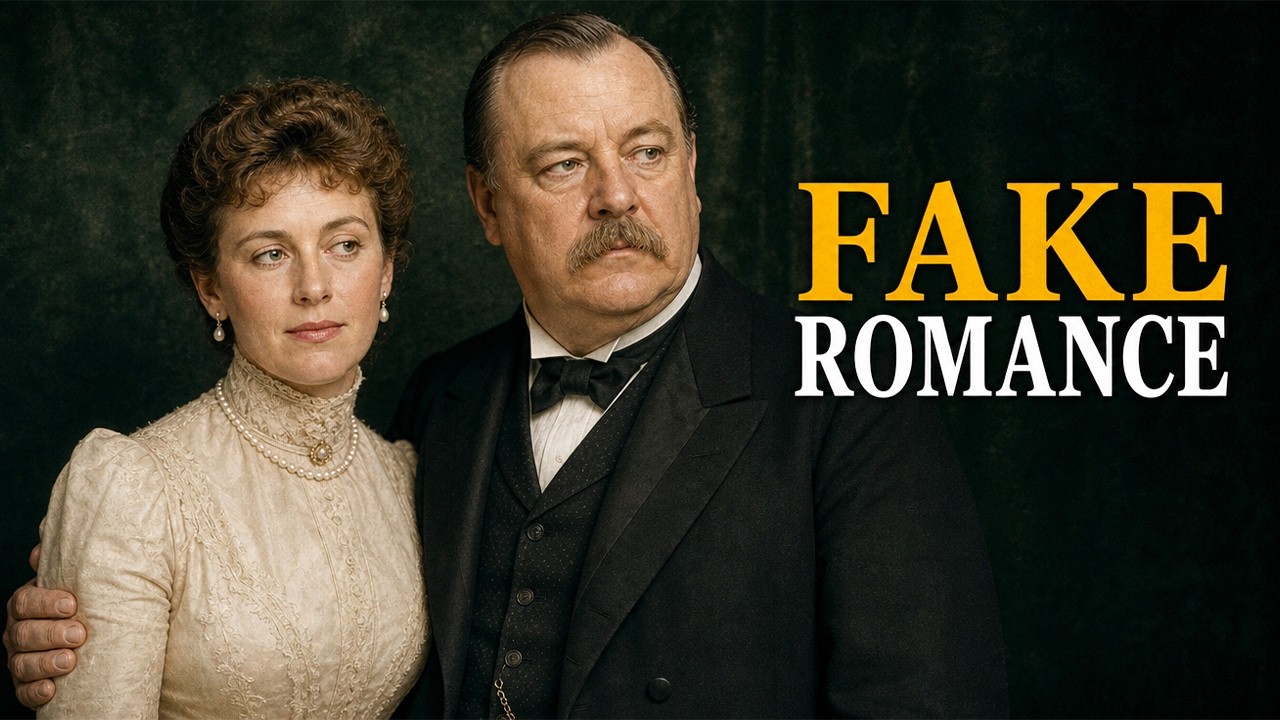
The bride was twenty-one. He had bought her a baby carriage years earlier, when she was an infant. During their secret engagement, his letters addressed her as “my dear child. ” Two years before the wedding, a scandal had stained his name with a child’s: Oscar Folsom Cleveland, named for her dead father.
She would outlive him by thirty-nine years, and she would be the one to decide what the country was allowed to know. The story began with a carriage accident. Not the wedding carriage, but a horse-drawn buggy on a road in Buffalo in July 1875. The man inside was Oscar Folsom, a well-loved lawyer, the type who stayed late with his colleagues and drove himself home.
He died in the accident, leaving no will. That last detail mattered, because when a man died in New York State in 1875 leaving a widow and a young daughter, someone had to be appointed to manage his estate. The court chose his law partner. Grover Cleveland took over the inheritance, paid off the family’s accumulated debts, and made himself responsible for the care of Emma Folsom and her eleven-year-old daughter.
A correction is needed here. For 140 years, newspapers and popular histories described Frances as Cleveland’s ward. White House historical sources are more precise. He was the administrator of the Folsom family estate, never her legal guardian.
The distinction matters, though not in the flattering direction. Legal guardianship comes with a court, accountability, and a fixed end date at the age of majority. What Cleveland had was something more flexible and more total. He controlled the family’s money.
He directed the girl’s education. No institution anywhere had the right to tell him when his role should end. He had been part of her life from the beginning. He was twenty-seven when she was born in 1864.
He bought the baby carriage. She was christened Frank, a family name after her uncle, and used it for years, causing trouble at school when teachers classified her with the boys. To her, he was called Uncle Cleve. That is a fact, and people repeat it with nostalgia.
It deserves a longer look. The nickname was not a romantic invention. It was what a child called the middle-aged man who paid the bills. Consider what that arrangement teaches a girl over ten years.
Her father is gone. The house is free of debt because of one man’s decisions. Her school is chosen on his advice. When she left Central High School in Buffalo in the fall of 1881 without graduating, a diploma was secured for her anyway.
The White House Historical Association credits Cleveland, then mayor of Buffalo, with arranging it. Money, education, security, affection: all came from a single source. She was a smart girl, and smart girls understand the nature of the system they live in. She enrolled at Wells College in Aurora, New York, entering ahead of her class.
The story shifts here, though no one said so at the time. Cleveland asked Emma Folsom’s permission to correspond with her daughter, and Emma agreed. He also made sure flowers were delivered to the college student’s room. During those years he was mayor of Buffalo, then governor of New York, then the Democratic candidate for president.
A man with a national reputation for hard, serious work, yet he found time to ensure a sophomore’s room never lacked fresh flowers. Nobody in Buffalo seemed to find this troubling. It is worth noting that a bachelor in his fifties, with a high public standing, was allowed in that society to move so freely. What he was doing had no name, because no one wanted to name it.
Then came the summer of 1884, and the story America agreed to remember as a charming political scandal. On July 21, the Buffalo Evening Telegraph published an article titled “A Terrible Story. ” The source was a local clergyman. The accusation was that a woman named Maria Halpin had given birth in Buffalo ten years earlier to a boy, that the child was handed to an orphanage, and that the mother was committed to an insane asylum.
The boy had been named Oscar Folsom Cleveland. Read that name again. He was born in September 1874. He carried the first and middle names of Frances Folsom’s father, the partner whose estate Cleveland would take over ten months later.
The version most Americans absorbed is the polished one. Cleveland, facing panicked advisers, is said to have told them to tell the truth. He admitted responsibility, acknowledged he had paid child support, and won the election anyway. Republicans shouted about a missing father.
Democrats had a joke after the results came in. The scandal became the one that proved his honesty. That is the story that survived. The evidence behind it is uglier and genuinely contested.
Maria Halpin was a widow in her late thirties, a clerk in a Buffalo store. In her affidavit, she claimed the encounter was not consensual, that he used force, and that he later threatened to destroy her life if she went to the authorities. Charles Lachman, who published the long-neglected affidavit in 2011, argues that the accepted narrative was public relations from the start. The older story, told in Allan Nevins’s Pulitzer Prize-winning biography of 1932, treated Halpin as an unreliable woman with a drinking problem, then moved on in a few pages.
Historians remain divided. What is not in dispute is that a doctor who examined her at the asylum concluded there was no justification for holding her, and she was released within days. Committing a working widow with no money, whose child’s name was linked to a powerful man, to an asylum was no small matter. There is another thread, one that runs directly into the marriage.
Cleveland’s defenders promoted the theory that the boy may not have been his son at all, that Halpin had been involved with more than one man in that circle, and that Cleveland, the only bachelor among them, took on the burden of paternity to protect a married friend. The married friend in that story was Oscar Folsom. This claim has been repeated until it hardened, but there is no evidence for it. It served Cleveland’s interests perfectly, which is reason for skepticism rather than belief.
Whichever version you find convincing, the raw fact sits at its core: in the summer of 1884, a twenty-year-old college student in Aurora, New York, read the papers and saw her dead father’s name in print across the country, tied to a child, tied to a woman in an asylum, tied to the man who paid her tuition. We do not know what went through her mind. She left no letter about it. What we know is what she did next, which in no way suggested retreat.
She finished her studies at Wells and graduated in June 1885. The commencement program listed her as Frank Folsom. Her mother took her to Washington that spring to visit the new president, inaugurated in March without them. By August, ten months before anyone in America learned the truth, she and Grover Cleveland were secretly engaged.
He proposed by letter. The engagement letters survive, and they are not the fairy-tale version. They are affectionate. They are also instructional.
He tells her he is glad to read her news of improvement, that he is pleased she appreciates what awaits her as the president’s wife and mistress of the White House, that no one has ever held that position so young and so unused to such responsibilities, and that his concern and his promise is that she will be fully prepared. In the middle of it all he addresses her as his wife. Dear child. A twenty-one-year-old girl receives lessons from the most powerful man in the country on how to be competent at a job she was never asked if she wanted.
The secrecy held for ten months, a miracle in Washington. It held because the press chased the wrong woman. Reporters sensed the president was interested in someone from the Folsom family and concluded it was the widow. Emma Folsom was a handsome woman of suitable age, and speculation circled her all winter.
Cleveland found the assumption annoying and complained about being linked to elderly ladies. The joke of the season was that the president would marry a mother. No one guessed the daughter, because she had grown up calling him Uncle Cleve. On May 28, 1886, the news broke on his terms.
He told her the papers would say what he thought the public should know for now. Five days. That was how much warning the United States got. Then the country turned the whole thing into the most spectacular public spectacle since the war, which suited the man perfectly, because the wedding was the one occasion on which a man could invite the entire nation to watch while keeping total control of what it saw.
He and his sister Rose organized it themselves. Thirty-one people were allowed into the ceremony. The press was permitted to see the flowers, then asked to leave the house. Reporters were shown the Blue Rooms banked with azaleas, smilax, and camellias.
The date was written in white pansies, the monograms in white roses. Then the doors closed in their faces. Rose Cleveland told the papers it would be a very private affair, the kind of statement that guaranteed the opposite. Hundreds of people stood on the lawn and peered through the windows at the potted plants.
The ceremony lasted about ten minutes. The Marine Band played under John Philip Sousa. The vows were changed at the couple’s request. Instead of promising love, honor, and obedience, she promised love, honor, and fidelity.
The change is real, and it is constantly cited as proof of a modern marriage based on affection. Possibly. But notice what it also reveals. Someone in that room was thinking about how to shape the wording for the morning papers.
Look at the guest list instead. Her family consisted of a widowed mother. His consisted of a president, a cabinet, and a sister who had run the White House for fifteen months and was now being replaced by a twenty-one-year-old. Rose Cleveland was a strong personality, a writer and lecturer who had published a book of essays while serving as her brother’s hostess, and she found the social duties tedious.
She handed over the house and left. Frances arrived in Washington with no faction, no money of her own, no home of her choosing, and a husband who had managed her family’s finances since she was eleven. They went to Deer Park, Maryland, for the honeymoon, and America made itself a memory. The resort was not even open for the season, which was the point.
Journalists came anyway. They watched the cottage. They used binoculars on the windows. They followed the couple to meals and lifted the lids of dishes to report what the president and his bride were eating.
Cleveland wrote an angry letter to the New York Evening Post, accusing the press of doing its utmost to make American journalism contemptible in the eyes of respectable people everywhere. He was right, and it was also the most useful thing that ever happened to him. From that week on, Cleveland had a permanent, publicly sympathetic, and entirely legitimate reason to control access to their private lives. Every closed door afterward could be explained with the words “Deer Park.
”
Back in Washington, he made a decision that tells you more about the marriage than the vows did. He bought a stone country house north of Georgetown, renovated it, painted the roof red, and moved his wife out of the White House. They lived at Oak View. The papers called it “Red Top.
” Most of the year he went there daily. The stated reason was privacy, and that was true. He was also a president removing the most popular woman in America from the building where the public could reach her, and installing her in a house he owned on a schedule he set. What did he want her to be?
He said it, and it was recorded. He was determined to make Frank a sensible, home-loving wife. He said he would be pleased if no one ever spoke of her as the First Lady of the land or the Lady of the White House. He wanted her happy, and added that he would be much affected if she allowed many ideas to steal into her head.
This was a college graduate who read Latin, spoke French and German, played piano, read constantly, and took photographs. Here is the contradiction that ran through the next three years. She was not silenced. She became the most photographed and reproduced woman in the country.
Her face appeared on soap wrappers, candy boxes, ashtrays, sheet music, playing cards, and patent medicine ads. None of it was authorized, and she was almost never compensated. The exploitation became so blatant that Congress took it up. A bill was introduced to prevent manufacturers from using a woman’s image without her consent.
It failed. The ads kept coming. Women copied her hairstyle and her clothes. When she stopped wearing the bustle, the bustle began to disappear.
She had one thing that was truly her own, and she built it deliberately. She held receptions twice a week, and she scheduled one for Saturday afternoons because that was the time working women could attend. Shop girls and store clerks stood in her line. It was the most popular thing anyone in that administration did, and it was her idea.
So when the 1888 campaign arrived and Democratic women organized packed Frances Cleveland Clubs across the country, one might think the campaign would weep with gratitude. Instead, Cleveland shut it down. He hated women in politics. She followed him.
The Democratic Party’s most valuable political asset in 1888 was officially instructed to stay out of politics while her image sold soap in every drugstore in America. Then a rumor started in the middle of that campaign. Word spread that the president beat his young wife. It came from a Republican pulpit.
It spread quickly, and people passed it along precisely because the age difference had always made them uneasy in ways they did not voice. The story dominated the season. No reliable evidence supports it, and historians treat it as a lie. Frances answered it herself in a letter written for publication.
She said the stories were atrocious falsehoods, and she wished the women of the country that no one might ever be blessed with happier homes or kinder, more attentive, more courteous, more affectionate husbands than hers. The letter reads like a young woman genuinely furious that strangers were inventing cruelty inside her home. But notice the mechanism just activated. In 1888, the administration discovered that when the public would not believe the president, it would believe his wife.
Her credibility was now a national political instrument. She used it, sincerely, to defend a man who had not hurt her. She would be asked to use that instrument again. He lost anyway.
Benjamin Harrison won the electoral college in November, and on March 4, 1889, the Clevelands packed and left. Then she said the words everyone quotes. Speaking to the White House staff as she departed, the story that reached us has her addressing Jerry Smith, who was cleaning the place, and asking them all to take good care of the furniture and ornaments, because they would be back in four years. It is a wonderful line.
It is also worth asking what it really meant. She was twenty-four. She had no children yet. She had no money except her husband’s, no career, no independent home, and under the legal framework of the time, a woman in her position had no meaningful exit without destroying her mother along with herself.
Whatever the sentence meant, it was a young woman’s declaration that her future was tied to his career and his alone, as far as she knew. She was right, which is why the words survived as a charm rather than an accounting. The four years in New York, by every surviving indication, were the best years of the marriage. He practiced law, made real money for the first time, and lived out of the spotlight.
They had a house on Madison Avenue and a summer home at Buzzards Bay on Cape Cod called Gray Gables, where he fished obsessively and wrote about fish with more enthusiasm than he ever wrote about politics. In October 1891, their first child was born. They named her Ruth. The country went as mad for that baby as it had for the wedding.
Strangers sent gifts. Crowds tried to touch her. When the family returned to Washington after the 1892 election, which he won, making him the only president ever to come back after being turned out of the White House, visitors would take the baby from her nurse’s arms to hold her, until Frances forbade her from going into the garden entirely. That was when the papers decided the child was sick, or deaf, or feeble-minded, and printed it.
It is the first recorded case of Frances Cleveland closing a door in the face of the American people. It would not be the last, and it had begun with a child. A second daughter, Esther, was born in the White House in September 1893, still the only presidential child born in the building. A third, Marion, was born at Gray Gables in 1895.
That leads to the summer of 1893, and to the thing that turned this story from a story about an unequal marriage into a story about the ultimate purpose of that inequality. In late June, a few weeks before Esther was born, Cleveland noticed a rough spot on the roof of his mouth. He asked his doctor to look at it. The doctor did not like it, and neither did the specialist who later examined the tissue.
The country was in the middle of a financial collapse. Banks were closing. The president had bet everything on the gold standard and called Congress into extraordinary session to repeal the Sherman Silver Purchase Act. His own vice president was a silver man.
If the markets learned that Grover Cleveland had cancer of the jaw, the Panic of 1893 would deepen catastrophically. So he decided no one would know. Not the cabinet, not the vice president, not the press. And the person who would have to stand before the country and hide the lie was his twenty-eight-year-old wife, whose honesty America had already tested five years earlier and found complete.
On June 30, he boarded his friend’s yacht, the Oneida, from a pier in New York. The official story was a pleasure cruise to Cape Cod for the summer. In early July, in the salon of that boat, a team of six men—a surgeon, a dentist, an anesthesiologist, and America’s first brain surgeon among them—strapped the president of the United States upright in a chair and cut out a tumor, five teeth, and a large part of his upper left jaw. They performed the entire operation through his mouth so that no scar would mark his face.
His mustache remained exactly as the country knew it. Afterward, a rubber prosthetic was fitted to preserve his ability to speak and the shape of his cheek. A second operation followed a few weeks later. He was hidden at Gray Gables for the rest of the summer, and Frances, pregnant with Esther, managed things.
She spoke to callers, told them her husband was resting, that he had a bad tooth, that rheumatism in his foot was bothering him. When the story finally broke, E. J. Edwards published it in the Philadelphia Press on August 29 under the headline “The President Is a Very Sick Man.
” The administration denied it flatly, and went further. They pursued Edwards. He was called a liar and a fabricator in the press by the White House and its friendly papers, and the accusation followed him professionally for the next twenty-four years. He was right on every essential fact.
That is the deepest betrayal in this story, and it is not an affair. There is no credible evidence that Grover Cleveland ever cheated on his wife, and no one should invent any. What he did instead was recruit her. The woman whose public honesty had saved him in 1888 was used in 1893 to destroy an honest journalist.
She did it while pregnant, in a summer house, with a husband who might have been dying in the next room. Did she think it justified? Probably. The banks were collapsing.
Her husband was the government. Many people would make the same choice. That is what makes it worth contemplating rather than condemning. She was not forced.
She agreed. And something in her changed after that. Not a break, but a professionalism. Watch what she did from that moment.
She kept the children out of the garden. She controlled the images taken of them. When the second term ended in March 1897, she moved the family to Princeton, to a house called Westland, and took over the household, the money, and the visits. When Ruth died of diphtheria in January 1904 at the age of twelve, the Clevelands sold Gray Gables, the house of the secret summer, the house that had overflowed with that child, and bought a place in Tamworth, New Hampshire.
Cleveland’s diary from those weeks is the only raw thing he ever wrote, a man circling the same unbearable thought about his daughter in the ground and trying to pray his way out. He never fully recovered. He died at Westland on June 24, 1908, and Frances was there. She was forty-three.
She had four living children, the youngest five years old. Now the story turns upside down, and keeps turning. Congress voted a pension for widows of presidents. She refused it, taking only the privilege of franked mail.
The refusal is usually filed under dignity. It was also a declaration of independence. She had money. She owned property in two states.
She refused to be an employee of anything again. Then, in February 1913, at forty-eight, she married Thomas Jex Preston Jr. , a professor of archaeology, in a small ceremony in Princeton. She was the first president’s widow in American history to remarry.
She kept the engagement secret and the wedding modest. She followed the same approach as in 1886, but this time on her own terms. The country that had watched her honeymoon through binoculars knew when she was ready. Some commentary was cutting.
She did not answer it. In that same decade, she made the decisions that determined what we would be allowed to know. In March 1915, two large trunks arrived at the Library of Congress. They contained Grover Cleveland’s papers, deposited by Mrs.
Thomas J. Preston Jr. The terms were hers. The collection was to remain closed except at her request or the request of her representative.
Over the next five years, only two people were allowed to see it: a former secretary of Cleveland’s from the Albany years, and a Princeton professor named Robert McElroy, who was writing the biography she had approved. McElroy’s authorized, two-volume biography appeared in 1923. That year, the collection became a gift. Consider the sequence.
For nearly a decade, the raw material of a presidency sat locked in a federal building in Washington, and the only people who could open the boxes were those she personally approved. When Allan Nevins appeared in the early 1930s and won the Pulitzer, then edited the published volume of Cleveland’s letters, he was working in a field she had already defined. This is the line that runs from the administration of an estate in Buffalo in 1875 to the shaping of Grover Cleveland’s reputation in American history. In the beginning, he controlled her money.
In the end, she controlled his record. She used that control once, with precision. In 1917, William Williams Keen, one of the surgeons from the Oneida, decided the country should finally know about the operation. He could not simply publish.
He wrote to Frances. She refreshed his memory of the details through correspondence, and he published only with her permission. The story appeared in the Saturday Evening Post on September 22, 1917, twenty-four years after the event, nine years after Cleveland’s death. E.
J. Edwards, still alive, was vindicated in his lifetime by a decision made by the woman who had helped bury him. She chose the year. She chose the surgeon.
She chose the magazine. Nothing about that publication was accidental, and there is no evidence she ever apologized to Edwards. She lived another thirty years. She led the Needlework Guild through the Great Depression, sat on boards, ran a speakers’ bureau during the war, and served as vice president of the New Jersey Association.
She had opposed women’s suffrage since 1912, and in 1914 she joined the Princeton branch of the anti-suffrage movement, campaigning publicly against the vote for women while personally wielding more influence over the historical record of a president than almost any other woman alive. She had understood at twenty-one how much power was available inside the system and how little was available outside it, and she never made the mistake of pursuing the wrong kind of power. She never wrote her memoirs. She never issued a statement to settle anything about her marriage.
She never said one word publicly about Maria Halpin or about the boy who carried her father’s name. She visited Washington often in her final decades, attending White House dinners during Franklin Roosevelt’s presidency. Princeton later recounted that a guest at one of those tables asked her whether she had ever lived in the city before, and she answered that yes, she had, in the White House. She died in her sleep in October 1947, at eighty-three, in her son Richard’s home in Baltimore, and she was buried in Princeton Cemetery beside Grover Cleveland, not beside the husband she had chosen for herself and lived with for thirty-four years.
Return to the Blue Room. Thirty-one guests, pansies spelling the date, ten minutes, a bride promising love, honor, and fidelity. Everyone who looked at that scene read it the same way: the country’s most eligible bachelor winning a lovely girl thirty years his junior. A national infatuation, and the girl swept along.
She was the only person in that room who understood what she was buying. Not the romance. She had found that in the flowers at Wells. It came from the same hand that signed the checks.
What she bought was the machine: the press management, the closed doors, the fury directed at journalists, the power to say anything and have America believe it. He had built it all to control her. And she learned how it worked, and she outlived him by thirty-nine years with the keys in her pocket. America was told a fairy tale about a marriage.
It was closer to a transfer of ownership—of an estate, of a name, and finally of a story. She left the picture exactly as it was. She only made sure she was the last one holding it.
