On a shelf in a garage or a basement workshop somewhere in America, there is a black meter with a curved glass face. The needle rests at zero. The rotary switch offers twelve positions. The case is Bakelite, weighing exactly three pounds, and across the top are two words: Simpson 260.
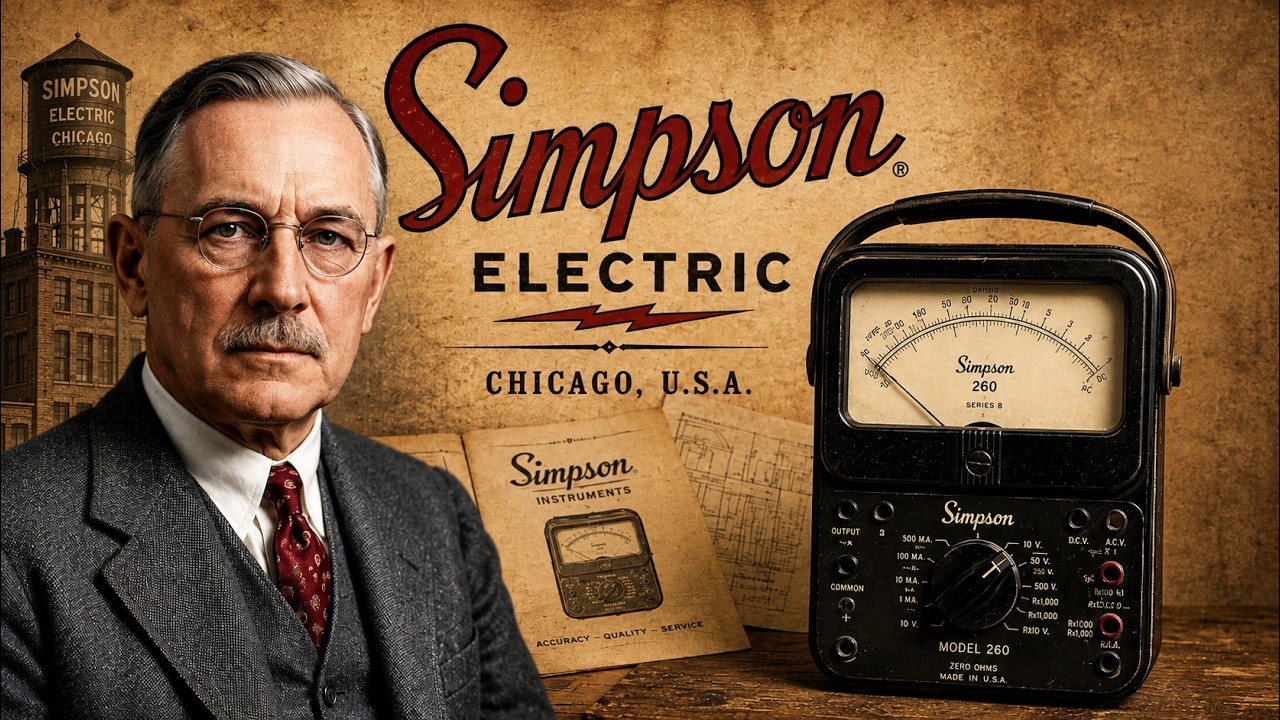
More than five million of these meters were sold. For forty years, from the end of World War II to the mid-1980s, the Simpson 260 was the first instrument American technicians reached for. Radio repairmen used it. Television servicemen used it.
Electricians, telephone linemen, avionics mechanics, and the engineers who built the guidance systems for the Apollo spacecraft used it. In 1939, twenty-seven dollars bought a volt-ohm-milliammeter with six voltage ranges, six current ranges, three resistance ranges, and a meter movement so precise that an experienced hand could read it to half a division. The needle swinging across a printed scale in response to an invisible current became the most trusted motion in American electronics. The company that made it was founded in Chicago by a man who had already spent two decades inside the precision instrument industry.
By the early 1920s, Ray Simpson was president of the Jewell Electrical Instrument Company, an established name in meters and panel instruments. At a time when the American electrical industry was still finding its shape, Jewell built instruments for utilities, factories, and the growing radio market, and Ray Simpson ran the operation. In 1931, Jewell was sold to the Weston Electrical Instrument Company, and Ray Simpson was out. Five years passed.
In 1936, he chartered a new company in Chicago under his own name. He was not starting from nothing. He was starting from everything he had learned across two decades, with the conviction that the market for portable test equipment was about to explode. What he saw more clearly than the established players was that the market was shifting from the laboratory bench to the field.
The people who would need meters in the coming decade were not scientists. They were repairmen, and they needed something they could carry in one hand. Simpson Electric Company opened with a single ambition: build portable, accurate, affordable test instruments for the working technician. In the late 1930s, that technician was everywhere.
The number of commercial radio stations in the United States had grown from nothing to over seven hundred in barely fifteen years, and every household with a radio set was a potential service call. In 1939, Simpson introduced the Model 260 volt-ohm-milliammeter. The price was twenty-seven dollars. For that sum, a technician received a handheld instrument weighing three pounds, enclosed in a Bakelite case.
It offered six ranges of DC voltage, six ranges of AC voltage, DC current ranges from one hundred microamps to five hundred milliamps, and three resistance ranges. The accuracy was three percent of full scale, and the sensitivity was high enough to measure circuits without distorting the reading. The heart of it was a D’Arsonval moving-coil meter movement. The precision of its jeweled bearings, the calibration of its hairspring, the linearity of its deflection was what separated a Simpson from the cheaper instruments crowding the market.
Every component was handwired. There were no printed circuit boards. The competitors at that price point could not match the sensitivity. The competitors that matched the sensitivity could not match the price.
The Model 260 arrived into a market about to be consumed by a force larger than any company could plan for. In September 1939, five months after the meter’s introduction, Germany invaded Poland. By December 1941, the United States was at war, and the War Department needed test instruments by the tens of thousands. Simpson Electric converted to military production.
The Model 260, already proven as a rugged field-portable meter, became standard issue for military technicians maintaining radar sets, communications equipment, and avionics across every theater of the war. The same three-pound Bakelite case that a radio repairman carried to a house call in Chicago could survive a maintenance tent on a Pacific island. The meter required almost no modification for military service. The war did for the 260 what no advertising budget could have accomplished.
Tens of thousands of young American men learned electronics in uniform, and the instrument they learned on was more often than not a Simpson. When they came home, they brought the habit with them. A returning veteran who had traced faults in radar sets with a 260 did not need a sales pitch when he opened his own service shop on Main Street. He already trusted the needle.
By the early 1950s, there were tens of thousands of independent radio and television repair shops across the United States, and in a remarkable number of them, the meter on the bench was a Simpson 260. Growth brought pressure. Manufacturing was still centered in Chicago, where labor was tight and expensive. In 1946, Simpson purchased and converted an old school building in Lac du Flambeau, Wisconsin, a small community on the reservation of the Lac du Flambeau Band of Lake Superior Chippewa Indians, and turned it into a molding plant.
The decision was pragmatic. Rural Wisconsin offered labor, space, and lower costs. The fact that the plant sat on tribal land appeared in 1946 to be a footnote to a real estate transaction. Through the 1950s, the American living room became a showcase for consumer electronics, and the Simpson 260 became the instrument that kept it all running.
The needle on a Simpson did not bounce and hunt for its resting point. It swung to the reading and stopped with a damping so carefully calibrated that experienced hands could feel the health of a circuit in the character of the needle’s motion alone. A steady swing meant a good component. A slow drift meant a leaking capacitor.
A hard snap to the right meant a dead short, and you pulled the leads before you read the number. In the 1960s, NASA needed instruments that could operate in environments no commercial meter was designed to survive. Simpson developed fourteen different specialized cross-pointer instruments for the Apollo spacecraft. These meters displayed two independent measurements on a single dial using two needles mounted at right angles, allowing an astronaut or flight controller to monitor two variables simultaneously without scanning a second gauge.
In a spacecraft where every square inch of panel space was rationed and every misread instrument could be fatal, these meters represented the highest expression of what an analog indicating instrument could achieve. The instruments flew to the moon and appeared decades later as props in the 1995 film Apollo 13, accurate enough for Hollywood to use without modification. By the late 1960s, Simpson Electric had arrived at a position that appeared permanent. But one line buried in the product catalog hinted at what was coming.
In the 1960s, Simpson had introduced its first digital panel meters. The company that had built its empire on the moving needle had begun building instruments that did not need a needle at all. By the 1970s, Simpson Electric was the world’s largest manufacturer of electronic measuring instruments. The Elgin, Illinois factory employed eight hundred people.
The complex sprawled across seven and a half acres. Then in 1977, a company in Everett, Washington, did something that changed the entire test equipment industry beneath Simpson’s feet. Fluke Corporation introduced the 8020A, the first commercially successful handheld digital multimeter. The price was one hundred sixty-nine dollars.
It gave its reading as a number on a screen. No needle, no printed scale, no interpretation required. The 8020A did not kill the analog meter overnight. An analog needle was still superior for watching a fluctuating signal or sensing a trend.
But the market did not pause to appreciate the distinction. By the end of the 1980s, Fluke had sold more than a million handheld digital multimeters. Every electronics training program in the country began teaching students on digital instruments instead of analog ones. The generation that had learned on the Simpson 260 was retiring.
The generation replacing them had never touched a needle, and they did not miss what they had never known. Simpson tried to follow. The company introduced the Model 360, a digital volt-ohm-milliammeter designed to sit alongside the 260 in a technician’s toolkit. It was competent.
But competing with Fluke on digital ground required chip design and display technology. Simpson’s engineers understood meter movements, hairsprings, and the physics of a coil rotating in a magnetic gap. The skills did not transfer. Simpson Electric was no longer an independent company.
It was a division of American Gauge and Machine Company, a line item in a diversified industrial portfolio. Decisions about investment and product direction were made by people whose primary obligation was to the quarterly performance of the whole. Sales declined through the 1980s. The television repair trade that had sustained the 260 for three decades was dying, replaced by consumer electronics cheap enough to throw away rather than diagnose.
The military bought digital. Vocational schools taught Fluke. And the conglomerate that owned Simpson looked for someone willing to take it off the books. In 1985, the Lac du Flambeau Band of Lake Superior Chippewa Indians purchased Simpson Electric Company.
The molding plant on the reservation, opened in that converted school building in 1946, had been one of the community’s largest private employers for a generation. When the corporate parent decided to sell, the tribe decided to buy, not as a speculative investment, but as an act of economic self-determination. The purchase did not reverse the market. Nothing could.
What tribal ownership provided was something the corporate structure never possessed: patience. A tribally owned enterprise does not answer to quarterly earnings calls. Its purpose is employment, community health, and long-term economic stability for the people it serves. The Elgin factory, however, was beyond rescue.
The century-old buildings that had housed over a thousand workers at peak dwindled to twenty-eight employees by the time the facility closed in 2006. In May 2011, crews brought cranes to the seven-and-a-half-acre lot and took the buildings down piece by piece over five months. The bricks were crushed for fill material. The structural steel was sold as scrap.
Grass was planted where eight hundred people had once calibrated meter movements by hand. The entire company consolidated to Lac du Flambeau, a town of roughly three thousand people, operating with a workforce of about seventy. A company that had filled a seven-and-a-half-acre industrial complex now occupied two buildings on Simpson Avenue. But here is what did not die.
The Model 260 Series 8, with its taut-band suspension and mirrored dial, still ships from Lac du Flambeau to customers across the country and around the world. Simpson Electric produces over a thousand products and components per day. Its customers include the Department of Defense, NASA, aerospace contractors, telecommunications firms, power utilities, and the skilled trades. Every unit is assembled, tested, and calibrated in the United States, on a reservation in the Wisconsin Northwoods, by a workforce that reports to a tribal council rather than a corporate board.
The company is one hundred percent American manufactured, one hundred percent Native American owned, and it still builds the instrument that Ray Simpson introduced in 1939. The 260 endures because the analog meter does things that a digital display cannot. A swinging needle shows rate of change, direction, and instability in a way that a flickering row of digits cannot convey. In applications where the operator needs to sense a trend rather than capture a fixed value, the analog meter remains the superior instrument, and the engineers who specify equipment for power plants, water treatment systems, and industrial process control still know this.
Simpson Electric was not killed by the digital meter. It was abandoned by the corporations that treated it as a line item, and saved by a tribe that understood a company is worth what it builds. There is a factory on Simpson Avenue in Lac du Flambeau, Wisconsin. It is not a seven-and-a-half-acre complex in Elgin.
It does not employ eight hundred people. No demolition crew is coming for it. Inside on any given weekday, roughly seventy workers employed by the Lac du Flambeau Band of Lake Superior Chippewa Indians build analog meters and digital panel instruments that ship to the American military, to NASA, and to every sector of industry that still needs a needle behind glass.
