The English army was close behind them, and that alone drove the captives forward. On the fifth remove, the Indians marched as though fleeing for their lives, then stopped and chose their bravest men, sending them back to slow the English while the rest escaped. Then they set off again in a swift, furious march, old and young alike. Some carried their ancient, decrepit mothers; others carried people who could not walk.
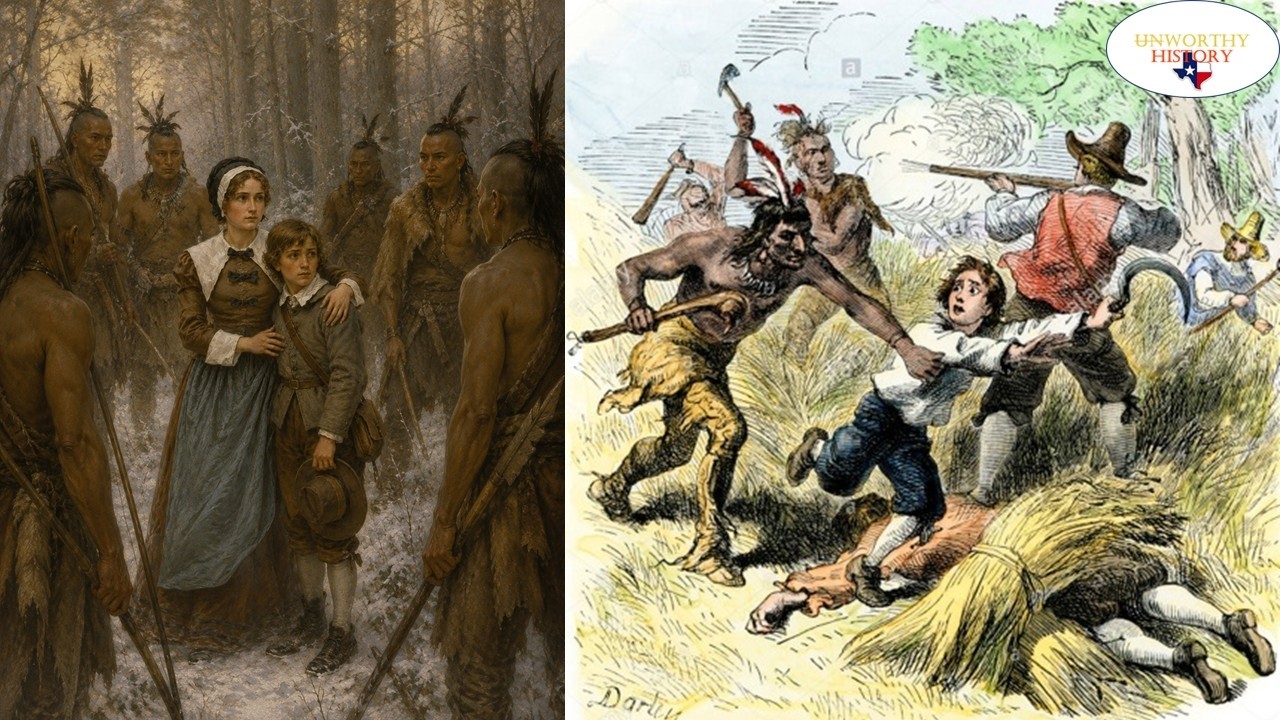
Four of them bore one huge Indian on a litter, but when they came to a dense thicket they could not move quickly with him, so they took him on their backs and carried him one after another until they reached the Pawtucket River. They arrived at the river on a Friday, shortly after noon. When the whole company had gathered together, I thought to count them, but they were too many, and being in constant motion it was beyond my skill. In this journey, because of my wound, my burden was lightened somewhat.
I carried only my knitting work and two quarts of parched meal. Feeling very weak, I asked my mistress to give me one spoonful of the meal, but she would not give it to me until she had tasted it herself. They quickly cut dry trees to make rafts to carry them over the river, and soon my turn came to cross. By reason of some brush I had laid on the raft to sit upon, my feet did not get wet, while many at the other end were up to mid-leg in water, which I could not but take as a kindness from God to my weak body, the cold being so intense.
I had never before been acquainted with such actions or dangers. The words of Isaiah came to me: if you pass through the waters, I will be with you, and through the rivers, they shall not overflow you. Some of us crossed that night, but not all until the night after Saturday. On Saturday they boiled the leg of an old horse they had obtained, and we drank of the broth as soon as they thought it was ready.
When the broth was almost gone, they filled the pot again. In the first week of my being among them I hardly ate anything. In the second week I found my stomach very faint for want of food, and yet it was very hard to swallow their filthy trash. But in the third week, though I had thought how my stomach had formerly recoiled at this or that, and I would rather starve to death than eat such things, yet they became sweet and savory to my taste.
At that time I was knitting a pair of white cotton stockings for my mistress, and I had not worked on the Sabbath. When the Sabbath came, they bade me go to work. I told them it was the Sabbath and asked them to let me rest, promising to do double work the next day. They answered that they would break my face.
Here I could not but take notice of the strange providence of God in preserving these heathen. They were hundreds, old and young, some sick and some lame. Many carried their children on their backs. The greater part of us at that time were women, traveling with all their goods and baggage.
Yet they all got over that river. On Monday they set fire to their wigwams, and we departed. That very day the English army came behind them to that river and saw the smoke of their wigwams, and yet the river stopped them. God did not give them courage or activity to overtake us.
We were not yet ready for so great a mercy as victory and deliverance. If we had been, God would have found a way for the English to cross that river, just as he found for the Indians, with their women and children and all their baggage. Oh that my people had hearkened to me, and Israel had walked in my ways. I should soon have subdued their enemies, and turned my hand against their adversaries.
On Monday, as I said, they set fire to their wigwams and departed. It was a cold morning, and before us lay a great brook with ice on it. Some waded through it up to the knee and higher, while others walked until they came to a beaver dam, and I was among them, so that my feet were not wet, by the providence of God. I traveled that day mourning and lamenting, leaving farther my own country and traveling into a vast and desolate wilderness.
I understood something of Lot’s wife’s experience when she looked back. That day we came to a great swamp, and by it we took up our lodging that night. When I came to the top of the hill that overlooked the swamp, I thought we had come to a great Indian town, though there was no one but our company. The Indians were as thick as trees.
It seemed there were a thousand axes going at once. If one looked before him, there was nothing but Indians. Behind one, nothing but Indians. And so on both sides.
I myself in the midst, and no Christian soul near me. Yet how the Lord preserved me in safety. What an experience I had of the goodness of God to me and mine. After a night of anxiety and hunger there, we had a hard time the next day.
The swamp we slept by was like a deep dungeon. Before it was a high and steep hill. Before I got to the top of the hill, I thought my heart and legs and all would break and fail me, by reason of weakness and pain of body. It was a hard day of travel for me.
As we went, I saw a place where English cattle had been. It was a comfort to me, though a small one. Soon after, we came to an English road, which affected me so that I wished I could lie down there and die in peace. That day, a little after noon, we came to Squakeag, where the Indians scattered quickly through the abandoned English fields, gathering whatever they could find.
Some picked up wheat ears that lay on the ground. Some found Indian corn ears. Some found black beans, and others found wheat bundles frozen together, and they began to thresh them. I got two ears of Indian corn, and while I turned my back for a moment, one was stolen from me, which grieved me much.
At that time an Indian came to them carrying a basket with a horse’s liver in it. I asked him to give me a piece. He asked, surprised, whether I could eat horse’s liver. I told him I would try if he would give me a piece, and he did.
I laid the piece on the coals to roast. But before it was half roasted, they took half of it from me, and I was forced to take the rest and eat it as it was, with the blood running in my mouth. And yet it was a sweet mouthful to me. For to the hungry soul every bitter thing is sweet.
It seemed a solemn sight to me to see the wheat and corn fields deserted and ruined, and what remained of them became food for our merciless enemies. That night we had a supper of wheat. The next morning we were to cross the river, the Connecticut River, to meet King Philip. They had already carried over the burden of two boats.
It was my turn to cross next. But as my feet were on the boat to go aboard, sudden cries arose among them, and I was forced to step back, and instead of crossing the river, I had to go four or five miles northward. Some Indians ran one way, some another. The cause of this disturbance, I think, was their seeing some English scouts who were in the area.
During this march along the river at noon, the company stopped and sat down, some to eat and others to rest. While I sat among them reflecting on the past, my son Joseph came to me unexpectedly. We asked each other how we fared, bewailing our doleful condition and the great change that had come upon us. We had a husband, father, children, sisters, friends, relatives, a house and home, and many comforts of this life, but now we might say as Job said: naked came I out of my mother’s womb.
The Lord gave, and the Lord hath taken away. Blessed be the name of the Lord. I asked him whether he would read. He told me he would very gladly.
I gave him my Bible, and his eye fell upon that comfortable verse: I shall not die, but live, and declare the works of the Lord. The Lord hath chastened me sore, but he hath not given me over unto death. He said to me, look here, mother, have you read this? And here I may take occasion to mention one principal reason for my writing these lines: to declare the works of the Lord and his wonderful power in carrying us along and preserving us in the wilderness while under the hand of enemies, and returning us in safety again, and his goodness in putting many comfortable and suitable scriptures into my hands in my distress.
But to return to our story. We traveled until night, and in the morning we were to cross the river to Philip’s company. When I was in the boat, I could not but be amazed at the vast crowd of heathen on the bank on the other side. And when I came to shore, they all gathered around me, while I sat alone in the midst.
I observed they asked questions of one another, and laughed and rejoiced over their gains and victories. Then my heart began to fail, and I burst into tears, the first time I remember weeping before them. Though I had met much affliction, and my heart was many times ready to break, yet I could not shed one tear in their sight, but rather had been all that time in a maze and astonishment, like one stunned. But now I could say as in Psalm 137: by the rivers of Babylon, there we sat down.
Yea, we wept when we remembered Zion. There one asked me why I wept. I could hardly know what to say. But I answered that they would kill me.
He said to me, no, none will hurt you. Then one came and gave me two spoonfuls of meal to comfort me. And another gave me half a pint of peas, which was worth more than many bushels at another time. Then I went to see King Philip.
He bade me come in and sit down, and asked me whether I would smoke. A usual compliment nowadays between good and bad. But this did not suit me at all, for though I had formerly used tobacco, I had left it off since I was taken captive. It seemed a bait the devil lays to make people lose their precious time.
I remember with shame how formerly, when I could smoke two or three pipes, I was ready for more. It is a bewitching thing indeed. But I thank God who has now given me power to withstand it. Surely there are many who could better spend their time than lying and sucking a stinking tobacco pipe.
The Indians now gathered their forces against Northampton. All night one of them cried and whooped to give notice of the design. And upon that they fell to boiling black beans and roasting corn for all who had provision. And in the morning they set out.
During my stay in this place, Philip asked me to make a shirt for his child, which I did, and he gave me a shilling for it. I offered the money to my master, but he bade me keep it. With it I bought a piece of horseflesh. Afterwards he asked me to make a cap for his child, and invited me to dinner for it.
I went, and he gave me a cake the size of two fingers. It was made of parched and ground wheat, fried in bear’s grease, but I thought I never tasted pleasanter food in all my life. There was a woman who asked me to make a shirt for her husband, and she gave me a piece of bear’s flesh for it. And another asked me to knit a pair of stockings, and she gave me a quart of peas for them.
I boiled the peas and bear’s flesh together, and invited my master and mistress to dinner. But that proud woman, because I served them in one dish, would not eat anything except one bit that he gave her upon the point of his knife. When I heard that my son had come to this place, I went to see him, and found him lying on the ground. I asked him how he could sleep so.
He answered that he was not sleeping, but praying, and lying so that they would not notice what he was doing. I pray God to remember these things. In this place, the sun being high, and by its beams and heat and the smoke of the wigwams, I thought I should be blinded. I could hardly distinguish one wigwam from another.
There was Mary Thurston of Medfield, who saw my condition and lent me a hat to wear. But as soon as I was gone, the Indian woman who owned Mary Thurston came running after me and took it back. Here was the woman who gave me one spoonful of meal. I put it in my pocket to keep it safe.
Yet someone stole it and put five Indian corn kernels in its place. Those kernels were the best provision I had in my journey for one day. The Indians returned from Northampton with some horses and sheep and other things they had taken. I begged them to take me to Albany on one of the horses and sell me for gunpowder.
For they had sometimes spoken of it. I had no hope of going home on foot the way I came. I could not bear to think of the many weary steps I had taken to come to this place. But instead of going to Albany or home, we had to go five miles along the river and then cross it.
We stayed here for some time. There lived here a miserable Indian who asked me to make him a shirt. When I had finished it, he paid me nothing, but since he lived near the river where I went to fetch water, I continually reminded him and demanded my wages. At last he told me that if I would make another shirt for a baby not yet born, he would give me a knife, and so he did when I had finished it.
I put the knife in, and my master asked me to give it to him. I was not a little glad that I had something they would accept and be pleased with. While we were in this place, my master’s servant came home. She had been away three weeks in the Narragansett country to fetch corn that they had stored in the ground.
She brought home with her about a bushel and a half of corn. This was about the time their great chief Nenant was killed in the Narragansett country. Since my son was about a mile from me, I asked permission to go and see him. They allowed me to go, so I set out, but I soon lost my way among the hills and swamps and could not reach him.
I could not but wonder at the great power and goodness of God to me, for though I was far from home and met with all sorts of Indians, people I did not know, and no Christian soul near me, yet none of them harmed me in any way. I returned and met my master again. He showed me the way to my son. When I came to him, I found him unwell, and he had a boil on his side that pained him greatly.
We shared our sorrow for a while as the Lord helped us, and then I returned again. When I came back, I found myself as unsettled as before. I kept wandering back and forth, groaning, and my spirit was ready to sink with thinking of my poor children. My son was sick, and I could not but think of his sorrowful looks.
And there was no Christian friend by him to do him any office of love, either for soul or body. As for my poor daughter, I did not know where she was, nor whether she was sick or well, alive or dead. Under these thoughts I turned to my Bible, which was my great comfort at that time. And my eye fell upon the verse: cast thy burden upon the Lord, and he shall sustain thee.
But I was forced to go and look for something to satisfy my hunger. And as I wandered among the wigwams, I went into one and found a woman who showed me great kindness and gave me a piece of bear’s flesh. I put it in my pockets and came home, but I had no chance to roast it, for fear they would take it from me. And there it lay all day and night in my stinking pockets.
In the morning I went to the same woman, who was boiling a pot of black beans. I asked her to let me boil my piece of bear’s flesh in her pot, and she did, and gave me some black beans to eat with it. I cannot but think how sweet it tasted to me. I had sometimes seen bear’s flesh well cooked among the English, and some liked it.
But the very thought of its being bear’s flesh made me tremble. But now it was so savory to me that one might think what I ate was enough to turn the stomach of any creature. On a very cold day, I found no place to sit by the fire. I went out, not knowing what to do, but I went into another wigwam where they were also sitting around the fire, and the woman spread a skin for me and asked me to sit down.
And she gave me some black beans and asked me to come again. She told me they would buy me if they were able. And yet these were strangers to me, I had never seen them before. That day a small part of the company moved about three quarters of a mile, intending to go further the next day.
And when they came to the place where they intended to lodge and had set up their tents, being hungry, I went back to the place where we had been before to get something to eat, encouraged by the kindness of the woman who had asked me to come again. While I was there, one of the Indians came looking for me, and when he found me, he kicked me all the way back. I came to my wigwam and found venison roasting that night, but they did not give me one piece. Sometimes I received good treatment, and sometimes I met with nothing but frowns.
The next morning they set out on their journey, intending to travel a full day along the river. I carried my pack on my back, and soon we came to wade through the river, and we crossed weary and tiresome hills. One hill was so steep that I had to climb on my knees and hold onto branches and bushes to keep myself from falling backward. My head was also so light that I usually staggered as I walked, but I hope all these weary steps I took were but a foretaste of heavenly rest.
I know, O Lord, that thy judgments are right, and that thou in faithfulness hast afflicted me. It was on a Saturday morning that they prepared to leave. That morning I asked my master whether he would sell me to my husband. He answered yes, which cheered my spirit greatly.
My mistress, before we left, had gone to attend the burial of a child, and when she came back she found me sitting and reading in my Bible. She snatched the book from my hand quickly and threw it out the doors. I ran out and picked it up and put it in my pocket and never let her see it again. Then they packed up to leave and gave me my burden.
I complained that it was too heavy, and she slapped my face and ordered me to move. I lifted my heart to God, hoping that deliverance was not far off, especially since their insolence was growing worse. But the thoughts of going home, which was our direction, cheered my spirit and made my burden seem light and not worth mentioning. But to my great surprise and confusion, the tables were soon turned.
For when we had gone a short distance, my mistress suddenly stopped walking. She refused to go further and turned back, saying I must go back with her. She called her son and wanted him to come back too, but he refused and said he would continue on and return to us in three days. I confess my spirit was then in the greatest distress, and I was nearer to losing my wits than ever before.
I thought death was easier for me than going back. I cannot describe the troubles I was in, but I had to go back. As soon as I had opportunity, I took my Bible to read, and my hand fell upon that soul-comforting verse: be still, and know that I am God. My spirit calmed at that moment, but I knew I would have a hard time of trial, especially after my master left, who seemed to me the best friend among the Indians, both in cold and hunger, and it soon proved so.
I sat down with a heavy heart, and yet I was so hungry I could not stay still, so I went out to look for what I could find, and as I walked among the trees I found six acorns and two chestnuts, which were my provisions. When night came, I gathered some wood to warm myself so I would not suffer from the cold. But when it was time to sleep, they ordered me to go out and sleep elsewhere, saying they had more guests than the place could hold. I told them I did not know where to go.
They ordered me to find a place. I said that if I went to another wigwam, they would be angry and send me back to them again. Then one of them drew his sword and said he would stab me with it if I did not leave at once. I was then forced to obey this rude man and go out in the dead of night without knowing where to go.
I saw that man afterward wandering in Boston disguised as a friendly Indian, he and others like him. I went to a wigwam and they told me they had no room. Then I went to another and they said the same. At last an old Indian invited me to come to him, and his wife gave me some black beans.
She also gave me something to put under my head, and we made a good fire. And by the providence of God, I had a comfortable lodging that night. In the morning, another Indian asked me to come at night, promising me six black beans, which I did. At that time we were in a place about two miles from the Connecticut River.
We went in the morning to gather black beans at the river and returned in the evening. I walked carrying a heavy burden on my back, because when they move, even a short distance, they take all their goods with them. I told them my back was raw, but I got no comforting answer, only that it did not matter if I lost my head too. Instead of heading toward the Bay as I had hoped, I was forced to go with them five or six miles down the river to a thick wood, where we stayed about two weeks.
Here a woman asked me to make a shirt for her child, and for it she gave me a dish of broth, thickened with flour made from tree bark. To improve the taste, I put in a handful of peas and a few roasted black beans. I had not seen my son for a while, and there was an Indian I asked about him, inquiring when he had last seen him. He answered that his master had roasted him sometime, and that he himself had eaten a piece of him the size of two fingers, and that it was good meat.
But the Lord strengthened my spirit against this discouragement, and I considered their terrible addiction to lying, and that there was not one of them who felt the least twinge of conscience about telling the truth. In this place, on a cold night while I lay by the fire, I moved a branch that was blocking the heat from me. A woman put it back, and when I looked at her, she threw a handful of ashes in my eyes. I thought I would be completely blinded and never see again, but as I lay, tears ran from my eyes carrying the dust with them, and by morning I had my sight again.
And yet on such occasions, I hope it is not too much to say with Job: have pity upon me, have pity upon me, O ye my friends, for the hand of God hath touched me. And here I cannot but remember how often, while I sat in their wigwams reflecting on the past, I would suddenly jump up and run outside as if I were at home, forgetting where I was and what my condition was. But when I went out and saw nothing but wilderness and woods and a crowd of savage heathen, my mind quickly returned to me, which made me think of what was said of Samson, who said, I will go out and shake myself as at other times, but he did not know that the Lord had departed from him. About this time I began to think that all my hopes of returning would come to nothing.
I thought of the English army and considered their coming and being rescued by them, but that did not happen. I considered being taken to Albany as the Indians had discussed before, but that also failed. I thought of being sold to my husband as my master had mentioned, but instead my master himself left and I remained, until my spirit was almost entirely broken. I asked them to let me go out to gather some wood, so that I could be alone and pour out my heart before the Lord.
Then I took my Bible to read, but I found no comfort in it, which I used to find so often. It is easy for God to dry up the springs of comfort in the Bible from us. Yet I cannot say that God, in all my sorrows and afflictions, left me to let my patience turn against him, as if his ways were unjust. But I knew he had brought less upon me than I deserved.
Afterward, before this gloomy time ended with me, I was turning the pages of my Bible, and the Lord led me to some verses that refreshed me a little, as in Isaiah 55:8, for my thoughts are not your thoughts, neither are your ways my ways, saith the Lord. And also in Psalm 37:5, commit thy way unto the Lord, trust also in him, and he shall bring it to pass. About this time they came crying from Hadley, where they had killed three Englishmen and brought a captive with them, named Thomas Reed. They all gathered around the poor man, asking him many questions.
I also wanted to go see him, and when I came he was weeping bitterly, thinking they would kill him quickly. So I asked one of them whether they intended to kill him. He answered that they would not. And after he was a little reassured by that, I asked him about my husband.
He told me he had seen him at that time in the Bay, and that he was well but very dejected, which made me know for certain, despite my former doubts, that all the Indians had told me about him was false and lies. Some of them had said he was dead, and that they had killed him. And some said he had married again, and that the governor wished him to marry, and told him he had freedom of choice, and that everyone had persuaded him that I was dead. How much these savage creatures resembled him who was a liar from the beginning.
As I sat one time in the wigwam here, Philip’s maidservant came in carrying a child and asked me to give her a piece of my apron to make a cover for it. I told her I would not. Then my mistress ordered me to give it to her, but I said no again. The maidservant said that if I did not give her a piece, she would tear a piece off it.
I told her I would tear her coat then. At that, my mistress got up and took a stick big enough to kill me and struck at me with it. But I stepped aside and the stick went into the mat of the wigwam. And while she was trying to pull it out, I ran toward the maidservant and gave her my whole apron.
And so that storm passed in peace. When I learned that my son had come to this place, I went to see him and told him that his father was well but dejected. He told me he was as sorry for his father as for himself, and I wondered at his words, for I thought the cares I had in my own heart were enough to make me forgetful of my husband and of everyone else, as long as they were safe among their friends. He also told me that a while before, his master, with other Indians, was going toward the French to get gunpowder, but on the way the Mohawks intercepted them and killed four of their company, which made the rest turn back.
So perhaps his condition would have been worse if he had been sold to the French than it turned out to be for the rest of his time with the Indians. I went to see a young Englishman in this place, named John Gilbert of Springfield. I found him lying outside on the ground. I asked him how he was.
He told me he was very sick of the flux by eating too much blood. They had turned him out of the wigwam with an Indian child who was almost dead, whose parents had been killed on a bitter cold day, with no fire and no clothes. The young man had nothing on but a shirt and waistcoat. This sight was enough to melt a heart of stone.
They lay there, shivering with cold. The young man writhed like a dog. The child lay with its eyes, nose, and mouth full of dirt, and yet it was still alive and groaning. I advised John to go and get to some fire.
He told me he could not stand, but I urged him, for fear he would stay there and die. And with much difficulty I brought him to the fire, and returned to my home. As soon as I came home, his master’s daughter followed me to know what I had done with the Englishman. I told her I had brought him to a fire in that place.
At that moment I needed to pray Paul’s prayer, that we might be delivered from unreasonable and wicked men. To please her, I went with her and took her to him. But before I came home again, word spread that I was running away and taking the young Englishman with me. And as soon as I came in, they began to cry out and take control, and asked me where I had been and what I had been doing.
And they said they would hit him on the head. I told them I had been to see the young Englishman, and that I would not run away. They accused me of lying, and one of them took an axe and came near me, threatening to strike me if I went out again. And so they confined me inside the wigwam.
Now I could say with David, I am in a great strait. If I stay inside, I will die of hunger, and if I go out, I will be struck on the head. This miserable condition lasted that day and half the next day. Then the Lord remembered me, whose mercy is great.
Then an Indian came to me with a pair of stockings that were too big for him, and wanted me to unravel them and knit them to fit him. I showed my willingness and asked him to ask my mistress whether I could go with him a little way. She said, yes, you may. But I was greatly relieved to hear that news, that I had regained my liberty again.
Then I went with him, and he gave me some roasted black beans, which revived my weak stomach. And as soon as I was out of her sight, I had time and liberty to look into my Bible, which was my guide by day and my pillow at night. Then that comfortable verse appeared before me: for a small moment have I forsaken thee, but with great mercies will I gather thee. And so the Lord supported me from time to time, and fulfilled this precious promise and many others to me.
Then my son came to see me, and I asked his master to let him stay with me for a while, so I could comb his hair and care for him, for he was covered with lice. He told me when I was done that he was very hungry, but I had nothing to give him, so I asked him to go into the wigwams as he walked, to see if he could get something. And so he did, and he seems to have been gone a little long, and his master was very angry with him and beat him, and then sold him. Then he came running to me to tell me he had a new master, and that he had already given him some black beans.
So I went with him to his new master, who told me he loved him and that he would not want for anything. His master took him away, and I did not see him again for the rest of the captivity, until I met him at Piscataqua, in the town of Portsmouth. That night they asked me to leave the wigwam again. My mistress’s child was sick, and it died that night, and there was one benefit in that, which was more room.
I went to a wigwam, and they asked me to come in, and gave me a skin to lie on, and a meal of venison and black beans, which is a special dish among them. And the next day they buried the child, and afterward, morning and evening, company came to mourn and wail with her. And yet I confess I could not comfort them much. I spent many sad days in this place, and often withdrew by myself.
Like a crane or a swallow, so did I chatter. I did mourn as a dove. Mine eyes fail with looking upward. O Lord, I am oppressed.
Undertake for me. I could say to the Lord, as Hezekiah did: remember now, O Lord, I have walked before thee in truth. Now I had time to examine all my ways. My conscience did not accuse me of wronging anyone, and yet I knew how negligent I had been in my walk with God.
As David said: against thee, thee only, have I sinned. And I would say with the poor publican: God be merciful to me a sinner. On the Sabbath days I would look at the sun and think of people going to the house of God to have their souls refreshed and their bodies rested, while I was deprived of both. And I would say as the prodigal son: he would fain have filled his belly with the husks that the swine did eat, and no man gave unto him.
So I must say with him: father, I have sinned against heaven and before thee. I remembered how on the nights before and after the Sabbath, when my family and relatives and neighbors were around me, we prayed and sang, and then refreshed our bodies with the good gifts of God, and lay down on a comfortable bed. But instead of all this, I had only a little scanty food, and I had to sleep on the ground like a pig. I cannot express to man the sorrow that weighed upon my spirit.
The Lord alone knows it. And yet that comforting verse often came to my mind: for a small moment have I forsaken thee, but with great mercies will I gather thee.
