A woman sat before a candle in a London parlor in 1876, reading. Two days earlier she had doused her hair in kerosene to kill the lice that had taken up residence there. She believed she had rinsed it out thoroughly. A strand came loose from her pins and fell forward, brushing the flame.
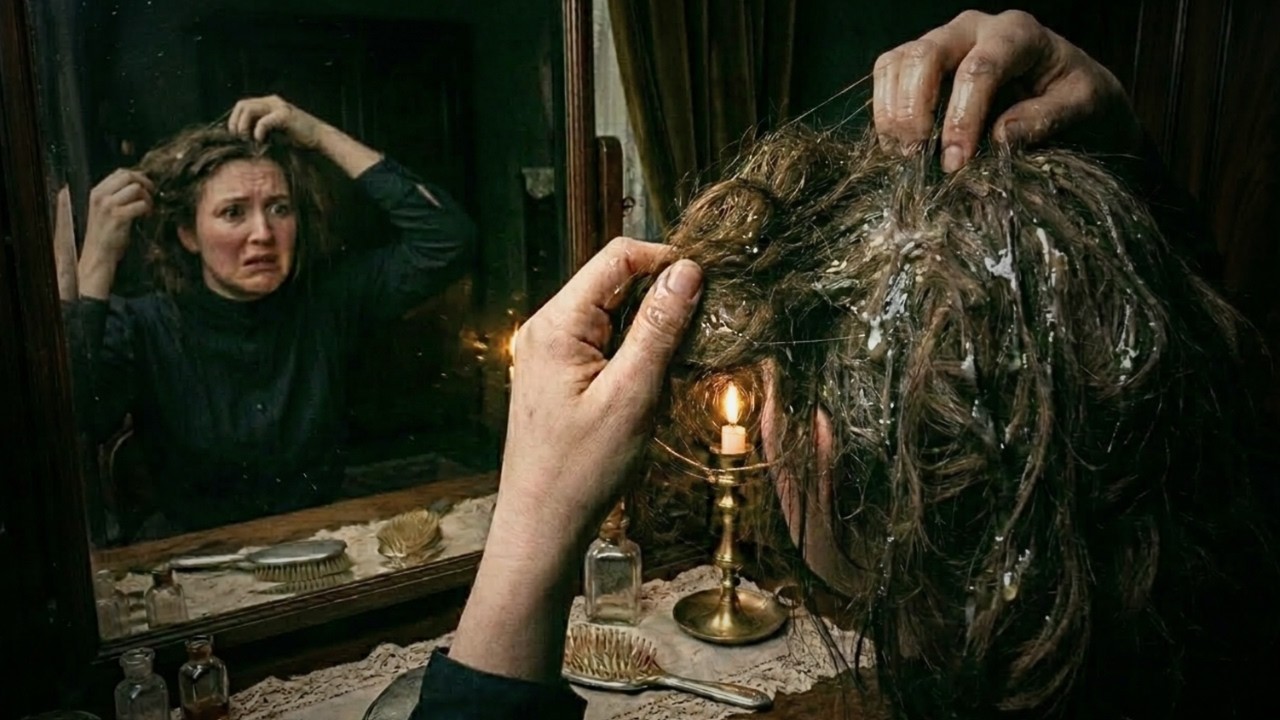
It ignited instantly. Within seconds her entire head was on fire. Her family managed to extinguish the flames, but she suffered severe burns to her scalp, face, and hands. An infection set in.
Three weeks later she was dead. She had been trying to get rid of lice. She died because the only working treatment for a parasite infestation was incompatible with a world lit entirely by open flames. It is difficult to grasp how far the Victorian relationship with water had drifted from anything resembling cleanliness.
To understand the hair, one must first understand the bath. Imagine no shower, no bathroom, no turning on anything. In Victorian England, if you wanted a bath, someone had to haul bucket after bucket of water from a well or pump, then heat those buckets over a fire, a process that could take hours. All that effort just to fill a small metal tub in which you would crouch, knees to your chest, like sitting in an oversized cooking pot.
Wealthier women had hip baths, shallow tubs holding only the bottom and hips. Picture washing yourself in a large cold metal bowl in your bedroom, shivering, because there was no central heating and it was the middle of an English winter. The medical establishment made matters worse. From the 1840s through the 1880s, medical journals published article after article cautioning women about the dangers of water on skin.
A prominent physician wrote in 1854 that frequent bathing could strip the body of its natural oils and protective barriers, leaving a woman vulnerable to consumption, rheumatism, and nervous disorders. Consumption, of course, was the era’s word for tuberculosis. Another medical expert claimed that water could open the pores too widely, allowing disease to enter the body directly. The logic treated pores as little doors; bathing flung them wide open for illness to march in.
These were respected physicians publishing in legitimate journals, teaching at prestigious universities. Women believed them. So Victorian women improvised. The most common method was the sponge bath, sometimes called a cat bath, a term they actually used.
You poured a small amount of water into a basin, took a cloth or sponge, and quickly wiped down what they called the critical areas: face, neck, underarms, and the private regions. The water was cold, because heating it was such a hassle, and the process was done quickly, because lingering undressed, even in your own bedroom, was considered improper and dangerous. Standing in a freezing bedroom, goosebumps covering your body, frantically wiping yourself with a cold damp cloth, trying to finish before you caught your death of cold, because they also believed that being naked and wet could cause pneumonia. Most Victorian women bathed fully about once a week if they were middle class, once a month if they were wealthy and following medical advice, and almost never if they were poor.
Lady Charlotte Thornberry kept detailed journals in the 1860s recording that she took a full bath exactly four times a year, once per season. She scheduled these baths around important social events, treating them as a special occasion. She was not unusual; she was normal. The rest of the year consisted of sponge baths, powder, and truly alarming amounts of perfume.
Undergarments acted as protective layers between skin and clothing. Dress shields were sewn into the underarms of dresses to absorb sweat. When all else failed, there was perfume, lots of it. If the bathing situation was bad, the hair was worse.
Commercial shampoo did not exist until 1890. For the entire Victorian era, there was no shampoo, no conditioner, no hair care aisle. For most women, washing their hair once a month was considered perfectly acceptable. The most popular method, documented in dozens of beauty manuals, was to crack raw eggs over your head.
Depending on hair length, you would break anywhere from three to six eggs, work the yolk through your hair like making a particularly disgusting omelet, and rinse it out with pitchers of water. An 1860s beauty manual titled The Lady’s Guide to Beauty and Comportment devoted an entire chapter to egg hair washing. The author wrote that the egg yolk contains natural oils which leave the hair soft and manageable, but one must take care to rinse thoroughly with tepid water, never hot, as hot water would cook the egg and leave one in a most unfortunate predicament. Eggs were only one option.
Vinegar was incredibly popular, not a splash of apple cider vinegar as a rinse, but straight vinegar, the kind that made your eyes water. Women diluted it slightly and poured it through their hair, believing it would cut through oil and add shine. Technically they were not wrong; vinegar is acidic and helps remove buildup. But the smell lingered for days.
Some women added rose petals or lavender to the mixture, which helped, but not much. There was also the rum method. Women, particularly those of Caribbean or colonial backgrounds, washed their hair with rum mixed with water, the theory being that alcohol would dissolve oils. The reality was that you smelled like a brewery and felt light-headed from the fumes in a poorly ventilated bedroom.
A diary entry from 1867 by a young woman named Constance Baker described her first attempt: “Mother insisted I try the rum method she learned from Mrs. Patterson who swears by it. I confess I may have used too much rum and not enough water. By the time I finished, I felt quite dizzy and had to lie down.
Father asked at dinner if someone had been drinking in the house. Most mortifying. ” Then there was the tea method: brewing extremely strong black tea, letting it cool, and pouring it through the hair. The tannins supposedly added shine and darkened the hair slightly.
The problem was that tea stains everything: hair, scalp, forehead, neck, clothing. None of this happened frequently. Once you had endured the ordeal of washing your hair with eggs or rum or vinegar, the cold water, the dripping mess, the smell, you did not want to repeat it soon. Most Victorian women washed their hair once a week if particularly fastidious, once every two weeks if average, once a month if following the beauty standards of the time, and some went even longer.
Thirty days between hair washes was not considered gross or unusual. It was normal, what respectable ladies did. The reason lay in the architecture of Victorian hairstyles, and architecture was the right word. Styles called Apollo knots, psyche knots, and chignon arrangements were engineering projects.
Women sectioned their hair, twisted it, braided it, coiled it around pads and frames, pinned it with dozens of hairpins, and created gravity-defying structures on top of their heads. A complex style could take two to three hours to build. Once styled, you absolutely did not want to take it down, because recreating it meant another three hours of work the next day. The solution was simply not to take it down.
Women slept on special small, hard pillows that went under the neck rather than the head, preserving the hairstyle through the night at the cost of any comfortable sleep. In the morning they would assess the damage, smooth stray wisps, repin what had shifted, tuck in loose hairs, and wear the same style again. An etiquette book from 1875 codified the practice: “A lady should not disturb her coiffure more than once per week unless attending multiple social engagements of great importance. The nightly ritual should consist merely of smoothing any stray wisps and ensuring pins remain secure.
”
For six days at a time, women slept in yesterday’s hairstyle on unwashed hair and unwashed scalps, in an era before proper ventilation or air conditioning. A diary entry from 1871 by a woman named Caroline Brooks captured the dilemma: “My hair has become so heavy with oil that the pins barely hold, yet I cannot bring myself to wash it before Saturday, as I have three social engagements this week and cannot appear with my hair in disarray. I have added more pins and applied perfume powder to the roots, which helps somewhat. ” She knew her hair was dirty.
She was uncomfortable. The social pressure to maintain the perfect hairstyle outweighed her desire to be clean. Between washes, women used powder to manage the accumulating oil. This was not dry shampoo as it exists today.
It was actual powder: starch, cornstarch, ground orris root, sometimes plain flour, rubbed directly into the scalp. The theory was sound, powder absorbs oil, then you brush it out taking the grease with it. The reality was that the powder mixed with oils, sweat from corsets and multiple layers of clothing, and dead skin cells accumulating on the scalp, and created a paste. A gritty, perfumed, oily paste that sat at the roots and never fully brushed out.
Imagine using too much dry shampoo and feeling dusty and weird, then multiply that by a hundred, sitting on your scalp for six days until the weekly rearrangement. Victorian beauty manuals also recommended brushing the hair one hundred strokes every night before bed. In theory, brushing distributes natural oils and keeps hair healthy. The problem was what those strokes distributed in Victorian hair.
The scalp had powder paste on it, but that was not all. Victorian cities were filled with coal smoke from fireplaces, factories, and steam engines. Soot settled on everything, including hair. Gas lamps inside homes produced their own grimy residue.
Dead skin cells, sweat, perfume sprayed to mask smells, all of it built up day after day. Every night women pulled their brushes through their hair one hundred times, distributing the powder paste, coal dust, lamp soot, dead skin, dried sweat, and perfume residue from roots to ends. An 1870 beauty manual described the process with enthusiasm, instructing readers to apply powdered orris root to the roots, allow it to absorb the natural oils, then brush vigorously to distribute the beneficial essences throughout the hair, nightly, to maintain lustrous locks. They thought the grime was beneficial.
Unwashed hair covered in powder paste and worn in elaborate styles for days at a time created the perfect environment for tiny visitors. Head lice were endemic in the Victorian era, so common they were expected, no more embarrassing than catching a cold. A letter preserved in the Bodleian Library archives, written in 1872 by a young woman named Margaret to her cousin Julia, made this devastatingly clear: “I confess to you in confidence, dear Julia, that my scalp itches abominably, and I fear I may have acquired uninvited guests from sitting too near Miss Thornton at the musical last week. Mother says I must endure until the monthly wash, as too frequent washing will damage my hair.
But I’m in such distress I can barely sleep. Please do not tell anyone of my condition, as I should die of shame. ”
Margaret knew she had lice. She knew she had acquired them sitting close to someone at a social event a week earlier.
Her scalp itched so badly she could not sleep. Her mother’s response was to wait until the monthly wash, because washing more frequently would damage her hair. The fear of damaging hair through washing outweighed the reality of insects living on her head. Margaret’s letter also reveals how lice spread: social gatherings were transmission events.
When women sat close together at concerts, tea parties, and church, lice crawled from one head to another. Because everyone’s hair was unwashed and elaborately pinned, the parasites found perfect hiding spots in all those coils and twists. The powder paste gave them texture to grip. The infrequent washing let them establish, lay eggs, and multiply without disruption.
A fine-tooth comb designed to catch lice and eggs was essential equipment in every Victorian household, not because it was unusual to need one, but because it was routine. Women would sit, comb through sections of hair, pull out lice, crush eggs between their fingernails, pin the hair back up, and go about their day. When the itching became unbearable and waiting for the monthly wash was not an option, there was one treatment that actually worked: kerosene. Lamp oil.
The same flammable petroleum liquid that powered their lamps. Women poured it directly onto their hair and worked it into their scalps to suffocate the lice. The smell was overwhelming, sharp, chemical, oily, and because they could not wash frequently, it lingered for days. But the smell was the least of the problems.
Victorian homes were lit entirely by open flames: gas lamps on walls, candles on tables and mantles, fireplaces in every room. Household manuals warned, “Rinse thoroughly with water to remove all traces of the kerosene before approaching any flame. ” But thoroughly rinsing meant using a lot of water, and getting water was difficult and time-consuming. Kerosene is oily and clings; it does not rinse out easily, especially with cold water and no soap designed to cut through petroleum.
Women walked around with residual kerosene in their hair, in homes full of flames, and sometimes their hair caught fire. Victorian newspapers carried reports of these accidents with disturbing regularity. The headlines followed a standard format: “Tragic conflagration, lady’s coiffure ignites during evening assembly,” or “Unfortunate incident, poor woman’s hair catches flame whilst reading by lamplight. ” Hair fires from kerosene lice treatment were common enough to have their own headline formula.
The 1876 account of the woman reading by candlelight, whose hair ignited and killed her three weeks later through infection, was one such report. She was trying to get rid of lice. She died because the treatment for a parasite infestation was incompatible with the way Victorian homes were lit. Women knew the risk.
They read the newspaper accounts. They knew kerosene near flames was dangerous. But the itching was unbearable, the lice were multiplying, and kerosene was the only treatment that worked. They weighed the certainty of continued suffering against the possibility of their hair catching fire, and often they chose the kerosene.
Hair loss was another consequence of this abuse. The chemicals, the infrequent washing, the tight pinning pulling at roots, the scalps never properly cleaned, all of it caused Victorian women to lose their hair at alarming rates. In a society that called hair a woman’s crowning glory and tied feminine worth to long lustrous locks, going bald was unacceptable. So they bought hair.
Other people’s hair. Dead people’s hair. Women losing their hair could purchase what were called switches, rats, or transformations: hairpieces made from real human hair, pinned into their own hair to add volume, length, or coverage. These were substantial pieces, sometimes entire wigs’ worth.
The hair came from two primary sources. The first was poor women who sold their hair to survive, growing it long and selling it to hair merchants for enough money to buy a week’s food or pay a month’s rent. The merchants traveled through poor neighborhoods, bought hair cheaply from desperate women, and sold it at a massive markup to manufacturers who processed it into hairpieces for wealthy clients. The second source was the recently deceased.
Shops in London, Paris, and New York openly advertised hair harvested from corpses, presenting it as a premium product. An advertisement from an 1880s London hair merchant read: “Finest human hair available, recently acquired from respectable sources. Various shades available. Note, suitable for ladies desiring fashionable transformations.
” Respectable sources meant morgues, hospitals, funeral homes, places where bodies were prepared for burial. Before a woman was placed in her coffin, her hair would be cut off and sold. The advertisements boasted that hair from the recently deceased was superior quality because, as one actual advertisement put it, “It has not been damaged by washing or styling. ” The lack of hygiene was a selling point.
Victorian women read these advertisements, knew what they were buying, and bought it anyway, because society demanded long thick hair, and if you could not grow it yourself, you wore someone else’s, even if that someone was a corpse. Picture the result: a Victorian woman with her own hair unwashed for three weeks, coated in powder paste, probably with lice. Pinned into that hair, woven through it, blended with it, is a hairpiece made from a dead woman’s hair, cut from a corpse in a morgue, sold to a merchant, processed in a factory, pinned onto a living woman’s head. She does not take any of it down for days.
She sleeps with it. The dead hair and the living hair and the lice all together in an elaborate architecture, held in place with dozens of pins, resting on that hard neck pillow. Beauty manuals gave extensive instructions on how to blend false hairpieces with natural hair, how to pin them securely, how to style them seamlessly. An 1875 beauty guide recommended: “For ladies experiencing hair loss, a well-constructed transformation can restore the appearance of abundant locks.
Select a shade that closely matches your natural hair. Ensure to secure it with sufficient pins to withstand the rigors of daily wear. ” Not once did these manuals express hesitation or disgust about wearing corpse hair. It was presented as a practical solution to a common problem.
This was not ancient history. It was a century and a half ago. Women washed their hair once a month, if that, with raw eggs, vinegar, or rum. They wore elaborate hairstyles for a week at a time without taking them down.
They rubbed powder into their scalps, creating a gritty paste that never fully brushed out. They dealt with lice infestations so common they were considered normal. When the lice became unbearable, they poured kerosene on their heads and risked burning to death in homes lit by open flames. When their hair fell out from all this abuse, they pinned in hairpieces made from corpses and called it beautiful.
Then commercial shampoo arrived in 1890. Germ theory became accepted. Public health reforms happened. Women demanded better, and slowly, painfully slowly, things improved.
Behind every elegant photograph from the era was a woman with unwashed, lice-infested hair who smelled like kerosene and vinegar, wearing dead people’s hairpieces and calling it crowning glory.
