The biting chill of a German winter gnaws through a heavy wool coat. Hands caked in frozen mud and engine grease fumble with the icy metal of a standard-issue canteen. It is February 1945, at a Third Army water supply depot near Trier, Germany. The air is thick with the acrid stench of diesel exhaust and damp earth.
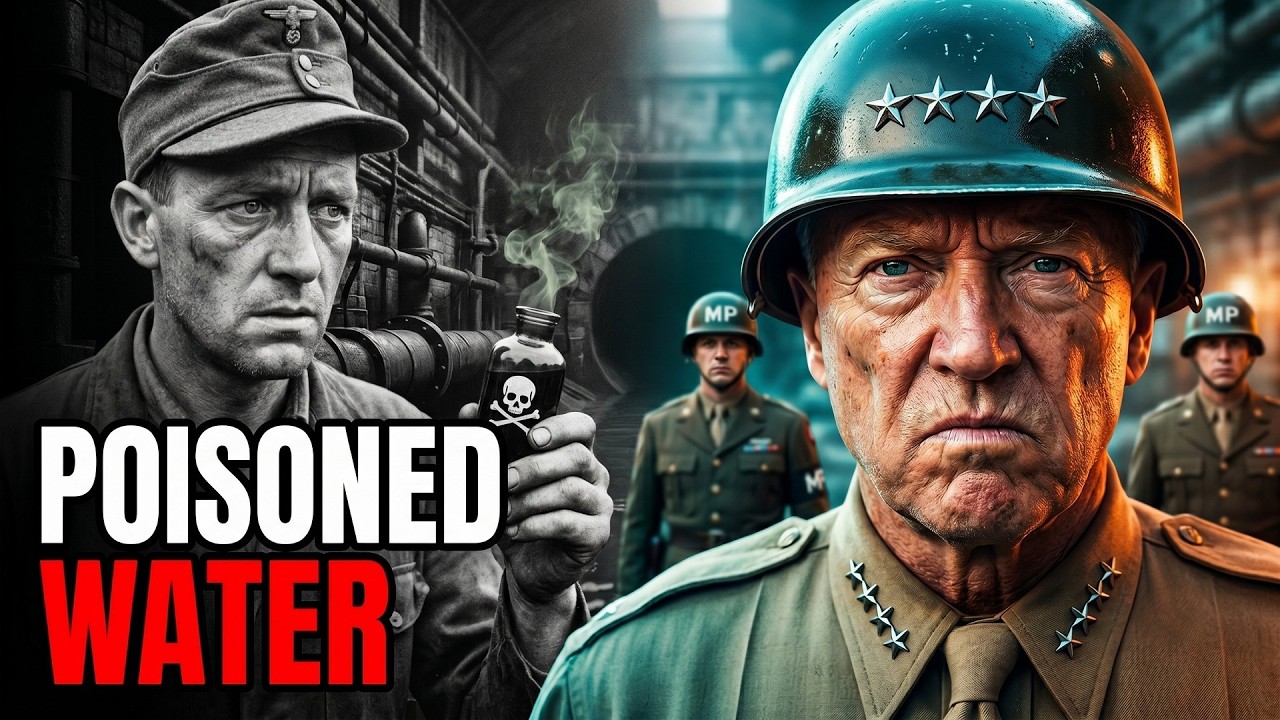
A man has not slept in two days. All he wants is a long, deep drink to wash down the chalky, dry field rations burning his throat. He falls into line with the other exhausted men. The water rushing from the heavy iron pipe looks clean.
He presses the tin to his cracked lips and drinks deeply. The freezing liquid hits his stomach like absolute salvation. Then the world abruptly tilts. The cold in his gut twists into a sudden, white-hot fire.
The canteen slips from numb fingers, clattering against the frozen mud. He drops to his knees, gasping for air that refuses to fill his lungs. A violent heave tears through his chest. Through the ringing in his ears, he hears the heavy thud of bodies hitting the ground beside him.
Five other men are writhing in the dirt, their skin rapidly fading to a sickly, unnatural gray. His muscles convulse in sudden agony. He is drowning on dry land. An invisible enemy is tearing men apart from the inside out, striking down hundreds without firing a single bullet.
The ancient city of Trier had fallen, but the sheer speed of the American advance had brought massive logistical chaos. Frontline combat units pushed deep into enemy territory faster than rear guard units could secure the newly occupied zones. Across the western border of the German Reich, infrastructure lay completely ruined. Water mains were shattered by relentless artillery, power grids were dead, and local municipal governments vanished into thin air.
To keep thousands of forward soldiers fighting, the American military had to rely on existing German facilities and the local civilian workers who knew how to run them. This frantic pace created dangerous security holes. The army desperately needed plumbers, mechanics, and engineers. Overwhelmed American administrative clerks rushed through mandatory denazification paperwork, signing official clearance forms for thousands of local civilians after only a few brief questions.
If a local man knew how to fix a high-pressure valve, he received an identification badge. Sector commanders let these administrative shortcuts slide because their absolute top priority was keeping the water flowing to the front lines. They tested the water for basic mud and common battlefield bacteria, but they never looked for chemical sabotage. They foolishly assumed a defeated population would simply comply with the occupation.
That assumption was a fatal mistake. A silent killer was already flowing through the pipes of the Third Army. Inside a freezing canvas tent at the supply depot, Captain Maria Lopez stared at a glass vial of local well water. At thirty years old, the El Paso, Texas native served as a medical officer in the Third Army Medical Corps.
She had trained at Tulane Medical School, specializing in rare chemical toxicology. Over two years in uniform, she had seen the brutal filth of the European theater. She was a quiet, clinical professional who trusted cold laboratory data over human guesswork. Now she stood over a makeshift workbench, watching as the chemical reagents in her test tubes turned a stark, undeniable color.
The violently ill men outside were not suffering from a standard bacterial pathogen. The data revealed an invisible chemical signature. The water had been deliberately poisoned. Hans Becker walked the American supply base with terrifying confidence.
To the border clerks, the forty-seven-year-old was just a local civilian maintenance plumber. In reality, Becker was a highly trained Abwehr sabotage operative who had mastered chemical warfare at a secret military intelligence academy in 1942. He carried a freshly stamped denazification clearance, allowing him to bypass armed guards. Over two years, he had slipped lethal industrial compounds into Allied fuel dumps, food stores, and water supplies, secretly claiming more than fourteen casualties.
He considered himself an untouchable ghost of the Reich. But the true nature of his operation was about to be exposed. Major Eleanor Stone sat across from Becker in the damp, dark basement of the Trier headquarters. She placed a copy of Captain Lopez’s laboratory report on the table.
“Why is your signature on the maintenance log for the fenced well enclosure just three hours before the first soldiers collapsed? ” Major Stone asked. “I am only a simple civilian technician following standard operating procedures,” Becker feigned innocence. “A routine clearing does not require opening the secondary chemical treatment line or staying inside the high security perimeter for forty-five minutes,” Stone countered.
Becker’s arrogant facade cracked. “American regulations are entirely meaningless to a man who understands the complex municipal layout of the Rhineland better than anyone else. Your amateur frontline soldiers can barely read a basic engineering blueprint. ”
“The military laboratory found a highly concentrated compound of industrial arsenic and a specific organic catalyst inside the well water,” Stone said.
“Naive Americans honestly believe a piece of paper can change the fundamental reality of who truly owns this sacred soil,” Becker sneered. “I have spent two long years successfully washing away the enemy without ever being suspected by your foolish lazy clerks. ”
“You are openly admitting to targeting hundreds of innocent military personnel,” Stone said. “The army will uncover your entire network.
”
“My final escape route out of Trier is already secured,” Becker laughed. “Your primitive guards are far too stupid to stop a true undercover operative. ”
Major Stone closed her folder, stood up, and walked out without another word. She immediately picked up a secure field telephone.
The urgent report reached General George S. Patton within the hour. Patton’s Jeep pulled up to the gate of the Trier facility, and the general strode into the interrogation room completely unannounced. He wore his immaculate winter uniform, four silver stars gleaming on his helmet, his iconic ivory-handled revolvers resting flat against his hips.
Every officer instantly snapped to attention, frozen by his cold, silent glare. Patton studied the prisoner for a long moment. When he spoke, his voice was quiet but razor sharp. “Did you mix the chemical agent into the central well pump yesterday morning to purposely poison 250 American soldiers?
”
“I used the available methods of warfare to clean the sector of foreign invaders,” Becker sneered. Patton did not blink. He stepped closer to the table. “You believe you are a superior operative executing a masterful strategy for a glorious Reich,” Patton began.
“The plain truth is that your empire is completely shattered. Your armies are retreating in absolute ruin, and you are nothing but a common criminal hiding inside a water pipe. You bragged your chemical knowledge would easily slaughter eight hundred unsuspecting men, but a single thirty-year-old American medical officer from Texas completely dismantled your entire operation with a few glass test tubes. She proved American scientific expertise is far superior to your cowardice.
”
Patton delivered his final ultimatum. “You will immediately sit down and write a complete, detailed list of every single poison dump and saboteur contact remaining in this Western theater. If you refuse, I will personally ensure you are handed over to a military tribunal as a brutal war criminal and you will swing from an American gallows. Decide right now.
”
Becker stared at the polished floor, his arrogant posture collapsing. Slowly, with trembling fingers, he reached for the fountain pen on the table. Simultaneously, military intelligence teams executed a flawless raid. Heavily armed military police kicked down the front door of Becker’s quarters.
Outside, a courier contact was seized without a single shot. The once confident Abwehr operative was dragged out in handcuffs. The aftermath of the Trier sabotage altered military protocol forever. Captain Maria Lopez received the Bronze Star.
She returned to Tulane University, developing advanced military water testing protocols that were officially adopted in 1948 and remain in use today. Major Eleanor Stone continued her career as a senior counterintelligence officer for the Central Intelligence Agency. In 1962, Lopez sent a letter stating she merely tested the water while Stone found the man who poisoned it. Stone replied that those eight hundred living men were the only thank you that mattered.
Hans Becker was convicted at a war crimes tribunal and hanged in 1946. General Patton never spoke about the sabotage publicly. In a private letter, he noted that the enemy thought he could kill hundreds of men through a single water supply, but quiet American expertise defeated him. The math is always on our side, Patton wrote, because we believe in genuine expertise.
What remains entirely certain is that the emergency water safety testing protocols developed during this crisis became foundational. Because a sharp medical officer caught an invisible chemical signature in a freezing canvas tent, a drop of poison led straight to a final public reckoning, and a silent killer was stopped dead in its tracks.
