The badge was supposed to mean something. It represented law, order, civilization creeping across an untamed frontier. When a man pinned that star to his chest, citizens slept easier and outlaws rode harder. But sometimes the man wearing the badge was more dangerous than the criminals he was supposed to hunt.
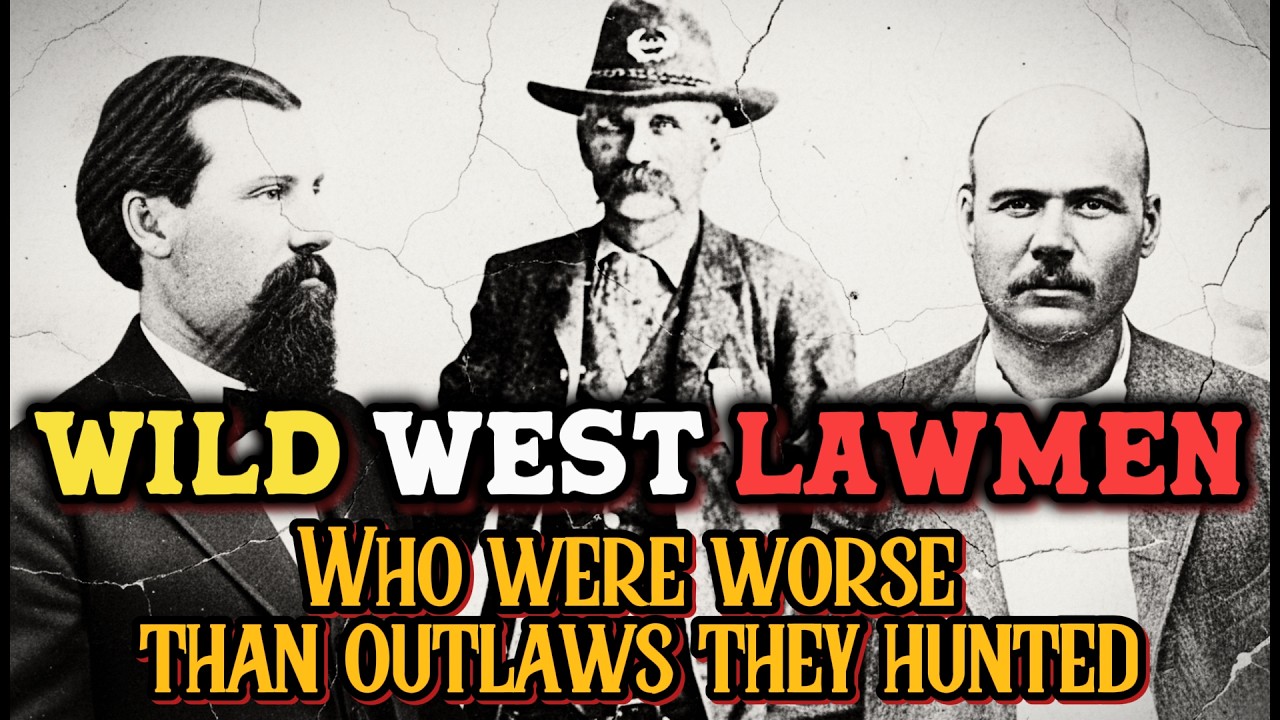
In the American West, there were men who wore badges by day and rode with bandits by night, men who hunted outlaws they had been drinking with hours earlier, men who testified in court and then robbed banks before sundown. Some of them got away with it for years. Bannack, Montana Territory, January 10th, 1864. A bitterly cold night with no moon, only wind howling through a mining camp that had seen too much blood.
Three men stood beneath a hastily built gallows, nooses already around their necks. One of them was Henry Plummer, the elected sheriff of Bannack, the man who was supposed to protect the town. The vigilantes did not give him a trial. They did not present evidence.
They did not allow him to speak in his own defense. They simply pulled the rope. For 150 years, history books told the same story. Henry Plummer was a monster.
He led a secret gang called the Innocents, road agents who terrorized travelers along the Montana trails, murdering over a hundred people and stealing gold by the wagon load. The reason no lawman could touch them was that the man leading the gang was the sheriff himself. That is the legend. But legends are often written by the people who benefited most from believing them.
The vigilantes who hanged Plummer were wealthy businessmen, Republicans with political ambitions in a territory about to organize formal government. Plummer was a Democrat who openly opposed vigilantism and associated with miners and wage workers instead of the economic elite. When they killed him, they claimed they were stopping a criminal mastermind. Yet the robberies did not stop.
After Plummer’s death, stage holdups became more organized, more violent, and more frequent. The so-called confession that damned Plummer came from a man named Red Yeager, a criminal being slowly strangled by the same vigilantes, desperate to say anything that might save his life. They hoisted him by the neck repeatedly until he gave them names. Plummer’s name was one of them.
No physical evidence ever connected Plummer to a single robbery. No stolen gold was found in his possession. No witness who was not facing execution ever testified against him. What is known is that Henry Plummer was a charismatic, well-educated man elected sheriff by popular vote.
He had applied to become a US Deputy Marshal, an appointment that came through one week after vigilantes hanged him from the gallows he had built for actual criminals. Was Plummer a corrupt lawman running a murder gang, or was he a political threat eliminated by men who wrote history in their own favor? The vigilantes who killed him, men like Thomas Dimsdale, who wrote the only early account of Plummer’s crimes, went on to become territorial judges, legislators, and founders of Montana’s government. They had every reason to justify what they had done, and for over a century, their version of events stood unchallenged.
It was not until the 1980s that historians began finding cracks in the narrative, court records that contradicted vigilante claims, newspaper accounts suggesting the crime wave was exaggerated, and evidence that Plummer had actually been enforcing the law aggressively, making powerful enemies in the process. The truth about Henry Plummer may be lost to time. If Plummer’s guilt remains uncertain, there is no ambiguity about John Selman. He was absolutely, undeniably, spectacularly corrupt.
His career reads like someone deliberately trying to hit every possible category of frontier crime while occasionally pausing to pin on a badge. Confederate deserter, cattle rustler, vigilante enforcer, deputy sheriff, gang leader, town constable, and finally the man who killed one of the West’s most notorious gunfighters. Born in Arkansas in 1839, Selman joined the Confederate Army at 22, then deserted in 1863. He drifted to Texas, married, started a family, and in 1877 became a deputy hide inspector in Fort Griffin, a town so wild it made Dodge City look like a church social.
His boss, Sheriff John Larn, had a unique approach to law enforcement. Control the vigilantes, rustle cattle on the side, and occasionally shoot people who asked too many questions. Selman and Larn did not just bend the law; they turned it into a profit center. They rustled livestock from neighboring ranches, sold the cattle to the US Army garrison, then used their badges to intimidate anyone who complained.
It worked beautifully until it did not. In June 1878, vigilantes locked Sheriff Larn in his own jail and shot him to death through the bars. Even though Selman was not in town that day, he was implicated in the cattle thefts. The vigilantes he had once controlled were now hunting him.
Selman fled to New Mexico and organized a gang called the Selman Scouts, a group accused of murder, rape, and robbery throughout Lincoln County during the late 1870s. They operated with such brutality that even in a region torn apart by the Lincoln County War, they stood out as particularly vicious. When Texas Rangers finally captured him in 1880, Selman escaped custody and disappeared into Mexico. He stayed gone for eight years.
When he returned to the United States in 1888, Selman had reinvented himself again. He settled in El Paso, married a young woman named Ramula Granadine, and worked as a town constable while supplementing his income through gambling. Children in El Paso remembered Uncle John as the kindly constable who handed out candy as he walked his rounds. Citizens of Lincoln County remembered him as the leader of a gang that made Billy the Kid look civilized.
On April 5th, 1894, Selman found himself in the middle of a chaotic gunfight at a brothel called Tilly Howard’s. A drunken Texas Ranger named Bass Outlaw had accidentally discharged his weapon, and when lawmen arrived to calm him down, Outlaw shot Ranger Joe McKidrick in the head, killing him instantly. Outlaw then turned his gun on Selman. Powder burns scarred Selman’s skin and permanently damaged his night vision.
Selman returned fire, hitting Outlaw above the heart. Outlaw fired back twice more, hitting Selman in the leg before staggering into the street and dying four hours later. A judge ruled it self-defense, and Selman walked free. The event that made John Selman infamous happened fourteen months later, on August 19th, 1895.
That night, Selman walked into the Acme Saloon in El Paso and shot John Wesley Hardin in the back of the head while Hardin was rolling dice at the bar. Hardin, a gunfighter credited with killing anywhere from twenty to forty men, died instantly. Selman fired three more rounds into his body as he fell. The official story involves Hardin’s girlfriend, an arrest by Selman’s son, and an argument earlier that day.
But some historians believe Selman was hired to eliminate Hardin, who had been causing problems for powerful men in El Paso. Selman was arrested and charged with murder. A hung jury could not reach a verdict, and he was released on bond pending retrial. He never made it back to court.
On April 5th, 1896, exactly two years to the day after he killed Bass Outlaw, Selman got into an argument with US Deputy Marshal George Scarborough outside the Wigwam Saloon. The argument escalated, guns were drawn, and Scarborough shot Selman four times. John Selman died on the operating table the next morning. He was buried in an unmarked grave in El Paso’s Concordia Cemetery.
Historians estimate he killed between twelve and thirty men during his life, some while wearing a badge, some while running from the law, and some in that murky gray zone where the two overlapped completely. If John Selman was brutal, Burt Alvord was brazen. Where Selman operated in the shadows, Alvord pulled off one of the most audacious schemes in Wild West history. He robbed trains while serving as town constable, then organized posses to hunt himself, and he almost got away with it.
Born in California in 1867, Alvord grew up in Tombstone, Arizona, working at the OK Corral during the town’s most violent years. He learned early that in the Wild West, survival meant being tougher than the next guy. Sheriff John Slaughter hired him as a deputy, describing him as a man who did not know the meaning of the word fear. Slaughter also joked that Alvord did not know the meaning of a lot of other words either.
Alvord had never attended school and could barely read. But what he lacked in education, he made up for in cunning. In 1897, the rough mining town of Wilcox, Arizona, needed a constable who could handle rowdy cowboys and enforce order. They hired Alvord.
Within months, he had pacified the town’s toughest troublemakers. Everything was going great, except Alvord was bored and broke. Constable wages were not impressive, so he decided to rob trains on the side. His plan was ingenious in its simplicity.
He would use his position as constable to create perfect alibis while his deputies did the actual robbing. Then, when the alarm was raised, he would lead the posse hunting for criminals he had personally instructed. On September 9th, 1899, Alvord put his plan into action. That night, as a Southern Pacific train approached Cochise Station just outside Wilcox, Alvord was sitting in the back room of Schwartner’s Saloon playing poker with three drinking buddies, Billy Stiles, Matt Burts, and Bill Downing.
Except they were not really there. Every few minutes, a bartender carried drinks into the back room and emerged with empty glasses, loudly announcing to the bar that Constable Alvord and his friends were having a serious game and did not want to be disturbed. Meanwhile, Stiles and Burts were ten miles away, climbing aboard the slowing train with guns drawn. The robbery went flawlessly.
They got away with several thousand dollars in cash and gold. When the train backed into Wilcox and the alarm was raised, someone suggested they fetch Constable Alvord from the saloon. Alvord emerged from the back room, feigning shock. “Great Scott,” he shouted, pointing at his three poker partners.
“I need volunteers for a posse. You, you, and you. ” The four men, three of whom had just committed the robbery, rode off into the night to hunt the bandits. The next morning, they returned to town, claiming they had lost the trail in the darkness.
A few eyebrows were raised, but Alvord deflected suspicion with humor, joking that everyone knew he was too dumb to pull off such a clever crime. For months, it looked like he had gotten away with it. Then Alvord made a critical mistake. He tried it again.
On February 15th, 1900, five members of the Alvord gang attempted to rob a train at Fairbank Station. What they did not know was that the Wells Fargo messenger that day was not the regular employee. It was Jeff Milton, a legendary ex-Texas Ranger and one of the toughest lawmen in the West. When the bandits opened fire, Milton grabbed a shotgun and returned fire with devastating effect.
He hit gang member Bravo Juan Yaos in the seat of the pants and mortally wounded Three-Fingered Jack Dunlap. As Dunlap lay dying, he gave up the entire operation. He named Alvord as the mastermind, detailed both robberies, exposed the poker alibi, the hidden dynamite, and the buried loot. Wells Fargo finally had the evidence they needed.
Burt Alvord was arrested, tried, and convicted. But even imprisonment could not hold him. He escaped from jail twice, once with the help of Billy Stiles, who broke him out and later mailed the jail keys back as a joke. Alvord was recaptured by Arizona Rangers in 1904 and sent to Yuma Territorial Prison.
He served two years, was released, and promptly vanished. Some say he died of fever in Barbados around 1910. Others claim he fled to Central America and bought a cattle ranch with the loot from his robberies, money that was never recovered. These three men represent a darker truth about the Wild West that does not make it into most history books.
The frontier was not a simple morality play with heroes in white hats and villains in black. It was a chaotic, violent, lawless world where the line between lawman and outlaw was often invisible, where badges could be bought, elections rigged, and justice served at the end of a rope without trial. They understood that the badge was not a symbol of justice. It was a tool, a weapon, a shield against accountability.
When you controlled the law, you controlled everything. Some used that power to bring order to chaos. Others used it to rob, steal, and kill with impunity.
And the scariest part was that for years, sometimes decades, no one could tell the difference.
