The diver rose slowly from the wreck of the American warship, somewhere in the waters of the South Pacific in the summer of 1942. He had gone down expecting to find proof of an enemy the Imperial Japanese Navy had taught him to look for — a nation of manufacturers and consumers, men who depended on volume and machinery because they lacked the spiritual quality that Japanese arms possessed. Instead, he came back up with a report that would reach his commanding officers within hours and be suppressed within 24 hours. The details of what he had seen were deliberately buried by the Imperial Japanese Navy’s intelligence division, passed up a chain of command to men who understood exactly what the information meant and chose not to share it with the sailors, pilots, and commanders who were still fighting the war on assumptions those details had just made obsolete.
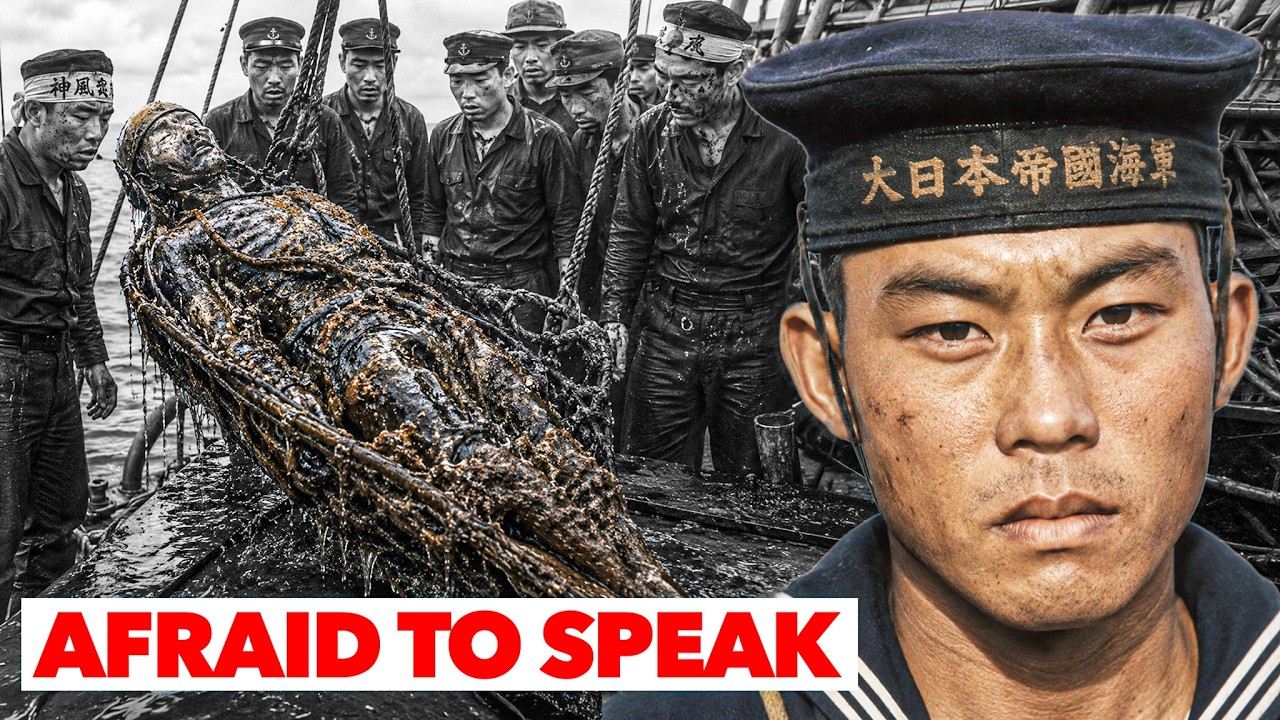
This was not an isolated incident. It was a pattern that repeated itself across the Pacific for three years as Japanese salvage teams and intelligence officers descended into sunken American ships, boarded captured American vessels, and inspected American equipment recovered from Pacific battlefields. They found things that frightened them. And the reason the reports were suppressed is the same reason they matter today: what Japanese sailors found in sunken American ships was evidence that the United States was winning a war Japanese high command was still telling its own men they were winning.
The officers who directed salvage and intelligence operations against American ships and equipment worked from a specific set of assumptions shaped by everything Japanese military culture had taught them to believe about the United States. The prevailing view inside the Imperial Japanese military establishment in 1941 and 1942 was that America was a nation of manufacturers and consumers, not warriors. A country that made automobiles and refrigerators and Hollywood movies. A country whose military had not fought a major war in living memory.
A country whose soldiers were recruited from a civilian population with no tradition of military service, no culture of sacrifice, and no particular reason to fight and die for Pacific islands that most Americans could not have found on a map before December 1941. The Japanese military’s institutional self-image was built on the concept of spiritual superiority. Where the American soldier had material abundance, the Japanese soldier had Bushido. Where the American naval officer had better equipment, the Japanese naval officer had willpower, discipline, and a readiness to die that no materialist culture could match or understand.
This belief was not cynical propaganda. It was genuinely held, deeply embedded in Japanese military training, and reinforced at every level by the record of Japanese arms since the Meiji Restoration. Japan had defeated China. Japan had defeated Russia.
Japan had taken Korea, Manchuria, and large portions of coastal China against opponents who should, on paper, have been able to resist. The spiritual superiority doctrine had been validated by decades of results. What Japanese intelligence officers expected to find when they descended into wrecked American ships was confirmation of that story. What they found instead began to rewrite it — and the rewriting was dangerous enough that the men at the top of the Japanese command structure decided it needed to be controlled.
The first major opportunity for Japanese naval intelligence to examine American warships in detail came in the aftermath of the battles of the Coral Sea and Midway in May and June of 1942, and from the campaign around Guadalcanal that followed in the second half of that year. The waters around the Solomon Islands became so littered with the wrecks of both navies that sailors called the stretch between Guadalcanal and Savo Island Ironbottom Sound, a name that has endured to the present day. The Japanese vessels lost in those waters were accessible to American divers when the war ended, and American naval intelligence conducted extensive surveys of the wrecks. But in the war years, the wrecks that mattered to Japanese intelligence were the American ones, and those waters contained more American wrecks than Japanese intelligence had ever had access to in one place.
What the salvage teams found when they went down into these ships was a picture of American naval capability systematically more sophisticated than Japanese briefings had portrayed. The quality of American fire control equipment recovered from wrecked destroyers and cruisers indicated a level of precision in naval gunnery that Japanese surface commanders had not been accounting for in their tactical planning. The communications equipment was more advanced than anything Japanese naval engineers had assessed the Americans as capable of producing in wartime. The damage control equipment and procedures, read from the physical evidence inside the wrecks, revealed an American naval establishment that had been thinking very carefully about how to keep ships alive and in action after they took hits — a problem Japanese naval doctrine had addressed primarily by trying to ensure that Japanese ships did not take hits in the first place.
These were not dramatic revelations in the sense of a single device or a single document that changed everything. They were an accumulation of physical evidence that, read correctly, described a naval adversary better equipped, better trained, and more systematically prepared for sustained combat than the Japanese officers analyzing the evidence had been told to expect. The single most consequential discovery Japanese salvage and intelligence teams made inside wrecked American ships was not a weapon or a cipher or a document. It was radar.
The United States Navy had been developing and deploying shipboard radar since before Pearl Harbor, and by late 1942 American warships carried radar systems that could detect enemy ships and aircraft at ranges and in conditions Japanese commanders had not fully appreciated until their men started going into the wrecks and finding the equipment. The Japanese Navy had radar too, and the technological comparison between the two nations’ systems at the start of the Pacific War is more nuanced than a simple advantage-and-disadvantage story. But what Japanese intelligence found in the wrecks was not just the existence of American radar. It was the integration.
American fire control systems were connected to their radar in ways that allowed American gunners to engage targets at night and in poor visibility with an accuracy that should not have been possible based on what Japanese commanders knew about American capabilities. The night surface actions in the waters around Guadalcanal in late 1942 and 1943 were devastating to Japanese naval forces in ways that began to make sense to Japanese analysts when the radar integration picture became clearer. Japanese destroyers and cruisers were being hit in conditions where they could not see the American ships that were hitting them. The men in the wrecks found the explanation.
American vessels were firing on radar-generated solutions in the dark, striking targets that Japanese commanders had no idea their opponents could even see. The consequences for Japanese naval tactics were grave and swift, and the consequences for Japanese confidence in the night surface operations their Guadalcanal supply strategy rested on were even graver. The accounts sent back by the salvage crews described a capability gap in surface warfare that Japanese naval aviation had been concealing, and that the shift toward a more surface-focused campaign around Guadalcanal was now laying bare. To grasp why Japanese naval intelligence suppressed or played down what was recovered from American wrecks, one has to grasp how the Imperial Japanese Navy was structured in 1942 and 1943.
Japanese naval command was no single body issuing uniform decisions about what to share and what to hide. It was an intricate bureaucratic machine built around the idea of face, around protecting institutional reputations, and around a deep cultural reluctance to send bad news upward through a chain of command designed to receive confirmation of expectations rather than challenges to them. When a salvage diver or an intelligence officer turned in a report describing American equipment as superior to what Japanese officers had planned against, that report created trouble for everyone in the chain between the diver and the flag officers at the top. The officer passing the report upward was, in effect, criticizing the intelligence assessments that had shaped Japanese operational planning.
The officer receiving it was being asked to explain why the plans he had approved rested on faulty information. The flag officer at the top was being told the strategic situation differed from what he had reported to his superiors. At every level, the institutional incentives pointed toward playing things down. The easiest and most professionally safe response to a report describing American capabilities as better than expected was to cast doubt on the report rather than on the plans.
The officer who questioned American equipment was viewed as defeatist, as eroding the spiritual foundation of Japanese military confidence, as a man whose loyalty to the spirit of the Imperial Navy was in doubt. This dynamic was not unique to Japan. It is a feature of hierarchical military organizations under wartime pressure when institutional self-protection and strategic reality pull in opposite directions. But it was especially acute in the Imperial Japanese Navy, because the doctrine of spiritual superiority had been raised from a tactical assumption to something close to religious conviction, and challenging it was not merely professionally dangerous.
It was a form of heresy. What Japanese sailors found in sunken American ships went beyond weapons and electronics. The logistical evidence was in some ways more unsettling to the men who understood it. The quantity and quality of spare parts, ammunition, food, medical supplies, and general stores recovered from American wrecks told a story about American industrial and logistical capacity that frightened Japanese naval planners more than any single weapon system.
A Japanese destroyer operating in the South Pacific in late 1942 was a vessel of limited and carefully rationed resources. Every shell fired, every liter of fuel burned, every spare part used brought the ship closer to a state of reduced capability that could not easily be fixed, because the supply chain reaching back to Japan was long, vulnerable to American submarines, and increasingly unable to meet the demands of operations across a Pacific theater now stretching from the Aleutians to the Indian Ocean. The American wrecks told a different story. The ammunition stores found in wrecked American cruisers suggested these ships had entered battle with more shells than a comparable Japanese warship carried as a full combat load.
The medical supplies spoke of a military establishment that expected to take casualties and had prepared to treat them on a scale Japanese medical doctrine had not matched. The food stores spoke of a military culture that fed its men rather than accustoming them to deprivation as a form of spiritual discipline. The spare parts spoke of an engineering culture that expected machinery to break down in combat and had provisioned for repair at sea, rather than requiring vessels to return to port for maintenance that Japanese ships increasingly could not get because the ports were too distant or too heavily burdened. Every inventory taken from an American wreck was a data point in a statistical picture describing an adversary whose logistical foundation was not only larger than Japan’s but organized on entirely different principles.
It was designed to sustain operations indefinitely. Japan’s was designed to support a short, decisive war. The pattern of finding more capability than expected was not confined to the salvage divers working in the wrecks. Japanese aviators who survived engagements with American carrier groups and American land-based air power across the Pacific reported the same structural surprise from a different vantage point.
The American aircraft Japanese pilots met in 1943 and 1944 were not the same aircraft that had been so badly mauled over Pearl Harbor and in the Philippines in the opening months of the war. They were aircraft that had been developed, tested, refined, and produced in quantities Japanese aircraft production could not approach. The F6F Hellcat that replaced the F4F Wildcat as the Navy’s primary carrier fighter was not merely better than the Wildcat. It was better than the Zero at the altitudes and in the tactical conditions where most Pacific air combat occurred in 1944, and it was appearing in numbers that Japanese pilots described in their debriefs with a consistency their intelligence analysts found hard to process.
A Zero pilot who returned from an engagement over the Philippine Sea in June of 1944 and reported that American fighters seemed to be everywhere, that there was no altitude where a Japanese formation could operate without running into American air cover, was reporting something his commanding officers had not prepared him to experience. The experience of Japanese naval aviators in the final two years of the war mirrored exactly what the salvage divers had found in the wrecks: an adversary better equipped than expected, present in larger numbers than expected, and operating with a tactical competence that the spiritual superiority doctrine had not predicted and could not explain. There were men inside the Imperial Japanese Navy’s intelligence apparatus who understood, clearly and with documented precision, what the salvage reports and the pilot debriefs and the battlefield intelligence assessments were collectively describing. They were not few in number.
By late 1942, the intelligence picture that lay before senior Japanese naval officers — for those who took the trouble to read it closely — painted a war Japan was losing on the material dimension while it remained possible to claim victory on the spiritual and tactical one. These officers confronted what was, within the institutional framework they operated in, hardly a choice at all. They could report their assessments faithfully, which meant informing senior commanders that the plans those commanders had approved rested on faulty assumptions about American capabilities — which in turn meant implicitly telling those commanders they had made errors of judgment that had cost Japan ships, men and strategic position. Or they could cast their assessments in a form that kept up the appearance of accuracy while softening the challenge to the prevailing narrative, which meant the plans would go on being built on faulty assumptions, and the ships and men and strategic position would go on being lost.
Those who took the first path found themselves pushed to the margins. Those who took the second found themselves promoted. This dynamic is not peculiar to Japan. It is simply the logic of institutional self-preservation in any hierarchy under strain.
But in the Pacific War the bill was paid by the sailors and pilots and soldiers who went into battle on plans that had been shielded from accurate intelligence by the very command structure that was supposed to give them a true picture of what they were up against. The ordinary Japanese sailor fighting in the Pacific in 1943 and 1944 had no access to the intelligence reports. He never read the salvage assessments. He was not present at the flag officer briefings where the capability gap between the two navies showed up in the aggregate data, even if no single data point revealed it.
What he had was his own combat experience, and combat experience is a kind of intelligence in its own right. Japanese sailors who came through the naval battles around Guadalcanal in late 1942 knew from firsthand experience that American ships could shoot accurately in the dark. They knew nothing of radar integration. They knew only that shells were striking their ships in conditions where they could not see where those shells came from.
Japanese destroyer crews who ran the Guadalcanal supply route — the operation American sailors nicknamed the Tokyo Express — knew their ships were growing ever more exposed to American air attack in conditions where Japanese air cover should have been enough, and was not. They knew the American supply and repair system was rebuilding American naval strength faster than the naval battles were wearing it down. They knew all of it from watching it unfold, from surviving it, from tallying the ships that never returned. The informal intelligence picture in the minds of ordinary Japanese sailors converged with the formal one their superiors were downplaying, and it yielded the same conclusion.
This was not the war Japanese military culture had told them they were fighting, and the adversary before them was not the one they had been told to expect. The suppression of intelligence on American capabilities by the Imperial Japanese Navy in the Pacific War is not merely a tale of institutional failure or bureaucratic dysfunction, though it is both. It is a tale of what happens when a military organization’s self-image matters more to preserve than accurate information about the enemy, and of the price paid by the men at the bottom when the men at the top decide on the basis of a battlefield picture distorted to protect institutional comfort. The Japanese sailors who went down into the wrecks and found things that frightened them were doing their jobs.
The Japanese intelligence officers who read the reports and grasped what they meant were doing their jobs. The institutional pressure that turned accurate reporting into minimized reporting worked a level above them, in the gap between what was known and what could safely be said. It worked there because the Japanese High Command in 1942 and 1943 was not chiefly organized to receive and act on accurate intelligence about American capabilities. It was organized to pursue a strategic vision fixed before the war began, confirmed by the triumphs of the war’s first six months, and shielded from challenge by the same institutional forces that shape every large bureaucratic organization under pressure.
What sets the Japanese case apart, and what makes the salvage reports especially poignant as historical documents, is that the men who entered the wrecks understood what they were seeing. They were professional naval officers and technical specialists capable of reading the physical evidence and grasping its implications. They wrote accurate reports. Those reports climbed upward through a system built to convert accurate reports into comfortable ones, and it was the comfortable versions that arrived on the desks of the flag officers making the decisions.
The sailors bore the cost of the difference. They bore it in the waters around Guadalcanal and in the Philippine Sea and off Okinawa and in every engagement where Japanese commanders planned against an American capability picture the men in the wrecks had already proved wrong. Japanese salvage divers entered American wrecks and found evidence that their commanders were planning against the wrong enemy. The reports they wrote were accurate.
The system that received those reports turned them into something that safeguarded the plan and the confidence and the strategy, and sent the sailors back to sea carrying the same assumptions they had taken into the water. What was found in the wrecks did not alter the war while it was being fought. It altered our understanding of it afterward, once the reports were at last read in full by historians able to trace the line from what the divers saw to what the admirals decided to what the sailors endured.
That line runs across the Pacific from 1942 to 1945, and the men who swam it paid for it in full.
