The bells of Lisbon had not stopped ringing, and still the queen lay dying. In the summer heat of the Rivera Palace, Maria Sophia of Neuburg, queen of Portugal, was slipping away two days short of her thirty-third birthday, her body ravaged by erysipelas, a severe skin infection that the physicians could not stop. The city that had once dressed itself in fireworks and festivity to welcome her now organized prayers and public religious observances, watching as the woman who had come to secure the dynasty faded. In her final hours, the fever took her mind, and the German princess who had spent nearly thirteen years as a Portuguese queen stopped speaking Portuguese entirely.
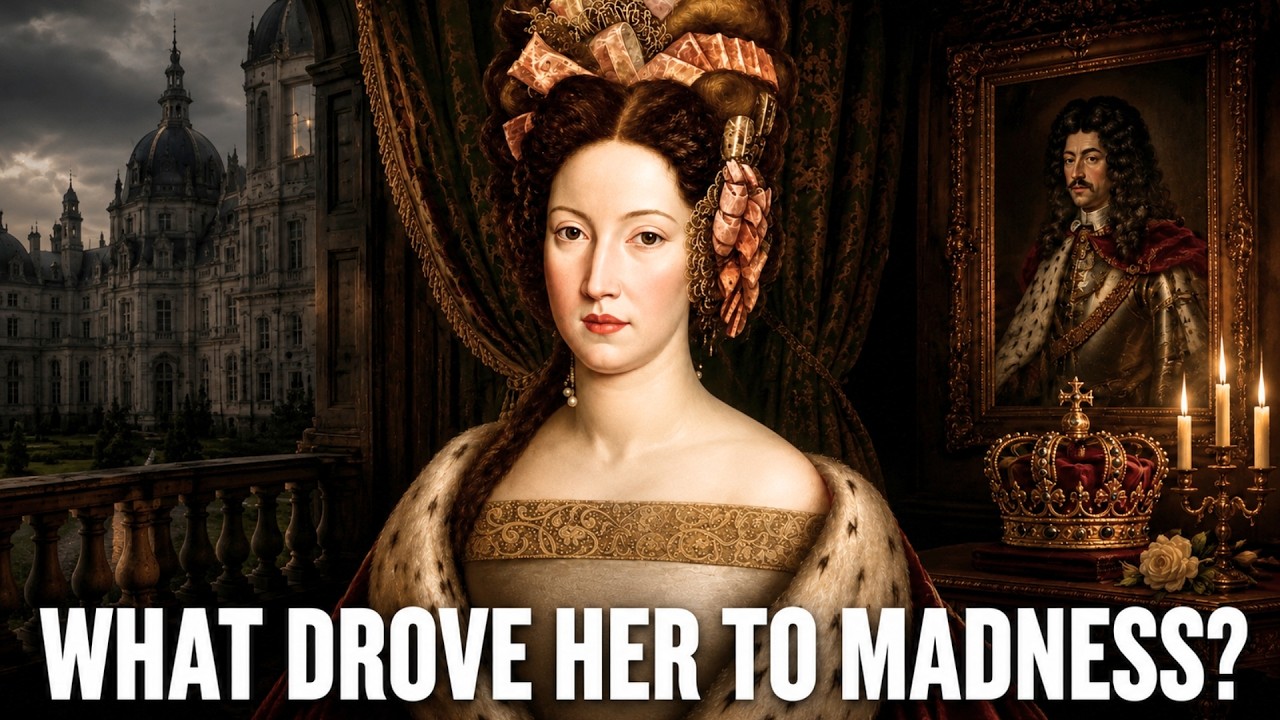
She returned to the language of her childhood, and asked for beer soup, the food of the Rhineland she had left behind as a girl of twenty. The Portuguese cooks struggled to reproduce it. She tasted only a little. Then she was gone.
How she had come to that bed, and what the years between had made of her, is a story that Lisbon itself had written in stages, beginning with one of the most elaborate royal receptions the city had ever staged. —
In August 1687, the Tagus glittered with decorated vessels, artillery salutes rolled across the water, church bells rang, and days of public celebration greeted Maria Sophia of Neuburg, the young German princess who had come to become the second wife of King Pedro II. Triumphal arches, fireworks, painted pavilions, and ceremonial processions turned her entrance into a spectacle of dynastic confidence. Pedro went out to meet his new queen, and the couple received the nuptial blessing amid lavish decoration before entering the Rivera Palace.
Portugal was celebrating the promise of a more secure succession as much as the arrival of a bride. Maria Sophia Elizabeth had been born on August 6, 1666, into one of the most marriageable Catholic dynasties in Europe. Her father, Philip William of Neuburg, and her mother, Elizabeth Amalie, had seventeen children, an extraordinary family size that would give the daughters of Neuburg a powerful reputation in dynastic negotiations. Maria Sophia grew up among siblings who doubled as potential bishops, electors, imperial spouses, and royal consorts.
In a family like this, private life and political usefulness were never entirely separate. The household was deeply Catholic, disciplined, and conscious of rank. The education expected of a highborn daughter included religion, languages, music, court behavior, and the practical skills needed to manage a noble household. An older sister, Eleanor Magdalene, married Emperor Leopold I, while another sister, Maria Anna, would later marry Charles II of Spain.
Each match reinforced the impression that the Neuburg women could carry influence into courts that needed both alliances and heirs. Of all her siblings, one of the closest was Maria Anna, the sister who would eventually become Queen of Spain. The two women would spend their adult lives in different kingdoms, but the emotional importance of their German family never disappeared from the stories told about Maria Sophia. By the mid-1680s, Pedro II had a problem that was personal, political, and dynastic at the same time.
His first wife, Maria Francisca of Savoy, was dead, and their only surviving child was a daughter, Isabel Luísa. She had been treated as the presumptive heir for years, but the Portuguese court remained anxious about what would happen if the king produced no surviving son. In 1685, state councilors formally urged Pedro to marry again. The search for a second queen unfolded inside the larger competition of European influence.
French interests pushed one direction, Spanish interests another. The House of Neuburg became attractive not only because it was Catholic and well-connected, but because fertility had become part of its political reputation. Maria Sophia’s mother had borne seventeen children, and the same family was already supplying brides to courts obsessed with the survival of their dynasties. Seventeenth-century diplomacy could treat family history as evidence where modern medicine would be far more cautious.
But perception mattered. Before Pedro knew Maria Sophia as a wife, diplomats already knew what made a Neuburg princess useful to a kingdom worried about succession. Pedro did not simply accept the first name placed before him. Envoys assessed candidates, and the eventual contract with Neuburg represented a victory for one network of influence over another.
The negotiations moved quickly once the choice hardened. A marriage contract was signed in May 1687, and the proxy wedding took place at Heidelberg on July 2. Maria Sophia was only twenty when Pedro first sought her hand, stepping toward a husband almost twice her age, a widower with a daughter, an established court, and a past she would have to enter rather than create. Her journey toward Portugal carried its own symbolism.
She traveled along the Rhine, received formal honors on the way, then continued by sea toward a country whose language, etiquette, and social rhythms were not her own. Everywhere she passed, she was treated as a future queen. The palace she entered had an emotional history that had begun long before her. That history centered on Maria Francisca of Savoy.
She had first been married to Pedro’s older brother, Afonso VI, before that marriage was annulled and Pedro emerged as the dominant political figure in the kingdom. Maria Francisca then married Pedro, making their relationship inseparable from one of the most turbulent chapters of the Portuguese monarchy. Contemporary and later histories remembered Pedro as deeply attached to her. Maria Sophia did not arrive in an empty role.
She inherited a title that continued to carry another woman’s memory. What she certainly faced was a court whose loyalties, habits, and friendships had been shaped under Maria Francisca. Some people around her had served the first queen, and political alignments did not vanish merely because the royal apartments had a new mistress. There was another person in the palace who made the succession question more human: Isabel Luísa, Pedro’s daughter by Maria Francisca.
She was close in age to her new stepmother, and one historical account says Isabel became genuinely fond of Maria Sophia. Maria Sophia had to learn the emotional geography of Portugal itself. The court was more enclosed than the German world she knew, and later anecdotes describe her discomfort with Portuguese customs, from closed interiors to the ritual habits of court ladies. Some of those details may have grown in the telling, but the larger adjustment was real enough.
A preference in dress could be read as foreign arrogance. A change in household routine could offend people whose status depended on precedent. The marriage appears to have settled into something more durable than a purely ceremonial arrangement. Historical tradition describes Pedro as treating Maria Sophia with affection and respect, while the couple’s rapid succession of pregnancies shows that the central dynastic expectation was pursued immediately.
The more difficult question concerns Pedro’s sexual life beyond the queen’s apartments. He had a reputation for passion, and later genealogical records show that he fathered children outside his marriages. Accounts of the marriage portray his infidelity as something Maria Sophia was expected to endure discreetly, a familiar double standard in royal courts. That tension is captured in one of the most memorable anecdotes attached to Maria Sophia.
According to the story, court ladies used fans as a form of coded social communication. During a gathering, a woman signaled to the queen that her husband was deceiving her. Maria Sophia, unfamiliar with or contemptuous of the game, allegedly took the fan and snapped its ribs shut so violently that they broke. There is no reason to present that scene as a documented fact.
It belongs in the category of court anecdote, the kind of story that survives because it feels perfectly designed to explain a personality. Whether or not the fan broke exactly as later retellings say, the image reveals something important about how Maria Sophia was remembered: controlled in public, unwilling to trade accusations across a ballroom, and especially sensitive to humiliation performed before witnesses. Soon, infidelity would become secondary to a loss neither ceremony nor rank could control. The palace had spent years worrying about whether Maria Sophia could produce an heir.
It was about to discover that producing one and keeping one alive were two very different things. Within months of the wedding, the question hanging over the new queen seemed to have its answer. Maria Sophia became pregnant, and on August 30, 1688, she gave birth to a son named João. For a kingdom anxious about succession, the meaning of a male child was larger than the nursery.
The infant represented continuity, relief, and proof that the political calculations behind the Neuburg marriage had not been misplaced. Celebration gave way to shock with brutal speed. The baby died on September 17, less than three weeks after his birth. Surviving records preserve the basic dates with painful clarity.
A prince arrived, was welcomed as the answer to a dynastic fear, and was gone before a month had passed. The first prince was more than a failed attempt before the future king. He was the child who turned the abstract possibility of loss into something Maria Sophia and Pedro had already lived through. There was little space in royal life for grief to remain entirely private.
A dead prince affected succession, diplomacy, and the mood of the court, while the queen’s reproductive future immediately became a public concern again. The pressure that had surrounded Maria Sophia before the first birth returned with an added cruelty: now everyone knew that success at childbirth could end in a funeral all the same. Maria Sophia became pregnant again, and in October 1689 she delivered another son, again named João. This child lived.
He would eventually become João V, one of the most consequential kings of eighteenth-century Portugal. With his survival, the immediate succession crisis that had shaped Maria Sophia’s marriage finally eased. Relief did not erase scrutiny. One later account describes the second infant being examined closely and portrays his mother’s attention to his health as unusually intense.
The detail is difficult to verify in every particular, but the setting itself was charged with memory. The same court that had celebrated one prince and buried him within weeks was now watching another boy occupy the same fragile place in the succession. Once João lived beyond infancy, the succession question no longer depended only on another pregnancy. It depended on the health and survival of a specific child, and every illness, accident, or rumor surrounding him carried consequences beyond the nursery.
Later retellings preserve a series of stories in which ordinary maternal concern becomes something more elaborate. Maria Sophia is said to have moved closer to João’s rooms, to have monitored who entered and left, and to have awakened at small noises in the night. Servants supposedly remembered a queen who treated access to the child as a matter requiring constant attention. None of these details can be treated as established fact, but together they form a consistent later portrait: safety became something she tried to manage personally.
One of the strangest accounts concerns the prince’s bedding. The story claims Maria Sophia required seven layers of cloth, each blessed by a different religious figure, to be placed over him as a form of protection. Taken literally, the image is almost absurd, especially in the heat of a Portuguese summer. Taken as a piece of court memory, it tells us how contemporaries or later storytellers wanted to understand her: deeply religious, intensely protective, and increasingly willing to turn fear into ritual.
Another thread is the fear of poisoning. Poison was not a purely imaginary concept in early modern courts; suspicion of food, medicine, and intimate servants could flourish wherever political rivalry met poor medical understanding. Yet the accounts do not establish a proven plot against João or Maria Sophia. What they do preserve is a recurring image of the queen acting as though danger through food, medicine, or close access could not simply be dismissed.
Royal children did die young. Disease could spread quickly. Medicine offered limited protection. And an infant’s death did not require a conspiracy.
Maria Sophia did not need to be irrational to know that a prince could disappear between one week and the next. She already had proof of that in her own family. What becomes unusual in the stories is not the existence of fear but the extent to which fear appears to organize behavior. After 1689, João was more than her child.
He was the male successor around whom factions, expectations, and future alliances would gather. Every illness in the nursery could become a state concern, every rumor more charged than it would have been in an ordinary household. Her religiosity shaped the form those behaviors supposedly took: blessings, amulets, prayers, and devotional practices belong to a world in which spiritual and physical protection were not cleanly separated. No figure complicates the darker version of Maria Sophia’s story more than Isabel Luísa.
Before the birth of the surviving João, Pedro’s daughter had been the presumptive heir, and later retellings sometimes cast the arrival of Maria Sophia’s sons as the beginning of a cold dynastic rivalry. One dramatic version claims the queen interfered in Isabel’s marriage negotiations because children born to the princess might threaten Maria Sophia’s own line. That claim cannot be repeated as settled history. A historical account from Portugal says something strikingly different: Isabel, who was nearly the same age as her stepmother, became very fond of Maria Sophia.
That does not prove the two women never disagreed, nor does it make succession irrelevant. It simply means the evidence does not support reducing their relationship to a simple story of a scheming stepmother pushing a rival aside. Isabel’s position was difficult even without Maria Sophia plotting against her. For years, she had embodied the future of the dynasty while her place became less central once a surviving male heir was born.
Marriage projects repeatedly failed for reasons that involved European diplomacy, rank, and politics far beyond a queen’s private wishes. When Isabel died in 1690, the line of succession shifted again, but the surviving record asks care about assigning Maria Sophia a motive for every change around her. The public encountered another Maria Sophia altogether. Historical accounts describe her as deeply devout and unusually charitable, supporting widows and orphans from her own funds and bringing poor sick people into the palace so they could receive care.
She was remembered as a queen willing to move closer to suffering rather than sealing herself entirely behind ceremony. That reputation survived strongly enough to become one of the defining positive elements of her memory. The warmth of that charitable reputation did not erase the factional atmosphere of court. The palace continued to contain people whose loyalties had been formed before her arrival.
Some retellings make much of her suspicion toward French women attached to the household, especially those connected in memory with Maria Francisca’s circle. From there, the anecdotes move into more intimate territory. One later narrative says Maria Sophia kept personal possessions locked away, carried keys with her, and even slept with a heavy ring of keys beneath her pillow. It also portrays her as fearing that hostile figures around the court might poison her.
One story claims she refused dishes she did not trust and developed small protective routines before meals. The dead Maria Francisca returns in this layer of the story, now less as a historical person than as a symbolic presence. Later tales say Maria Sophia avoided jewelry associated with her predecessor and treated pearls in particular as if they could preserve another woman’s sorrow. Another anecdote claims she kept a handkerchief that had belonged to Maria Francisca, not from affection, but from a belief that possession of the object somehow kept the dead queen’s spirit from reclaiming what had once been hers.
None of those details establishes that Maria Sophia literally feared her predecessor’s spirit. Their value lies elsewhere: the tales keep positioning her against Maria Francisca, turning the second marriage into a contest with a memory that could no longer answer back. Maria Sophia was foreign, and foreign queens were unusually easy targets for explanations built from secrecy. Her accent, household customs, correspondence, and preferences could all be interpreted as evidence that she belonged to another network.
In a court already divided by international influence, what looked like homesickness to one observer could look like concealed allegiance to another. Distance did not end Maria Sophia’s attachment to the Neuburg family. Her sister Maria Anna eventually became queen of Spain, placing two sisters in neighboring Iberian courts whose interests did not always align. Later accounts describe the women exchanging coded correspondence, supposedly using flowers, medical complaints, and private expressions to hide political meaning inside letters that could pass as domestic conversation.
How much of that system can be independently documented is uncertain, but the idea itself is entirely plausible. In a world where royal correspondence was monitored, copied, and intercepted, women at court did not need supernatural powers to understand that a letter could travel through hostile hands. Later rumor made the story stranger: the sisters were said to understand one another through an invented language, and frustrated observers allegedly imagined a bond so uncanny that it bordered on telepathy or witchcraft. There is no evidence for supernatural communication.
A simpler explanation is possible: perhaps the sisters were not mysterious at all, only better at communicating privately than the people trying to understand them. The same mixture of memory and embellishment surrounds the catalog of unusual habits attached to Maria Sophia’s later years. One story says she could not tolerate white flowers because their pallor reminded her of death. Another claims statues in the palace were covered after dark because she feared their expressions changed in the damp night air.
Mirrors form a third motif: one later tradition says Maria Sophia ordered them covered when she was not using them, as though reflective surfaces might retain something harmful from those who passed before them. A separate story says that hair lost while brushing was carefully collected and burned so that no one could use it in harmful magic. Whether these practices happened exactly as described remains uncertain. Modern audiences often reach for a diagnosis at precisely this point, invoking obsessive-compulsive disorder, inherited mental illness, paranoia, or other conditions.
None of those labels can responsibly be assigned from a collection of uncertain anecdotes about a seventeenth-century woman. Some behaviors may have been ordinary within her religious and cultural world. Others may have been unusual. Still others may be products of retelling.
Three centuries later, diagnosis is easy. Evidence is harder. Several possibilities remain open at once: some practices may reflect ordinary beliefs of the period, some could have been intensified by grief, bodily strain, or anxiety, and some may have been exaggerated because an eccentric foreign queen made good court gossip. By the late 1690s, Maria Sophia’s body had endured repeated pregnancies and the strain of a life lived under constant ceremonial obligation.
She had arrived in Portugal as a young woman celebrated for the promise of fertility. Twelve years later, she was only thirty-two. In the summer of 1699, she became gravely ill at the Rivera Palace. Historical accounts identify erysipelas as the illness associated with her death.
The court understood that the danger was real. Prayers and public religious observances were organized while the queen’s condition worsened. On August 4, 1699, Maria Sophia died in Lisbon, two days short of her thirty-third birthday. Around those final hours, documented history blurs again into intimate anecdote.
One account says fever left her delirious and that she eventually stopped speaking Portuguese, returning instead to German. The same tradition tells of a final request for beer soup, a food associated with the world of her childhood. Then history gives way to legend. One tale claims her Jesuit confessor held a small vessel near her mouth and captured her final breath before sealing it like a relic.
Another says she wanted earth or sand from her homeland placed with her so that some part of Germany could accompany her into burial. An even more theatrical legend says a great bell in Lisbon cracked at the moment she died, as though the city itself had registered the queen’s final heartbeat. Pedro’s response belongs to a firmer historical tradition, though later anecdotes magnify it as well. Maria Sophia’s death was remembered as a genuine blow to the king and to a public that knew her charitable reputation.
She was buried at São Vicente de Fora, the royal pantheon of the Braganzas. Pedro did not take another queen after her, and the marriage that had begun as a solution to succession remained his last. Maria Sophia had borne seven children. The first João died in infancy, but the second survived to become João V.
Other sons reached adulthood, though not all of the children lived long or established legitimate lines of their own. For the narrow political purpose that had helped bring Maria Sophia to Portugal, one fact overshadowed the rest: the Braganza throne had the surviving male heir it had sought. In 1687, Lisbon had celebrated a young princess amid fireworks, decorated vessels, and triumphal display because her marriage represented hope for continuity. By 1699, the queen herself was gone while João remained.
The dynastic mission had succeeded, even though the woman at its center never reached middle age. The political outcome was clear, but Maria Sophia’s memory never settled into a single shape. She remained the charitable queen remembered beyond the palace, the German consort who retained the emotional pull of home, the mother surrounded by stories of vigilance, and the figure later linked to poison fears, coded letters, covered mirrors, and omens. Those identities do not carry the same evidentiary weight.
Yet together they explain why her afterlife became more complicated than the dynastic success she helped secure. Which Maria Sophia comes closest to the truth? The dynastic queen chosen to secure succession, the grieving mother associated with increasingly elaborate protection, the deeply superstitious woman described by later tradition, or a historical figure whose strangest qualities grew larger every time her story was retold.
Perhaps the most revealing answer is that all four images have become part of her afterlife, while the real woman remains somewhere between them—beneath the crown, beyond the gossip, and just out of reach.
