In the spring of 1943, a Japanese naval flight instructor at the Kasumigaura airbase north of Tokyo stood before a classroom of newly qualified Zero pilots and removed a diagram from the curriculum he had been teaching for four years. The diagram showed the maneuver that had made Japanese naval aviation the most feared air force in the Pacific: a rolling scissors defense that allowed a Zero pilot to reverse a pursuit, get behind an attacking aircraft, and convert an enemy’s offensive position into a firing solution in less than eight seconds. It had worked over China. It had worked over Pearl Harbor.
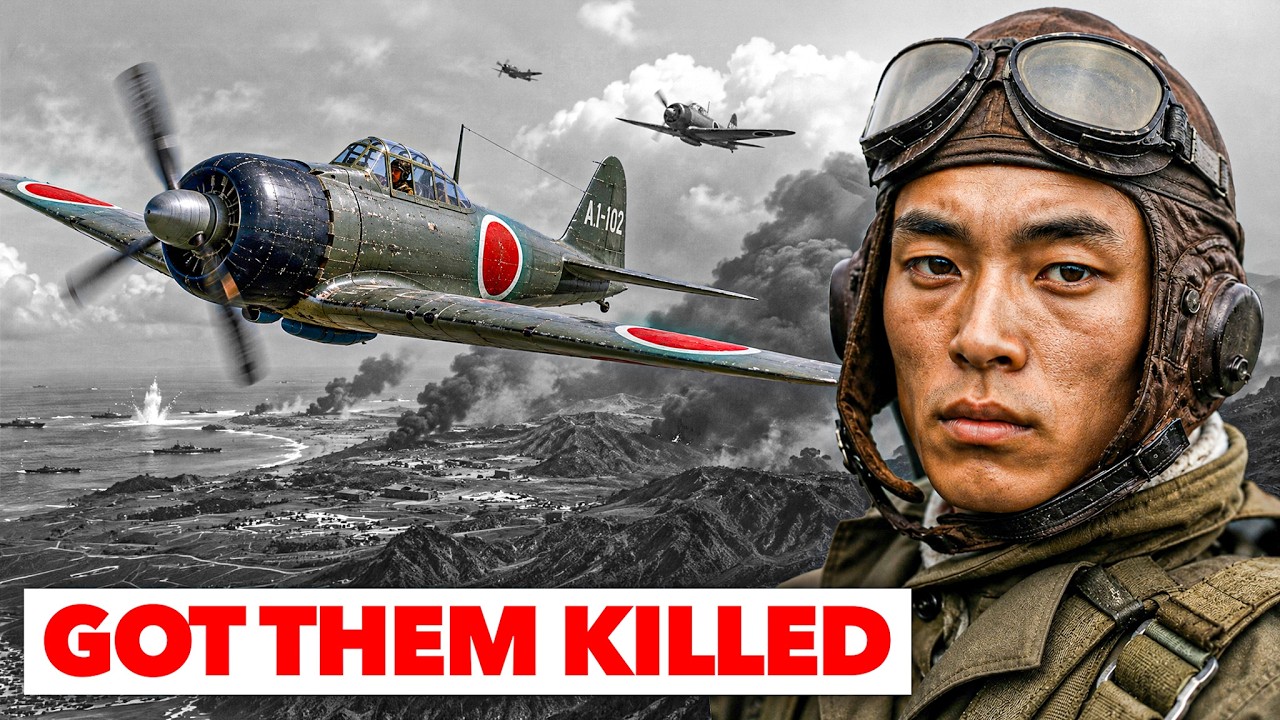
It had worked over the Philippines, Malaya, the Dutch East Indies, and across every theater where Japanese pilots had encountered enemy air forces. And now, in the spring of 1943, it was getting Japanese pilots killed so consistently and so predictably that teaching it had become, in the instructor’s own words recorded in a postwar debrief, an act of sending men to die on purpose. The maneuver that had beaten every opponent the Zero had ever faced had stopped working. The reason was a change in American aircraft and American tactics that Japanese flight training had not caught up with—and would never fully catch up with before the war ended.
To understand why Japanese flight instructors stopped teaching the maneuvers that had built their dominance, you have to understand what those maneuvers were and why they had worked so completely in the first two years of the Pacific War. Japanese naval aviation doctrine in 1941 was built around the specific performance characteristics of the Mitsubishi A6M Zero. The Zero’s defining characteristic was its ability to out-turn anything it encountered at low and medium altitude. Its extraordinary lightness, achieved by stripping out pilot armor and self-sealing fuel tanks, gave it a turning radius so tight that no American, British, or Dutch fighter of the opening war years could match it in a sustained turning engagement.
Japanese flight instructors had spent the 1930s developing a curriculum built entirely around this advantage. The core doctrine was simple in principle and demanding in execution. When an enemy aircraft attacked from behind or above, the Zero pilot would execute a tight rolling turn toward the attacker, forcing the attacker to overshoot and reverse, and then use the Zero’s superior turning rate to get behind the overshot aircraft and into a firing position. The maneuver required precise timing, exceptional spatial awareness, and the kind of physical coordination that came only from hundreds of hours of practice.
The pilots who had trained on it through the 1930s and the early years of the war were among the most skilled aviators in the world, and the maneuver worked against every opponent they encountered. Against the American F4F Wildcat, it worked. Against the British Hurricane, it worked. Against the Dutch Brewster Buffalo, already obsolete when the war began, it worked with a completeness that bordered on the absurd.
Japanese pilots returning from the opening months of the Pacific campaign reported kill ratios that their instructors had not thought possible even in optimistic prewar projections. The maneuvers had not merely worked; they had produced results so overwhelming that the Japanese flight training system concluded it had found the template for air combat superiority and deepened its commitment to the curriculum rather than questioning it. That is what institutions do when their methods are validated by success. The Americans who survived the first months of the Pacific air war came home with a body of knowledge that the Japanese flight training system did not possess and would not develop in time to matter.
Lieutenant Commander John Thach, a Navy fighter pilot who had studied the Zero’s performance characteristics from intelligence reports before the war and then encountered the aircraft in combat over Midway in June 1942, returned from the Pacific with a tactical solution he had developed and tested in actual combat. He presented it to Navy leadership with the urgency of a man who understood that what he had learned was the difference between winning and losing the air war. Thach had developed what became known as the Thach weave, a two-aircraft mutual defense tactic that specifically countered the Zero’s turning advantage by ensuring that a Zero pursuing one American aircraft would always present itself as a target to the second American aircraft in the pair. The tactic did not require the American aircraft to out-turn the Zero.
It required American pilots to work together in a way that converted their aircraft’s individual weaknesses into a defensive system that the Zero’s doctrine of individual aerial combat had no answer for. The Navy adopted the Thach weave and built it into the training curriculum immediately. Beyond the specific tactic, what Thach and the other surviving American pilots from the opening months of the war brought back was a conceptual shift in how American naval aviation thought about fighting the Zero. The conclusion was not that the Zero needed to be beaten at its own game.
The conclusion was that the Zero needed to be fought on terms that negated its turning advantage entirely, at speeds and altitudes and in tactical situations where the Zero’s lightweight was a liability rather than an asset. That conceptual shift translated into a new training curriculum—the thing Japanese flight instructors were competing against when they went into the classroom in 1943 with the same diagrams they had been teaching since before the war. The specific tactical discovery that most rapidly made the Japanese turning maneuvers obsolete was the altitude relationship between the Zero and its American opponents. Japanese flight doctrine had been developed and tested primarily in the low and medium altitude bands where the Zero’s performance was at its peak.
Below 15,000 feet, in the close turning engagements the doctrine was designed for, the Zero’s advantages were real and decisive. Above 15,000 feet, the picture was different, and it became dramatically more different as American aircraft improved and as American pilots learned to fight at altitudes where Japanese doctrine had not prepared them to operate. The F6F Hellcat, which began appearing in Pacific combat in September 1943, was faster than the Zero above 15,000 feet, climbed faster above 10,000 feet, and could dive at speeds that the Zero’s airframe could not safely match without risk of structural failure. An American pilot who maintained altitude above the engagement ceiling of Japanese doctrine could dictate the terms of every encounter.
He could choose when to attack by diving, generate attacking speed that the Zero could not match in level flight, fire a burst, and zoom climb back to altitude before the Japanese pilot could execute the turning reversal that was the core of his defensive curriculum. The turning maneuver that Japanese instructors had spent years perfecting was irrelevant in this engagement geometry, because the American pilot was never in a position where the turning reversal could bring Japanese guns to bear on him. By the time a Japanese pilot had completed the rolling scissors that was supposed to reverse the situation, the American aircraft was already climbing back to altitude, five hundred feet above and five hundred yards ahead, and the entire geometry had to begin again from scratch, with the same outcome waiting at the end of it. The Japanese flight instructors who recognized that the curriculum needed to change were not few in number, and they were not slow to see what was happening.
The problem was not a failure of perception at the instructor level. It was a failure of institutional response at the command level above them. Postwar accounts of Japanese naval aviators who survived the war include a consistent pattern of instructors who privately told students that the old maneuvers were dangerous against American fighters, that the Americans had found the answer to the rolling scissors, that flying the doctrine as written was a reliable way to die quickly—while publicly continuing to teach a curriculum they had been ordered to teach by a command structure that was not prepared to acknowledge that the tactical foundation of Japanese naval aviation had been overtaken by events. One flight instructor at the Oita Naval Air Training Base, identified in postwar records as a veteran of the Coral Sea and Guadalcanal campaigns who had personally observed the failure of the turning maneuvers in combat against American fighters, was reported by multiple students to have told his class that the scissors was now a suicide maneuver against a Hellcat, and that any pilot who used it above 10,000 feet against an American fighter would be dead before completing the first half roll.
He told them this in the barracks after training hours, not in the classroom. In the classroom he taught the curriculum. The gap between what experienced instructors knew from combat observation and what the curriculum required them to teach is one of the clearest examples in the Pacific War of the institutional failure that ran through the entire Japanese military establishment in the middle years of the war. While Japanese instructors were privately questioning a curriculum they were required to teach, American naval aviation was undergoing a training transformation that would prove decisive in the air war over the Pacific.
The Naval Aviation Training Command at Pensacola and the advanced training bases that fed pilots into the Pacific theater were rebuilding their curriculum from the ground up, based on the combat reports coming back from surviving pilots, the intelligence assessments of Japanese aircraft performance, and the tactical innovations that men like Thach, Butch O’Hare, and Alexander Vraciu were developing and testing in actual combat. The new American training curriculum was built around three principles that represented a complete inversion of the Japanese approach. First, altitude advantage was treated as the primary tactical asset, not maneuverability. American pilots were taught to fight from above and to disengage by climbing rather than by turning.
Second, section tactics and division tactics were drilled until they were reflexive, because the mutual support of two or four aircraft was treated as the fundamental unit of combat rather than the individual pilot in a one-on-one turning engagement. Third, energy management was taught as the central technical skill of air combat: the ability to convert altitude into speed and speed back into altitude while maintaining a tactical position from which the next attack could be executed cleanly. These three principles produced a style of air combat that was specifically and deliberately designed to deny the Zero the conditions under which its performance advantages mattered, and to exploit the conditions under which its performance disadvantages were most acute. American pilots who graduated from this training and arrived in the Pacific in 1943 and 1944 were pilots whose institution had been willing to learn from combat experience and translate that learning into a new curriculum faster than the Japanese institution could respond.
The failure of Japanese flight training to adapt its curriculum was compounded by a second crisis developing by late 1942 that would become catastrophic by 1944. Japan was running out of experienced pilots faster than its training system could replace them. The generation of naval aviators who had trained through the 1930s and accumulated thousands of hours of flight time before the war began was being consumed by the combat attrition of the Pacific campaign at a rate Japanese training infrastructure had not been designed to sustain. The pilots lost over Midway, over Guadalcanal, over Rabaul and the Solomons were not replaceable on any timeline the war permitted.
They represented years of training, thousands of hours of practice, and an accumulated body of tactical knowledge that existed only in the men who carried it, and that died with those men when they did not come back from their missions. The Japanese naval aviation training program responded to this attrition by doing what all military training systems do when they face a pilot shortage under combat pressure: they shortened the training pipeline. Flight hours required before a student pilot was declared combat ready were reduced. The curriculum was compressed.
The standard of performance required to advance through training was lowered to keep the pipeline moving at the volume the combat losses demanded. The result was a generation of Japanese pilots entering combat in 1943 and 1944 with two hundred hours of total flight time, against American opponents who had five hundred hours or more before their first combat assignment. These pilots were being sent into battle with inadequate training in a curriculum that even its most experienced instructors privately acknowledged was obsolete, against opponents who had been trained in tactics specifically designed to counter everything those pilots had been taught. The combination was not a recipe for competitive air combat.
It was a pipeline delivering men to their deaths. The curriculum changes that Japanese flight instructors made in the middle years of the war were not announced as doctrine shifts or presented as acknowledgements that the old methods had been overtaken by American tactical development. They happened quietly, instructor by instructor, base by base, as experienced aviators made individual decisions about what they could responsibly teach to men who would be flying combat missions within months. The rolling scissors defense was the first maneuver to effectively disappear from active instruction at forward bases, though it remained in the printed curriculum and was never formally removed from official doctrine.
Instructors who had returned from combat against Hellcats and Corsairs understood that the maneuver required the attacker to be close enough and slow enough to overshoot the defending aircraft during the reversal. Against an American fighter using boom-and-zoom tactics from altitude, neither condition was reliably present, and attempting the scissors against a diving attack from above typically resulted in the defending aircraft being hit during the reversal rather than completing it. The high-deflection turning shot, a demanding maneuver that required a pilot to fire accurately while both aircraft were turning at high angular rates, was similarly de-emphasized at many bases—not because instructors considered it unimportant, but because the flight hours available to train new pilots to an adequate standard of execution had been cut to the point where spending time on a high-skill maneuver produced false confidence rather than genuine capability. What replaced these maneuvers in the practical instruction of new pilots was a narrower and more conservative approach that amounted to teaching pilots to survive individual engagements rather than to win them, because surviving had become the realistic objective for many of the men entering the training pipeline by 1944.
The Japanese military’s decision to formalize the Kamikaze program in October 1944 was not only a response to the tactical situation over the Philippine Sea. It was, in ways that Japanese commanders may not have articulated explicitly but that the decision itself makes plain, an acknowledgement that the conventional air combat training program had failed to produce pilots who could survive long enough to inflict the damage the strategic situation required. A conventional fighter pilot needed hundreds of hours of training to reach the standard of performance at which he could consistently engage American fighters and survive the engagement. A Kamikaze pilot needed to know how to take off, navigate to a target, and aim his aircraft.
The training pipeline the Kamikaze program required was a fraction of what conventional fighter training required, and the Kamikaze pilot’s effectiveness was not degraded by his limited training in the way that a conventional fighter pilot’s effectiveness was degraded by it, because the Kamikaze pilot was not trying to survive the mission. The formalization of the Kamikaze program therefore represented the Japanese military’s implicit concession that the conventional training system could not produce, in the time available and with the resources available, pilots capable of fighting effectively against American air power using conventional tactics. The maneuvers that Japanese flight instructors had stopped teaching were stopped because they no longer worked against the aircraft and the pilots they were going to face. The Kamikaze program was adopted because continuing to send conventionally trained pilots into conventional engagements against American fighters was producing unacceptable losses for unacceptable results.
The flight instructors who had quietly removed the scissors from their practical curriculum in 1943 had understood something that the high command took another year to formally acknowledge in policy. The failure of Japanese naval aviation training to adapt its curriculum in the middle years of the Pacific War is not simply a historical footnote about institutional rigidity under pressure. It is a story about what happens when the gap between what an institution knows and what it can bring itself to act on becomes wide enough that men die in the space between those two things. The Japanese flight instructors who knew the rolling scissors was obsolete but continued to teach it were not cowards or incompetents.
They were professionals operating inside an institutional structure that made adaptation functionally impossible, even when the need for adaptation was obvious to the men closest to the problem. The command structure that should have processed the combat reports coming back from the Pacific and revised the training curriculum accordingly was the same command structure that was minimizing uncomfortable intelligence assessments, suppressing reports about American capabilities, and protecting the strategic plan from the challenge that accurate information would have posed to it. The training failure and the intelligence failure were both symptoms of the same institutional disease. An organization that cannot update its picture of reality cannot update its response to reality, and the price is paid by the men who go into the field with an outdated picture and an outdated response to it.
The Japanese pilots of 1943 and 1944 paid that price in the air over the Pacific, executing maneuvers that their most experienced instructors privately knew would not work against the aircraft and the tactics they were going to face, because the institution that trained them had decided that consistency with established doctrine was more important than the survival of the men the doctrine was supposed to serve. The Americans who shot them down were not necessarily better individual pilots in the cockpit. They were pilots whose institution had been willing to learn from what was happening and change what it taught before the cost of not changing became too high to bear. A Japanese flight instructor removed a diagram from his practical curriculum in the spring of 1943 because the maneuver it described had started killing the men he taught it to.
He kept teaching it in the classroom because the curriculum required it. He told his students the truth after hours in the barracks, where the curriculum could not reach. That gap between what experienced men knew and what the institution allowed them to say ran through the entire Japanese military in the middle years of the Pacific War, and it cost Japan the air campaign before the aircraft numbers and the pilot shortages and the fuel crisis made the outcome arithmetically inevitable.
