The telegram arrived at General Grant’s headquarters on the evening of April 14, 1865, and it carried an invitation that would test more than protocol. President Lincoln and his wife were going to Ford’s Theatre that night to see a play called Our American Cousin, and they wanted the Grants to join them in the presidential box. It was meant as a friendly gesture, a celebration shared between the two most powerful men in the country, coming just days after Lee’s surrender at Appomattox. Grant’s wife, Julia, read the invitation and did something that would be debated for more than a century afterward.
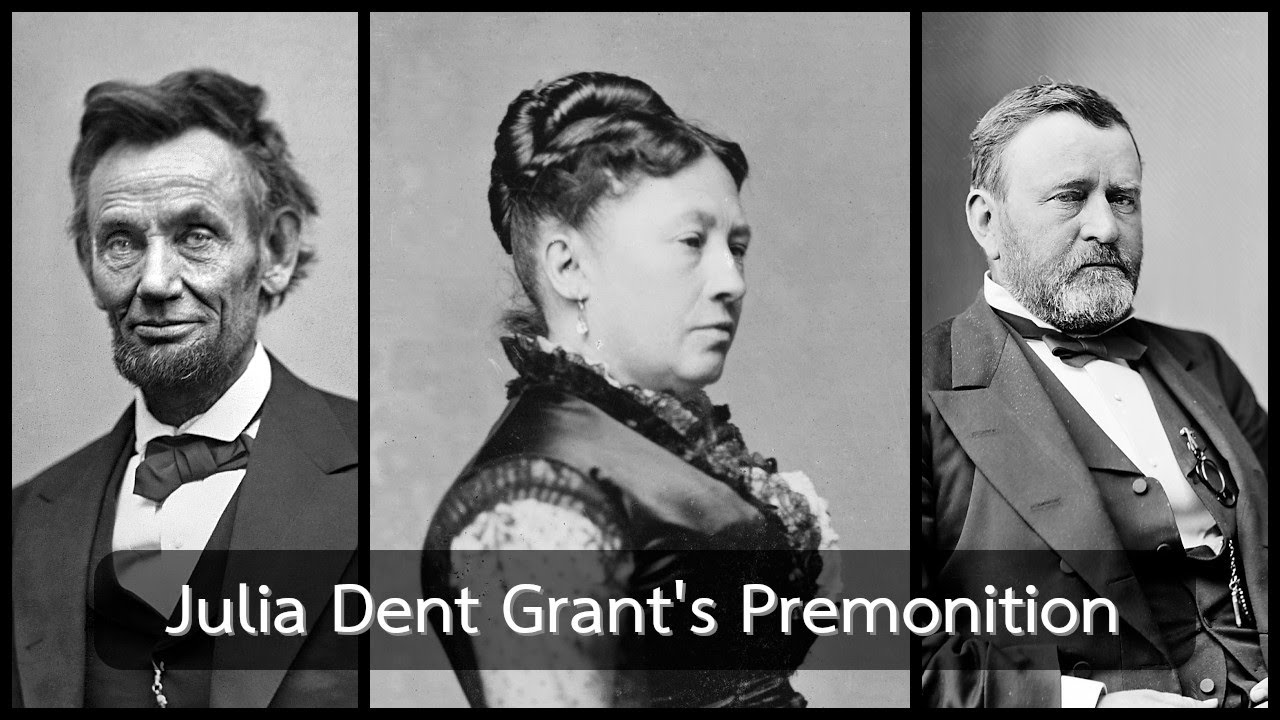
She asked her husband to refuse. The general later told the story plainly. Julia firmly believed that something bad was going to happen if they attended that performance, and she requested that he decline the invitation. Grant, who had spent four years making decisions under fire, did not argue with her.
He sent his regrets, and the Grants stayed home. That night, John Wilkes Booth entered the president’s box and shot Abraham Lincoln. The most powerful military commander in the Union had not been in the room. The question that has followed the Grant family ever since is whether Julia’s warning was a genuine premonition, a lucky guess, or something far more ordinary.
Julia Dent Grant believed herself to be psychic, and she had at least one other episode involving her husband that seemed to support that belief. But to understand whether she truly foresaw the assassination, it helps to look first at what the conspirators had planned and what they expected. The assassination conspiracy that night was designed to cripple the United States government in a single stroke. The plot called for the murder of President Lincoln, Vice President Andrew Johnson, Secretary of State William Seward, and General Grant himself.
The conspirators no doubt believed the Grants were going to be at Ford’s Theatre with the Lincolns. Grant’s place in the plot may have been included simply because he was going to be sitting with the president that evening, or it may have been because there was a good chance he would be president after Lincoln. Either way, the men planning the attack counted on him being there, and Grant’s sudden absence forced them to improvise. Julia’s biographers and historians have long noted that she had a strong sense of her own psychic abilities.
She spoke openly about it, and her husband did not dismiss the idea. But there is another explanation for her behavior that night that has nothing to do with the supernatural. It is possible that Julia used the premonition as an excuse to avoid an evening with Mary Todd Lincoln. The two women did not get along well, and spending a night in the First Lady’s company was not something Julia looked forward to.
If she had simply said she did not want to go, her husband, the general, might have encouraged her to grin and bear it. The invitation was a political and social obligation, and declining it without a serious reason could have seemed rude. By claiming a premonition of danger, Julia gave Grant a reason he could accept and use with the Lincolns without insulting them. It is a plausible explanation, and it would mean Julia was not psychic at all, at least not in this instance.
But there is another incident that complicates that theory. During the Civil War, Grant found himself in a tactical situation that convinced him he might be shot at any moment. He later said that while he was in that position, he was thinking of Julia and had a strong feeling he would never see her again. When the two of them compared notes afterward, Julia told him that at that very same time, she had felt strongly that he was in immediate danger.
She had been at home, far from the battlefield, with no way of knowing what was happening to him in that moment. Grant himself thought the coincidence was remarkable, and he recorded it in his writings. How such a premonition could work is a mystery that remains unsolved. For a feeling or thought to be transmitted across a distance, it would have to travel through some medium, and modern science has not identified what that medium might be.
Early scientists hypothesized the existence of something called the ether, not the medical anesthetic, but a substance that permeated the entire universe. They believed light propagated through it and gravity worked through it. Today, scientists reject the ether theory, and no one has found a replacement for it. If the ether does not exist, then what would a psychic emanation travel through to reach its recipient?
Some have suggested it could be some subdivision of the electromagnetic spectrum that has not yet been detected, but that remains speculation. The mechanism of any such communication is unknown, and it has been unknown for more than a hundred and fifty years. What is not in dispute is the chain of events. The Grants were invited to Ford’s Theatre by the Lincolns.
Julia Grant declined the invitation because she believed something bad was going to happen. Because of her actions, her husband’s life was saved. Whether that was prescience or an excuse, the outcome was the same. The bullet that killed Lincoln did not kill Grant.
Grant survived the night, and he survived the weeks and years that followed, going on to become the eighteenth president of the United States. He lived until 1885, when he died of throat cancer, having spent his final months writing his memoirs to provide for his family. Julia Grant lived until 1902. Throughout her life she maintained her belief in her own psychic abilities, and she remained convinced that she had saved her husband on the night Lincoln was murdered.
Historians and skeptics have weighed the evidence ever since. Those who believe in the premonition point to the wartime episode as supporting evidence, a woman sensing danger for her husband across miles of distance at the exact moment he feared for his life. Those who do not believe point to the simpler explanation: a woman who disliked Mary Lincoln and wanted a way out of an unpleasant evening, and who happened to make the right decision for the wrong reason. Neither side can prove its case, and the question remains open.
On a scale of one to ten, with one being not probable or even a hoax, and ten being probable genuine unexplained phenomena, the Ford’s Theatre premonition rates a five. Maybe it was a premonition. Maybe it was not. There is one thing that can be said for certain.
When the invitation arrived, Julia Grant acted on her conviction. She did not hesitate, and she did not let politeness or duty override her sense that something terrible was coming. Whatever her motive, she removed her husband from the path of John Wilkes Booth’s conspiracy.
The general who won the war was not in the presidential box at Ford’s Theatre that night, because his wife had insisted he not be.
