The oldest undisputed reference to Israel outside the Bible appears on a slab of black granite over three meters tall, carved during the reign of the Egyptian pharaoh Merneptah around 1205 BCE. The inscription boasts of military victories, listing defeated enemies in Canaan. Among the cities of Ashkelon, Gezer, and Yanoam, one line stands apart. It reads, “Israel is laid waste, bare of seed.
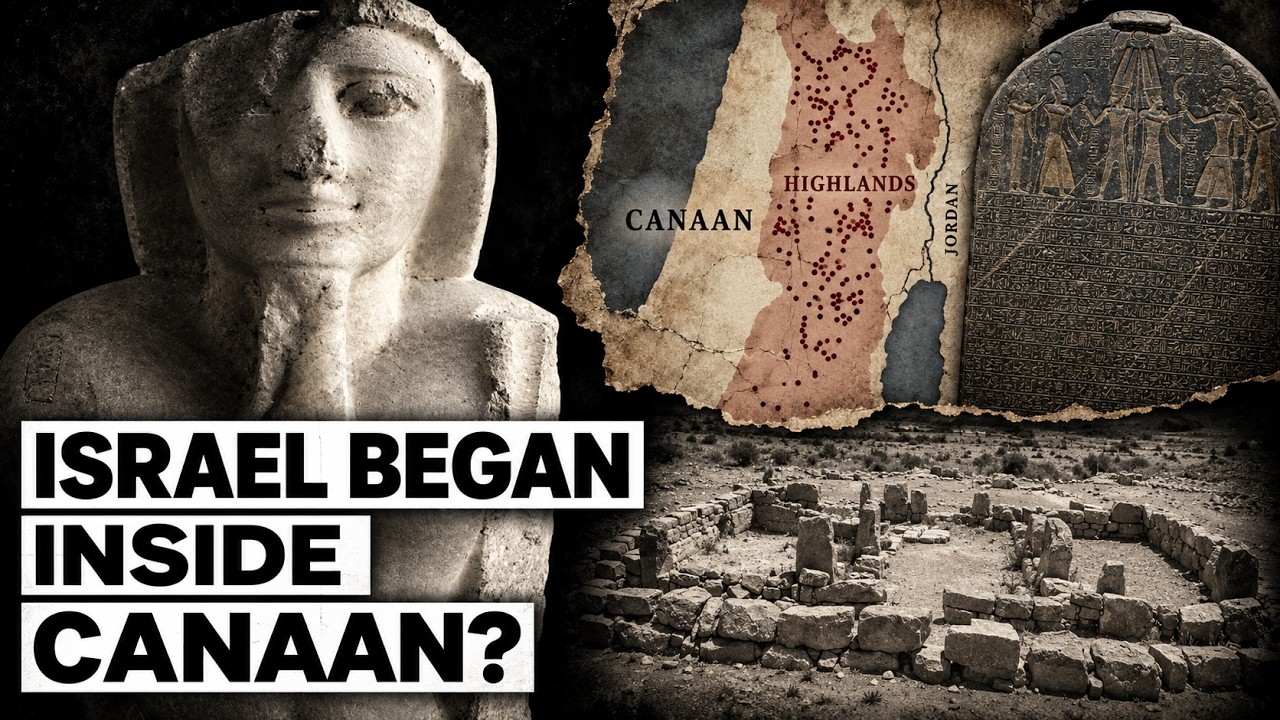
” The hieroglyphs mark Israel not as a city or a state, but as a people. At that moment, the Egyptians recognized an ethnic group dwelling in the highlands of the southern Levant, distinct enough to name, yet not organized into a kingdom. This single artifact anchors the story of how Israel came to be, and it contradicts the familiar biblical account of a dramatic conquest of a promised land. The region in question, the southern Levant, was a narrow corridor squeezed between the Mediterranean to the west, the Arabian desert to the east, Egypt to the south, and the great powers of Mesopotamia to the north.
For most of recorded history it was a contested borderland, a route for armies and merchants passing between far stronger kingdoms. The people who lived there, eventually called Canaanites, were not a unified nation but a patchwork of city-states, each ruled by its own petty king and paying tribute to whichever empire dominated at the time. During the late Bronze Age, roughly 1550 to 1200 BCE, that empire was Egypt. The pharaohs of the New Kingdom held Canaan as a network of vassal states, and we know the details of this arrangement from the Amarna letters.
Discovered in 1887 in Egypt, nearly four hundred clay tablets record diplomatic correspondence between the Egyptian court and Canaanite rulers. These letters describe a land in constant turmoil, with local kings begging for reinforcements, accusing one another of treachery, and complaining about roving bands of people called the Habiru. For a long time, scholars tried to connect the Habiru with the Hebrews, noting the similarity of the words. But deeper study showed the Habiru were not an ethnic group at all.
They were a social class, consisting of outcasts, refugees, mercenaries, and others who had fallen outside settled society. They appear in texts from across the ancient Near East, from Mesopotamia to Anatolia to Egypt, over many centuries. They were a category, not a people. Some ancestors of the Israelites may have been among them, but the Habiru were not the Hebrews.
If the Habiru connection is shaky, the evidence for the Exodus is far worse. The foundational narrative of Israelite identity, enslavement in Egypt, the ten plagues, the parting of the sea, forty years of wandering in Sinai, and the conquest of Canaan under Joshua, has left no trace in the archaeological record. After more than a century of excavation in Egypt, the Sinai Peninsula, and the land of Israel, no Egyptian text mentions Israelite slaves. No record describes a mass departure of a foreign population.
The Sinai, supposedly hosting hundreds of thousands of wanderers for four decades, has yielded not a single campsite, burial, or pottery shard that can be linked to a large migrating population. The cities that the book of Joshua says were conquered were often uninhabited or already destroyed long before the supposed invasion. Jericho, whose walls famously tumbled, was not even occupied during the late thirteenth century BCE, the time when the conquest is usually dated. The site of Ai, another key target, had been abandoned for over a thousand years by then.
These are fundamental contradictions between the text and the physical evidence. So if the Israelites did not arrive through conquest, where did they come from? Three major theories have competed for decades. The conquest model, championed by archaeologist William Foxwell Albright in the early twentieth century, held that the Bible was essentially accurate and that archaeology would confirm Joshua’s campaign.
He pointed to destruction layers at Canaanite sites as proof, but as dating methods improved, the evidence crumbled. The destruction layers dated to different centuries, were caused by different events, and in many cases had nothing to do with any invasion. The peaceful infiltration model, proposed by German scholar Albrecht Alt in the 1920s, argued that the Israelites were semi-nomadic pastoralists who gradually migrated from the desert fringes into the sparsely populated hill country of Canaan, settling down over time. It was more nuanced, but it still assumed the Israelites were outsiders.
The peasant revolt model, proposed by George Mendenhall in 1962 and expanded by Norman Gottwald, turned the narrative around completely. It argued that the early Israelites were not outsiders but lower-class Canaanites who rebelled against the oppressive city-state system. The Exodus story, in this view, was not a literal migration but a powerful metaphor for liberation from local tyranny. This theory was influential, but there is little archaeological evidence for a widespread peasant revolt, and the material culture of the early highland settlements does not reflect a revolutionary movement.
The theory that has become dominant among archaeologists today is the emergence model, or indigenous origins theory, most prominently advocated by Israel Finkelstein and William Dever. Around 1200 BCE, the entire eastern Mediterranean collapsed. The Hittite Empire, Mycenaean Greece, and the Egyptian New Kingdom all contracted or disintegrated in a remarkably short period. This event, known as the late Bronze Age collapse, was caused by a combination of climate change, drought, famine, earthquakes, disruptions in trade, and raids by the Sea Peoples, confederations of naval raiders recorded in Egyptian inscriptions.
When the system collapsed, the Canaanite city-states that had existed under Egyptian protection collapsed with it. Trade routes were severed, cities were destroyed or abandoned, and the political and economic order disintegrated. And it was in this power vacuum that the first identifiable Israelite settlements appear. Starting around 1200 BCE and accelerating over the next two centuries, a wave of new settlements sprouted in the central highlands of Canaan.
The late Bronze Age region was sparsely populated, with about thirty small villages. By the early Iron Age, around 1100 BCE, there were over three hundred settlements with an estimated forty-five thousand people. By the tenth century, that number had grown to hundreds of villages with a population possibly in the hundreds of thousands. This was not an invasion but an emergence.
And the key detail is this: the material culture of these new highland settlements was fundamentally Canaanite. The pottery, the architecture, the agricultural techniques, and the language were all shared with their Canaanite neighbors. In the words of Finkelstein and Silberman in their 2001 book The Bible Unearthed, the early Israelites were, irony of ironies, originally Canaanites. There were differences, and they reveal how this new identity formed.
The early Israelite settlements show a near-total absence of pig bones, while pig bones were common in Canaanite lowland cities. The avoidance of pork, which becomes a defining marker of Israelite identity in the biblical texts, appears to have been a social boundary marker, a way for a new community to distinguish itself from its neighbors. The highland villages were typically small, unfortified settlements arranged in an elliptical plan with houses facing inward, suggesting a community organized around extended families without the hierarchical structures of the Canaanite city-states. There were no palaces, no temples, no monumental buildings.
This was a society that defined itself in opposition to the stratified urban culture it had emerged from. Another diagnostic artifact is the collared-rim storage jar, a large ceramic vessel used for storing grain and olive oil, found in huge quantities at these sites and reflecting an agricultural economy adapted to the challenging hill terrain. What the record shows is a people becoming, not a people arriving. Peasant farmers, pastoralists on the margins, refugees from destroyed cities, perhaps even some with connections to Egypt, all came together in the highlands and forged something new.
A possible earlier reference to Israel exists on a broken statue pedestal in the Berlin Museum, which some scholars read as dating to around 1400 BCE, two centuries before the Merneptah stele, though this reading is disputed. Genetic evidence adds another layer. A landmark 2020 study analyzing ancient DNA from ninety-three Bronze Age individuals buried at Canaanite sites found that the Canaanites were a mix of earlier local Neolithic farmers and migrants from the Caucasus and Zagros mountain regions. Modern populations in the Levant, including Jewish and Arabic-speaking groups, share more than half of their ancestry with these Bronze Age Canaanites.
In 2023, DNA extracted from ancient Israelites of the First Temple period found in a burial near Jerusalem, dating to around the eighth century BCE, confirmed that the ancient Israelites shared substantial genetic ancestry with the earlier Canaanite population. They were not a genetically distinct group that arrived from elsewhere. If the early Israelites were fundamentally Canaanites, where did the Exodus story come from? Several possibilities emerge.
A small group of people with genuine Egyptian connections may have been part of the mix that formed early Israel. Egyptian names appear within the Levite priestly tribe, names like Moses, Hophni, Phinehas, and Aaron, all with plausible Egyptian etymologies. Perhaps a small group of Semitic people who had been in Egypt, possibly enslaved, escaped or were expelled and made their way to the highlands, joining the larger population. Their story could have been adopted as the foundational narrative for the entire people.
The Hyksos, a dynasty of rulers with Canaanite origins who controlled lower Egypt for over a century, were expelled by native Egyptian pharaohs around 1550 BCE. The memory of this expulsion, transformed over centuries of oral tradition, may have contributed to the Exodus narrative. And the biblical place names associated with the Exodus, places like Pithom and Yam Suph, correspond to Egyptian locations attested together only in texts from the thirteenth to eleventh centuries BCE. The writers of the narrative had access to authentic geographical knowledge from that era.
The Exodus story served a profound political function. It united a diverse, fragmented population under a single identity. It declared that the people were not just a collection of hill farmers but a chosen people, forged in oppression and delivered by divine power, bound by covenant to the creator of the universe. The biblical kingdoms tell a similar story of divergence from the evidence.
The united monarchy of David and Solomon, a vast empire stretching from the Euphrates to Egypt, has left little trace. The monumental gates at Hazor, Megiddo, and Gezer, once attributed to Solomon’s building program, have been redated by some scholars to the ninth century BCE, during the reign of the kings of the northern kingdom of Israel. Jerusalem in the tenth century was likely a small hill town of a few hundred or at most a couple of thousand people. The Tel Dan stele, discovered in 1993, provides strong evidence that a dynasty claiming descent from David ruled in Judah, but the biblical portrayal of David as ruler of a mighty empire appears to be a later construction.
The core narratives of the Pentateuch were written down in something close to their current form during the seventh and sixth centuries BCE in the Kingdom of Judah, a period of immense upheaval. The northern kingdom of Israel had been destroyed by the Assyrians in 722 BCE, and Judah found itself the sole surviving heir to the Israelite tradition. Under King Josiah, who reigned from around 640 to 609 BCE, a national history was compiled that traced the origins of the people back to a single ancestor, Abraham, through the Exodus to the United Monarchy. This was an act of nation building, identity construction on a grand scale.
The scribes worked with real traditions and real memories, but they shaped those materials into a coherent narrative that served their present-day agenda. They were creating a usable past. This question of Israelite origins remains deeply political in the modern Middle East, where claims to ancient ancestry are used to justify territorial rights and national narratives. Understanding that Israelite identity emerged from within the Canaanite world complicates simplistic claims on all sides.
The people of the ancient Levant, whatever they called themselves, shared deep genetic and cultural roots. What made Israel different was not its DNA or its pottery but its story, a vision centered on one God, one covenant, and one people with a unique destiny. That vision gave rise to Judaism, and through it Christianity and Islam, three traditions that encompass more than half of the human race. The monotheistic revolution that began in those humble highland villages reshaped the spiritual landscape of the planet.
The Israelites were not strangers in Canaan. They were Canaan’s own children, reinventing themselves in a time of crisis. The story they told about their origins was itself one of the most powerful acts of creation in human history, not because it recorded what literally happened, but because it defined who they would become.






