The outlaw’s hand hovered above a holster that Hollywood had taught the world to recognize at a glance: slung low on the thigh, cut away so the cylinder and trigger guard sat naked to the sun, the leather polished and supple, built for one purpose only. In the movies, that holster wins the duel before the first shot is fired, letting the revolver clear leather in a fraction of a second faster than the enemy’s. It is a brilliant piece of cinema. It is also almost entirely fiction.
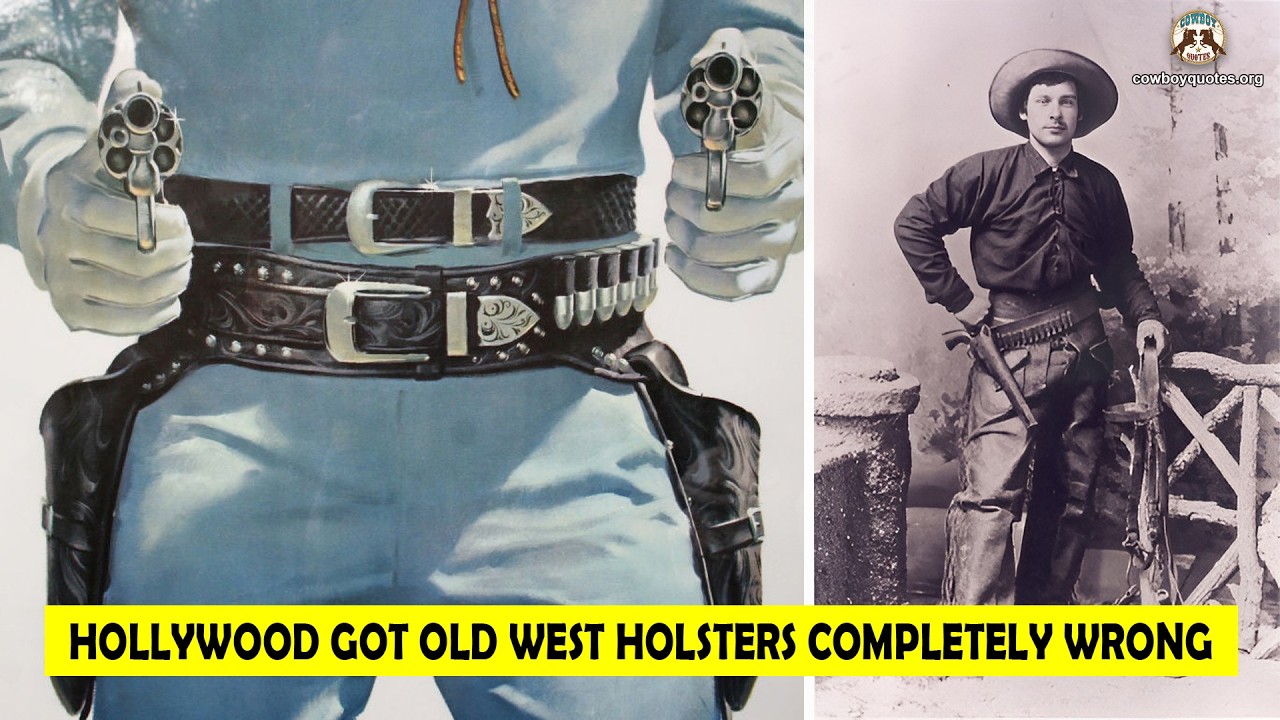
Step out of a time machine onto the main street of Dodge City or Tombstone in the late 1870s, and the truth becomes obvious. The real gun leather of the Old West was not designed for showdowns at high noon. It was designed for survival. For most people who lived on the frontier—cattle drivers pushing herds up the Chisholm Trail, lawmen patrolling dusty streets, families breaking ground on new homesteads—a revolver was not a stylish accessory.
It was an expensive, essential piece of equipment, often the most valuable thing a man owned. Consider the actual costs. Through the 1870s, a new Colt revolver, the legendary “Peacemaker,” sold for between seventeen and twenty dollars at general stores or through catalogs. That sounds modest today.
But the average cowboy or laborer earned only about twenty-five to thirty dollars a month. Buying a revolver meant spending nearly a full month’s wages on a single item. Losing it or breaking it was not a minor inconvenience; it was a financial catastrophe that could not be easily repaired. The gun was often a person’s most treasured possession.
Given that value, frontier saddlers and leatherworkers had no interest in designs that sacrificed protection for speed. A holster that left the cylinder and trigger exposed invited trouble—not from rival gunmen, but from the elements themselves. The real Old West was no tidy film set. It was a place of wind, thick alkaline dust, sudden storms, and deep mud.
Black-powder firearms of the era were highly vulnerable to moisture and dirt. Grit or debris working into the cylinder or forcing cone could jam the mechanism. Water could ruin paper cartridges or early rimfire ammunition, leaving the owner with a useless weapon at a critical moment, whether that meant facing down a rattlesnake or simply protecting the herd. The primary job of the holster, therefore, was protection and secure retention, not speed.
It had to shield the firearm from weather while holding it tightly against the body regardless of how rough the terrain became. The historical record supports this completely. Frontier newspapers like the Tombstone Epitaph and the Dodge City Times published advertisements for saddlers and leatherworkers throughout the era. Not one of those advertisements promoted quick-draw features or fast-release designs.
Instead, they emphasized durability, weather resistance, and secure fit. Historian David Dary, known for his research into frontier tools and equipment, noted that holsters of the period were regarded much like sturdy boots or heavy canvas: practical gear built to endure years of hard use. Hours in the saddle meant constant vibration, sudden bursts of speed, and the real danger of falling from a horse. The loose, open holster of Hollywood would have lost its revolver within the first mile of rough riding, leaving its owner unarmed and out months of savings.
To prevent that, real holsters cinched tightly around the weapon, prioritizing security over access. Settlers on the American frontier were not concerned with looking dramatic for a camera that did not yet exist. Their focus was keeping a precious firearm clean, dry, and exactly where it belonged. A close look at historical photographs from the 1850s through the 1880s—widely considered the true golden age of the American frontier—reveals something striking.
The wide leather holsters famous from mid-century films simply do not appear. Instead, the men captured by those early plate-glass cameras wore holsters that were slim, tight, and eminently practical. This was the famous “Slim Jim” holster, also known as the California pattern, regarded as one of the finest examples of nineteenth-century frontier craftsmanship. To understand what made the Slim Jim so effective, it helps to look at its predecessor: the military holster used during the Mexican-American War and the Civil War.
These early designs were bulky, heavy leather pouches made for cavalry soldiers. They featured a large flap covering the entire rear of the revolver, secured with a brass stud or buckle. This was excellent for keeping rain, mud, and powder residue out in battle conditions, but it was slow and impractical for civilians who needed faster access while working on foot. As the Gold Rush and cattle trade drew Americans westward through the mid-nineteenth century, frontier saddlers recognized the need for something in between.
They removed the heavy top flap from the military design while retaining its focus on protection. That modification became known as the Slim Jim. The original Slim Jim design bears no resemblance to the Hollywood version. Instead of a wide, one-size-fits-all pocket, each Slim Jim was carefully wet-molded to match the exact shape of a specific revolver model—typically a Colt 1851 Navy, a Colt 1860 Army, or a Remington New Model Army.
The leather wrapped tightly around the barrel, cylinder, and frame, completely covering the trigger guard. That detail deserves emphasis. The trigger guard, which movie characters reach for just before drawing, was fully enclosed inside the authentic Western holster. This custom fit served a practical function.
The natural tension between the leather and the revolver’s cylinder and barrel created a built-in retention system, holding the weapon securely without the need for straps or locks. The holster also featured a raised back plate protecting the hammer and recoil shield from chafing against heavy canvas or wool clothing. By the 1870s and 1880s, as the heavier single-action Colt became the standard sidearm, the Slim Jim evolved into what became known as the Cheyenne pattern or the “Myres and Winchester” style, named after prominent saddle shops in Wyoming and California. These updated holsters added a wide belt loop instead of threading the belt directly through a pocket.
But the core design principle remained unchanged. The trigger guard stayed covered, and the holster mouth hugged the weapon tightly to keep out dust and moisture. The surviving records of esteemed nineteenth-century leather makers, such as E. L.
Gallatin of Denver and Myres and Winchester of San Francisco, reflect this same priority. Their catalog descriptions from the period highlight precise fit and heavy-duty leather designed to resist deformation. Quality was measured by how effectively the holster sealed the weapon off from the elements. For a real cowboy or lawman, cutting the leather away to expose the trigger guard—the defining feature of the movie quick-draw holster—would have seemed impractical, even reckless.
It risked letting rain pour directly into the cylinder, damaging the black-powder charge, or allowing dirt and gravel to interfere with the internal mechanism. Rough terrain, unpredictable weather, and long trail rides meant a person’s safety often depended on their gear holding up and their gun staying clean and functional. A lightning-fast draw was a rare scenario. Keeping the revolver in working condition during a months-long cattle drive across Kansas was the daily concern.
The elegant Slim Jim holster was not designed for dramatic confrontations. It was designed to help an expensive and essential tool survive the demands of frontier life. Now consider the low-slung holster that defined the movie gunslinger. As the hero walks down the street in a John Wayne or Clint Eastwood western, his gun belt hangs low on one hip, the holster tied tightly to his lower thigh with a thin leather cord.
This tied-down style is the accepted visual symbol of the feared duelist. It looks stylish, exciting, and positioned for rapid access. But examined through the biomechanics of horseback travel in the nineteenth century, this cinematic holster falls apart. Daily life in the Old West revolved around one fact: people spent enormous amounts of time in the saddle.
During the 1870s and 1880s, men regularly spent ten, twelve, or even fifteen hours a day riding, covering long distances across rough terrain. Anyone who has ridden a horse knows that the thighs remain in near-constant contact with the saddle and the animal’s sides. Now imagine strapping a solid steel revolver weighing about three and a half pounds—a Colt Peacemaker with a 7. 5-inch barrel—tightly against the outside of the thigh.
Within the first mile of riding, that weight would slam against the leg with every stride. A tight cord around the thigh would restrict circulation or chafe the skin beneath denim trousers. Worse, the dangling holster risked catching on the saddle horn or cantle every time the rider mounted or dismounted, creating an awkward, uncomfortable situation—or worse, causing the weapon to fall. Historical evidence points to a far more sensible position.
Frontier residents wore their revolvers high, snug against the waist, settled near the hip bone. Surviving photographs from the period, including tintypes and glass plates preserved by institutions like the Library of Congress, consistently show this pattern. Almost every cowboy, lawman, or scout wore his gun belt cinched at or slightly above the waistline, with the holster positioned high enough that the revolver’s cylinder sat level with or above the belt. This high position served two practical purposes.
First, it distributed the weapon’s weight evenly across the pelvis rather than dragging on one leg. Second, while seated in the saddle, the high holster naturally rode forward or rested over the thigh, keeping it clear of the horse and equipment. It is also worth noting that the “buscadero” belt—the Hollywood style in which the holster hangs from a separate, low-slung belt—did not exist at all during the frontier period. Historians specializing in Western American equipment and supplies have confirmed that this belt style did not appear until the 1920s.
Throughout the nineteenth century, men typically wore a plain, straight leather belt passed through the holster’s belt loop. These belts were wide, often two to three inches, to help support the weight of the revolver and a complement of ammunition. Instead of using a thigh strap for stability, frontier residents relied on the thick, sturdy leather of the holster loop itself to hold the weapon steady on the hip through friction. The people of the Old West were not chasing a split-second advantage for a dramatic duel.
They wanted a comfortable, reliable way to carry a heavy, valuable tool over long distances without discomfort, damage to clothing, or unnecessary strain on their bodies. So if the real holsters were high, protective, and practical, where did the low-slung, quick-draw style actually come from? The answer is not found on the Kansas plains but in early film studios in Southern California. The image of the gunslinger that became iconic was not shaped by historical accuracy.
It emerged from the technical constraints of early moviemaking and the rise of mid-century entertainment culture. During the 1920s and 1930s, westerns were enormously popular in silent films and early talkies. Directors favored dramatic close-ups, yet they faced a practical framing problem. Film historians note that when actors like Tom Mix or William S.
Hart wore their holsters in the historically correct position at the natural waist, the standard medium shot captured the face and torso while cutting off the hand and holster entirely. To overcome this, studio prop designers and leatherworkers began modifying the equipment. By attaching the holster to a separate belt that hung below the main belt—an early version of what became known as the buscadero style—they lowered the weapon’s position by a few inches. This allowed directors to frame a single shot that included the actor’s facial expression, hand movement, and revolver together.
In short, the holster was lowered primarily to fit the camera frame, not for any practical purpose on the frontier. This image gained further momentum during the 1950s, when television westerns like Gunsmoke, The Life and Legend of Wyatt Earp, and Bonanza became enormously popular. By 1959, roughly thirty western series were airing in prime time simultaneously, and the competition for viewers pushed studios to make their lead characters look as fast and skilled as possible. This television boom coincided with a popular postwar hobby: the competitive sport of quick-draw.
Developed by Hollywood stuntman and leather craftsman Arvo Ojala, quick-draw rapidly became a nationwide phenomenon. Ojala discovered that achieving a draw time under a quarter of a second required a completely different holster design than the traditional nineteenth-century pattern. He designed a modern, specialized holster by inserting a thin metal plate, usually steel or aluminum, between two layers of heavy saddle leather. This kept the holster mouth wide and rigid, preventing the revolver’s front sight from snagging during a fast draw.
He also removed the leather around the trigger guard entirely, allowing the shooter’s finger to reach the trigger while the revolver was still inside the holster. To keep this rigid, heavy design from shifting, Ojala invented the now-familiar thigh strap, tying the bottom of the holster to the leg. He patented the design and trained famous actors in its use, including James Arness, who played Marshal Matt Dillon, and Hugh O’Brian. As millions of viewers watched their favorite television lawmen execute dazzling quick draws every week, the fictional image gradually transformed into historical fact.
Over time, the public forgot that these low, metal-reinforced holsters were modern sporting equipment developed in the 1950s. Instead, many assumed this was how historical figures like Wyatt Earp or Wild Bill Hickok actually dressed. In reality, a twentieth-century entertainment innovation became widely accepted as nineteenth-century historical truth. The modern audience often imagines the classic western town as a dusty main street where everyone, from the blacksmith to the saloon keeper, openly carries a revolver on their hip.
Towns like Tombstone and Dodge City are often imagined as lawless places where public gun carrying was simply a fact of frontier life. In reality, gun carrying in nineteenth-century frontier towns was shaped by specific laws, social expectations, and a strong cultural preference for concealment over open display. The notion that frontier towns allowed unrestricted open carry does not hold up against historical legal records. As cattle towns grew, local governments realized that combining alcohol, gambling, and visible firearms created serious risks to public order and business.
In response, many early town councils enacted strict firearms regulations—rules that might shock contemporary audiences familiar only with the movie version of the West. Dodge City, Kansas provides a clear example. In the late 1870s, a large sign at the town’s entrance informed arriving visitors that carrying firearms within the city limits was not permitted. Similarly, in Tombstone, Arizona, municipal ordinance number nine, passed in April 1881, prohibited carrying weapons within the city without special permission from local officials.
Anyone entering town was expected to leave their firearm at a hotel, livery stable, or the sheriff’s office. Notably, the enforcement of this very ordinance played a direct role in the events leading up to the famous gunfight at the O. K. Corral.
Because wearing a gun belt openly was often against the law, or at least considered improper and alarming within town limits, those who wanted to carry a firearm often chose to conceal it instead. In settled communities, a firearm hidden in a pocket, coat, or purpose-built holster was far more common than open carry. Firearm sales data from the 1870s and 1880s supports this trend. Major manufacturers like Colt, Smith & Wesson, and Remington sold far more compact, short-barreled pocket revolvers than large cavalry models.
These small guns, typically . 32 or . 38 caliber, were designed to fit easily into a coat pocket or waistband without any holster at all. For those who preferred a full-size revolver but wanted privacy, the shoulder holster became a popular option.
Unlike the belt holsters seen in films, early shoulder rigs, such as the Texas pattern that appeared in the late 1870s, consisted of a simple leather holster suspended from a strap, positioning the weapon under the arm. This style was popular among professional gamblers, undercover lawmen, and city dwellers alike. It allowed a person to keep their coat closed against cold weather while keeping the weapon out of sight of local authorities, yet easily accessible if the situation demanded. Looking beyond the Hollywood version, the visible gun belt was specialized equipment used primarily by cattlemen, military personnel, or lawmen on duty.
Walking into a bank or restaurant with a revolver openly displayed was not seen as a sign of independence or strength. It was generally viewed as improper and disruptive behavior likely to result in a night in the local jail. To fully understand the reality of historical gun belts, it is useful to look past the film additions and examine the documented habits of well-known frontier figures. Studying how men like Wild Bill Hickok, John Wesley Hardin, and Wyatt Earp carried their weapons reveals a combination of cunning, individualism, and a clear departure from the Hollywood style.
These men were not interested in looking cinematic. Their choices were driven entirely by practicality. Take James Butler “Wild Bill” Hickok, one of the most famous figures of the frontier era. While films typically show him wearing a low-slung gun belt, historical photographs and firsthand accounts paint a different picture.
Hickok was known for carrying a pair of ivory-gripped Colt 1851 Navy revolvers, and he did not use a conventional holster at all. Instead, he tucked them into a silk sash or a narrow leather belt worn high at the waist, with the grips pointing forward. This style, sometimes called the cross-draw, allowed Hickok to draw his revolvers with a reverse grip motion. It suited his lifestyle, as he spent long hours seated at gaming tables.
A traditional holster at the waist would have been awkward or restrictive while sitting. With the grips pointing forward near his waist, Hickok could reach both guns in a single fluid motion while standing, without needing extra space to maneuver. Then there is John Wesley Hardin, one of the era’s most notorious figures, historically linked to a large number of violent confrontations. Hardin was known for his innovative method of concealing weapons.
Accounts indicate he wore a custom vest with sheaths built directly into the lining near the chest, positioned under each arm with the grips pointing inward. This early version of a shoulder rig allowed Hardin to move through towns with firearm restrictions without being detected. It also gave him a practical advantage. If police approached and ordered him to raise his hands, he could pretend to comply while actually preparing to reach his weapons quickly, often before those around him realized the situation.
Even Wyatt Earp, so closely associated with the famous O. K. Corral shootout, does not match his typical screen portrayal. Films often show him with a long-barreled Colt Buntline in a visible holster at his waist, but historical research by his biographers suggests a different arrangement.
On that October afternoon in Tombstone in 1881, reports indicate Earp was not wearing a holstered revolver at all. Instead, he kept a ten-inch Smith & Wesson American revolver in his coat pocket, which a local tailor had reinforced with heavy cloth lining to prevent the barrel from protruding through the fabric. These examples point to a consistent pattern. The most capable and famous figures of the era valued secrecy, comfort, and quick access over flashy appearances.
They did not use standard open holsters because they were not engaging in a sport or a performance. They modified their clothing and carried their weapons high, concealed, and secure, understanding that success in real situations depended on keeping the gun clean, hidden, and ready when needed—far more than on flashy equipment. Debunking the Hollywood version of the Old West does not diminish its history. It reveals a story that is more compelling, more powerful, and more honestly human.
The true origin of Western gun leather has nothing to do with stunt coordinators or prop designers of the 1950s. The credit belongs to the skilled and hardworking saddlers and leather craftsmen of the nineteenth century who designed practical solutions for surviving that harsh frontier. Figures like E. L.
Gallatin of Denver, J. S. Collins of Cheyenne, and the esteemed Myres and Winchester shop in San Francisco deserve recognition as the true pioneers of frontier equipment. In humble workshops scented with leather and lit by kerosene lamps, these craftsmen transformed thick, sturdy hides into precise, durable gear built to last.
Using water and custom wooden forms, they carefully shaped each holster around a specific firearm, ensuring the precious revolver was protected from weather and wear. Many pieces featured precise hand-stamped patterns, carved floral decorations, and sturdy brass rivets. This was not for aesthetic effect before a camera, but because owners of that era treasured their equipment. A cowboy might travel light and own little, but his saddle and holster reflected his personal identity and status.
So why does the image of the gunslinger wearing a low holster, poised for a quick draw, remain so deeply etched in popular culture? Why does the drama of the thigh-strapped holster and the classic street confrontation still captivate us even after we realize it is historically inaccurate? The answer lies in the storytelling power of the American western as a film genre. Westerns function as a form of national mythology, much as other cultures draw on ancient legends or epic tales.
In storytelling, symbolism often matters more than strict accuracy. The low-worn holster, the open-mouthed leather, the hand hovering near the grip became visual symbols expressing independence, honor, and courage. These images helped transform a complex and difficult period of western expansion into a romantic narrative built on decisive dramatic moments. There is nothing wrong with enjoying those classic films.
Watching Marshal Matt Dillon expertly handle the rig designed by Arvo Ojala, or admiring the bold visual style of Clint Eastwood’s gun belt, remains an enjoyable part of American cinematic history. At the same time, as lovers of western history, it is worth honoring the truth about the people who actually lived in that era. The real Old West was not a polished film set. It was full of intense heat, thick dust, and harsh winter conditions.
The cowboys and lawmen who faced that environment were not interested in style. They needed practical equipment that worked. Recognizing that the high, practical Slim Jim holsters and innovative concealment methods of the nineteenth century were the norm does not diminish the legend. It finally acknowledges the true resilience and ingenuity that helped shape America’s frontier.
From the high-riding Slim Jim holsters to the hidden shoulder systems favored by figures like Wyatt Earp and John Wesley Hardin, the real story of Old West gun leather is not about speed and showmanship the way Hollywood wanted us to believe. The low-slung quick-draw rig was not a product of the frontier at all. It was a twentieth-century invention shaped by camera angles and television ratings decades after the era it claims to represent. Once you understand the difference between cinematic myth and historical reality, it becomes difficult to watch classic westerns without noticing every small detail that never quite matched the truth.
The real history, built by skilled leather craftsmen and shaped by the practical demands of frontier life, turns out to be every bit as fascinating as anything Hollywood created.
