In February 2019, Dr. Rebecca Thornton sat alone in her office late at night, staring at a computer screen. She had spent fifteen years cataloging Civil War-era photographs—thousands of stern-faced soldiers, stiff family portraits, and fading tintypes of people whose names had been lost to time. She had learned not to expect surprises.
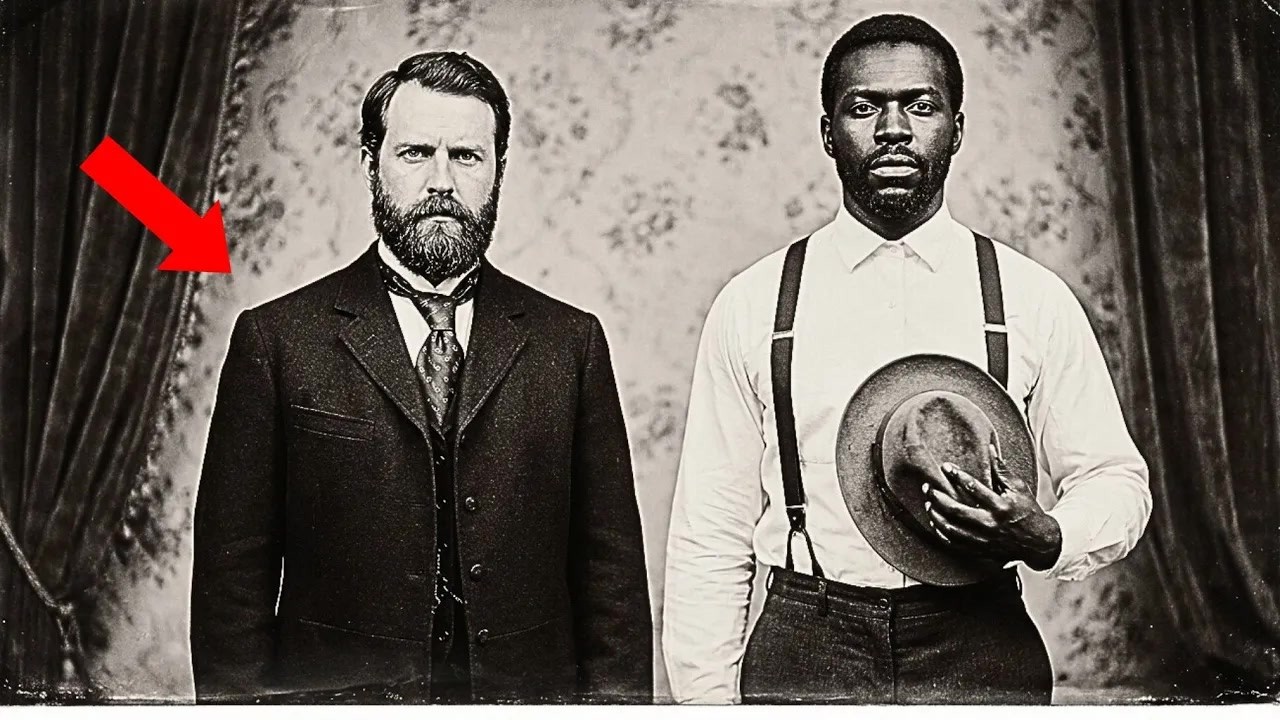
But for nearly a month, a single image had pulled her back, again and again, until on one of those long nights she leaned closer to her monitor and saw something she had missed. Behind two men posed in a Boston studio, barely visible in the soft focus of the backdrop, was a section of wallpaper where the pattern appeared mismatched, as if a piece had been replaced or pasted over another layer. Within its folds and creases, she could make out faint lines—too deliberate to be accidental, too structured to be mere decoration. They looked almost like markings, symbols, directions.
She reached for her phone and called her colleague, Dr. Marcus Whitfield, a specialist in abolitionist history and the Underground Railroad. When he answered, she didn’t bother with pleasantries. “Marcus,” she said, her voice tight with excitement, “I need you to look at something.
I think I just found a map. ”
The photograph itself was unremarkable at first glance. Two men stood side by side in what appeared to be a photography studio. The taller man on the left was white, perhaps in his early thirties, wearing a dark wool suit with a high collar and a thin silk tie.
His expression was serious but not cold, his eyes fixed directly on the camera with a kind of quiet intensity. Beside him stood a black man, slightly shorter, dressed in simpler but well-kept clothing: a pressed shirt, suspenders, dark trousers. His hands rested at his sides, his posture upright, dignified. There was no subservience in his stance.
He stood as an equal. Photographs of black and white men standing together as apparent equals in the 1870s were not common, especially in formal studio settings. Enslaved people had been photographed, of course, but typically in ways that emphasized their status—standing behind white families, positioned as servants, posed to reinforce racial hierarchies. This image was different.
The two men were positioned identically, their shoulders nearly touching, their gazes forward. It suggested familiarity, perhaps even friendship. Rebecca had made a note in her catalog and moved on, but the image stayed with her. Marcus Whitfield arrived at Rebecca’s office the next morning carrying two large coffee cups and a leather satchel filled with reference books.
He had been intrigued by her late-night call, but skeptical. Maps hidden in wallpaper sounded like the plot of a sensational documentary, not serious historical research. But Rebecca wasn’t prone to wild speculation, and the urgency in her voice had convinced him to drive three hours to see the photograph himself. She pulled up the image on her computer and walked him through what she had found.
Marcus set down his coffee and leaned in, his eyes narrowing as he studied the mismatched section. Rebecca had already enhanced the image using digital restoration software, isolating the background and increasing the sharpness of the faint markings. What emerged was unmistakable: a series of lines, dots, and small symbols that formed a crude but deliberate pattern. “These look like route markers,” Marcus said quietly, tracing the lines with his finger on the screen.
“See here? This could be a river. And these dots, they might represent safe houses or stations along the Underground Railroad. ” Rebecca nodded.
It was what she had thought, but she wanted to be sure before saying anything. Marcus pulled out one of his books, flipping to a section on coded maps used by abolitionists in the 1850s and 1860s. He compared the symbols on the screen to documented examples—quilts, songs, and occasionally hidden drawings. The similarities were striking.
Wavy lines for waterways, circles for safe locations, stars for guides or conductors. “This is real,” Marcus said, his voice filled with quiet astonishment. “This isn’t just decoration. Someone put this here deliberately.
”
But why would a photography studio have a map like this embedded in its wallpaper? Rebecca had already begun researching the studio itself. The photograph bore a faint stamp on the reverse side: JM Hartford Studio, Boston, Mass. , Est.
1868. She had found a few scattered references in old business directories and city records, but little else. Most studios from that era left minimal documentation, and many had closed or burned down decades ago. Then, in an 1875 edition of the Boston Daily Advertiser, she found a small notice: “JM Hartford, photographer and proprietor, offers discrete portraiture services for all clients, regardless of station or circumstance.
Appointments available at all hours. ” The wording was peculiar. In the racially divided society of 1870s America, that phrase was loaded. It suggested Hartford welcomed clients who might not be accepted elsewhere, and “appointments available at all hours” hinted at flexibility, secrecy, perhaps even clandestine meetings.
Marcus looked up from the newspaper clipping. “You think Hartford was running a station? ” he asked. Rebecca thought it possible.
The Underground Railroad hadn’t ended with the Emancipation Proclamation or even the end of the Civil War. There were still people escaping violent situations in the South, seeking safety, trying to reunite with families. And there were people in the North willing to help them, even after the war. If Hartford was one of them, hiding a map in his studio wallpaper would have been brilliant.
It was right there in the open, but unless you knew what you were looking for, it just looked like a bad wallpaper job. Marcus sat back, exhaling slowly. “So, who are these two men? ” That, Rebecca admitted, was the question she couldn’t yet answer.
There were no names on the photograph, no inscriptions, no accompanying documents. Just two men standing together in a studio that may have doubled as a refuge, in front of a wall that concealed a secret map. To find out who they were, she would have to go deeper into family records, census data, and the fragmented, often deliberately obscured history of those who risked everything to help others escape bondage. Rebecca and Marcus spent the next several weeks working in tandem, each pursuing different threads.
Rebecca focused on the studio itself, while Marcus dug into abolitionist networks and post-war assistance organizations in Massachusetts. They met twice a week to compare notes, their shared determination growing stronger with each new discovery. Rebecca’s breakthrough came from an unexpected source: a probate record. In 1889, a man named Jonathan Michael Hartford had died in Boston, leaving behind a modest estate that included the building where his photography studio had once operated.
Among his personal effects was a handwritten journal, donated to the Massachusetts Historical Society after his death but never fully cataloged or transcribed. Rebecca requested access, and when the journal arrived, carefully preserved in an archival box, she spent an entire afternoon reading Hartford’s cramped, fading handwriting. The journal was a revelation. Hartford had not been a mere businessman.
He had been a committed abolitionist, deeply connected to the network of activists who had operated the Underground Railroad before and during the Civil War. Even after the war’s end, he had continued to assist formerly enslaved people who arrived in Boston seeking work, education, and safety from the violent retaliation they faced in the South. His studio, as Rebecca had suspected, had served as more than a place for portraits. It had been a meeting point, a place where information was exchanged, where maps were shared, and where those fleeing danger could find temporary refuge.
One entry dated April 1873 caught her attention. Hartford wrote: “Today I made a portrait of two friends whose bond defies every cruelty this nation has inflicted. One was born free, the other was born into chains, yet they have remained brothers in all but blood. They asked that I include a particular section of wall in the frame, the one we use for those who need guidance.
I understood their meaning. This photograph is not merely a keepsake. It is a testament. ” Rebecca’s hands trembled as she read the passage aloud to Marcus over the phone.
“He’s talking about them,” she said. “The two men in the photograph. Hartford knew them. He knew what they were doing.
”
Marcus, meanwhile, had been combing through records of abolitionist families in the Boston area, cross-referencing names with property records, church membership rolls, and old letters preserved in university archives. He found a reference to a man named Thomas Whitaker, a white landowner from Virginia who had moved to Boston in 1869. According to a letter written by a Quaker abolitionist, Whitaker had brought with him a companion—a man of remarkable courage, who had once been held in bondage on his family’s estate, but who now stood as his equal and most trusted friend. The letter didn’t name the companion, but it described him as someone who had escaped slavery with Whitaker’s assistance years before the war and who had returned to Virginia during the conflict to help others flee.
After the war, the two men had settled in Boston together, where they worked quietly to continue the mission they had started. Rebecca found the confirmation she was looking for in a collection of letters held by a small historical society in Richmond, Virginia. The letters had been written by members of the Whitaker family between 1848 and 1875, and among them was a series of correspondence between Thomas Whitaker and his younger sister Katherine. The letters painted a vivid picture of a family divided by conscience and circumstance.
Thomas Whitaker had been born in 1840 into a wealthy Virginia family that owned a tobacco plantation worked by enslaved people. From childhood, he had been deeply uncomfortable with the institution of slavery, influenced in part by his mother, a devout Quaker before marrying into the Whitaker family. She had taught Thomas to see enslaved people not as property, but as human beings deserving of dignity and freedom. This belief had put him at odds with his father, who viewed abolition as a threat to their livelihood and social standing.
Among the people enslaved on the Whitaker plantation was a boy named Samuel, born the same year as Thomas. The two had grown up together, playing in the fields and woods surrounding the estate. Despite the vast gulf in their legal and social status, they had formed a genuine friendship, one that became increasingly painful and complicated as they grew older and the realities of slavery became impossible to ignore. In one letter dated 1859, Thomas wrote to his sister: “I can no longer pretend that this arrangement is just or tolerable.
Samuel is my friend, my brother in every way that matters. Yet the law and our father’s will bind him to a life of servitude. I have decided that I must act, even if it costs me everything. ” The following year, Thomas helped Samuel escape.
According to the letters, Thomas had used his knowledge of the family’s land and his connections to arrange Samuel’s passage north, providing him with false papers, money, and contacts in abolitionist networks. The escape was successful, but it came at a tremendous cost. Thomas’s father disowned him, and Thomas left Virginia shortly afterward, moving to Pennsylvania and eventually to Boston. He maintained contact with his sister, who sympathized with his actions but remained bound to the family estate.
The letters also revealed that Samuel had not simply disappeared into the North. During the Civil War, he had returned to Virginia, working as a scout and guide for Union forces, helping to free others still enslaved on plantations throughout the region. After the war, he reunited with Thomas in Boston, where they worked together to assist newly freed people in finding homes, jobs, and education. Their friendship, forged in childhood and tested by the brutality of slavery, had endured.
By 1873, both men would have been in their early thirties. The photograph taken that year would have been a deliberate commemoration of their bond, a visual record of a friendship that had survived separation, war, and a social order designed to keep them apart. But there was still the question of the map—why they had chosen to be photographed in front of that specific section of wallpaper. To understand its significance, Marcus reached out to Dr.
Evelyn Carter, an expert on the Underground Railroad and resistance networks at the Smithsonian’s National Museum of African American History and Culture. He sent her high-resolution scans of the photograph and the enhanced image of the wallpaper map, along with the context he and Rebecca had uncovered. Dr. Carter’s response came within two days, and it was more detailed than either of them had anticipated.
The map, she wrote, was consistent with route markers used by conductors on the Underground Railroad in the mid-nineteenth century, but with some notable differences. The symbols suggested a route running from Virginia through Maryland and into Pennsylvania, with stops at safe houses operated by Quaker and abolitionist communities. However, some of the markers appeared to be post-war additions, indicating the map had been updated or modified after 1865. The network hadn’t simply dissolved after emancipation; it had adapted, continuing to help people escaping violence, reuniting families, and relocating to safer areas in the North.
She went on to explain that embedding such a map in a studio’s wallpaper would have been a stroke of genius. To the untrained eye, it looked like nothing more than a decorative flaw. But to those who knew what to look for, it served as a discreet reference guide, something that could be consulted during a portrait sitting without drawing suspicion. Hartford’s studio, she concluded, had likely been a hub for this continued work.
Rebecca also contacted a local wallpaper conservator, who examined the photograph and confirmed that the mismatched section appeared to be a printed pattern layered over the original wallpaper, likely applied by hand. The printing technique matched methods used in the 1860s and early 1870s for producing abolitionist pamphlets and coated materials. It was possible, the conservator suggested, that Hartford had commissioned the map himself, or that it had been provided to him by associates in the abolitionist network. Armed with this information, Rebecca and Marcus began searching for records of other people who might have visited Hartford’s studio during the same period.
They found references to several notable abolitionists, including Frederick Douglass, who had visited Boston in 1873, and Harriet Tubman, who had been living in Auburn, New York, but maintained correspondence with activists in Massachusetts. While there was no direct evidence that either had visited Hartford’s studio, the connections suggested his work was well known within the network. Marcus also discovered something else—a brief mention in an 1874 letter written by a formerly enslaved woman named Hannah, who had arrived in Boston from South Carolina with her two children. She wrote to a friend in Philadelphia: “A kind man named Samuel helped me find work and a place to stay.
He took me to a photographer’s studio where I could see a map on the wall hidden in the flowers. It showed me where others like me had traveled, and it gave me hope that I could build a new life here. ” The letter didn’t provide Samuel’s last name, but the description matched. Samuel, the man who had escaped slavery with Thomas’s help, had continued the work of the Underground Railroad in his own way, guiding others to safety and ensuring that the knowledge encoded in that map reached those who needed it most.
With the identities of Thomas Whitaker and Samuel now confirmed, Rebecca and Marcus turned their attention to understanding why the photograph had been taken in the first place. In the nineteenth century, portrait photography was an expensive and deliberate act, especially for working-class people or those recently freed from slavery. A sitting at a studio like Hartford’s would have required planning, money, and intent. This was not a casual snapshot.
It was a statement. Rebecca returned to Hartford’s journal, searching for more entries from 1873. She found several that referenced Thomas and Samuel, though never by their full names—Hartford had been careful to protect the identities of those he helped, using only initials or vague descriptions. One entry written in late April provided crucial insight.
“T and S came to me today with a request both humble and profound,” Hartford wrote. “They wish to have their portrait made together as equals, to commemorate the bond they have shared since boyhood. But more than that, they wish for the portrait to serve as a record—proof that friendship, loyalty, and justice can endure even in a world built to destroy them. They asked that the wall behind them show the path, so that anyone who looks upon this image in years to come will understand that their work did not end with their own freedom, but extended to all who sought refuge.
” When Rebecca read the passage aloud to Marcus, her voice was filled with emotion. “They wanted it to be a record,” she said—“not just for themselves, but for everyone who came after. ” Marcus was silent for a moment, processing the weight of what she had read. The photograph wasn’t just about their friendship.
It was about the mission. They were documenting the network, preserving it in a way that couldn’t be easily destroyed or forgotten. And by including the map in the background, they were embedding that mission directly into the image. Anyone who knew what to look for would see it, and even those who didn’t would see two men standing together as equals—which in 1873 was a radical act in itself.
Marcus began searching for other photographs from Hartford’s studio, wondering if the map had appeared in other portraits. He found a handful of images in various archives, most showing individual subjects or small family groups. But in two photographs, the same section of wallpaper was visible in the background, slightly out of focus but unmistakable. One showed a young black woman holding a baby, her expression serious but hopeful.
The other showed an elderly white man seated in a chair, his hands folded in his lap, his eyes gazing directly at the camera with quiet determination. Marcus reached out to descendants of families connected to abolitionist networks in Boston, hoping to identify the subjects. Within weeks, he received a reply from a woman named Clara, who recognized the elderly man as her great-great-grandfather, a Unitarian minister who had sheltered fugitives in his church basement during the 1850s and continued to support newly freed people after the war. She had no idea a photograph of him existed, much less one that might contain a hidden map.
The young woman with the baby proved harder to identify, but eventually Marcus found a reference in a church registry: a woman named Ruth, listed as having been baptized in 1873 along with her infant daughter. The registry noted that she had arrived in Boston from Georgia earlier that year, seeking sanctuary and a new beginning. The timeline matched, and Marcus suspected Ruth had been one of the many people Samuel had helped settle in the city. Each photograph, it seemed, was part of a larger tapestry—a deliberate effort by Hartford, Thomas, Samuel, and others to document a movement that had been largely invisible, to preserve the names and faces of people who had fought for freedom in ways both large and small.
Rebecca wanted to understand more about the personal relationship between Thomas and Samuel, not just their abolitionist work, but the friendship itself. She returned to Thomas’s letters to his sister, searching for passages that revealed the emotional depth of their bond. What she found was both heartbreaking and inspiring. In a letter from 1862, written while Thomas was living in Pennsylvania and Samuel was somewhere in the South, Thomas wrote: “I think of him every day, wondering if he is safe, if he remembers our childhood promises, if he knows that I would give anything to see him again.
People ask me why I risked so much to help him escape, as if friendship and loyalty were not reason enough. They cannot understand that Samuel is not merely someone I helped. He is the person who taught me what it means to live with courage and integrity. I owe him everything.
” Another letter from 1868, after the two had reunited in Boston, revealed the quiet joy of their restored friendship. “Samuel and I have found a rhythm here,” Thomas wrote. “We work together. We share meals.
We argue about politics and philosophy late into the night. There are those who look at us with suspicion, who cannot fathom why a white man and a black man would choose to live as equals and companions. But we have never needed their approval. We have only needed each other.
”
Marcus wanted to find Samuel’s voice, to understand how he had experienced the friendship and the work they did together. This proved more difficult. Formerly enslaved people in the nineteenth century rarely had the resources or opportunity to leave written records, and Samuel appeared to be no exception. But Marcus didn’t give up.
He contacted archives specializing in African American history, oral history collections, and genealogical societies. Finally, he found a reference in the archives of a Black church in Boston: a brief oral history collected in the 1930s from an elderly woman named Esther, who had been a member of the congregation in the 1870s. Esther recalled a man named Samuel who had been active in the church, helping newly arrived families find housing and work. She described him as a quiet man who carried himself with great dignity.
“He never spoke much about his past,” she said, “but we all knew he had suffered and survived. He and his friend Thomas, a white man, which was unusual, worked together to help people like us. They were like brothers. ” Esther also mentioned that Samuel had once told her: “Thomas gave me my freedom, but I gave him his purpose.
We saved each other in different ways, and now we save others together. That is what friendship should be—not just affection, but action. ”
Those words resonated deeply with both Rebecca and Marcus. The photograph wasn’t just a static image of two men standing together.
It was a visual representation of a philosophy, a way of understanding friendship as something active, something that required sacrifice, risk, and a commitment to justice. Thomas and Samuel hadn’t simply preserved their bond despite the forces that sought to tear them apart. They had transformed that bond into a force for change, using it to build networks, shelter the vulnerable, and challenge the very systems that had once held Samuel in bondage. As they continued their research, Rebecca and Marcus began to uncover the broader network that Thomas, Samuel, and Hartford had been part of.
It wasn’t just a handful of individuals working in isolation. It was a sprawling, interconnected web of activists, church groups, business owners, and everyday people committed to helping those escaping violence and oppression in the post-war South. Marcus found records of a group called the Boston Vigilance Committee, which had been active during the 1850s in protecting fugitive slaves from capture under the Fugitive Slave Act. After the Civil War, the group had reorganized under a new name, the Committee for Southern Refugees, and shifted its focus to assisting newly freed people who faced violence, exploitation, and discrimination as they tried to build new lives.
Thomas and Samuel had both been members. One letter written in 1874 by Thomas to a colleague in Philadelphia outlined the scope of their work. “We have assisted over 200 individuals and families in the past year alone,” he wrote, “providing temporary housing, employment referrals, legal assistance, and safe passage to other locations when necessary. The map that J.
M. Hartford so cleverly embedded in his studio has proven invaluable. It allows us to discreetly share route information with those who need it, and it serves as a reminder to all who see it that the struggle for true freedom is far from over. ” Cross-referencing the committee’s records with Hartford’s journal, Rebecca found numerous overlaps.
Hartford had photographed dozens of people connected to the committee, and many of those portraits had been taken in front of the same section of wallpaper. The map wasn’t just a decorative choice—it was a deliberate tool integrated into the committee’s operations, used to communicate vital information in a way that appeared innocent to outsiders. With Dr. Carter’s help, Rebecca and Marcus traced the routes indicated on the map.
Using geographic analysis and historical records of safe houses, they determined that the map covered a network stretching from Richmond, Virginia, through Baltimore and Wilmington, and into Philadelphia and Boston. Some stops corresponded to known Underground Railroad stations from before the war, while others appeared to be new locations established after 1865 to help people fleeing the rising violence of white supremacist groups in the South. One stop was a farm outside Baltimore owned by a Quaker family named Patterson. Rebecca found references to the farm in several abolitionist memoirs, describing it as a place of refuge where fugitives had been sheltered during the war.
She contacted the current owners, descendants of the Patterson family, and was astonished to learn that the original farmhouse still stood. The family invited her to visit, and she made the trip with Marcus the following week. Walking through the old farmhouse, they found evidence of its history everywhere: hidden compartments in the walls, a concealed cellar accessible only through a trap door in the kitchen, and faint markings on the floorboards that matched symbols used in Underground Railroad codes. The family showed them a diary kept by the farm’s original owner, which included entries describing the people who had stayed there, their journeys, and their destinations.
One entry from 1873 mentioned a man sent by “T and S” from Boston, seeking passage to Canada to reunite with his brother. The timeline and details matched the work Thomas and Samuel had been doing. Standing in that farmhouse, Rebecca felt a profound sense of connection to the past. The map on Hartford’s wallpaper wasn’t just an abstract set of symbols.
It represented real places, real people, real acts of courage and compassion. And the photograph of Thomas and Samuel, taken in front of that map, was a testament to all of it. By the summer of 2020, Rebecca and Marcus had compiled enough evidence to publish their findings. They co-authored a paper for the Journal of American History, detailing the discovery of the map, the identities of Thomas Whitaker and Samuel, and the broader network they had been part of.
The paper included high-resolution images of the photograph, the enhanced map, and excerpts from Hartford’s journal and Thomas’s letters. The response was immediate and overwhelming. Historians, journalists, and genealogists from across the country reached out. Several descendants of families connected to the Boston Vigilance Committee and the Committee for Southern Refugees came forward with their own family stories, adding new layers to the narrative.
One woman, a descendant of Ruth—the young mother photographed in Hartford’s studio—shared letters and documents that confirmed her ancestor’s journey from Georgia to Boston and her connection to Samuel, who had helped her find work as a seamstress. The photograph itself became the subject of exhibitions and educational programs. The Massachusetts Historical Society organized a special display featuring the original image alongside Hartford’s journal, the letters, and artifacts from the Patterson farm. Visitors stood in silence before the photograph, struck by the quiet dignity of the two men and the hidden story the image contained.
Rebecca and Marcus were invited to give talks at universities, museums, and historical societies. At one lecture in Richmond, Virginia, they were approached by an elderly man who introduced himself as a distant cousin of Thomas Whitaker. He had grown up hearing vague family stories about an ancestor who had caused a scandal by helping enslaved people, but the details had been lost over generations. Seeing the photograph and learning the full story, he said, had given him a sense of pride he hadn’t known he was missing.
“For so long,” he told Rebecca, “this part of our family history was buried, treated as shameful. But now I see it differently. Thomas didn’t just defy his family. He chose a higher loyalty.
He chose justice. And he did it alongside someone he loved as a brother. ”
Marcus, meanwhile, had been working with genealogists to trace Samuel’s descendants. It was a painstaking process, as many records of Black families from the nineteenth century had been lost, destroyed, or never created in the first place.
But eventually he found a lead: a woman named Angela living in Atlanta, whose great-great-grandfather had been named Samuel and had lived in Boston in the 1870s. Angela agreed to take a DNA test, and the results confirmed the connection—she was Samuel’s direct descendant. When Marcus called to tell her about the photograph, Angela wept. “I never knew,” she said.
“I never knew he had done all of this. I knew he had been enslaved, that he had escaped. But I didn’t know about Thomas or the map or the people he helped. This changes everything.
It means my family’s story isn’t just about survival. It’s about resistance, about building something better. ” Rebecca and Marcus arranged for Angela to visit Boston and see the photograph in person. She stood before it for a long time, her fingers lightly tracing the glass that protected the image.
“He looks strong,” she said softly. “He looks free. ”
The photograph of Thomas Whitaker and Samuel, taken in Jonathan Michael Hartford’s studio in 1873, is more than a historical artifact. It is a window into a moment when friendship, courage, and justice converged in the most deliberate and profound way.
For over a century, the image had been overlooked, filed away in archives, its significance hidden beneath layers of faded wallpaper and forgotten names. But when historians finally looked closely—when they zoomed into the background and saw the map embedded in the wall—they uncovered a story that had been waiting to be told. Thomas and Samuel had grown up in a world designed to keep them apart, a world where one was born free and the other was born into bondage. But they had refused to accept that division.
Thomas had risked everything to help Samuel escape, and Samuel had dedicated his life to extending that same gift of freedom to others. Together, they had built a network of resistance that continued long after the Civil War ended, helping hundreds of people find safety, work, and dignity in the North. The map on the wall, hidden in plain sight, disguised as decorative wallpaper, was a stroke of brilliance. It served as both a practical guide and a symbol of hope, a reminder that the struggle for liberation was ongoing and that ordinary people working together could change the course of history.
And the photograph itself—with Thomas and Samuel standing side by side as equals—was a deliberate act of defiance and commemoration. It was their way of saying: we were here. We mattered. And this bond, this friendship, was stronger than any law or prejudice.
The photograph now hangs in the Smithsonian’s National Museum of African American History and Culture, where thousands of visitors see it every year. They stand before it just as Angela did, and they see two men—one white, one black—standing together in a moment of perfect equality, their friendship immortalized, their mission preserved. And behind them, barely visible but undeniably present, is the map: a testament to the network they built, the people they saved, and the legacy they left behind.
