In the autumn of 1908, a skilled cartographer from Springfield, Missouri, walked into the dense forests of the Ozark hills and never came back. The official report filed by the United States Geological Survey in November of that year stated simply that Thomas Holloway had not returned from his expedition. His camp was found intact, his equipment untouched, and his food supplies nearly full. The only thing missing was Holloway himself.
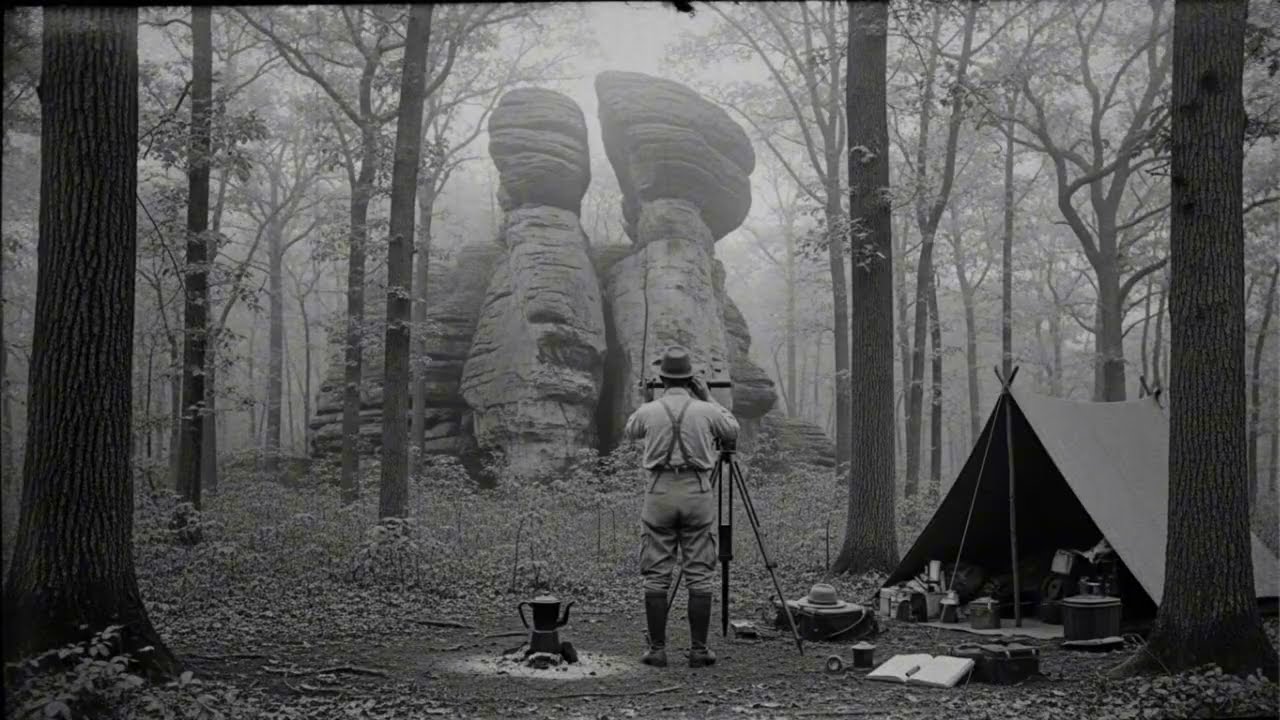
What the report left out was the journal found among his belongings, a leather-bound notebook filled with entries marked by signs of wear over time. The journal was never included in any official documents. According to records later uncovered in 1963, the agency supervisor deemed it unsuitable for publication and had it stored in a regional archive in Jefferson City. The last person known to have seen Thomas Holloway alive was Elias Burkhardt, the owner of a general store in the small settlement of Garber, located at the foothills of the mountains.
According to Burkhardt’s statement to local authorities, Holloway appeared perfectly calm and organized while purchasing supplies for his trip. He said he planned to camp near what the locals called Stillwater Hollow, a remote valley about twelve miles northeast of Garber, known for its unusual quietness even by Ozark standards. The following account is assembled from Thomas Holloway’s recovered journal, interviews with locals conducted in the aftermath of his disappearance, and regional newspaper archives from 1908 to 1912. Some details have been confirmed through Geological Survey records declassified in 1963 following a Freedom of Information request filed by the Missouri Historical Society.
Had it not been for what happened to those who searched for him, the disappearance of Thomas Holloway might have remained just another forgotten tragedy in America’s backcountry. Thomas Holloway was thirty-seven years old in 1908, a widower whose wife had died of tuberculosis three years earlier. He had no children. His colleagues described him as precise, reserved, and completely devoted to his profession.
His supervisor at the Geological Survey, Dr. William Barrett, noted that Thomas had an almost uncanny knack for perceiving geographic features that others might overlook. This talent made him particularly valuable for surveying areas like the Ozarks, where dense forests and irregular limestone formations posed significant challenges for cartography. The Ozarks in 1908 remained among the most isolated regions of the continental United States.
While railroad lines were beginning to push through parts of southern Missouri, vast stretches were still accessible only on foot or horseback. Communities lived in relative isolation, often suspicious of outsiders. The hills themselves were ancient mountains carved by millions of years of erosion, creating a landscape of steep ridges, hidden valleys, and branching cave systems. It was not uncommon for even experienced lumbermen to lose their way among the dense groves of oak, hickory, and pine.
What made Thomas Holloway’s disappearance particularly strange was the condition of his camp when a search party found it ten days after he failed to return. According to the report filed by Webster County Sheriff Ambrose Coleman, everything appeared to be in order. The tent was properly pitched. His bedding was carefully arranged.
His surveying equipment was organized and protected from the elements. A coffee pot had been prepared but never poured. His rifle remained leaning against a tree, unfired. There was no sign of a struggle, no animal attack, no hasty departure.
It looked as though Thomas Holloway had simply walked away from his camp and vanished. The only thing out of place was his journal, lying open on his bedding. The last entry, dated September 17, 1908, read simply: “The forest is quiet today. Quieter than it should be.
Something is watching from the hollow. ”
His handwriting, usually precise and methodical according to his colleagues, had become increasingly disturbed as the entry progressed. In the days before that final entry, Thomas had documented his work with his usual attention to detail. Coordinates were recorded, landmarks described, geological features catalogued.
But starting on September 12, a subtle shift appeared in his writing. He began noting the unusual acoustic properties of the valley he was mapping. He described how sound seemed to travel differently there, how his footsteps sometimes echoed in the wrong places and at other times made no sound at all. He observed the absence of birdsong at midday, something any naturalist would recognize as abnormal in a healthy forest ecosystem.
By September 14, his notes included references to disturbances in his peripheral vision and movement that stopped when observed directly. These observations were interspersed with technical notes about elevation changes and rock formations. It was as though Thomas was trying to maintain professional detachment even as something began to unsettle him. Sheriff Coleman organized a more thorough search.
After discovering the abandoned camp, he enlisted experienced trackers from across the county. Despite exhaustive efforts that covered miles of rugged terrain, no trace of Thomas Holloway was ever found. No clothing, no blood, no remains, nothing to indicate what might have happened to him. But what the sheriff’s report did not include, revealed later in a personal letter to his brother in St.
Louis, was the strange behavior of the tracking dogs. According to this correspondence, discovered in 1959 during the settlement of the Coleman family estate, the dogs refused to follow any consistent trail. They became agitated, backtracked on their own tracks, and finally sat down and howled in a way the sheriff had never witnessed in thirty years of law enforcement work. By the second day of the search, the dogs were so frantic they had to be returned to town.
The disappearance might have remained merely a local curiosity had it not been for Professor James Wickham, a geologist from Washington University in St. Louis, who arrived in the area in early 1909, ostensibly to conduct a study of the karst formations common to the region. University records show that Wickham had corresponded with Holloway in the months before his disappearance, discussing unusual geological features in the area. It was not widely known that Wickham and Holloway had been classmates at Yale University some fifteen years earlier.
Wickham based himself in the town of Galena, about twenty miles from the last known location of Holloway. He hired local guides and spent several weeks exploring the area, focusing particularly on Stillwater Hollow and its surroundings. Unlike Holloway, Wickham was accompanied by an assistant, a graduate student named Edward Mercer. Together, they collected samples, took photographs, and conducted what Wickham described in his notes as acoustic experiments throughout the valley.
On March 23, 1909, Wickham and Mercer pushed deeper into the hollow than they had previously explored. According to the account of their guide, Harlon Thatcher, the two men had become increasingly interested in a particular limestone formation the locals called the Whispering Wall, a curved rock face about twelve meters high that seemed to capture and distort sounds in unusual ways. Thatcher reported that he advised against remaining near the formation after sunset, citing local superstitions. When questioned by authorities, he hesitated to provide further details, saying only that people here do not go to that place, and animals do not approach it either.
There is a reason for that. Wickham and Mercer apparently disregarded these concerns, ordering Thatcher to return to their base camp and prepare dinner while they took final measurements. That was around four-thirty in the afternoon, according to Thatcher’s statement. When they had not returned by nightfall, he grew worried, but he did not want to venture back to the site in the dark.
At dawn, he returned to find the site abandoned. Their equipment remained as it was, their notebooks open, their tools arranged as if still in use. But there was no trace of Wickham or Mercer. He immediately returned to Galena to report their disappearance.
The resulting search lasted nearly two weeks but produced nothing. The disappearance of two educated men from St. Louis generated considerably more interest than the loss of a lone surveyor. The St.
Louis Post-Dispatch published several articles on the case, speculating that the men may have fallen into an undiscovered cave system or fallen victim to hostile locals. A reporter named Frederick Palmer traveled to the area to investigate and produced a series of sensational articles hinting at hidden forces at work in the remote hills of southern Missouri. What Palmer discovered during his investigation, which never appeared in his published articles, was a notebook kept by Edward Mercer that had been overlooked during the initial search. This notebook, which surfaced decades later among Palmer’s personal effects after his death, contained observations disturbingly similar to those of Thomas Holloway.
Mercer wrote about acoustic anomalies and visual disturbances at the edge of perception. He described how Wickham had become abnormally preoccupied with the acoustic properties of the valley, spending hours recording and analyzing how sounds worked there. In an entry dated March 21, just two days before their disappearance, Mercer wrote: “Professor W. insisted today that he heard voices emanating from the rock face.
I heard nothing, though the silence itself seemed expectant. He pressed his ear against the limestone for nearly 30 minutes, nodding occasionally as if in conversation. When I asked what he heard, he only said: ‘They know we are here now. ’ His expression was difficult to interpret, not fear exactly, but a kind of resignation and acknowledgment.
”
Public interest in the case gradually waned. The university conducted its own investigation but eventually declared the disappearances a tragic accident, likely the result of a cave collapse. Insurance settlements were paid to the families. Academic journals published respectful obituaries.
The case was considered closed. By late 1909, the events at Stillwater Hollow had largely faded from public memory. But in certain circles in the Ozarks, the disappearances only deepened a sense of unease about that particular area. Locals, never open with outsiders to begin with, became even more reticent about discussing the valley.
Hunters avoided it. Trappers skirted it. Lumber companies, which had begun exploiting the region’s forests, mysteriously excluded that hollow from their cutting plans, despite the mature hardwoods that grew there. Matters might have remained that way indefinitely had it not been for the interest of Karl Denman, a private investigator from Kansas City who had built a reputation for solving mysterious disappearances across the American Midwest.
In the spring of 1910, he was hired by Elizabeth Wickham, the professor’s sister, who was not convinced by the official explanation for her brother’s disappearance. Denman arrived in Stone County in April of that year and spent several weeks interviewing locals, reviewing official reports, and gradually piecing together the threads of the two disappearances. What distinguished Denman’s investigation was his meticulous approach and his willingness to take local folklore and superstition seriously. While others dismissed these tales as the ignorant musings of isolated hill dwellers, Denman recognized them as a form of cultural memory, ways of encoding real dangers in cautionary narratives that could be passed down through generations.
Among the stories he collected was the tale of the Stillwater silence, a phenomenon locals claimed had existed in the valley since before the arrival of white men. According to these accounts, the unnatural quiet of the valley was not merely an absence of sound but something more oppressive and active. A suffocating silence that pressed against the ears, making a man’s own thoughts thunder in his head. Many elderly residents spoke of hunters who entered the valley and came out changed, withdrawn and reclusive, sometimes talking to themselves or to voices that were not their own.
What struck Denman particularly was the consistency of these accounts across different communities that had no regular contact with one another. The same elements recurred again and again: the unnatural silence, the feeling of being watched, the distortion of perception. These elements corresponded uncomfortably with the journals of both Holloway and Mercer. On May 18, 1910, Denman ventured into Stillwater Hollow himself, accompanied by a local guide named Josiah Wendell, a man in his seventies who claimed his grandfather had been part of the first European settlement in the area.
Wendell agreed to take Denman to the hollow but refused to enter it himself, saying he had promised his mother on her deathbed that he would never set foot there. Unlike previous investigators, Denman carried with him an Edison phonograph, determined to record the acoustic anomalies he had noted in his journals. He set up his equipment at the edge of the hollow while Wendell waited at a distance. According to Denman’s notes, later found among his belongings, he made several recordings at different locations, gradually moving deeper into the hollow toward the limestone formation known as the Whispering Wall.
What happened next is known only through fragmentary evidence. Wendell reported that after waiting several hours for Denman’s return, he heard the echo of a single gunshot through the forest. Alarmed but unwilling to enter the hollow, he returned to the nearest settlement for help. A search party was formed, but a sudden violent storm delayed their departure until the following morning.
When they finally reached the hollow, they found Denman’s equipment scattered near the base of the Whispering Wall. His phonograph was damaged, and the cylinder recordings were missing. His notebook was open, the last sentence ending mid-line. The recordings, when played, contained something beneath the surrounding forest sounds, an rhythmic pattern resembling speech, though not in any language I can identify.
The locals may be right about this place. Remarkably, Denman himself was found about 200 yards from the site, standing motionless in a small clearing. According to those who found him, he did not respond to their calls, staring fixedly at a point in the air. When they approached, he showed no reaction.
When they took his arm, he moved compliantly but did not speak or show any emotion. This unresponsive state continued after Denman was brought back to town. A physician was called from Branson, who diagnosed a form of acute catalepsy of unknown origin. Unable to determine appropriate treatment, the doctor recommended Denman be transferred to the state hospital in Nevada, Missouri.
Records from that institution show that Denman remained in this catatonic state for approximately seven weeks. When he finally began to respond again, his mental state had deteriorated markedly. He could speak, but his speech was described as disjointed and frequently incomprehensible. He showed extreme agitation when questioned about the events at Stillwater Hollow.
The most coherent statement he made was recorded by Dr. Harold Winters, the hospital’s chief physician, on July 12, 1910: “The silence is not empty, it is full. Full of them. They have been there a long time.
Waiting in the stone. Listening through the stone. Speaking through the stone. They have learned our words by listening to us.
They are learning to use our voices. To call with familiar voices. Do not listen when someone you know calls your name in the hollow. It is not them calling.
”
Denman remained in the asylum until his death from pneumonia in 1913. The cylinder recordings he had made in the hollow were never found. The Missouri Historical Society later acquired his research notes, which the hospital had confiscated as part of his personal effects, but they remained largely forgotten in their archives for decades. In the years following these incidents, Stillwater Hollow gained an increasingly ominous reputation among locals.
The few settlements near the area were gradually abandoned. In 1915, a lumber company attempted to log the hollow and recorded unusual difficulties. Equipment malfunctioned, workers lost their bearings, and in one case, an experienced timberman suffered a complete nervous breakdown, claiming the trees whispered when struck with an axe. By 1920, maps of the region were redrawn to exclude any specific reference to the hollow.
In the conversations of local guides, the hollow became a place of vague mention. Those who needed to know were aware of it, and those who did not were directed elsewhere. The stories of the disappearances of Holloway, Wickham, and Mercer faded into local legend, told sometimes as cautionary tales around campfires but rarely discussed in daylight. This deliberate obscurity may explain why the hollow escaped scientific scrutiny for several decades.
The region did not attract outside attention again until 1947, when Dr. Raymond Foster, an acoustics engineer from the University of Arkansas, learned of the site while conducting a study of natural amphitheaters in the Ozark region. His interest was purely scientific. He specialized in the study of unusual acoustic phenomena and had published several papers on natural acoustic anomalies across North America.
Unlike his predecessors, Foster approached the hollow with comprehensive equipment and a team of three assistants. He had no knowledge of the previous disappearances, as these events had never been linked in any academic literature. The reluctance of locals to discuss the area was merely an anthropological curiosity, an example of the insular nature of rural communities. Foster’s expedition arrived in the area in June 1947 and established a camp about three miles from Stillwater Hollow.
Their presence generated considerable unease among locals. According to Foster’s notes, they encountered unexpected difficulty hiring guides, and those who eventually agreed to work with them refused to enter the hollow itself or remain in the area after dark. Foster and his team spent two weeks conducting detailed acoustic tests throughout the valley, focusing particularly on the limestone formation previous researchers had called the Whispering Wall. Their results were never published in any peer-reviewed scientific journal.
Foster’s field notes were preserved among his papers, which his widow later donated to the University of Arkansas archives in 1964. These notes describe several phenomena that challenge conventional acoustic principles. The cavity exhibited what Foster called selective frequency absorption. Certain sound frequencies disappeared entirely when directed into the hollow, while others amplified beyond natural parameters.
Stranger still was his documentation of what he called delayed acoustic returns, sounds that echoed back long after physics would predict, sometimes minutes after the original sound was produced. Foster’s notes dated June 24 include this observation: “The limestone formation appears to possess resonance properties unlike any previously documented natural structure. When struck with a tuning hammer, it produces overtones that seem to originate from within the rock itself rather than from its surface. Frequency analysis reveals patterns strongly resembling vocalization, as if the rock is attempting to mimic the sounds directed at it.
Matthews, one of my assistants, suggested, rightly I believe, that we are teaching it to speak. The idea is absurd, of course, but it captures the strange sensation one gets when working with this formation. ”
By July 1, Foster’s notes had taken on a distinctly different tone. His scientific detachment had been replaced by more subjective observations.
He wrote of persistent auditory phenomena the team experienced during quiet periods, whispers at the edge of perception that their recording equipment could not capture. He noted that two of his assistants had begun experiencing insomnia and strange dreams in which they reported conversations with people who were not physically present. Foster himself admitted to becoming unusually preoccupied with the acoustic properties of the cavity, often returning to the site alone in the early morning hours when the forest was at its quietest. During these solitary visits, he conducted what he described as perception experiments, sitting motionless for hours, listening to the silence.
The final entries in Foster’s field notebook, dated July 7, contain scattered observations indicating a significant deterioration in his scientific methodology. He wrote about moments of revelation when he believed he could hear through the stone, not just hear from it. He described the silence of the cavity as filled with consciousness and claimed to have established primitive contact with what he called the watchers. On July 8, 1947, Foster ordered his team to return to their university with all the data they had collected, claiming he needed to stay to verify some results.
He assured them he would catch up within a week. When he had not returned by July 20, a search was organized. Foster was never found. His last camp, set up right next to the Whispering Wall, was intact.
His journal lay open beside his sleeping bag, the final entry unfinished: “Everything makes sense now. The mathematics of it, the patience. They have been waiting for someone to understand them, to truly listen to them. They have been alone for a long time.
I can hear them clearly now, not just with my ears, but with…”
The university classified Foster’s disappearance as an accident, possibly the result of disorientation in the rugged terrain. His research materials were archived. His acoustic findings were never published, with reports deemed inconclusive and unsystematic in final evaluation. The area returned to a state of deliberate obscurity.
By the mid-1950s, the region surrounding Stillwater Hollow had become part of the Mark Twain National Forest, placing it under federal administration. Forest Service maps from that period show the area simply classified as unstable terrain with incomplete surveying, discouraging casual visitation. Rangers assigned to the area reportedly received informal instructions to direct hikers and campers away from the region, citing concerns about dangerous sinkholes and unstable limestone formations. Matters might have remained that way indefinitely had it not been for the interest of Marian Leedbetter, a graduate student in anthropology at the University of Missouri conducting research on Ozark folklore for her doctoral thesis.
In 1962, while examining historical county records, she discovered references to the disappearance of Thomas Holloway. Further research led her to connections with the Wickham-Mercer case and, ultimately, to Karl Denman’s investigation. Leedbetter was a methodical researcher, spending nearly a year gathering documents before visiting the site herself. She filed Freedom of Information requests for sealed records, contacted historical societies, and conducted interviews with elderly residents who still remembered the events.
Gradually, she assembled the threads of a pattern of disappearances and unusual phenomena associated with Stillwater Hollow. Unlike previous investigators, Leedbetter approached the hollow with full knowledge of its history. She was aware of the fate of those who had come before her. In a letter to her academic supervisor dated April 1963, she wrote: “There is a clear pattern to these events that cannot be dismissed as coincidence.
Every investigator has followed a similar trajectory: initial scientific curiosity evolving into obsession, followed by behavioral changes, and ultimately disappearance or psychological collapse. This consistency indicates either a genuine phenomenon worthy of serious study, or a complex form of regional psychosis passed down through generations. Both possibilities merit rigorous investigation. ”
Leedbetter entered Stillwater Hollow on June 12, 1963, accompanied by two fellow graduate students who were fully briefed on the site’s history.
They carried modern recording equipment, cameras, and geological sampling tools. They established protocols for maintaining objectivity and agreed to leave immediately if any team member began experiencing unusual psychological symptoms. For the first three days, their research proceeded smoothly. They documented the valley’s acoustic properties, confirmed some of Foster’s findings regarding sound anomalies, and mapped the precise dimensions of the Whispering Wall.
Their recordings captured nothing beyond what could be explained by natural acoustic principles. Leedbetter noted in her journal that many of the phenomena reported by previous researchers could simply be the result of suggestion and isolation, the tendency of the human mind to impose patterns on random stimuli when placed in unfamiliar environments. On the fourth day, however, the team’s photographer, David Summers, reported hearing what he described as voices in the static when reviewing audio recordings from the previous night. Leedbetter and the third team member, William Cartwright, could not discern the voices Summers claimed to hear, even after amplifying and filtering the recordings.
This disagreement created tension within the group. According to Leedbetter’s notes, Summers became increasingly insistent, spending hours listening to the recordings with headphones, noting the moments when he claimed the voices were clearest. By the sixth day, Summers had stopped participating in the team’s research activities altogether, instead sitting near the Whispering Wall for extended periods, pressing a microphone against different points on the limestone surface. When questioned about his behavior, he reportedly became defensive, claiming that Leedbetter and Cartwright were missing something important because they were not listening carefully enough.
Concerned by these developments and mindful of the historical pattern, Leedbetter decided to end the expedition. Initially, Summers refused to leave, leading to a heated argument that Cartwright documented in his personal notes. Eventually, Summers was persuaded to depart, but he insisted on keeping copies of all the audio recordings for further analysis. Upon returning to the university, Leedbetter documented the expedition meticulously, noting her concerns about Summers’s behavior, which seemed to conform to the psychological effects reported in previous studies.
She recommended that any future research at the site be conducted under close psychological supervision, with periodic evaluations of all participants. Meanwhile, Summers withdrew from his graduate program two weeks after returning from the hollow. He took a job as a sound engineer at a radio station in Springfield, where colleagues later described his growing preoccupation with background noise and subliminal messages. In January 1964, he abruptly quit his job and returned to the Ozarks.
His landlord reported him missing in February of that year after he failed to pay rent. His car was eventually found on a Forest Service road about eight kilometers from Stillwater Hollow. Despite extensive searches, Summers himself was never found. This development deeply affected Leedbetter, who had begun organizing her research for publication.
She immediately suspended her work and instead compiled all her findings into a comprehensive report submitted to both the University of Missouri and the United States Forest Service. In this document, titled “Acoustic Anomalies and Psychological Effects at Stillwater Hollow,” Leedbetter recommended restricting access to the area. She detailed the history of incidents associated with the site and officially recommended that the region be declared off-limits for research and recreation. The Forest Service, perhaps mindful of liability implications, quietly implemented these recommendations.
By 1965, the hollow was officially classified as a research natural area, a designation that severely restricted access without explicitly acknowledging any unusual phenomena. Academic interest in the site gradually waned. Leedbetter herself abandoned her thesis topic and eventually completed her doctorate with a study of folk medicine traditions in the Appalachian Mountains. The last documented incident associated with Stillwater Hollow occurred in the fall of 1968.
Bradley Compton, a freelance journalist who read Leedbetter’s report during a research visit to the University of Missouri archives, became fascinated by the valley’s history. He entered the restricted area in late September without official permission, carrying portable recording equipment and a camera. Compton informed his editor at the Kansas City Star of his plans, promising an investigative piece on either a genuine scientific mystery or a peculiar case of regional mass delusion. He estimated the investigation would take about a week.
After three weeks without contact, the editor contacted authorities. A search was organized, but it yielded no trace of Compton. His campsite was never found. His car was discovered parked at a trailhead several miles from the hollow, containing only his luggage and a notebook detailing his planned research methodology.
The disappearance received brief media attention but was ultimately attributed to an accident in the rugged terrain. Few connections were made to the historical pattern of the hollow, as most of those records remained either sealed or scattered across various institutional archives. The Kansas City Star published a brief obituary in December 1968, noting that Compton was presumed dead after his disappearance while on assignment in southern Missouri. What was not made public was the package that arrived at the newspaper’s offices in November of that year, postmarked from Springfield, Missouri, containing Compton’s audio recordings and a handwritten note.
According to the editor who received it, the recordings contained only forest sounds and occasional equipment noise. The note, which handwriting experts later confirmed was in Compton’s hand, consisted of just three sentences: “It is not on the recordings. It was never on the recordings. You have to be there to hear it.
”
Over the decades that followed, Stillwater Hollow remained an officially restricted area, though its history had largely faded from memory. Occasional rumors circulated among hikers about a hollow in the Ozarks that forest rangers refused to discuss, a place that maps did not clearly show. Every few years, academic researchers rediscovered fragments of the pattern. A reference to Holloway’s disappearance here prompted acoustic studies there, but the full narrative remained scattered across numerous archives, institutions, and local historical societies.
Less well known is the fact that the United States Geological Survey conducted a classified assessment of the limestone formations in the hollow in 1973. This study was carried out under the cover of a mineral resource evaluation, motivated by Department of Defense interest in anomalous natural acoustic phenomena for potential use in surveillance technologies. The team operated under strict protocols that limited each individual’s time at the site to four hours maximum and required daily psychological evaluations. Their findings, partially declassified under a Freedom of Information request in 1997, described the limestone of the Whispering Wall as structurally unique, containing unusual crystalline formations that appeared to resonate at specific frequencies.
The report offered no definitive conclusions but recommended against further research at the site, citing unexpected environmental factors that could jeopardize both research integrity and personnel safety. The declassified portions made no mention of the team’s audio recordings. However, a former technician who worked on the project, speaking anonymously to a paranormal research publication in 2001, claimed that their equipment captured what he described as organized patterns in the ambient sound of the valley. Patterns that should not exist according to conventional acoustic science.
When asked for details, he would only say that these patterns suggested waiting. Local histories of the Ozark region contain scattered references to the hollow dating back before European settlement. Fragments of oral tradition collected from indigenous peoples in the late nineteenth century speak of a place where trees do not speak with one another, where the silence feels hungry. Early French hunters supposedly called it “le vallon qui écoute,” the listening valley.
The earliest documented European encounter with the site appears in the journals of a wandering Methodist preacher named Ezekiel Harmon, who traveled through southern Missouri in the 1820s. In his journal entry dated August 1823, he described camping near a strange depression in the hills where birds did not sing and the night seemed to settle over the place unusually. He wrote that he woke before dawn with the firm conviction that someone had been calling his name, though his traveling companions had heard nothing. Throughout the nineteenth century, local newspapers periodically published brief reports of hunters or trappers who disappeared in the surrounding area.
In most cases, these disappearances were attributed to accidents, exposure, or encounters with indigenous peoples. However, scrutiny of these incidents reveals a geographic clustering that seems more than coincidental when compared to modern understanding of the hollow’s boundaries. Perhaps most intriguing is the case of the Keller farm. In 1879, a German immigrant named Friedrich Keller established a small farm on the eastern edge of what would later be known as Stillwater Hollow.
County records show he purchased the land at a notably low price, with the previous owner eager to sell for reasons unspecified in the documents. Keller, his wife Margaret, and their three grown children worked the land for two seasons. By all accounts, they were industrious and reclusive, their only regular contact being a general store in the nearest settlement, where they traded surplus crops for supplies they could not produce themselves. In the spring of 1881, the store owner grew concerned by the family’s unusual absence and organized a group of neighbors to check on the Kellers.
They found a farm in perfect order: freshly plowed fields, well-grazed livestock, a clean and tidy house, but completely devoid of any human presence. Half-eaten meals sat on the table, beds were made, and the family’s two horses remained in the stable. But there was no trace of the five Kellers. Subsequent investigations produced nothing, with no evidence of violence, theft, or hasty departure.
The most notable finding in the sheriff’s report was the discovery of dozens of small stone cairns in the forest behind the house, arranged in concentric circles around a limestone outcropping. When dismantled, the cairns revealed nothing beneath them. The Keller disappearance generated considerable local speculation, but no definitive explanation was ever reached. The land remained abandoned afterward, with locals unwilling to claim it despite its apparent fertility.
By the turn of the century, the forest had reclaimed the fields. The house gradually collapsed. Within a generation, little visible evidence remained that anyone had ever attempted to settle there. It is worth noting that Thomas Holloway’s journal includes a brief reference to discovering the remains of an old house during his survey work.
He noted the unusual pattern of stone cairns still visible in the surrounding forest and commented that they appeared to have been deliberately placed according to some organizing principle he could not discern. He collected several soil samples from the area, intending to analyze them upon his return. Those samples, like Holloway himself, vanished into the mystery of Stillwater Hollow. The geological history of the region may contribute to understanding some of the phenomena associated with the hollow.
The Ozark Mountains are among the oldest land masses in North America, with portions remaining above sea level for more than 300 million years. The limestone formations that dominate the region formed when ancient seas covered the area, depositing calcium-rich remains of marine organisms that were eventually compressed into stone. What makes the limestone at Stillwater Hollow unique are the conditions under which it formed. Geologists who have studied core samples from the region, though not specifically from the hollow itself, have noted unusual mineral inclusions and crystalline structures suggesting hydrothermal vent activity during the formation period.
These ancient hot springs may have introduced rare earth elements and minerals into the calcium carbonate matrix of the forming limestone, potentially creating unique physical properties in the resulting stone. One geologist suggested in a paper published in 1995, which referenced the hollow indirectly without naming it explicitly, a speculative theory that certain crystalline structures might be capable of storing and releasing vibrational energy in ways not fully understood by conventional physics. The paper was largely dismissed by the scientific community, and its author later disavowed it, claiming portions had been misinterpreted and that he never intended to suggest anything beyond conventional geological processes. Meanwhile, local folklore offers its own explanations for the hollow’s unusual properties.
One account, documented by folklorists in the early twentieth century, tells of a tribal shaman who, centuries before the arrival of Europeans, attempted to communicate with what dwelled beneath the earth through rituals conducted in the hollow. According to this account, the shaman succeeded, but he was not prepared for what answered his call. The silence of the hollow is not an absence but a presence, something that emerged from the stone and remained there, listening and occasionally calling to those who venture too deep into its realm. More mundane explanations have also been proposed.
The unusual acoustic properties could result from rare atmospheric conditions created by the hollow’s unique geography, temperature inversions, air density variations, and the distinctive terrain of the limestone formations producing what acousticians call acoustic anomalies. The psychological effects reported by visitors could be attributed to low-frequency infrasound, which studies have shown can cause anxiety, confusion, and even visual hallucinations in some individuals. However, these natural explanations fail to account for the consistent pattern of disappearances and psychological deterioration associated with the site over more than a century. If purely geological or atmospheric phenomena were responsible, similar effects would presumably have been documented at other locations with comparable features.
The specificity of the hollow’s effect suggests something unique to this particular place. In 1975, researcher Dr. Rebecca Lansing of the University of Colorado attempted to compile a comprehensive chronology of events associated with the Stillwater Hollow area, drawing on official records and local oral accounts. Her study, never formally published but preserved in the university archives, identified at least 27 documented disappearances in the region between 1823 and 1968, along with numerous reports of personality changes in individuals who spent time in the area but emerged physically unharmed.
Lansing’s research stopped abruptly when the university administration halted funding for her project, citing budget constraints. In a letter to a colleague later found among her papers, she expressed frustration with the decision, noting that she had begun to notice disturbing temporal patterns in the area’s activity. She wrote: “The events seem to cluster in cycles of approximately 30 years, punctuated by periods of relative quiet. If this pattern holds, the region is entering another period of activity.
” Lansing moved to California shortly afterward and declined further comment on her research when contacted by later investigators. Her personal journals, however, contain references to dreams in which she heard voices from the stone calling her back to the hollow. In her final documented comment on the subject, she wrote: “Some things that are known cannot be unknown. Some places that know you never forget you.
”
The historical record becomes increasingly fragmentary after 1968. The classification of the area as a restricted research zone effectively curtailed official documentation. Scattered references appear in Forest Service incident reports, with rangers encountering hikers who seemed unusually disoriented or anxious after wandering near the hollow’s undefined boundaries. Internal memos note the need to maintain and periodically reinforce warning signs about unstable terrain.
What these official reports do not record are the stories that still circulate among locals. Families in surrounding communities maintain their own oral histories of the hollow, passing warnings down through generations. These accounts rarely reach outsiders, as Ozark residents have learned from bitter experience that their concerns are often dismissed as superstition or rural paranoia. Walter Simmons, a lifelong resident of Stone County who worked as a hunting guide from the 1950s through the 1990s, gave a rare interview to a folklore researcher in 1988.
Simmons, then in his seventies, described an encounter that occurred in the autumn of 1977 when he was leading a group of deer hunters from Kansas City. According to his account, the group inadvertently approached the boundary of Stillwater Hollow late in the afternoon as daylight was fading. Simmons said: “I knew exactly where we were, and I knew we needed to turn back. But before I could say a word, one of the men stopped and tilted his head as if listening to something.
Then he said: ‘Did you hear that? Someone calling my name? ’ None of us heard anything. The silence in the forest was absolute.
That eerie quiet that settles over the place, like the air is too thick for sound to travel through, you know? ” Simmons described how the man, despite the group’s protests, began walking toward the hollow, insisting he had heard someone calling for help. Simmons recalled: “His walk was unnatural, like he was being pulled forward. His eyes were vacant.
We had to physically restrain him. It took three grown men to hold him back. He resisted violently, then suddenly collapsed unconscious. When he came to, he remembered nothing of what had happened.
He said he felt like he had been dreaming but could not recall the details of the dream. ” Simmons claimed such incidents recurred regularly, though they were rarely reported officially. He explained: “People here know to stay away. It’s outsiders who get into trouble.
Sometimes they listen to the warnings, sometimes they don’t, and those who don’t, well, not all of them come back. ”
Official scientific interest in the Stillwater Hollow area appeared to decline in the decades following the 1973 USGS study. Perhaps this was due to the access restrictions imposed by the Forest Service, or perhaps due to the area’s reputation among researchers. Academic careers had stumbled because of association with the site, and funding was difficult to secure for related studies.
The phenomena also resisted traditional analysis, making it an unattractive subject for serious scientific inquiry. This changed somewhat in the early 1990s with the emergence of new theoretical frameworks in quantum physics and consciousness studies. Dr. Malcolm Blackwood, a theoretical physicist at MIT with an unconventional interest in what he called anomalous interactions between consciousness and environment, became aware of the area through his review of declassified government research on acoustic phenomena.
Blackwood’s approach was notably cautious. Rather than visiting the site himself, he conducted a comprehensive analysis of all available documents, searching for patterns that could be explained by emerging theories about quantum coherence in biological systems. In a paper published in 1994 in an obscure interdisciplinary journal, he suggested that the limestone formations at Stillwater Hollow might possess unusual quantum properties capable of interacting with the quantum aspects of human consciousness. He wrote that certain crystalline structures, particularly those formed under extreme conditions of heat and pressure, might exhibit quantum entanglement properties across macroscopic distances.
If the human brain, as some researchers suggested, uses quantum effects in consciousness, then it might be theoretically possible for these geological formations to interact with neural quantum states, producing what could be considered telepathic or psychic phenomena. The paper received little attention in mainstream scientific circles, but it inspired a group of paranormal psychology researchers to attempt an expedition to Stillwater Hollow in the summer of 1995. Their request for a permit from the Forest Service was formally denied due to concerns about environmental sensitivity. According to a leaked internal memo, the decision was influenced by recommendations from a psychological consultant who reviewed the group’s proposal and noted that “previous patterns indicate a high risk of adverse psychological effects on study participants.
”
This did not deter two members of the group, Dr. Sarah Chen, a neuroscientist, and Marcus Withers, a sound engineer, who allegedly entered the restricted area without permission in August of that year. According to a report filed by a Forest Service ranger who encountered them leaving the area, they appeared disoriented but physically unharmed. When questioned about their presence in a restricted zone, they claimed to have lost their way while hiking on a permitted trail several miles away.
What this official report did not include was Withers’s statement, given later to a specialized paranormal research newsletter, describing their actual experience in the hollow. According to this account, the two researchers brought sophisticated recording equipment designed to capture both traditional acoustic waves and electromagnetic fluctuations. They set up this equipment near the formation known as the Whispering Wall and conducted a series of experiments over approximately six hours. Withers claimed: “The data we collected was unlike anything I had seen in twenty years of acoustic research.
The frequency distributions showed patterns that should not occur naturally. When we ran spectral analyses, we found what appeared to be modulations in the background noise, rhythmic sequence changes reminiscent of linguistic patterns, but distinct from any human language. ” More disturbing, according to Withers, was what happened when they attempted to use the hollow’s acoustic properties to amplify their own voices. “We conducted a series of echo experiments, recording our voices reflecting off the limestone face.
When we listened to these recordings, we discovered that the echoes contained audio components that were not present in our original voices. It was as if something was being added to our voices as they bounced back. ” Dr. Chen never publicly commented on these claims.
She resigned from her university position shortly after returning from the expedition and reportedly moved to New Zealand. Colleagues’ attempts to contact her about the Stillwater research were unsuccessful. Withers maintained his interest in the hollow for several years. He attempted to organize another expedition but could not secure funding or permits.
In 2001, he published a brief article retracting his earlier claims, attributing them to equipment malfunction and the power of suggestion in an environment known for generating folklore. The final chapter in the documented history of Stillwater Hollow began in 2002, when the Forest Service initiated a comprehensive environmental assessment of the Mark Twain National Forest, including the restricted area surrounding the hollow. This assessment, required by federal regulations, involved teams of biologists, geologists, and environmental scientists to catalog species diversity, geological features, and potential environmental hazards throughout the forest. The initial survey team assigned to the hollow consisted of four researchers: Dr.
James Harrington, a geologist; Dr. Elena Vasquez, a botanist; Michael Reeves, an environmental science technician; and Chae Williams, a graduate student in ecology working as a research assistant. According to the official timeline, the team was scheduled to spend five days conducting a baseline assessment of the area, focusing primarily on cataloging plant species and collecting soil samples for analysis. On the second day of the survey, radio contact with the team was lost.
A forest ranger sent to their last known location found their camp intact but abandoned. Immediately, an intensive search began, with additional teams brought in from surrounding areas. After three days of continuous searching, Reeves and Williams were found approximately eight kilometers from their camp, walking along a Forest Service road in a state of confusion. They could not remember how they had become separated from the rest of the team or how they had covered such a distance from their original location.
The following day, Dr. Harrington was found sitting motionless at the base of a limestone outcropping deep within the hollow. According to the incident report, he did not respond to any verbal appeals but was physically unharmed. When medical personnel attempted to move him, he became agitated, pointing repeatedly at the rock face and saying only: “It’s in there.
It’s always been in there. It wants to come out. ” He was evacuated by helicopter to a medical facility in Springfield, where he was diagnosed with acute stress disorder and temporary cognitive impairment. Dr.
Vasquez was never found, despite one of the most extensive searches in the history of the Mark Twain National Forest. The official report concluded that she most likely fell into one of the many sinkholes or cave entrances scattered throughout the region’s rugged terrain. The case was classified as a presumed accidental death, although her body was never recovered. What the official documents did not include was the content of Dr.
Harrington’s personal field journal, which was among the items found at the team’s camp. This journal, portions of which were later published anonymously to a reporter from the Springfield News-Leader, contained observations eerily similar to those of previous researchers dating back to Thomas Holloway in 1908. Harrington noted unusual acoustic properties in the hollow, describing how certain sounds disappeared while others amplified beyond expectations. He documented the team’s growing sense of unease, particularly during quiet periods when they switched off their equipment.
He wrote: “There is something profoundly wrong with this silence. It feels evaluative, as if it is listening with intent. ” Most significantly, Harrington’s final written entry described what he called a significant discovery in understanding the nature of the hollow. He wrote: “The limestone does not merely reflect sound, it processes it.
The crystalline matrices act as a primitive sensory system, storing and analyzing the acoustic patterns they encounter, then eventually mimicking them. It learns from what it hears. It has been learning for millions of years. The question is not what is in the hollow, but whether the hollow itself is the entity we have been sensing.
I believe it is becoming more skilled at communication. ”
The Forest Service’s response to the incident was swift and comprehensive. The environmental assessment of the hollow was suspended indefinitely. The area’s restricted status was reinforced with additional signage and more frequent ranger patrols along its perimeter.
Internal memos later obtained through Freedom of Information requests revealed discussions about possibly fencing off the entire area, though this proposal was ultimately rejected due to cost concerns and the likelihood of attracting unwanted attention. After several weeks of treatment, Dr. Harrington was released from the hospital and returned to his position at the University of Missouri. Colleagues reported that he seemed radically changed by his experience, becoming more withdrawn, frequently distracted, spending long hours in the university’s geology laboratory analyzing limestone samples from various Ozark locations, though notably never analyzing any sample from Stillwater Hollow itself.
He declined all requests to discuss the incident, citing a confidentiality agreement with the Forest Service. Ironically, the efforts to restrict access to Stillwater Hollow and information about it contributed to its growing fame on the internet. Beginning around 2005, online forums dedicated to paranormal phenomena and unsolved mysteries began circulating stories about a haunted hollow or the whispering forest in the Ozarks. These accounts, often exaggerated and blended with elements of unrelated legends, nonetheless contained a kernel of documented history.
“The Hollow” became a curiosity destination for a certain type of thrill-seeker and paranormal enthusiast. Most were deterred by the obvious restrictions and the genuine challenges of navigating the rugged Ozark terrain. Those who attempted to reach the site typically found themselves intercepted by park rangers long before approaching its boundaries. Nevertheless, occasionally, despite these precautions, people still disappeared in the surrounding area.
Between 2006 and 2018, local law enforcement documented seven cases of missing persons in the areas adjacent to “The Hollow. ” Five of these were eventually resolved. The individuals were found alive, typically confused, with limited memory of their experiences. Two cases remained open, with the missing individuals never found despite intensive search efforts.
One of the resolved cases involved a college student named Jason Merrick, who set out in 2010 to explore what online forums had dubbed “The Silence” after reading about it on a paranormal website. Merrick told friends he planned to record the alleged abnormal acoustic properties of the hollow as part of a project for an experimental sound design class. When he did not return after three days, his friends reported him missing. Search teams found his car parked at a trailhead about eight kilometers from the hollow’s boundary.
His camping and recording equipment were missing, indicating he had set out on foot as planned. After an intensive four-day search hampered by unusually severe weather, a volunteer search team member found Merrick. He was sitting against a tree at the edge of a clearing, staring fixedly at a limestone outcropping. His recording equipment was arranged in a semicircle around the rock face.
When approached, he responded to the searchers but was unable or unwilling to explain what had happened or how long he had been there. After being escorted to a populated area, Merrick underwent a medical examination that revealed no physical injuries but indicated symptoms consistent with sleep deprivation and mild dehydration. When questioned by authorities about his experience, he gave conflicting and fragmentary accounts. At times he claimed he had become lost, at other times he hinted that he had found what he was looking for but could not explain it.
Merrick’s recording equipment was returned to him after examination by the sheriff’s department. When asked whether he had recorded anything in the hollow, Merrick reportedly answered that nothing could be heard by listening to the recordings. That is not how it works. He declined to elaborate further.
In the months following his return, friends and family reported subtle but persistent changes in Merrick’s behavior and personality. He withdrew from many social relationships, shifted his academic focus from sound design to geology, and spent increasing amounts of time in remote areas of the Ozarks, though he apparently never approached the hollow itself. On the online forums where the hollow’s case is discussed, some users occasionally claim to have encountered Merrick during their explorations of the region. These accounts describe Merrick offering cryptic warnings about the need to listen very carefully, advising people to trust the silence but never to answer when their name is called.
The most recent documented incident associated with the Stillwater Hollow area occurred in the spring of 2017, when a forest ranger named Daniel Matt disappeared during a routine patrol along the boundary of the area. According to the official report, Matt had worked in the region for over fifteen years and was thoroughly familiar with the area’s restricted status and boundary monitoring protocols. Colleagues described him as experienced, level-headed, and extensively knowledgeable about the terrain. Matt radioed in at the beginning of his patrol, noting conditions were normal and estimating his circuit around the restricted perimeter would take four hours.
When he failed to report at the scheduled time, his supervisor attempted to contact him but received no response. Given the area’s history, a search was initiated immediately. Tracking dogs brought to Matt’s last known location exhibited the same unusual behavior documented in reports dating back to the search for Thomas Holloway in 1908. The dogs showed initial enthusiasm, then confusion, backtracked on their own trail, and finally sat down and refused to continue despite their handler’s encouragement.
After three days of intensive searching, Matt was found approximately two miles inside the hollow’s boundary, well beyond the range he was assigned to monitor. He was found sitting on a fallen log, staring at a limestone outcropping similar in composition to the formation historically known as the Whispering Wall. His radio lay disassembled on the ground beside him, its components arranged in a precise geometric pattern. When search team members spoke to him, he responded with single words that seemed unrelated to their questions.
Matt was transported to a medical facility where he was diagnosed with what doctors described as a severe dissociative disorder of unknown ideology. Over the following weeks, he gradually regained his ability to communicate, although he claimed to have no memory of entering the hollow or the time he spent there. When pressed by Forest Service investigators, he became agitated and repeated only: “It knows we are listening. It is learning to speak.
”
After six weeks of treatment and evaluation, Matt was discharged from the hospital but did not return to his position with the Forest Service. According to former colleagues who maintained contact with him, he moved to the Pacific Northwest, as far from the Ozarks as possible while remaining within the continental United States. He consistently declined all interview requests regarding his experience, citing medical privacy concerns and the terms of his separation agreement with the Forest Service. Internal documents from a subsequent Forest Service review of the incident, obtained through a Freedom of Information request filed by a journalist in 2018, reveal significant concern among senior officials about the pattern of incidents associated with the hollow.
One memo written by a regional supervisor noted: “The consistency of psychological effects over more than a century suggests an unidentified environmental factor that has not been determined despite numerous scientific studies. Until this factor is identified and mitigated, existing access restrictions should not only be maintained but strengthened. ” A separate document outlined plans for more comprehensive monitoring of the hollow, including the possible use of remote sensing technologies that would allow data collection without requiring human presence within the affected area. Whether these plans have been implemented remains unclear.
The official current status of Stillwater Hollow remains a restricted research natural area, a classification that effectively prevents public access while avoiding any explicit acknowledgment of unusual phenomena associated with the site. Forest Service maps continue to mark the area with the vague notation that the terrain survey of unstable ground is incomplete. Rangers assigned to the area receive special briefings about the hollow, the content of which is not available to the public. What remains, behind the official documents and formal restrictions, is the oral history maintained by generations of Ozark families.
These stories, passed down over decades, warn of the place where the silence listens. They advise that if you are walking deep in the forest and suddenly realize the birds have stopped singing, you should turn around immediately and head back. They warn that if you hear someone calling your name from deep in the woods, you should never answer, never follow, especially if the voice is familiar to you. These warnings have protected generations of locals from the effects of that mysterious place.
But outsiders, scientists, researchers, and thrill-seekers continue to be drawn to the mystery, often with dire consequences. In the summer of 2018, forest rangers intercepted a group of college students attempting to reach the site with recording equipment and camping supplies. When questioned, they explained they were working on a documentary about America’s most terrifying forests for a streaming platform. They had no knowledge of the documented history of disappearances at the site, believing it to be merely another exploitable internet legend.
The rangers confiscated their equipment, issued citations for attempting to enter a restricted area, and escorted them back to their vehicles. Before releasing them, the head ranger reportedly offered one piece of advice: whatever you think you are looking for out there, it is not worth finding. Some things, once known, cannot be unknown. Some places, once they know you, never forget you.
The hollow waits as it has always waited. The silence listens. And sometimes, if the locals are to be believed, it speaks with voices that are almost, but not quite, the voices of people who ventured in alone and never came back. So if you find yourself hiking in the backcountry of the Mark Twain National Forest, and the sound of birds suddenly stops, and the air grows thick with a silence that seems to press against your eardrums, turn back.
And if you hear, in that silence, someone calling your name in a voice that is familiar yet strange, do not answer. Do not follow. Above all, do not listen too closely to what it might be trying to tell you. In that forest, the silence has spent over a century learning how to use human voices.
And it has had plenty of practice.
