She was born on August 21, 1930, in Glamis Castle, during a violent thunderstorm. The second daughter of the Duke and Duchess of York, she arrived in the tapestry room of a fortress already thick with legend. The government had sent the Home Secretary to witness the birth, a relic of an age when royal births required official verification. She was not expected to be a princess of consequence.
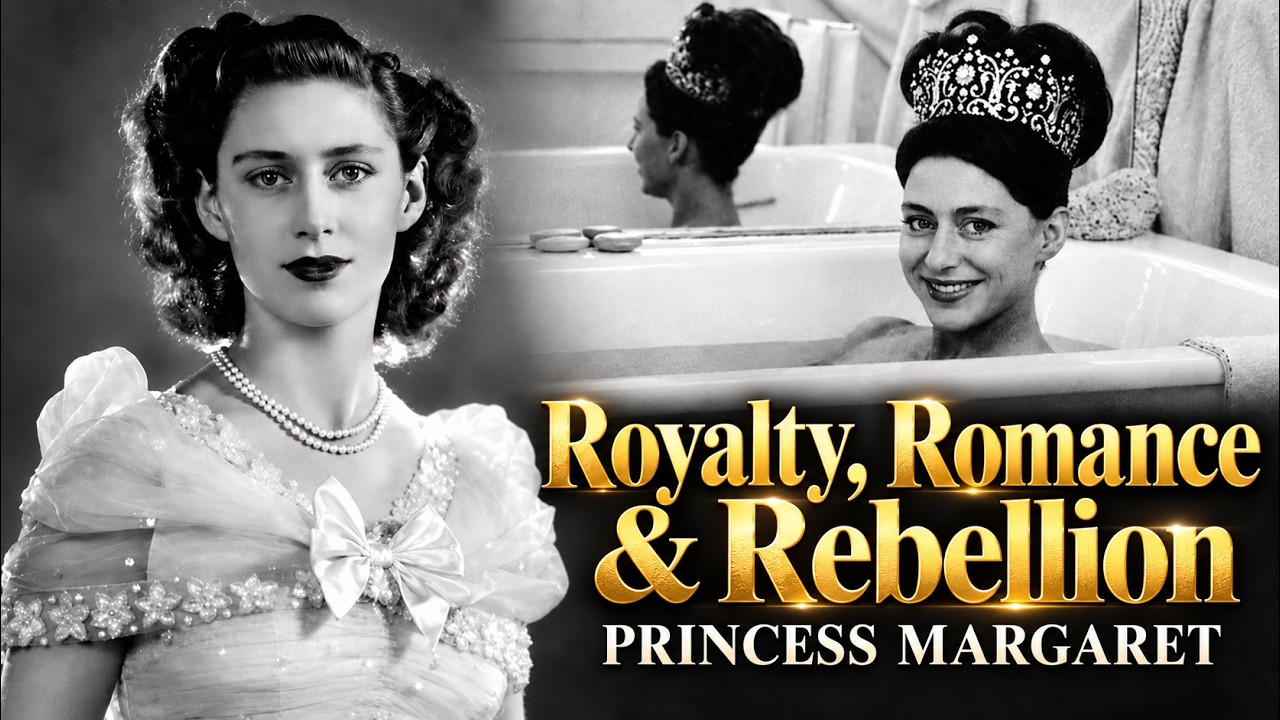
The heir was her sister, Elizabeth. Margaret was the spare. Her name took twelve days to settle. Her mother wanted Anne Margaret.
The King objected. Finally, the Duchess chose Margaret Rose, a bridge between nations. Margaret for Scotland, for its saints and queens. Rose for family, for her mother’s sister.
The baby was registered as entry fourteen in the village log, delayed a day by her father’s superstition about the number thirteen. Her christening robe had been sewn for Queen Victoria’s eldest child. The water came from the River Jordan. Before she could lift her head, the shape of her life was already closing in.
Her father, Prince Albert, had been hollowed out by his own childhood. Splints on his legs, forced right-handedness, a stammer that made public speech an ordeal. Her mother, Elizabeth Bowes-Lyon, was warmth itself. At 145 Piccadilly, the nursery was bright beneath a glass dome, and from her window Margaret watched the glowing squares of St.
George’s Hospital across the street. She said once that it looked like other people’s lives were happening in squares of light. Even as a child, she seemed to know she was not in the light. She was watching it.
Her father swore his daughters would never know what he had known. No cold rooms, no silence, no fear. “Come what might,” he said, “they should look back on their childhood as a golden age. ” For six years, before the abdication cracked the monarchy, it was.
Pillow fights, laughter, bathwater on the floor. The stairwell rang nightly with the same words: “Good night, Mummy. Good night, Papa. ”
But even golden nurseries have bars.
Margaret was raised not only by her parents but by nurses, nannies, and governesses. Her first memory was falling out of her pram. “I just wanted to be seen,” she said. She was the performer from the start.
She hummed waltzes at nine months. She invented an imaginary aristocrat, Cousin Halifax, and blamed him for everything. She mocked courtiers with terrifying precision. When she was five, dressed as an angel for a costume party, her mother said gently, “You don’t look very angelic, Margaret.
” The child did not blink. “That’s all right,” she said. “I’ll be a holy terror. ”
Her grandfather, George V, was a man carved from iron.
Margaret remembered him differently than the public did. “He was the most objectionable old man,” she said later. Queen Mary was stone, stiff-backed and immaculate, greeting her granddaughters with a kiss on the hand and two on the cheek, with no flicker of emotion. Margaret called her “absolutely terrifying.
”
Then came the abdication. Uncle David, once warm and full of stories, fell for a divorced American named Wallis Simpson and gave away the crown. Margaret watched it happen from a child’s vantage point. Her father stood before his daughters in full admiral’s uniform and told them that when he came home, he would be king, and they must curtsy.
He turned to Margaret. “You too, darling. Try not to topple over. ” That night, Margaret asked her sister whether she would be queen someday.
Elizabeth said yes. Margaret thought for a moment. “Poor you. ”
The Second World War scattered their ordinary days.
The girls were evacuated to Windsor, where carpets were rolled up against fire risk and air-raid sirens shrieked through stone. Margaret turned it into theater. She planted gardens, knitted scarves, collected tin foil. She staged pantomimes, casting herself as principal girl, designing costumes, painting sets, raising money for the war effort.
She began to suffer migraines that would haunt her for life. Stage fright crept in, but when the curtain rose, she glowed. The war ended, and Margaret stepped into her own light. She was brilliant, dramatic, the darling of the press.
Dior’s new look became her uniform. Photographers called her eyes the most beautiful in the world. She learned to walk like a sword in a silk sheath. But the one man who became constant was her father’s equerry, Peter Townsend, a war hero, married, with two sons.
He had a stutter like the King. He had carried the King’s gloves, read his silences. After the King died in February 1952, he carried Margaret’s grief. She fell in love in the space death left behind.
Townsend divorced. Margaret told the Queen. The answer was to wait a year, let time prove itself. At the coronation in June 1953, the world saw it.
As Margaret moved through the Abbey, she reached out and brushed a piece of lint from Townsend’s tunic. A hundred cameras flashed. The secret was out. The cabinet was unanimous.
The answer was no. If she married Townsend, she would lose her title, her income, her place in the family. She would become Mrs. Townsend, living abroad.
The Queen refused to discuss it. Margaret was not invited to the decisions being made about her life. On October 31, 1955, she broadcast her statement to the world. “I have decided not to marry Group Captain Townsend.
I have put duty before all else. ” The word devotion stayed in the statement against palace objections. They met one last time, said goodbye without repeating what was said. Years later she would say only that she was never allowed to explain, and that it hurt too much.
After the renunciation, she did not retreat. She danced. She stayed out past three, surrounded herself with musicians, actors, Americans, anyone loud enough to drown the ache. Louis Armstrong called her “one hip chick.
” She was becoming the modern princess, glamorous, sharp, watched. But the matchmaking failed. She accepted a proposal from Billy Wallace, then ended it when he confessed to an affair. By 1959, she was still unmarried.
Then Peter wrote to say he had met a nineteen-year-old Belgian heiress and was getting married. That night, she accepted a proposal from Antony Armstrong-Jones, a photographer, sharp-featured, a commoner, a curiosity. She would later say it was no coincidence. It would be the greatest mistake of her life.
He was electric behind a camera, one foot in the aristocracy, one in the avant-garde. He did not flatter her. He teased. They met in his Bermondsey flat above a junk shop, drinking cheap red wine, washing their own dishes.
She called it deliciously strange and romantic. The wedding was televised in May 1960, the first ever. She spoke her vows a line too soon, an omen unnoticed by most. He was made Earl of Snowdon.
The marriage unraveled slowly, then completely. He withdrew into his darkroom. She drank and smoked and called him, desperate for a reply that never came. He had affairs.
She had an affair with Anthony Barton, then with Robin Douglas-Home, who sold her letters and later took his own life. The palace demanded the myth hold. It did, barely. A photograph of Margaret in a bikini beside Roddy Llewellyn, twenty-five years her junior, on a Mustique beach, ended the performance.
The photograph ran on every front page in Britain. Tony moved out. In 1978, the divorce was announced. Margaret declined.
A stroke in 1998, a scalding bath in 1999 that her poor circulation meant she did not feel until it was too late. A cane, then a wheelchair. She died just before dawn on February 9, 2002, at King Edward VII Hospital. She was seventy-one.
She was cremated, the first senior royal to choose fire over earth in modern memory. Her ashes were placed in the King George VI Memorial Chapel at Windsor, beside the father she had adored. Forty-nine days later, her mother was gone too. She had been many things.
A gifted pianist, a sharp wit, a fashion icon, a source of scandal and fascination. Some called her a disappointment. Others, quietly, fiercely, called her real. She had loved badly and too much.
She had chosen loyalty over love. And when the flame finally went out, the world felt the cold. From the moment she became the spare, she had been one thing most of all.
Margaret, all alone.






