At dawn on a January morning in 1948, a 42-year-old man stood in a prison in Kraków, waiting for the rope. His name was Maximilian Grabner, and for more than three years he had decided the fate of thousands in Auschwitz. Now the decision was his own. The executioner’s noose was the end of a path that had begun two decades earlier, in a Vienna police station where a bored clerk stamped forms and walked the same beat every day.
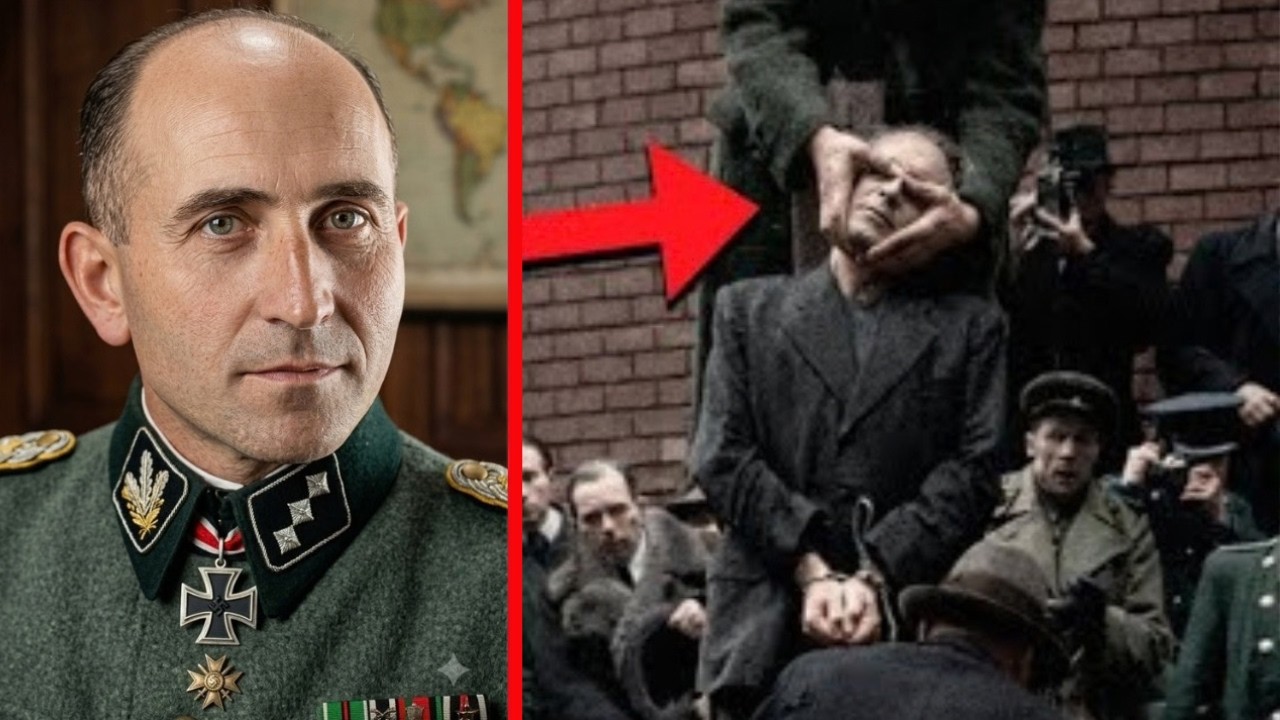
What turned him into the most feared official in the camp? And how did his own SS end up building the case that destroyed him? Grabner was born on October 2, 1905, in Vienna. Nothing in his early life hinted at what he would become.
His family was working class. He moved between manual jobs until he joined the Austrian police in 1930. By every account, he was forgettable. He filled in forms, walked his route, followed routine.
His colleagues saw a man of average ability with no obvious future. In a normal century, his story would have ended there, with a small pension and a quiet retirement and a name nobody remembered. But the century was not normal. In March 1938, Nazi Germany annexed Austria, and the Austrian police were absorbed into the Reich.
Grabner had seniority of a kind. He had sympathized with the Nazi movement when it was banned in Austria. Now that early loyalty paid off. He was transferred to the Gestapo, the secret state police, and assigned to Katowice in occupied Poland.
His new superiors noticed what his old ones had missed. Grabner was ambitious. He was obedient and showed no discomfort with cruelty, which counted as a qualification in that system. They did not need a genius.
They needed a man they could rely on, someone who would carry out the task to the end without asking what it meant for the people on the other side of the desk. In May 1940, Grabner received the assignment that would define his life. A new camp was being built in former Polish army barracks near the town of Oświęcim. The Germans called it Auschwitz.
The first prisoners arrived that summer, mostly Polish political prisoners arrested across the occupied territories. From the first weeks, the camp needed a department to watch them, interrogate them, and decide which of them posed a threat. That department was placed under Grabner’s command. He was appointed head of the political department, the camp’s own branch of the Gestapo.
On paper, the department handled prisoner records, interrogated suspects, and investigated escapes and resistance activities. In practice, it became the most terrifying address in the camp. The department controlled Block 11, which the prisoners knew as the Death Block. Anyone summoned there understood they might never come out.
Survivors later said the name Grabner alone could silence a crowded barrack. Men used to living with hunger, cold, and exhaustion went quiet when his office summoned them. The interrogations conducted by his department relied on violence. Prisoners were beaten for hours to extract confessions and names.
One of his subordinates, Wilhelm Boger, invented a torture device so notorious that inmates named it after him. Grabner did not merely look the other way. He ran the office. He signed the papers.
He was the engine behind all of it. Between blocks 10 and 11 was a narrow courtyard. At one end stood a wall covered with dark cork panels, placed there to stop bullets from ricocheting. This was the execution wall, the place where Grabner’s decisions ended for many.
His staff had a cold bureaucratic phrase for what would happen next. They called it: clearing the cellar. Grabner would walk through the cells of Block 11, examining the prisoners held there and deciding their fate on the spot. A few were sent back to the main camp.
Most were not. Many of the victims were members of the Polish resistance. Others were prisoners suspected of smuggling letters or attempting escape. In periods of harsh reprisals, civilians from neighboring towns were brought directly to Block 11 and executed without being registered as prisoners at all.
Then came the part that shows the machine at its most criminal. The political department recorded those deaths, when it recorded them at all, with invented causes. Heart failure. Pneumonia.
Ordinary diseases. On paper, the dead had simply fallen ill. Consider what that meant. A man could be taken from his home and killed within days, while the official record said he died of a common illness.
His family might wait months for an answer that had never been true. Survivors described those selections as arbitrary. A file might contain no more than a rumor, an unproven accusation, or a note that the investigation was still ongoing. For Grabner, that was enough.
After the war, investigators estimated that thousands of people died at that wall during his tenure. There were no trials behind those deaths, no sentences issued, often no completed investigations. His department also stood at the center of one of the most horrifying turning points in the history of Auschwitz. In September 1941, in the basement of Block 11, SS personnel carried out the camp’s first experiment with Zyklon B, the poison gas that would later be used on a massive scale.
The victims were Soviet prisoners of war and sick prisoners, estimated by historians at about 850 men. The SS was testing whether a chemical used to fight pests could be turned into a tool for killing on a scale that shooting had never allowed. The answer they found changed the history of the camp and the history of the world. Block 11 was Grabner’s territory.
His office sat at the heart of the camp machinery while the horror escalated year after year. And he stayed there. For more than three years, no one stopped him. Not the guards around him.
Not the officers above him. Not the men who read his reports in Berlin. For a long time, the system treated him exactly as he wanted to be treated. Now comes the surprise.
It was not the resistance that ended his career. It was not the Allied armies. It was the SS itself. An SS judge named Konrad Morgen was sent to investigate corruption within the concentration camp system.
Morgen had pursued officials in other camps, men who believed their uniform placed them above any court. His most famous target was the commandant of Buchenwald, Karl Otto Koch, a man later executed by his own organization. Grabner was watching a very dangerous type of investigator move toward him. But understand what Morgen was and what he was not.
He was not a humanitarian. His mission was about theft, not mercy. The Reich considered the property of murdered prisoners to be state property. So any officer who seized it was stealing from the state.
When Morgen’s investigation reached Auschwitz, it led straight to the political department. Investigators discovered that Grabner had been quietly collecting valuables taken from prisoners. But while Morgen was digging through the files of Block 11, he found something bigger. There were patterns of executions that Berlin had never approved.
Grabner was ordering killings on his own initiative, going beyond even the brutal rules the SS had set for itself. Grabner was arrested in December 1943. The charges were astonishing. Alongside corruption, he was accused of responsibility for at least 2,000 unauthorized killings.
The man who had spent three years deciding the fate of others now sat in a cell waiting for someone to decide his. But the stranger part is still to come. The man who exposed Grabner was not trying to save anyone, and what happened to the case afterward is hard to believe. Grabner faced an SS court.
He presented the defense he would repeat for the rest of his life. He had only been doing his duty. He had acted for the Reich. He claimed the real responsibility lay with those above him in the hierarchy.
But the proceedings stalled. By then, the war was turning, and the Reich was collapsing from within. The case dragged on and never produced a lasting sentence. So the SS did something striking.
It documented Grabner’s crimes in its own files, then failed to hold him accountable. When the war ended, he was in Allied hands. For a short time, he may have hoped the chaos of 1945 would bury his case as it buried so many others. Thousands of men served in Auschwitz, and most never saw the inside of a courtroom.
But Grabner was not an anonymous guard. His name filled the surviving records of the political department. Survivor after survivor mentioned him in their testimony. Poland demanded his extradition.
In 1947, he was handed over to the country where he had committed his crimes. One of the largest war crimes trials in history was waiting for him. From late November to late December 1947, the Supreme National Tribunal of Poland tried 40 members of the Auschwitz staff together. In the dock sat the former commandant Arthur Liebehenschel, the women’s camp supervisor Maria Mandl, and Hans Aumeier, the former deputy commandant.
Grabner was among them. The courtroom in Kraków was packed with survivors. For many, it was the first time they saw their captors without uniforms or rank or weapons. Those men now sat on a wooden bench under Polish guard.
Former prisoners took the witness stand. They described the selections in Block 11. They described the interrogations. They described what they had seen in that courtyard.
The documents from Grabner’s own department, which had survived despite German attempts to destroy the camp records, confirmed what the witnesses said. His defense did not change. He said he was a small man in a giant machine. He claimed he was only following orders.
He even claimed he had saved prisoners when he could, and that the numbers attributed to him were exaggerated. He portrayed himself as a clerk trapped by overwhelming circumstances. The judges had heard that excuse from nearly every defendant. And they had something else.
They had the SS investigation itself, in which his fellow officers had accused him of killings beyond his orders. The argument of following orders collapsed against the official papers of his own organization. On December 22, 1947, the court read its verdicts. Twenty-three of the forty defendants were sentenced to death.
Maximilian Grabner was one of them. The court held him responsible for the murder of thousands through the executions at the wall and the operations of the political department. His pleas for mercy were rejected. This time there was no postponement.
There was no collapsing system to save him. There was no second chance. In January 1948, the sentence was carried out at Montelupich Prison in Kraków. Maximilian Grabner was hanged.
He was 42 years old. Kraków lies only about 60 kilometers from Auschwitz. Some survivors who testified against him were able to return home the same day justice was done, but the verdict could not bring anyone back to life. What it did do was something the SS had never managed.
It recorded the truth in a public courtroom where the world could see it. There is one detail from his final months that survivors never forgot. In a written petition from his cell, Grabner again insisted he had only done his duty. He described himself as a man carrying out the tasks assigned to him.
The prisoners who had once waited in the cells of Block 11 knew exactly what that duty looked like. It looked like a man walking slowly in front of them, glancing at a file, then pointing his finger. In Grabner’s hands, duty and murder were the same thing. Two separate courts, one run by his enemies and one run by his own party, had reached the same conclusion about what he had done.
His story holds a strange place in the history of the camps. He was one of the very few Auschwitz officials whose crimes the SS officially documented while the war was still raging. Morgen’s files survive as a written confession in the cold language of Nazi bureaucracy. They admit that what happened in Block 11 was murder, even by the standards of the men who built that system.
So when the Polish court convicted him, it was not merely a victor punishing a defeated enemy. It was the completion of a prosecution his own organization had begun and then abandoned. Few defendants in Kraków had a weaker case for innocence. And almost none had been accused by their own side before.
The wall itself no longer stands in its original form. The Germans dismantled it before the liberation of the camp as part of their efforts to erase evidence. Today, a reconstruction of the wall stands in the courtyard between blocks 10 and 11. Visitors from around the world place flowers and candles at its base.
Most have never heard the name Grabner. Names like his fade, as they usually do, but the memory of the people he sent to that wall does not fade. It is honored every day. So what turned a bored Viennese policeman into the most feared official in Auschwitz?
Not genius. Not grand ideology. Just a system that rewarded obedience and ignored cruelty, and gave an ordinary man the power to decide whether another human being would live, with a look and a signature. That is the lesson his case leaves behind.
Evil on this scale does not always come with the face of a monster. Sometimes it comes as a trusted clerk who never asks questions. And what destroyed him? Paperwork.
Maximilian Grabner spent three years believing his position placed him above accountability. He spent the next five years learning it did not. The records he created to conceal the deaths of others became the evidence that decided his own fate. The system he served was the one that accused him.
The country he terrorized convicted him. And the record he tried to justify outlived every excuse he offered.
