The Imperial Japanese Navy’s heavy cruiser force was built on a lie. The London Naval Treaty of 1930 granted Japan twelve heavy cruisers, while the United States was permitted fifteen. Within a few years, Japanese strategists were deeply dissatisfied. They resented being treated as an inferior naval power and considered heavy cruisers essential to their war plans.
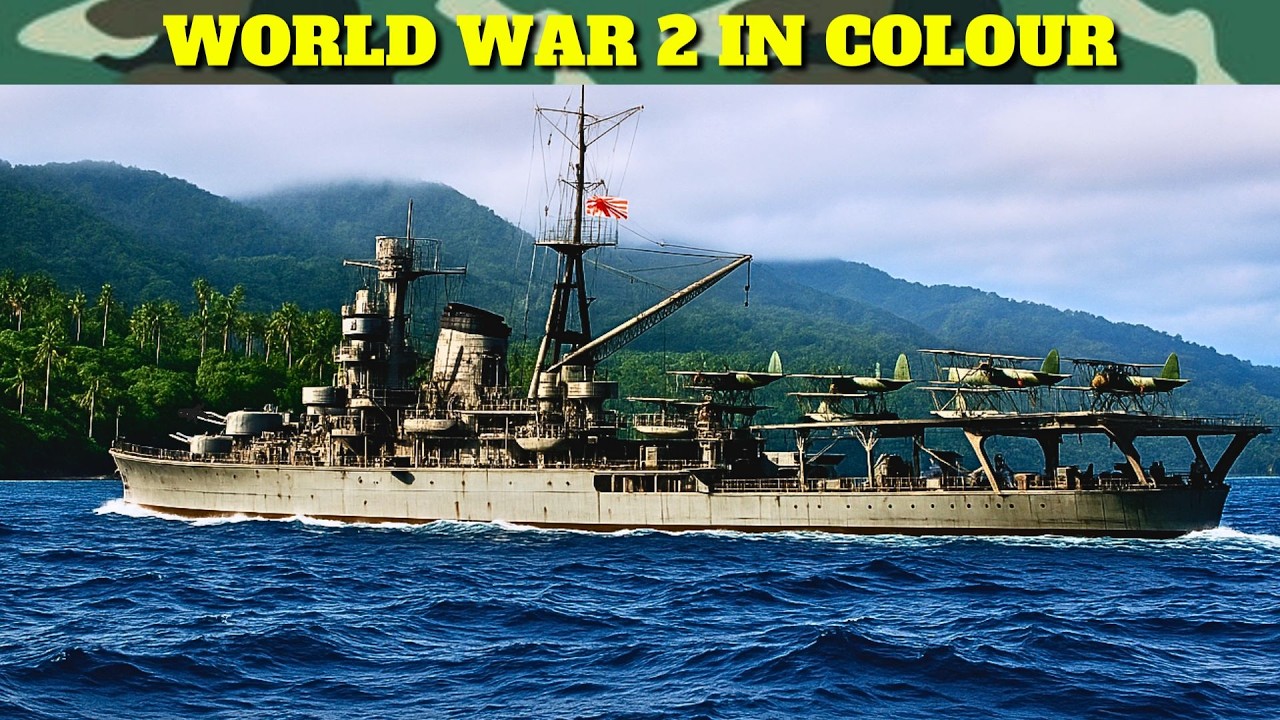
But Japan had already reached its allotted tonnage for those ships, and the treaty forbade building more. The navy did possess unallocated tonnage for light cruisers, yet Japanese strategy saw little use for such vessels, dismissing them as little more than large destroyers. That unused tonnage, combined with the desire to overtake the United States, produced one of the most dishonest attempts ever made to bypass treaty obligations. Before Isoroku Yamamoto took command of the Imperial Japanese Navy in 1939, Japan’s plans for war with the United States rested on a specific scenario.
If Japan invaded the Philippines, the U. S. Pacific Fleet would sortie from its base in Hawaii to destroy the invasion force. This American strategy was known as Plan Orange.
The Japanese intended to intercept that relief force just south of Japan and destroy it in a decisive battle. Their doctrine, called Kantai Kessen, or the decisive battle, had its origins in the Russo-Japanese War of 1905, when a Japanese fleet annihilated a larger Russian fleet at the Battle of Tsushima and forced the Russian Empire to sue for peace. The problem was numbers. The United States had a larger fleet, and Japan would be at a numerical disadvantage when the decisive battle came.
Japanese strategists believed they could offset this weakness before the battle began by exploiting the long distance their enemy would have to travel from home ports. They developed a three-stage attrition plan to weaken the American fleet before it reached the western Pacific. First, submarines would patrol the American route and pick off targets. Second, land-based bombers operating from Japanese-held islands, supported by carrier aircraft, would harass the fleet along its path.
Finally, on the night before the great battle, heavy cruisers supported by destroyers would use their superior speed to launch hit-and-run attacks. They would launch volleys of the deadly Type 93 torpedo, known as the Long Lance, at American battleships, then withdraw to the main fleet for the decisive engagement the next day. The goal was to reduce the American fleet to a size the Japanese battle line could defeat in a battleship-to-battleship confrontation. Because heavy cruisers were central to this plan, the navy was eager to increase their numbers while still appearing to obey the London Naval Treaty.
The solution was a class of ships officially designated as light cruisers but designed from the keel up as heavy cruisers in disguise. They were called the Mogami class, and they became known as cheat cruisers. The treaty required a light cruiser to carry six-inch guns and displace no more than 8,500 tons. The Japanese solved the first problem with clever engineering.
The barbettes, the structures that supported the main gun turrets, were designed to be robust enough to carry eight-inch turrets from the start. The ships would initially be fitted with lighter six-inch turrets, but those could be replaced with eight-inch turrets built in advance for that future purpose once the deception was no longer needed. The weight issue was handled with a combination of clever design and outright lying. The Japanese would not compromise on speed or protection, and their designers argued that no amount of creative engineering could keep the ships within the 8,500-ton limit.
The declared weight remained 8,500 tons, but the true design limit was raised to 9,500 tons. To save weight, the ships received a compact superstructure made of welded aluminum instead of riveted steel. Ten boilers were installed instead of the twelve in previous classes, but new geared impulse turbines increased overall shaft horsepower. The chimney arrangement was redesigned to minimize weight, with the forward funnel reclined so its top merged with the middle and rear funnels.
When the Mogami class was launched in 1934, Britain and the United States looked on with alarm. Nothing afloat among light cruisers could match them. The Japanese ships carried fifteen guns, while the latest American light cruisers, with their outdated designs, carried only ten, and only seven of those could fire a broadside. That meant the Mogami had more than twice the effective firepower and considerably better protection.
Even the most advanced European light cruiser designs carried only nine six-inch guns. In 1935, as the Mogami was commissioned into the Imperial Japanese Navy, the United States and Great Britain were already preparing countermeasures. The Mogami class had a significant impact on light cruiser design for years to come. The U.
S. and Royal Navy spent considerable time and resources developing powerful light cruisers to counter ships that were, in effect, not light cruisers at all. When the Royal Navy asked the Director of Naval Construction how Japan could build such powerful ships at such a small displacement, the answer was blunt: the Japanese must be building their ships out of cardboard, or they were lying. By 1937, the U.
S. Navy’s Brooklyn class and the Royal Navy’s Newcastle class began to appear. But the clouds of war were gathering, and by 1939 the restrictions of the London Naval Treaty had become irrelevant. The masquerade was abandoned.
The four Mogami-class ships quietly entered Japanese shipyards, where the eight-inch turrets that had always been intended for them were installed in place of the six-inch turrets that had once adorned their decks. The ships underwent extensive reconstruction. Their triple six-inch turrets were removed and repurposed as secondary armament for the Yamato-class super battleships. The superstructures were reinforced, torpedo bulges were added, and other modernization work was completed.
Full displacement increased to over 13,000 tons, far beyond the 8,500 tons originally declared. After reconstruction, the Mogami class combined high speed, strong armor protection, and heavy armament to rank among the best cruiser designs in the world. When the Pacific War began, the planned attrition strategy became unnecessary. The destruction of the U.
S. Navy’s battleships at Pearl Harbor in December 1941 meant Japanese heavy cruisers would not be needed to whittle down an American fleet before a decisive battle. But the Imperial Japanese Navy’s emphasis on night battle training and its use of the powerful Long Lance torpedo served it well throughout the early stages of the war. The Mogami class and the tactics built around them proved effective until overwhelming American industrial and military strength eventually brought about their destruction.
The ships that had been designed to cheat a treaty were lost in the vast naval battles of a war the treaty had been meant to prevent.






