A boy of fifteen sat by himself in a cramped room on a mountain farm in the Austrian Alps, reading a newspaper by the glow of an oil lamp. It was 1946, and the name he went by was not his own. It could not be. This was Martin Adolf Bormann, the eldest son of Martin Bormann, Adolf Hitler’s private secretary and one of the most powerful figures in the shattered Third Reich.
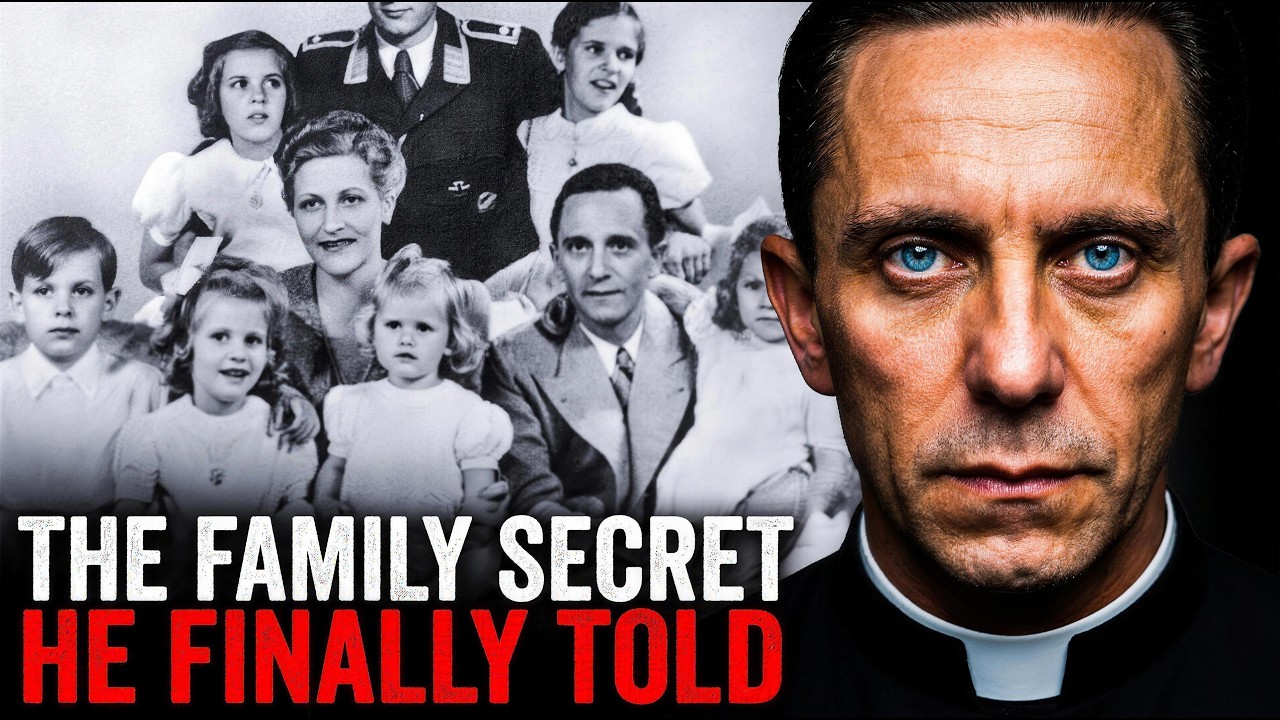
The paper carried word that his mother was dead. Gerta Bormann had passed away at 36 in an Allied prison hospital in Italy, from uterine cancer, following months of questioning and isolation. No family member had told her son. No clergyman had softened the blow.
It was a random article that did it, read in solitude, in a borrowed bed, far from everything familiar. He wept all night, covering his face, unable even to name for himself the shame that clung to his sorrow. Decades afterward, as an old man, he would face rooms full of schoolchildren in Germany and Austria and describe what it had been like. He would speak of a childhood spent inside the sealed mountain compound of the Obersalzberg.
A father who was stern and distant, yet wrote love letters so tender they embarrassed him. A mother who gave birth to ten children for the glory of the Reich and quietly accepted her husband’s mistress. A family existence so bound up with the Nazi state’s machinery that even birthdays and baptisms turned into instruments of political theater. What did Gerta Bormann’s son really expose about that household?
By the early 1940s, Martin Bormann senior had worked his way into the position of arguably the second most powerful man in Nazi Germany. He controlled who reached Hitler, ran the Party Chancellery, and steadily gathered authority over nearly every domestic decision that landed on the Führer’s desk. Contemporaries dubbed him the brown eminence, a man who operated in shadow while others took the spotlight. He was crude, fiercely ambitious, and entirely unsentimental toward political rivals.
And yet within his own home, a different and odder set of dynamics took hold, resting on ten children, a remote mountain estate, and a wife who had been raised from childhood to regard everything the Nazi movement asked of her as natural and sacred. Martin Adolf Bormann was born on April 14, 1930, in Grünwald near Munich. His mother Gerta was scarcely twenty. Born Gerda Buch on October 23, 1909, in Konstanz on the shore of Lake Constance, she was the eldest of four children of Major Walter Buch, a decorated First World War officer who had joined the Nazi Party as early as 1922 and would eventually become chairman of the party’s own internal court.
To grow up in the Buch household was to be steeped in National Socialist ideology from the earliest age. Gerda was exposed to anti-Semitic rhetoric and radical nationalist politics from roughly the age of eleven, taking it in the way other children take in nursery rhymes, never meeting a competing worldview. As a teenager, she saw a constant stream of young, ambitious Nazi men pass through her father’s home. Among them was Martin Bormann, nine years older than her, already a rising figure in the party apparatus.
Whether the union was true romantic attraction or a marriage arranged between an ambitious subordinate and his patron’s daughter is still debated by historians. The practical result was plain: Bormann’s marriage into the Buch family in September 1929 gave him a direct channel into the party’s inner sanctum. Adolf Hitler and Rudolf Hess stood as witnesses at the wedding. For a young woman taught since childhood that a woman’s highest calling was devotion to husband, children, and Führer, having Hitler himself at her wedding must have felt like the ultimate confirmation of everything she had been raised to believe.
Seven months later, Martin Adolf Bormann was born. The child’s very name signaled the kind of household he would grow up in. He was baptized in the German Evangelical Church with Adolf Hitler standing as godfather. That honor followed him for the rest of his life in the form of a nickname whispered around the Nazi elite: Krönzi, a mocking yet affectionate shortening of Kronprinz, crown prince.
Within the closed social circle of the Obersalzberg, the joke carried a genuine edge of truth. As the eldest son of Hitler’s most trusted administrator and the Führer’s own godson, young Martin held a position no other child in the Third Reich, apart perhaps from the offspring of Joseph and Magda Goebbels, could claim to match. Over the next thirteen years, Gerta Bormann gave birth to nine more children. There was Ilse, born in 1931, whose name was later changed to Eike after Rudolf Hess’s flight to Scotland in 1941 made the family reluctant to keep naming children after a man now branded a traitor.
There was Irmgard, born in 1933. There was Rudolf Gerhard, born in 1934 and later renamed Helmuth for the same reason his sister had been renamed. There was Heinrich Hugo, born in 1936 and nicknamed Heiner, named for his godfather Heinrich Himmler, the Reichsführer SS himself. There was Eva Ute.
There was a second Gerda, born in 1940, named for her mother. There was Fritz Hartmut, born in 1942. And finally Volker, born in 1943, who would not survive childhood. For bearing this staggering number of children, Gerta Bormann was awarded the Gold Cross of Honor of the German Mother, the highest tier of a medal the regime had instituted in 1938 to celebrate women who produced eight or more children for the Reich.
She had, in the coldly biological language of Nazi ideology, outproduced even Magda Goebbels, the woman Hitler publicly styled as the Mother of the Nation. In the summer of 1936, when Martin Jr. was six, the family moved to the Obersalzberg, the mountain retreat above Berchtesgaden where Hitler had built his alpine residence, the Berghof. The move placed the Bormann children inside what was effectively a walled political fortress, a restricted area known as the Führersperrgebiet, sealed off from the outside world by guards, checkpoints, and barbed wire, populated almost entirely by the families of the Nazi elite and the army of staff needed to serve them.
Martin Jr. and his siblings grew up playing alongside the children of Albert Speer, Hitler’s architect and later armaments minister, within sight of the mountain panorama that postcards and propaganda films had turned into a symbol of German natural grandeur. They were present, at least in the background of family photographs, at New Year celebrations hosted by Hitler himself, where Eva Braun’s private albums captured images of the Bormann and Speer children mingling with the Führer’s inner circle as though it were the most ordinary thing in the world. In later life, Martin Jr.
he would look back on those years with a blend of dry irony and unmistakable unease, calling it a kind of paradise. A childhood passed carefree and protected on a mountainside, while unspeakable crimes were being plotted in offices not so very distant. He remembered his father above all as a severe man. Martin Bormann senior was a harsh disciplinarian who expected unquestioning obedience and offered little of the affection a child longs for.
And yet he was conscientious in a manner many of his fellow Nazi leaders were not. Whatever his political obligations, he made certain to see his wife and children whenever his schedule permitted, and he insisted on keeping close watch over their education and moral upbringing. Martin Jr. would later make a careful distinction, one that shows how tangled the reckoning with a monstrous parent can become.
He set apart the father he had known personally as a boy, a man who was strict but whom he loved all the same, from the political figure whose crimes he only came to grasp much later and whose deeds he condemned without reservation. That line between the private father and the public criminal became the central tension running through everything he eventually disclosed. His mother offered a gentler presence, though no less committed in ideological terms. Gerda Bormann took on the role of the nurturing parent in a household where discipline was regarded as the father’s territory.
She sang to her children, drew pictures with them, and read them stories. By every measure available to historians she was a devoted and unrepentant anti-Semite. A woman whose worldview had been shaped in a household given over to National Socialism before she could even walk, and who never in any surviving letter or record voiced a single doubt about the rightness of the cause. She was, in the words of one historian who has studied the wives of the Nazi leadership, the very embodiment of what the regime asked of German womanhood: modestly dressed, endlessly fertile, and unwaveringly loyal to a husband she treated as her natural superior.
One detail keeps surfacing in accounts of the household. Visitors to the Obersalzberg were reportedly made uncomfortable by the sight of the supposedly cultured Reichsleiter whistling through his fingers to summon his wife to his side the way one might summon a dog. Gerda would obey at once, without hesitation or any visible resentment. Behind closed doors, though, this same gruff and domineering man proved to be a startlingly sentimental correspondent.
Martin Bormann’s surviving letters to Gerda, later published as a historical record, are full of clumsy, almost childlike tenderness that clashes jarringly with his public reputation. In one letter he asked, in a tone of near worship, who was everything to him, who was his highest happiness, who was his greatest wealth, who was his most beautiful treasure, before answering his own question: Mommy. This was the same man, his son would later observe with resigned bitterness, who could shout at his children and lash out at them in anger within the very household where he wrote those lines. Perhaps no single detail captures the oddity of that household quite like the story of his father’s mistress.
Around 1940, Martin Bormann senior met a Dresden-born stage actress named Manja Behrens at a film festival and in time installed her as his long-term lover, a relationship he made no serious effort to conceal from his wife. What followed was not the confrontation one might expect. Gerda did not simply tolerate the affair. She seemed to actively endorse it, presenting the arrangement as the natural fulfillment of duty for what she regarded as an honest National Socialist household.
In one letter that has since become notorious among historians, Gerda advised her husband on how to manage his double life with chilling practicality, telling him to arrange matters so that Behrens bore a child one year and Gerda herself bore one the next, ensuring, in her words, that he would always have a wife who remained serviceable to him. She went further, suggesting in correspondence that a law should be passed after the war, modeled on precedents she believed had existed after the devastation of the Thirty Years’ War three centuries earlier, allowing healthy and capable German men to take a second wife in order to help repopulate a nation that had lost so many of its young men in combat. For the children growing up inside that household, the presence of their father’s mistress was simply another fact of life, absorbed the way children absorb whatever arrangement the adults around them present as normal. The rhythms of daily life for Martin Jr.
and his siblings followed a pattern designed to produce loyal, disciplined future servants of the Reich. Ideology was woven into the ordinary fabric of the household. Several of Gerda’s children were never baptized at all, a direct reflection of both parents’ open hostility toward organized Christianity. Martin Jr.
himself, baptized in 1930 before his parents had fully hardened their anti-religious stance, would later be one of the only children in the family to have received any formal religious rite at all. A detail that takes on considerable irony given the path his life would eventually take. On May 10, 1940, just ten years old, Martin Jr. was sent away from the Obersalzberg to begin his formal schooling at the Reichsschule der NSDAP in Feldafing, an elite Nazi Party academy on the shores of Lake Starnberg, designed to mold the sons of the party’s leadership into the next generation of functionaries.
At Feldafing, the curriculum stressed not only conventional academic subjects but also physical training, ideological instruction, and an aggressively anti-religious nationalist worldview. He would later describe this education as having conditioned him to interpret Hitler’s death and Germany’s final collapse in 1945 not as liberation but as an apocalyptic ending. The end, full stop, of the only world he had ever known. Letters exchanged between Martin Bormann senior and Gerda throughout the war years reveal a household attempting to maintain an appearance of domestic normalcy even as the military situation deteriorated.
In one letter from October 1944, Gerda wrote to her husband about listening to an opera broadcast on the radio, interrupted repeatedly by reports on enemy air activity overhead, and passed along gossip about the wives of other Nazi officials evacuated from Berchtesgaden ahead of Allied bombing raids. The tone is almost eerily domestic. Part of what makes Martin Jr.’s later testimony so valuable to historians is the window it opens onto his nine younger siblings, most of whom lived almost entirely outside the public record until their eldest brother began speaking and writing about them decades later.
His sister Ilse, who had been given the name Eike, reached adulthood only to pass away at a relatively young age in 1957 or 1958, her grown-up years kept mostly out of the public eye. Irmgard and Helmuth each came of age carrying a surname that, after 1945, had become one of the most infamous in Germany. Heinrich Hugo, known as Heiner and named after his godfather Heinrich Himmler, bore what was perhaps the heaviest symbolic weight of all, his very name linking him to the man who had orchestrated the administrative apparatus of the Holocaust. Eva Ute, the second Gerda, Fritz Hartmut, and the youngest, Volker, who did not live past childhood, completed a family whose sheer size meant that its wartime and postwar experiences differed enormously from one child to the next.
As the war lurched into its last phase, the fragile bubble started to burst with frightening rapidity. By early 1945, with Allied and Soviet forces pressing in from opposite directions, the Obersalzberg compound that had once seemed so secure turned from a refuge into a target. Fifteen-year-old Martin Jr., still enrolled at his party academy—now moved to Mauterndorf in the Tyrol region because Allied bombing had made the Feldafing campus untenable—found himself more and more isolated from dependable news about his parents and younger siblings.
On April 15, 1945, as Allied forces pushed further into Austria, the academy shut its doors permanently. A party official in Munich told the fifteen-year-old to head toward his mother, who by then had fled the Obersalzberg with eight of her children and found shelter in the still German-occupied village of Völlan in the Val Gardena valley of the South Tyrol. Martin Jr. never succeeded in reaching her.
Rather, he ended up stranded in Salzburg—a fifteen-year-old boy alone in a city wracked by the final agony of a regime his whole family had helped to build. In Salzburg, a Gauleiter, one of those very officials whose careers had rested on loyalty to men like Martin Bormann senior, saw the danger the boy faced and gave him false identity papers, knowing that the name Bormann had become, almost overnight, one of the most notorious surnames in Europe. Armed with this false identity, young Martin made his way into the Salzburg Alps and was taken in by a Catholic farming family headed by a man named Nikolaus Hohenwarter at a mountain homestead called the Kotalm, set halfway up a remote slope. The family welcomed the boy and treated him as one of their own, feeding him, giving him shelter, and asking few questions.
For a boy brought up inside a fortress reserved for the families of Nazi power, this was his first real encounter with a family whose kindness owed nothing to political calculation or ideological duty. His mother’s fate, meanwhile, was following a much darker path. After Germany’s surrender in May 1945, Gerda Bormann, still sheltering with eight of her ten children in Völlan, was found by Allied authorities and subjected to intense interrogation by officers of the CIC, the joint American-British intelligence body assigned to track down high-ranking Nazi officials and their families. She was held in the prison at Völlan, refused visitors, and denied any ability to correspond with her scattered children.
In the autumn of 1945, prison authorities moved her to a hospital in the Italian city of Merano after she began to show signs of serious illness. Doctors soon found uterine cancer, almost certainly present and untreated for some time. Some accounts suggest that the treatments given during this period, including mercury-based compounds still sometimes used in cancer care at the time, may have accelerated rather than slowed her decline. Gerda Bormann died in the prison hospital at Merano on either March 23 or April 23, 1946, depending on which historical source one consults, at the age of thirty-six, having outlived her husband by less than a year.
She was buried without ceremony in a military cemetery in a grave she shared with an unrelated German soldier, before her remains were later exhumed, cremated, and scattered at sea. Her sixteen-year-old son did not learn of her death through any official notification. He learned of it by reading a newspaper article in the Salzburger Nachrichten, alone in his small room at the farmhouse where he had been sheltering under a false name, with an oil lamp providing the only light. He would later describe crying through the night, hiding his face out of a shame he could not fully explain.
Only after learning of his mother’s death did Martin Jr. finally confess his true identity to Hohenwarter. The farmer then reported the boy’s identity to the local priest serving the parish of Weißbach bei Lofer, who passed the matter up the chain to the rector of the church of Maria Kirchtal, a pilgrimage church nestled deep in the Austrian Alps. Instead of turning the boy away, the rector took him into the church’s care.
It was there that Martin Bormann Jr. began the process that would shape the rest of his life: conversion to a faith his parents had actively despised, and immersion in a community founded on precisely the kind of unconditional Christian charity that his family’s entire worldview had dismissed as weakness. While serving as an altar boy at Maria Kirchtal, still a teenager grappling with grief and the collapse of everything he had once believed, Martin Jr. was arrested by American intelligence officers who held him for several days of interrogation at Zell am See before finally releasing him and returning him to his parish, apparently satisfied that a sixteen-year-old altar boy posed no meaningful threat.
Gradually, Martin Jr. was able to reestablish contact with his scattered siblings, several of whom had also been taken in by sympathetic families or religious institutions. Remarkably, given how thoroughly their childhood had been built around an ideology fiercely hostile to organized religion, nearly all of the surviving Bormann children eventually found their way into the Catholic Church in the years after the war, much as their eldest brother had. Only one sister among them did not.
Martin Jr. stayed with the parish at Maria Kirchtal for several years before deciding to join the religious congregation of the Missionaries of the Sacred Heart based in Ingolstadt. On July 26, 1958, at the age of twenty-eight, he was ordained a Catholic priest. The godson of Adolf Hitler now stood at an altar, having formally dedicated his life to the faith his parents had scorned.
In 1961, he was sent to the newly independent Republic of the Congo to serve as a missionary in a region torn by the chaos of decolonization. He worked in conditions of genuine hardship, ministering to communities devastated by poverty and political violence. His time in the Congo was cut brutally short in 1964 when the Simba rebellion erupted across the eastern regions of the country, a violent uprising that saw missionaries, foreign nationals, and perceived government sympathizers targeted for kidnapping, torture, and execution. Martin Jr.
was compelled to escape together with dozens of other missionaries and foreign workers—a close call that the New York Times took note of, reporting that he had come back alongside twenty-five others. Unbowed, he went back to the Congo in 1966 for another year of missionary work. A number of years after his last return from Africa in 1969, Martin Jr. sustained an injury that nearly killed him, the exact details of which remain somewhat unclear.
Through his lengthy recovery, a Catholic nun by the name of Cordula cared for him until he regained his health. In the early 1970s, the two of them made the weighty choice to abandon their respective religious vocations, and in 1971 the former priest and former nun wed. The pair stayed together for decades, although they never had children of their own. Yet stepping away from the priesthood did not mean he abandoned his calling altogether.
Martin Jr. moved into a career teaching theology, a position he held until he retired in 1992. Throughout most of those teaching years, he kept a relatively low profile. As for what had happened to his father, the question stayed agonizingly unanswered for decades.
The last reliable sighting of Martin Bormann senior was in Berlin on May 1 or 2, 1945, as he tried to flee the ruined city with a small group that included Hitler’s personal physician. Anything after that remained a true mystery, feeding endless theories that he had fled to South America. At the Nuremberg trials in 1946, Bormann was tried in absentia, found guilty of crimes against humanity and war crimes, and sentenced to death by hanging. For Martin Jr.
and his siblings, this meant decades of living beneath the shadow of real uncertainty, with lurid and almost certainly bogus sightings reported from South America and secret compounds well into the 1960s and 1970s. The riddle was at last solved in December 1972, when construction workers digging near the Lehrter Bridge in Berlin found a skeleton that forensic examiners later identified, first through dental records and then in the 1990s through DNA analysis, as the remains of Martin Bormann senior. The evidence pointed strongly to his having died on the night of May 1 to May 2, 1945, most likely by taking a cyanide capsule after running into Soviet troops while trying to cross the Spree River. For Martin Jr.
, the find brought an odd, long-delayed sense of closure. To grasp just how remarkable Martin Bormann Jr.’s eventual candor really was, it helps to look at how differently most other children of the Nazi leadership chose to deal with their family legacy. Gudrun Himmler, Heinrich Himmler’s only child, went the opposite way entirely, devoting her long life to a staunch and unrepentant defense of her father’s memory, joining the shadowy organization Stille Hilfe to support fugitive and imprisoned former SS members, and never once showing the kind of moral reckoning that came to define her exact contemporary Martin Bormann Jr.
Edda Göring, Hermann Göring’s only daughter, chose a sharply different course too, living in relative seclusion while staying fiercely loyal to her father’s memory. Wolf Rüdiger Hess, Rudolf Hess’s only son, devoted much of his adult life to tireless campaigning for his father’s release from Spandau Prison and to framing Hess’s 1941 flight to Scotland as a genuine peace mission. The gap between these responses and Martin Jr.’s decades of public reckoning shows just how differently the children of history’s worst perpetrators handle the same basic inheritance of guilt by association.
Martin Jr.’s own memoir, Leben gegen Schatten, meaning life against shadows, came out in German in 1996 and was later translated and published in other languages, Czech among them. Starting around 2001, already past his seventieth birthday, he set out touring schools across Germany and Austria, standing before rooms full of teenagers to talk at length, often for two hours at a stretch, about his childhood. Students, parents, and invited guests who attended these talks, including one memorable session at Munich’s Edith-Stein-Gymnasium that drew roughly two hundred attendees, later described the experience as both fascinating and deeply unsettling.
Once the formal lecture ended, he would stay on to take questions directly from students. His readiness to speak did not stop at the borders of German-speaking Europe. Martin Bormann Jr. traveled to Israel to meet Holocaust survivors face to face, a journey that put the godson of Adolf Hitler in the same room as people whose lives and families had been torn apart by the very regime his father had helped run.
In late December 2010 and on into January 2011, a story surfaced in the Austrian press that threw a deeply troubling shadow over the carefully built narrative of contrition Martin Jr. had spent decades constructing. A man who had been a twelve-year-old pupil at an elite Catholic boarding school in Salzburg in the early 1960s, run by the Missionaries of the Sacred Heart, came forward with an allegation that Bormann, who had worked at the school as a priest and schoolmaster during that period, had raped him. Other former pupils from the same institution and era came forward too, describing a pattern of severe physical violence inflicted on boys under Bormann’s supervision, painting a picture of a post-war disciplinary regime hidden behind monastery walls in which children were subjected to constant religious discipline, physical brutality, and military-style drilling.
Former students described Bormann himself as physically fit, secretive, vain, and given to explosive, brutal fits of temper. By the time the accusations became public, Martin Bormann Jr., then in his eighties, was already suffering from dementia, a condition that left him unable to respond to the specific charges. No criminal legal proceedings followed.
Instead, the matter was passed to the independent Klagsverband Commission, a body set up to investigate and address cases of abuse committed by members of the Catholic Church across Austria. After reviewing the case, the commission concluded that the accuser’s claims warranted compensation, and he was awarded a settlement, a form of institutional acknowledgement that the allegations carried genuine credibility. The school at the center of the allegations operated, according to multiple former pupils, under a regime of constant religious discipline combined with military-style drilling, an atmosphere in which physical punishment was treated as an unremarkable feature of daily education. One former pupil told journalists that the pain remained sharp enough that he wept while recounting it even after years of psychotherapy.
The final years of Martin Bormann Jr.’s life were overshadowed by these allegations. He died on March 11, 2013, in the town of Herne in North Rhine-Westphalia at the age of eighty-two, having outlived both of his parents by more than six decades. His death drew relatively modest press coverage compared with the intense media attention the abuse allegations had generated just two years earlier.
People who had sat through his school lectures tended to greet the news with a tangled blend of sorrow and lingering moral unease. No single word quite does justice to a life so full of contradiction. Martin Bormann Jr. brought into view a father who was at once a coldly calculating political operator, a severe and frequently terrifying disciplinarian, and, in his private letters, an almost painfully sentimental husband who filled his wife’s correspondence with childlike avowals of love, even while he summoned her in public with a whistle, as one would a servant.
He brought into view a mother who could sing songs and draw pictures with her children in one moment and, in the next, calmly weigh the practical arrangements of her husband’s mistress bearing him further children. He brought into view a household of ten children raised within a sealed mountain fortress, schooled from infancy to treat exceptional privilege and closeness to totalitarian power as nothing more than the ordinary fabric of daily existence. Most of his siblings would devote the remainder of their lives either to defending that inheritance or to quietly burying it. In the singular case of Martin Bormann Jr.
himself, he devoted decades to hauling it into the light and scrutinizing it honestly. However partial and however compromised that scrutiny ultimately turned out to be.
