At 4:30 on the morning of June 4, 1942, Vice-Admiral Chuichi Nagumo stood on the bridge of the aircraft carrier Akagi, flagship of the Imperial Japanese Navy’s First Air Fleet, 240 miles northwest of a tiny coral atoll called Midway. He watched the last of his strike aircraft climb into the gray dawn: 108 planes, bombers, torpedo aircraft, and Zero fighters, heading toward a target Japanese intelligence had assured him was unprepared, undefended, and unaware. Behind him steamed the most powerful carrier strike force ever assembled: four fleet carriers, two battleships, three cruisers, and twelve destroyers. These were the same ships that had struck Pearl Harbor six months earlier, the same air groups that had sunk the British battleships Prince of Wales and Repulse, the same commanders who had never known defeat.
Three hundred miles farther west, aboard the super battleship Yamato, Admiral Isoroku Yamamoto waited for reports. He had planned this operation for months, argued for it against the skepticism of the Imperial Army, and assembled more than 200 ships, the largest naval armada in Japanese history. The objective was to seize Midway atoll, destroy the remnants of the American Pacific Fleet, and force the United States to negotiate an end to a war Japan never intended to fight for long. Every calculation said Japan would win.
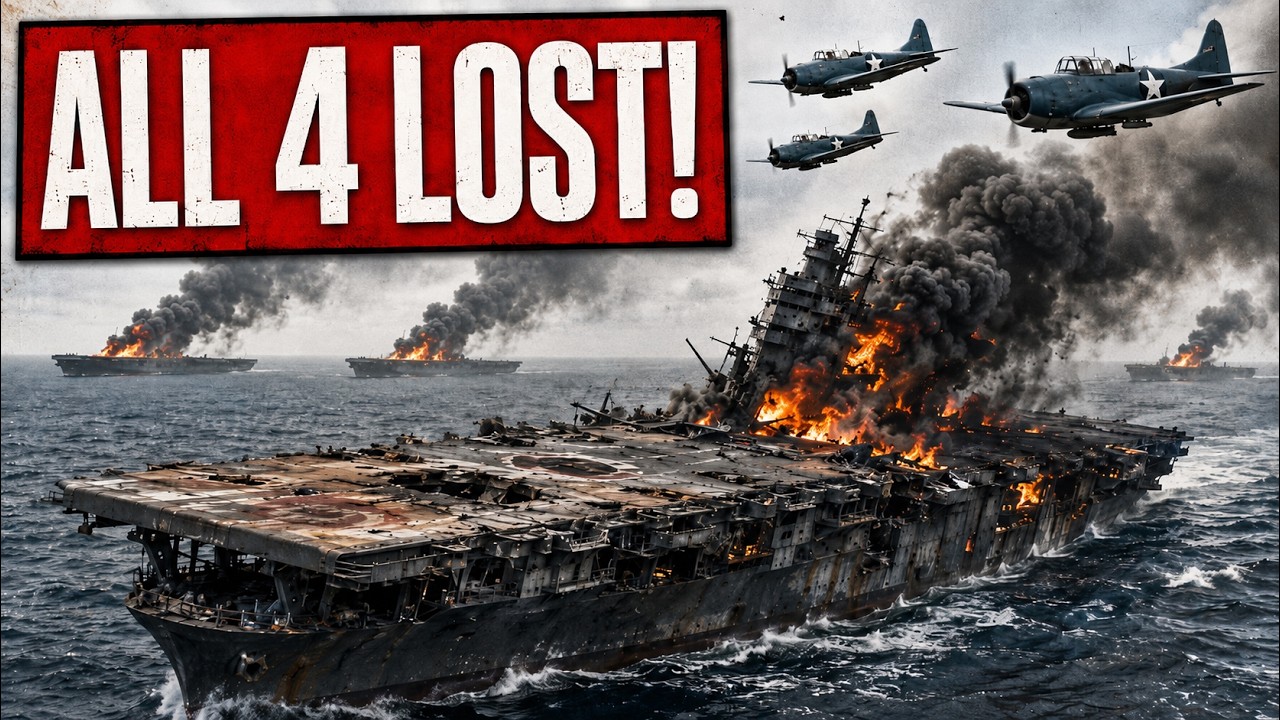
Every assumption said the Americans were too weak, too demoralized, too predictable to mount a serious defense. By 10:25 that same morning, three of Nagumo’s four carriers would be on fire. By sunset, all four would be gone. In the six months since Pearl Harbor, the Imperial Japanese Navy had achieved what no navy in modern history had accomplished.
It had sunk five Allied battleships, two carriers, eight cruisers, and fifteen destroyers. It had driven the British from Singapore, the Dutch from the East Indies, and the Americans from the Philippines. It had seized an empire stretching from the Aleutians to the Solomon Islands, from Wake Island to the borders of India, all while losing not a single ship larger than a destroyer. The men who commanded this fleet had begun to believe in their own invincibility.
Japanese pilots, trained in a merciless selection process that eliminated all but the most gifted aviators, had compiled a kill ratio American pilots could only envy. This confidence had a name among the officers who gathered in Nagumo’s war room: victory disease. It was not merely arrogance but a belief system, a conviction that the enemy would behave as expected, that the plan would unfold as designed, that the spirit of the Japanese warrior would overcome any material disadvantage. Rear Admiral Ryūnosuke Kusaka, Nagumo’s chief of staff, later described the mood aboard Akagi in the hours before battle: “There was an atmosphere of complete confidence.
We did not believe the Americans would come out to fight. And if they did, we did not believe they could harm us. ”
What the Japanese did not know was that the Americans had been reading their mail. In a windowless basement at Pearl Harbor, Commander Joseph Rochefort worked in a room that smelled of coffee, cigarette smoke, and stale air.
He wore a maroon smoking jacket over his uniform and carpet slippers on his feet, worked twenty-hour days, and rarely saw sunlight. His staff of cryptanalysts, linguists, and puzzle solvers called the basement “the dungeon. ” They were reading the Japanese naval code, not all of it, perhaps ten to fifteen percent of any given message, but enough. By late May 1942, Rochefort’s team had pieced together a clear picture: the Japanese were planning a massive operation against a target they called AF.
Rochefort was convinced AF was Midway. Admiral King in Washington believed the Japanese might strike Hawaii or the West Coast. So Rochefort devised a test. On May 19th, the commander of Midway sent a message in plain English, a message he knew the Japanese would intercept, reporting that the atoll’s water distillation plant had broken down and Midway was running short of fresh water.
Two days later, Rochefort’s team intercepted a Japanese transmission: AF is short of water. AF was Midway, and Midway was the target. On May 27th, Admiral Chester Nimitz, commander in chief of the Pacific Fleet, issued his operational order. The American carriers would sail to a point northeast of Midway, a position Nimitz called Point Luck, and ambush the Japanese fleet.
Three American carriers were available: Enterprise, Hornet, and Yorktown, if she could be repaired in time. The Yorktown limped into Pearl Harbor on May 27th with severe damage from the Battle of the Coral Sea, a bomb through her flight deck that had penetrated three decks before exploding. Navy engineers estimated she needed three months in dry dock. Nimitz gave them three days.
More than 1,400 welders, electricians, and shipfitters descended on the ship and worked through the night, through the next day, through the night after that. Seventy-two hours after she arrived, Yorktown steamed out of Pearl Harbor. Her repairs were incomplete, but her flight deck was intact, her engines worked, and she carried 75 aircraft. The Japanese had reported Yorktown sunk at Coral Sea; their intelligence assessments stated the Americans had at most two carriers in the Pacific.
They were wrong. The commander of one of those carriers was not the man Japan expected. Vice Admiral William “Bull” Halsey, the most aggressive American carrier commander, lay in a hospital bed at Pearl Harbor with severe dermatitis. In his place, Nimitz appointed Rear Admiral Raymond Spruance, a cruiser commander who had never commanded a carrier before.
The appointment was controversial, and the pilots on Enterprise were nervous. But Nimitz knew Spruance was a man who calculated, who acted on data rather than instinct, and who, once he decided, did not hesitate. It was precisely the temperament this battle would require. At 4:30 on the morning of June 4th, Nagumo launched his strike against Midway.
But he made a decision that would haunt him: he launched only seven search planes to cover 180 degrees of open ocean, not the dense coverage his subordinate Admiral Yamaguchi had urged. And one of those planes, a floatplane from the cruiser Tone, was delayed thirty minutes by a catapult malfunction. Thirty minutes, the difference between victory and annihilation. At 7:00 a.
m. , the American carriers began launching their strike aircraft. Commander John Waldron, leading Torpedo Squadron Eight from the Hornet, briefed his pilots before takeoff, telling them to write letters to their families and that if any man wanted to turn back, he would not be judged. No one turned back.
Waldron’s fifteen TBD Devastators were obsolete, slow, and poorly armed, and the torpedoes they carried often failed to run true or explode at all. The men who flew them knew this. They went anyway. At 9:20 a.
m. , Waldron’s squadron found the Japanese fleet, alone, without fighter escort or dive bomber support. The Zeros above the Japanese carriers spotted them immediately. Fifteen Devastators against twenty-six Zeros.
Not one American pilot turned back. Within minutes, every torpedo bomber in the squadron was in the water. Only one pilot survived, Ensign George Gay, floating in the sea, watching the battle unfold from beneath his life raft. Torpedo 6 from Enterprise attacked next, losing ten of fourteen aircraft.
Torpedo 3 from Yorktown lost all twelve. Not one torpedo found its target. Forty-one aircraft, 123 air crew, almost all of them dead. But they had done something no one could have planned.
They had drawn every Japanese Zero down to sea level. The combat air patrol, Nagumo’s protective umbrella, was now at 1,000 feet chasing the last of the torpedo planes across the waves. Above the Japanese fleet at 20,000 feet, the sky was empty. Lieutenant Commander Wade McClusky, leading Enterprise’s dive bomber group, was running out of fuel.
He had been searching for the Japanese fleet for more than two hours, his navigation uncertain, his radio silent. Then he spotted a Japanese destroyer, the Arashi, moving fast to the northwest, heading for the main fleet. McClusky followed. At 10:20 a.
m. , he looked down through a break in the clouds and saw four Japanese carriers sailing in a loose box formation: Akagi, Kaga, Soryu, and Hiryu. Their flight decks were crowded with aircraft being refueled and rearmed, fuel hoses running everywhere, bombs and torpedoes stacked on the hangar decks. They were in the most vulnerable state a carrier could be in, and their fighters were a mile below.
McClusky led his 33 Dauntlesses into their attack runs. Simultaneously, by pure chance, Lieutenant Commander Max Leslie’s dive bombers from Yorktown arrived from a different direction: 17 more Dauntlesses converging on the same fleet at the same moment. What happened in the next five minutes destroyed Japanese carrier aviation. Kaga was hit first, four bombs, one penetrating the forward hangar and detonating among armed and fueled aircraft.
Within minutes, she was a floating inferno, her captain dead, more than 800 of her crew dead at their stations. Soryu took three bombs, her flight deck opening like a torn envelope, fires reaching her aviation fuel tanks within minutes. The order to abandon ship came at 10:45. By sunset, she was gone.
But it was Akagi that took the most critical blow. Lieutenant Richard Best, leading a section of three Dauntlesses, saw both Kaga and Akagi below him. Doctrine said to attack the nearest target, but Kaga was already burning. Best broke doctrine and dived on Akagi.
His 1,000-pound bomb struck the center of the flight deck, penetrated to the hangar deck, and detonated among 41 fully armed and fueled aircraft. The bridge windows shattered, and Nagumo was thrown to the deck. At 10:46, he was physically carried from the bridge by his staff. He did not want to leave.
He sat on the flight deck staring at the flames. Three carriers were gone, but one remained. Rear Admiral Tamon Yamaguchi, commanding the Hiryu, mounted a counterattack. At 11:00 a.
m. , 18 dive bombers and six fighters launched from Hiryu and found the American carrier Yorktown. Three bombs struck her, fires broke out, and Yorktown went dead in the water. But American damage control was the best in the world, and within two hours, Yorktown was underway again.
Yamaguchi’s scouts reported she was burning and abandoned, so a second wave launched from Hiryu: ten torpedo bombers and six fighters. They found Yorktown steaming at 19 knots and put two torpedoes into her port side. This time, the damage was mortal. Yorktown took a 26-degree list, and Captain Buckmaster ordered abandon ship at 3:00 p.
m. But Yamaguchi had used his last aircraft. American scout planes had found Hiryu, and at 5:00 p. m.
, 24 dive bombers from Enterprise, including several from the now homeless Yorktown, arrived overhead. Four bombs struck Hiryu. Her forward flight deck collapsed, and fires consumed the hangar deck. By midnight, the fires were uncontrollable.
Yamaguchi gathered his crew on the flight deck, spoke of honor and duty, and ordered the ship abandoned. He would not leave. He gave his white cap to his executive officer as a keepsake, then climbed to the bridge with Captain Kaku and waited. At 5:10 a.
m. on June 5th, Japanese destroyers scuttled Hiryu with torpedoes. The last of Nagumo’s four carriers disappeared beneath the Pacific. Aboard Yamato, three hundred miles to the west, Yamamoto received the reports in silence.
When the full picture reached him, all four fleet carriers lost, the invasion force retreating, the operation in ruins, he retired to his cabin. He did not speak. He did not issue orders. He sat alone with the knowledge that the war he had predicted Japan could not win had just been lost.
In 1940, Yamamoto had warned the Imperial government: “In the first six to twelve months of a war with the United States and Great Britain, I will run wild and win victory upon victory. But if the war continues after that, I have no expectation of success. ” He was right. He just did not expect the turning point to arrive after six months and one day.
Japan lost four irreplaceable fleet carriers, 248 aircraft, and more than 3,000 of its most experienced pilots, mechanics, and deck crews, human capital that could not be replaced. The Americans lost one carrier and 307 men. But the cost was not measured only in ships. Without Midway, there would have been no Guadalcanal, no island-hopping campaign, no liberation of the Philippines.
The war in the Pacific would have followed a darker, longer, and vastly more costly path. The battle was decided by intelligence, by sacrifice, and by strange accidents of timing: the thirty-minute catapult delay on the cruiser Tone, the empty sky at 20,000 feet, Richard Best’s decision to break doctrine in the last seconds of his dive, and men like Joseph Rochefort, who worked in a basement in carpet slippers and read the enemy’s most carefully guarded plans. Rochefort never received the recognition he deserved. A bureaucratic dispute denied him the Distinguished Service Medal, and his contribution remained classified for decades.
He retired quietly, his name unknown to the nation he helped save. The Navy finally awarded him the medal posthumously in 1985. Japan expected to win at Midway. Every calculation said it would.
The failure was not in the plan. It was in the certainty that the plan could not fail: certainty that the Americans would not fight, certainty that Yorktown was at the bottom of the Coral Sea, certainty that the enemy’s codes were secure. Somewhere in the dungeon at Pearl Harbor, a man in a smoking jacket was reading Japan’s most secret messages and writing three words that would decide the Pacific war: AF is Midway.






