In the autumn of 1890, sixty feet beneath the bed of the St. Clair River, on the American side of the international boundary, a compressed-air laborer listed on the Michigan Central Railroad payroll as a “sand hog” held his position at the face of a tunnel that was not yet finished and would not be finished for another six months. He worked a pneumatic drill into clay that nothing had touched since the glaciers had laid it down twelve thousand years before. The air around him carried twenty-six pounds per square inch more pressure than the air above ground.
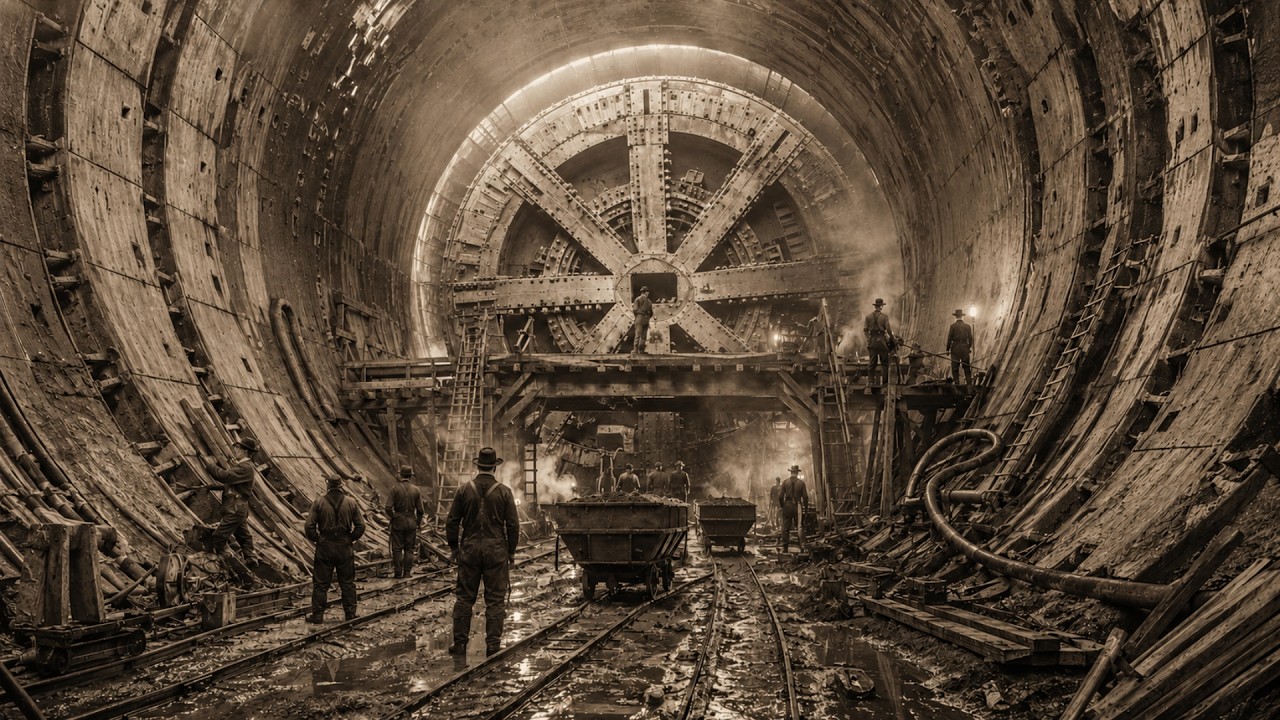
The river above ran at its autumn level, roughly six feet over the crown of the tunnel. The clay around him held. Compressed air was what kept it holding. The men at his sides dug at the same pace, through the same clay, breathing the same compressed air, drawing the same extra pay beyond the ordinary labor rate that the railroad paid to men who worked under pressure, because men who worked under pressure did not always return to the surface the same way they had gone down.
He did not know, the way a man working underground in 1890 knew such things, whether the clay overhead would hold through his whole shift. He knew what the supervising engineers had told the foreman, and what the foreman had passed along: that the soil samples taken along the tunnel’s alignment showed a blue clay of consistent character at the working depth. Clay that compressed air could hold steady against the water of the river above. He knew what the men who had worked the face before him knew: that the clay was consistent most of the time, and that the word “most” was what kept a man careful.
He ran his drill and loaded the cut material onto muck cars that ran on a light railway toward the shaft for hoisting to the surface. He breathed the compressed air, and he did not come up too fast at the end of his shift, because men who came up too fast got the bends, and men who got the bends badly did not finish the job. The St. Clair Tunnel opened on September 19, 1891.
It was the first underwater tunnel in North America built by the compressed-air shield method. It ran 6,025 feet, from Port Huron, Michigan, on the American side to Sarnia, Ontario, on the Canadian side. Its bore was nineteen feet ten inches in diameter, large enough for the standard-gauge railway cars of that age without modification of their dimensions. It connected the main line of the Grand Trunk Railway, running east from Toronto across southwestern Ontario, with the system of the Michigan Central, running west from Detroit through Port Huron to Chicago and the western rail network.
The link replaced a ferry that carried railroad cars one at a time across a river that froze in winter, ran ice in the spring, and bred fog in the autumn, making the schedule of every freight shipper who crossed that border uncertain in a way a fixed link under the river would not be. The men who built the tunnel exist in the payroll records of the Michigan Central Railroad and of the contractors the railroad hired. The payroll records are in the archives, where the archives of that era remain in whatever condition a hundred years of institutional keeping has left them. The names in those records are not on the tunnel entrance at Sarnia.
They are not on the entrance at Port Huron. They are not on anything that would catch the eye of a person crossing the border on the Blue Water Bridge today, looking down at the river from the expressway span. This is the story of how they drove that tunnel under a river between two countries, and what it cost the men who drove it, and why the answer to both halves of that question is worth knowing. To understand why crossing the St.
Clair at Port Huron was a specific problem, and why it waited so long for a fixed solution, you have to understand what the St. Clair River is and what it does in the continental geography it occupies. The St. Clair is not a river in the way the Mississippi is a river.
It does not drain a watershed in the traditional sense. It is an outlet of water. It is the channel through which Lake Huron empties into Lake St. Clair, which empties through the Detroit River into Lake Erie, then into the Niagara River, Lake Ontario, and finally down the St.
Lawrence to the Atlantic. The St. Clair is about forty miles long. It runs south from the southern end of Lake Huron, between 1,600 and 4,000 feet wide.
Its current is not the current of a river fed by rain and snowmelt from a watershed. It is the discharge current of Lake Huron itself, steady and continuous, running at four to five miles per hour in the navigation channel through the straits at Port Huron, where the lake narrows into a river and the full volume of lake discharge accelerates through the constricted cross-section of the channel. At Port Huron and Sarnia the river is about 2,000 feet wide across the navigation channel. The main channel at that location runs between twenty and twenty-five feet deep.
The bottom is the blue clay the glaciers left when they retreated. Dense and moldable, and at the depth of the tunnel crown it was cohesive enough that the engineers who designed the crossing believed it could be held against water seepage by compressed air at pressures the human body could tolerate through a working shift. In the 1850s the Canadian Grand Trunk Railway reached the Ontario side of the St. Clair at Sarnia and had to get across to the Michigan shore.
The answer was the ferry. Car ferries on the St. Clair had the same problems car ferries had at every major river crossing: weather, ice, fog, capacity, and schedule. The St.
Clair freezes. Not every winter, but in a hard winter the freeze could stop the ferry for weeks. The ice running in the river each spring before it hardened could disable a vessel or damage it. Fog forming over the river when warm water met cold air could close the crossing for a full day at a time.
A shipper whose goods waited on the Michigan side of the river until the fog lifted was paying for time the railway had promised he would not pay for. The Grand Trunk and the Michigan Central, which connected with the Grand Trunk at the St. Clair crossing, studied building a bridge. The current was manageable for bridge piers.
The depth was not severe. The width was no obstacle to the bridge technology of the 1870s and 1880s. What was the obstacle was navigation. The St.
Clair carries the Great Lakes trade from the upper lakes to the lower lakes and the St. Lawrence. Bulk carriers hauling iron ore from the Lake Superior ranges to the steel mills of the Ohio Valley. Grain ships moving wheat from the prairie ports of Lake Michigan and Lake Superior to eastern mills.
Package freighters running on fixed schedules between lake ports. A bridge across the St. Clair at Port Huron required a navigational clearance dictated by that traffic, which bridge technology of the era could not deliver at a cost the economics of a single-line railway crossing could justify. The bridge would have required a main span high enough to clear loaded ore carriers and grain ships, which were growing larger through the 1870s and 1880s as the lake trade developed, plus a moveable span or lift mechanism for vessels needing passage at heights beyond the fixed structure, and the navigational disruption caused by any moveable part of a bridge was exactly what the river’s traffic was trying to avoid.
The tunnel was the answer the engineers reached independently and jointly in the late 1880s. Putting a tunnel under the river solved the navigation problem by going beneath it. It did not obstruct lake shipping. It required no moveable span.
It was not subject to ice and fog the way the ferries were. It was, in the engineers’ language to the railroad board in 1886, a permanent solution to a problem the ferry had been managing temporarily for thirty years. The engineering firm charged with designing the crossing was that of Joseph Hobson, chief engineer of the Grand Trunk Railway, who had built bridges across Ontario’s river systems and studied the tunnel-driving methods being developed in Europe and applied with mixed results on American railroad tunneling projects in the 1870s and 1880s. Hobson’s firm studied the St.
Clair crossing and concluded that the shield method of tunneling developed by James Henry Greathead in London, modified by American engineers for particular soil conditions, was applicable to the blue clay of the St. Clair bottom at the depth the tunnel’s alignment required. The Greathead shield was a cast-iron cylinder pushed forward by hydraulic jacks braced against the completed tunnel lining behind it, with a cutting edge at its forward face that penetrated the material ahead. Men working at the face inside the shield excavated the material ahead of the cutting edge.
The shield advanced as material was removed. Behind the shield, cast-iron rings were bolted together to form the permanent lining of the tunnel. The process was continuous. The face always advancing, always being excavated, always being lined behind the point of advance.
What made the St. Clair crossing possible, and what made the Greathead shield effective in London clay and in the American tunnel projects that followed, was compressed air. At the depth of the St. Clair tunnel crown, about fifty feet below the river surface and twenty feet below the riverbed, the hydrostatic pressure of the water above was about twenty-two pounds per square inch.
Pumping compressed air into the working chamber at the shield face and throughout the tunnel under construction, at a pressure slightly above the hydrostatic pressure of the river, pushed the water back. The clay face stayed dry. Men could work at the face. The compressed-air plant for the St.
Clair was assembled on both banks of the river. Steam-engine-driven compressors forced air through pipes down into the tunnel through air locks that controlled entry to and exit from the pressurized zone. The lock was a steel cylinder with two airtight doors. One opening gave onto surface air, the other onto the pressurized tunnel.
A worker entered via the surface door into the lock. The door closed behind him, and the air pressure in the chamber was raised gradually to equalize with the tunnel pressure before the inner door was opened. A worker leaving the tunnel reversed the process, entering the chamber from the pressurized side and spending the required decompression time while the pressure was lowered to atmospheric in controlled stages. The decompression protocol was the engineering specification that stood between men working in compressed air and decompression sickness.
The engineers of 1890 understood the physics in general terms, even if the biochemistry was not fully characterized until decades later. The nitrogen in compressed air dissolves in the blood and body tissues under pressure at a rate proportional to the pressure and the duration of exposure. If the pressure is lowered slowly enough, the dissolved nitrogen returns gradually to a gaseous state within the lungs and is exhaled without forming bubbles in the tissues. If the pressure is lowered faster than the lungs can clear it, it comes out of solution in the blood and in the tissues.
In the joints, in the muscles, in the spinal cord, and in the brain. The pain it caused in the joints gave the condition its common name among the workers who suffered it. Cases reaching the spinal cord caused paralysis. Cases reaching the brain were fatal.
The specific decompression tables for the St. Clair Tunnel in 1890 were based on the best practices available at the time, drawn from the work of the Brooklyn Bridge caisson workers in the 1870s, the Eads Bridge, and the smaller tunnel projects that followed. The tables required men working at St. Clair Tunnel pressures to spend between forty and sixty minutes in staged decompression per shift, which limited the actual working time of each man, and meant the number of men required to maintain the desired rate of advance was larger than simple calculations of face area and excavation rate would suggest.
The men who entered that air lock at Port Huron in the winter of 1890 and 1891 faced the winter conditions of the Great Lakes region in those months, conditions imposed by Lake Huron, which stretches twenty-three thousand square miles of open water that does not freeze in most winters, upon the Michigan shore. Average temperatures at Port Huron in January ran to the low twenties Fahrenheit. The winds coming off the lake carried a particular cold, the cold of a wind that had crossed two hundred miles of open water unimpeded. A man walking to the shaft head at dawn in January 1891 in Port Huron walked through a cold that the brick building of the shaft-head machinery only partly blocked, while the compressed air below did nothing at all for warmth, because compressed air at twenty-six pounds per square inch above atmospheric pressure is not warm air.
It is dense air, and dense air in a tunnel during a Michigan January is cold air under high pressure, with specific effects on a body already working hard against clay at the face of a huge boring shield in darkness. The pay differential the Michigan Central paid compressed-air workers on the St. Clair project was a premium above the ordinary labor rate of the era. The ordinary labor rate in the Port Huron area in 1890 ran roughly between $1.
25 and $1. 50 per day. Compressed-air workers received a premium of twenty-five to fifty cents a day above that rate. The premium reflected the nature of the work.
The men who did the work understood the premium in the terms available to workers in 1890, the terms of what work pays for alternatives, and what the risk was worth against the risk of no income. The alternatives for an ordinary worker in Port Huron in 1890 were farm labor, or dock work at the port on the river, or the small industries the town’s economy provided. None of those alternatives offered the compressed-air premium. The premium was real money in the economy of a working family in 1890.
The bends were real too. The number of cases of decompression sickness on the St. Clair Tunnel project, and the number of those cases that resulted in permanent injury or death, are not numbers that appear in any of the widely read accounts of the project. The engineering literature of the era documents the project as a technical success.
First underwater tunnel in North America, accomplished by the shield and compressed-air method, completed on schedule and within the cost estimates the engineers had given the railroad board. The engineering literature does not count the bends cases because that count was not a purpose of engineering literature. The purpose was to describe the method and its results for the benefit of engineers who would use it on later projects. The men who were injured exist in the medical records kept by the project physician on site, if those records survive, which is uncertain for a project of that era.
They exist in whatever correspondence the project contractors filed reporting accidents to the railroad, if that correspondence remains in the company archives, which for the Michigan Central of 1891 requires knowing where the company’s records ended up after the twentieth-century mergers and acquisitions that folded it into Penn Central and beyond. Tracing a man who suffered decompression sickness at the face of the St. Clair Tunnel in February 1891 through to any surviving record is a path through an institutional history that most labor historians have not had the resources to fully trace. Joseph Hobson presented the completed tunnel to the Grand Trunk Railway in September 1891.
The first locomotive passed through it on that occasion. Hobson received the recognition due an engineer of achievement, and it was considerable in the professional culture of 1891. Papers read before engineering societies, entries in the technical encyclopedias of the era, a place in the profession’s record. The contractors who managed construction on the American and Canadian sides received their fees and their standing in the construction records.
The men who dug the tunnel exist in the payroll records, in the daily attendance books, and in whatever remnants of project paperwork survived the closing of the site. They built something that changed the commercial geography of the Great Lakes region. Before the tunnel opened, the Grand Trunk main line from Montreal and Toronto to Chicago was divided at the St. Clair into two sections joined by a ferry subject to ice and fog and capacity limits that traffic had already exceeded by 1885 when the tunnel idea was first seriously proposed.
After the tunnel opened, the line was continuous. A through freight car could move from Montreal to Chicago without being broken down, loaded onto a ferry, and re-broken on the other side. The schedule promised to a shipper became a schedule the railroad could now keep, because the tunnel, unlike the ferry, did not stop for fog. The tunnel served the Grand Trunk and its successor companies for sixty years.
By the 1950s the railroad cars carrying North American freight traffic had grown larger in every dimension: longer, wider, and heavier than the cars the 1891 tunnel was designed to carry. The Greathead shield’s nineteen-foot-ten-inch bore fit the equipment of 1891, but it did not fit the equipment of 1955. Canadian National Railway, which had absorbed the Grand Trunk in 1923, built a new tunnel beside the original in 1994 to accommodate modern equipment. The 1891 tunnel was taken out of service.
It still lies in the riverbed, sealed tight. The 1994 tunnel is the one carrying rail freight under the St. Clair today. At Port Huron, the south entrance of the 1891 tunnel can be seen from the riverbank, a closed brick arch at the edge of the rail corridor that runs along the St.
Clair. A historical marker stands there. The marker describes the tunnel, its dimensions, its date of completion, and engineer Joseph Hobson. It does not list the names of the compressed-air workers.
It does not describe decompression sickness. It does not describe the winter mornings at the shaft head, or the decompression protocol, or the wage premium, or what that premium meant to a family living in Port Huron in 1891 on an ordinary worker’s income plus what the risk of working under pressure in a Michigan January added to the daily rate. This omission should be understood precisely for what it is and is not. It is not the marker’s fault in any individual sense.
A historical marker is a small object in a public space and can hold only so much. What it carries is the frame: the general history, the engineer, the technical achievement. The frame is accurate. But the frame is also a process of selection.
A selection based on what the available record has prioritized, and the record of the St. Clair Tunnel, like the record of every project of its era, prioritized the engineer, the railroad, the completion date, the technical first. The worker’s name existed in the daily attendance book, a document no one expected to survive. The St.
Clair still runs between Port Huron and Sarnia. The current still moves at four to five miles per hour through the navigation channel. The lake ships still pass through. Bulk carriers hauling iron ore, grain, and limestone, far larger than the ships of 1891, cross the bottom with margins the channel depth allows and the Coast Guard monitors.
The Blue Water Bridge, now a pair of spans, carries highway traffic between Michigan and Ontario at the same crossing where the ferry once ran and where the tunnel passes beneath. On a clear day from the bridge you can look downstream where the river widens toward Lake St. Clair, and upstream where it narrows toward the southern end of Lake Huron. You cannot see the tunnel.
It is fifty feet beneath the riverbed, a hundred feet below the river’s surface. The 1994 tunnel still works. The 1891 tunnel is closed and dark, still in the blue clay, in the place where the Greathead shield reached it foot by foot, while the men at the face aimed their drills and loaded the cut material onto the muck cars, breathing the compressed air, coming up through the decompression lock at the end of their shifts with varying results. Some of their names are in the payroll records.
Some of the payroll records are in the archives. The archives are open to researchers who have the knowledge to find them, the time to read them, and the interest to dig into them. The tunnel is there in the dark beneath the St. Clair, in the clay that held.
It held because someone pushed a great shield through it foot by foot, came up through the air lock at the end of every shift, drew his pay, and left no trace in any record that a person looking at the Blue Water Bridge today would know how to find. He is in the clay. The clay held.
