The man in the cell asked for a photograph on the morning of February 24, 1865. He was tall and thin, thirty years old, and his name was John Yates Beall. He had been awake for half an hour before the church bell rang on Governors Island. The room where he sat had stone walls and a single high window that gave him only a square of gray sky above New York Harbor.
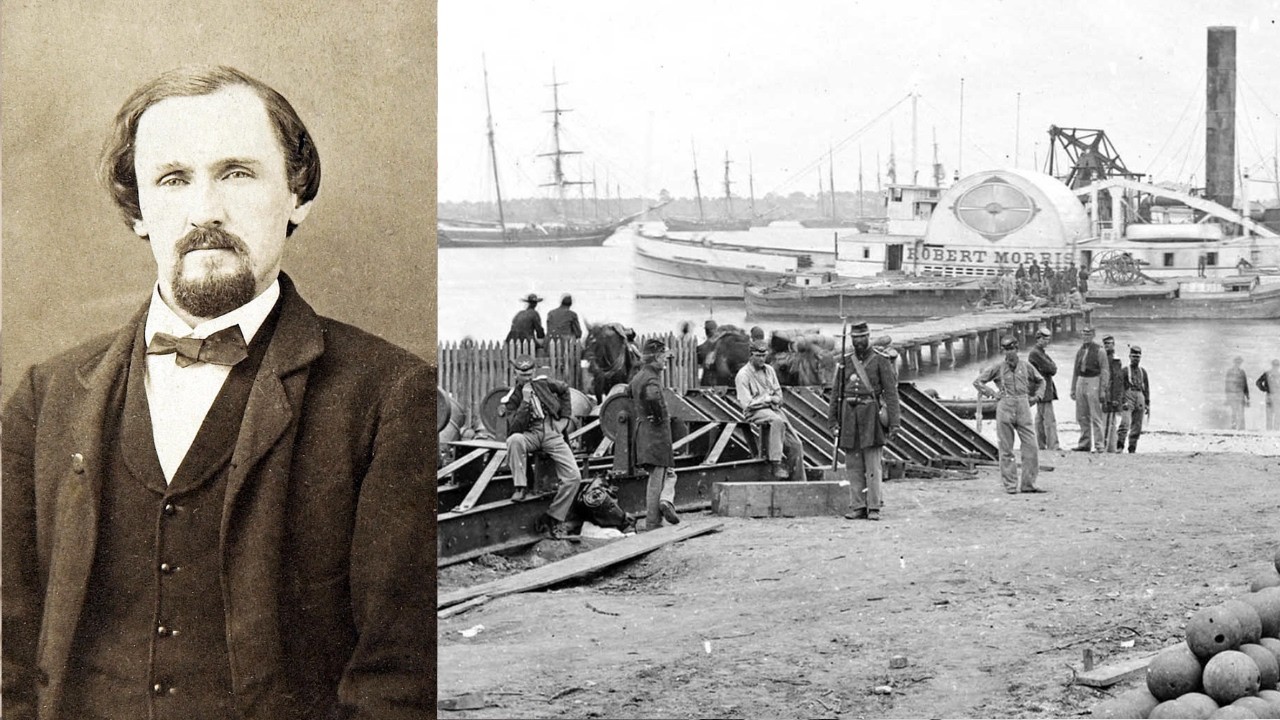
Snow had fallen in the night. He could smell it through the glass, that sharp wet smell snow carries just before it begins to melt. The photographer came in with a wooden box on a tripod and a black cloth. Beall sat for him without any posing.
He kept his hands folded in his lap. He did not look down. The camera shutter went. The photographer left.
The photograph exists—you can find it in the archives—and what stays with you when you see it is not the face of a condemned man. It is the face of a man who has already gone somewhere calmer than the room he is in. A few minutes later, three men came down the corridor. He heard their boots on the stone before he saw them.
There was Captain Tollman, who was in charge of the arrangements. There was the United States Marshal, a man named Murray, present by request. And there was the executioner. They opened the door.
Beall stood before any of them spoke. He told them he knew why they had come. He said he wanted the matter done quickly. Then he said something else, preserved in the newspaper report published that evening: that it was merely a question of muscle strength, and he thought he could endure it.
They bound his arms. They placed a military cloak over his shoulders. They put a black hood over his head, raised so he could see. They marched him between two lines of soldiers through the snow across the parade ground of Fort Columbus to a scaffold built that morning.
He could see the harbor. He could see the lower bay where Fort Lafayette sat on its little island. Somewhere beyond the Narrows, ships were moving. He could see the bare trees of Governors Island and the gulls circling over the water.
It was a quiet day. The wind was not strong. Still, the cold cut through the cloak. The scaffold was made of new wood.
He could smell the pine. He could smell the wet ropes. The order was read. It had been signed by Major General John Adams Dix on the eighteenth of February.
It stated that John Y. Beall would be hanged by the neck until dead. He stood on the drop. He turned once to the chaplain accompanying him, Dr.
Weston, and said something in a low voice that only a few heard: that a man might be as near to God on the gallows as anywhere else. Then the executioner pulled the black hood down over his face. The provost marshal drew his sword. The newspapers of New York reported the time as thirteen minutes past one in the afternoon.
There was a noise from inside the box. The body of John Yates Beall hung in the air. It hung there for twenty minutes. A physician named Connor stepped forward and confirmed that the neck had been broken by the fall.
The body was lowered. Soldiers in blue carried it across the parade ground through the wet snow. The question I always come back to—the question this entire story turns on—is the same one the lawyers and generals and the President of the United States had been arguing over for thirty-eight days in New York City that winter, when the United States executed this man on this island in this harbor. What, exactly, did it think it was executing?
Was it executing a soldier? Was it executing a criminal? Or was it executing something for which it had not yet found a name? That is the question.
Hold it in your mind. We will go back through the life of John Yates Beall, and trace the war he fought, and the trial that took his name and gave it back to him as a legal verdict. And we will come back to this scaffold at the end. By that time you may have your answer.
To understand what was happening on that gallows at Fort Columbus on February 24, 1865, you have to understand that the war was nearly over and everyone knew it. Sherman had already taken Savannah. He was marching north through the Carolinas. Grant had Lee besieged at Petersburg and was tightening the noose every day.
The Confederate Congress was talking in faint voices about arming the slaves. The South had no fleet left at sea. In February 1865, in the offices of the Department of the East in New York City, Major General John Adams Dix sat with the trial record of a man arrested at a train station outside Niagara Falls two months earlier, and he had to decide what kind of war this man had been fighting. That question is harder than it sounds.
In 1865, the laws of war as practiced by the United States and recognized in Europe contained two clear categories of combatant, and only two. There was the soldier. The soldier wore a uniform. The soldier carried his weapons openly.
The soldier fought under a flag and under the command of officers commissioned by a recognized government. If you captured a soldier, you held him for exchange. You did not hang him. That was the law.
Then there was the criminal. The criminal was a civilian who had broken the peace. You arrested him. You tried him in a civilian court and punished him.
He was not a combatant. He had no rights as a soldier. He had only the rights of a citizen accused of a crime. There was no third category.
There was no word in the laws of war that winter that described a man holding a genuine commission from a recognized navy, fighting against military targets, all of it in civilian clothes, operating from across a neutral border, sometimes among civilian passengers on a public ferry. That kind of combatant had no name in the laws of war yet. The British and French had not invented a name for him. The Americans had not invented a name for him.
The Lieber Code, which Francis Lieber had written for the Union Army in 1863, the most modern code of military justice in the Western world, did not actually cover what John Yates Beall had been doing on Lake Erie and on the railroads of New York. So the question on General Dix’s desk in February 1865 was not about the man himself. It was a question of classification. Was the man in his hands a soldier, in which case he could not be hanged?
Was the man in his hands a criminal, in which case he must be tried before a civilian court in New York and probably serve a life sentence? Or was the man in his hands something new, something the country had not yet named? In that case, the United States would have to invent the name and write it into law through the rope of the gallows. Now let me tell you who he was.
He was born on January 1, 1835, on a ten-thousand-acre plantation called Walnut Grove in Jefferson County, Virginia. Jefferson County lies in the narrow panhandle of the state. The nearest town to Walnut Grove was Charles Town. The town just beyond Charles Town on the road was Harpers Ferry.
He was the second of four sons, and the fourth of nine children, of George Brooke Beall and Janetta Yates Beall. His family held enslaved people on the land. At one point they numbered more than one hundred. Much of the family’s wealth came from their labor.
Beall did not fight the war to preserve slavery—not in his own mind. In his mind, he fought to defend Virginia. But the wealth that paid for his education at the University of Virginia, the wealth that supported him during his recovery, the wealth that bought the boats he ran on the Chesapeake—that came from human beings his family owned. That is the ground he stood on.
The same is true of many men in this story, on both sides of the line. He enrolled at the University of Virginia in 1852 to study law. He left in 1855 without his degree. His father had fallen ill.
His father died on August 20 of that year. Beall went home and took over the management of the farm. He was active in Zion Episcopal Church in Charles Town. Those who knew him then described him as quiet, serious, fond of reading, a man who did not drink much, a man who took the prayer book seriously.
Then, in the fall of 1859, the world came to Jefferson County. On October 16, 1859, a man named John Brown crossed the Potomac with twenty-one followers and attempted to seize the federal arsenal at Harpers Ferry. His aim was to ignite a general uprising of the enslaved across the South. He was stopped after thirty-six hours by a detachment of United States Marines under a colonel named Robert E.
Lee. John Brown was tried in Charles Town. He was convicted of treason, of inciting a slave rebellion, and of murder. He was sentenced to be hanged.
The execution was set for December 2, 1859. The governor of Virginia, a man named Henry A. Wise, was so afraid of an attempt to rescue Brown from the gallows that he ordered as many militia companies as possible into Charles Town, so that the small town looked like an armed camp that winter. The streets were full of armed men in cold weather waiting for an attack that never came.
One of those armed men was John Yates Beall. He had joined the local militia company in Charles Town after the Harpers Ferry raid. It was called the Botts Greys. He was a private.
He stood guard at the gallows on the morning of December 2, 1859, in the cold, watching John Brown being carried to the scaffold, sitting on his coffin in the back of a wagon. He watched Brown climb the ladder. He watched Virginia hang him. And here is the detail I always come back to.
There was another militia company present that morning, a company called the Richmond Greys, which had come from Richmond for the same duty. Standing in that company, almost certainly, was a young actor named John Wilkes Booth. He was a corporal. He was one year younger than Beall.
The records do not tell us whether the two men spoke that morning. But the field where they stood, on opposite sides of an executed man, is the same field they would stand in for the rest of their lives. Beall in the cold, Booth in the cold, and the body of John Brown swinging at the end of a rope. Eleven years and three months later, John Yates Beall would be hanged in a place not so different.
Eleven years and four months later, John Wilkes Booth would shoot the President of the United States in a theater in Washington. There are those who believe the second happened because of the first. We will get to that. But consider the picture for a moment.
Two young men in gray militia uniforms on a winter hill in Virginia watching a man swing from a gallows. Whatever began inside them that day did not stop. The war came in April 1861. The Botts Greys became Company G of the Second Virginia Infantry.
The Second Virginia became part of the brigade of Brigadier General Thomas Jonathan Jackson, a brigade that within months would be known as the Stonewall Brigade. Beall enlisted as a private. He was twenty-six. He had no significant military experience, but he had grown up around horses and guns, and he had stood guard at John Brown’s gallows, and he was, as his neighbors put it, ready.
In October 1861, while assigned to escort a sick soldier to his home in Jefferson County, Beall learned that Colonel Turner Ashby’s cavalry was under attack at a place called Bolivar Heights, just above Harpers Ferry. He left his assignment. He rode toward the sound of the guns. He joined Ashby’s force, and during the fighting on October 16, 1861, despite his low rank, he led a charge.
A Union bullet struck him in the chest. It passed through his lung. He fell to the ground. But he survived.
They carried him off the field. The wound never fully healed. For the rest of his short life, he had trouble breathing deeply. He could no longer carry a rifle all day or sleep on cold ground without coughing blood.
The Confederacy gave him a medical discharge in February 1863. He was twenty-eight years old, and in the eyes of the army, he was finished. What he did between October 1861 and February 1863 is the part of the story that could be called the wandering. He went south to recover.
He visited a plantation in Louisiana. He met a schoolteacher from Nashville named Martha O’Brien and became quietly engaged to her, without any formal announcement. He returned briefly to Jackson’s brigade after the First Battle of Winchester in May 1862. But during the retreat through the Shenandoah Valley, he became separated from his unit and could never find it again.
He drifted west. He ended up in Dubuque, Iowa, where his older brother had a job for him managing a grain mill under an assumed name. He called himself John Yates. He worked at the mill for a few months.
Then word reached him that someone in town knew his real identity, and he moved on, north into Canada. And from Canada, in January 1863, he made his way back to Richmond. He had a plan by then. He went to Richmond with a colonel named Edwin Gray Lee, a former officer of the Stonewall Brigade and a cousin of Robert E.
Lee. Together they obtained a meeting with President Jefferson Davis. Beall presented two ideas. One plan was to free Confederate officers held at Johnson’s Island, a prison camp in Sandusky Bay on Lake Erie, by launching a force of privateers on the Great Lakes.
That idea was rejected—it would mean arming a fleet in waters shared with neutral Canada, and the Confederacy could not afford the diplomatic trouble. The other idea was to conduct irregular naval operations in the Chesapeake Bay. That idea was approved on March 5, 1863. John Yates Beall was commissioned as an acting master in the Confederate States Navy.
The commission was real. The signature was real. The document, preserved at the University of North Carolina, gave him the rank and standing of a naval officer of the Confederate States of America. It did not provide him a ship, so he bought his own.
He fitted out two small vessels, a sailboat and a small open boat, and gave them names. He called the larger one the Raven and the smaller one the Swan. He recruited a crew of eighteen men. His second-in-command was a twenty-two-year-old Scot named Bennet G.
Burley, a sailor by training. They launched their boats in the summer of 1863 and went to work. What they did over the following months in the bays and inlets of the Chesapeake was small-scale harassment. They cut an underwater telegraph cable connecting Cape Charles to the Union signal system.
They burned the lighthouse at Cape Charles. They captured small Yankee sailing vessels carrying goods and supplies, took the cargoes, released the crews, sometimes leaving the boats, sometimes burning them. The physical damage was slight. The damage to nerves was greater.
Beall and his men became a presence in the bay that the United States Navy could neither catch nor ignore. There is a letter Beall wrote during his later recovery after his capture, quoted by his biographer William C. Harris. In it, Beall does not claim great achievements.
He says simply that they made the lives of the gunboats trying to catch them miserable. On November 15, 1863, a fisherman near Tangier Island in the Chesapeake stumbled upon Beall’s hidden group, asked what they were doing, believed their answer that they were on a hunting trip, and then quietly went and informed the United States Navy. Within a few hours, two Union gunboats with their guns loaded reached the hiding place. Beall and his men were captured without a fight.
The Union initially held them as pirates. They were put in irons. They were taken to Fort McHenry in Baltimore. They were threatened with trial in a civilian court where they would be hanged.
The Confederate government in Richmond moved quickly. Secretary of War James Seddon announced that if Beall and his men were treated as pirates, a number of Union naval officers in Confederate hands would be treated the same way. The threat worked. The trial never happened.
After a long imprisonment at Fort McHenry, then aboard a ship off Fort Monroe, then at the prisoner-of-war camp at Point Lookout, Beall was exchanged. He returned to Richmond in March 1864. That was the first time the United States had to decide what John Yates Beall was. In 1863, it decided he was a prisoner of war.
In 1865, it decided otherwise. The man was the same. What had changed was the war. Now we come to the Lake Erie raid.
This is the part everyone who knows Beall’s name knows him for, and the part the courts in New York would later use to put the rope around his neck. In August 1864, after his exchange and a brief meeting with Martha in Georgia, Beall went north. He went to Toronto. He went to the Queen’s Hotel, which was the unofficial Confederate embassy in Upper Canada.
He asked for a man named Jacob Thompson. Jacob Thompson had been, before the war, Secretary of the Interior in the administration of President James Buchanan. He resigned in 1861 to follow his state of Mississippi out of the Union. He served briefly as an inspector at Vicksburg.
And in April 1864, President Jefferson Davis sent him to Canada as the chief commissioner of what was, simply, the Confederate intelligence service in the British provinces. Thompson’s mission was to inflict every kind of damage on the United States that could be inflicted from across the border. Freeing Confederate prisoners, burning northern cities, aiding disaffected northern Democrats in splitting the Union, sinking Union ships on the Great Lakes, and stirring up the so-called Sons of Liberty, the Copperheads of the Midwest who wanted a negotiated peace. Thompson was not skilled at running espionage.
He spent lavishly. He trusted the wrong people, and his operations leaked badly. By the fall of 1864, his offices in Toronto were under open surveillance by Canadian and American investigators. But in August 1864, when Beall walked into the Queen’s Hotel, Thompson had a plan he had been working on for months and believed could change the course of the war.
He needed a seaman. Beall was a seaman. Thompson welcomed him. Here was the plan.
There were nearly three thousand Confederate officers held at Johnson’s Island prison camp on a small island in Sandusky Bay on Lake Erie. The only Union warship on the Great Lakes was a fourteen-gun iron-hulled side-wheel steamer called the USS Michigan. The Michigan was old. The Michigan was under-crewed.
The Michigan was the only thing standing between those Confederate officers and their freedom. If the Michigan could be captured, the camp would surrender. If the camp surrendered, there would be three thousand officers in the field. They would march south.
They would free another five thousand soldiers at Camp Chase outside Columbus, Ohio. They would arm themselves from the Ohio arsenals. They would force the Union to pull troops from the front to deal with them. The Confederacy would buy the time it needed.
Thompson had already placed an agent in Sandusky. The agent was Captain Charles H. Cole, a former cavalry officer under Nathan Bedford Forrest. Cole had lived in Sandusky for months under the cover of a representative of a Pennsylvania oil company.
He had rented rooms at the West House hotel. He had thrown lavish dinner parties. He had befriended the officers of the Michigan. He had made himself a familiar and trusted face in the small port society of Sandusky.
The plan was for him to host a dinner aboard the Michigan on the evening of September 19. He was to put a narcotic in the wine. When the officers fell asleep, he was to give a signal to a steamer approaching in the dark, whose men would board the warship, seize it, free the prisoners, and set the operation in motion. That was Beall’s mission—to bring the steamer.
He recruited a new crew in Windsor, Ontario, just across the river from Detroit. He found old Burley, the Scot from the Chesapeake days, and made him second-in-command again. He gathered, by the account you read, between twenty and twenty-six men. They had one box between them.
The box contained pistols and hatchets. On the morning of September 19, 1864, they boarded the steamer Philo Parsons as ordinary passengers at Detroit and the Canadian stations along the way, in small groups, paying their fares, carrying only the box. By two in the afternoon, the ship was in American waters near Kelly’s Island. The box was opened.
The pistols came out. Beall and his men seized the Parsons without firing a single shot. They put the passengers ashore on Middle Bass Island. They took on firewood, because the Parsons was short of fuel and they would not reach Sandusky without it.
While they were coaling, a smaller steamer called the Island Queen came alongside to dock. The Island Queen was carrying about thirty discharged soldiers of the Union Army, Company K of the 130th Ohio Volunteer Infantry, on their way home on leave. Beall seized her too. A few shots were fired.
A man named Alonzo Miller from Port Clinton, the engineer, was wounded in the head. He survived. The discharged soldiers were released and left on the island with the civilians. The Island Queen was towed out into the lake and deliberately sunk over a reef.
By dusk on September 19, John Yates Beall had two prizes to his credit. One was sunk, and the Philo Parsons was under his command, heading toward Sandusky Bay. He could see the lights of the bay. He could see the navigational lights of the Michigan somewhere in the dark.
He dropped anchor in the bay. He waited for Cole’s signal. The signal never came. The reason it never came is the kind of thing that decides the fate of wars.
Cole had been spotted earlier that day by an officer from Johnson’s Island who recognized him from before the war. The officer brought an arrest warrant aboard the Michigan and arrested Cole at the dinner before he could pour a single drop into the wine. The dinner itself was a sham. The officers of the Michigan had been warned.
They were on alert. The signal Beall was watching for would never be sent. Beall did not know that. He sat in the dark on the deck of the Philo Parsons watching the lights of the warship.
As the hours passed with no rocket and no boat coming out, his men grew restless. Whispering spread among them. Arguments broke out. Around ten o’clock at night, seventeen of them came to him and told him plainly they would not continue the mission.
They did not believe Cole was free. They did not believe capturing the Michigan was possible. They had not signed up to attack a warship that was ready and waiting. Beall tried to persuade them.
He pleaded with them. He stood on the rail of the ship and called them cowards. They gave him their position in writing, these men. They signed a paper saying that, in their judgment as experienced soldiers, the operation could not succeed, and they were not willing to risk their lives further.
He read the paper. He folded the paper. He put the helm over and turned the Philo Parsons north, back toward Canada. They reached Sandwich, Ontario, in the early hours of September 20.
They sank the Philo Parsons at the dock. They scattered. Most of the crew melted away inside Canada. Bennet Burley was captured and cornered by the British authorities a few days later.
The United States demanded his extradition. He fought it for months in the Canadian courts and lost. He was eventually sent back, and through a series of chances escaped from an Ohio prison and made his way home to Scotland, where he lived another fifty years, became a famous war correspondent, and died in his bed in 1914. Beall got away.
He returned to Toronto. The raid was over. The plan that was supposed to free three thousand officers and put the Confederacy on the offensive in the West ended with one wounded engineer, two sunk ships, and twenty men back in Canada with nothing to show for it. He should have stopped there.
He did not. In December 1864, with the war clearly lost, Beall devised another plan. There were a number of Confederate generals who had been captured at different stages of the war and were being transported by train from Johnson’s Island to a holding fort in Boston Harbor called Fort Warren. The route ran over the New York Central Railroad through Buffalo.
Beall and a small group of conspirators aimed to derail the train near a small station outside the city, free the generals in the chaos, and smuggle them across the river into Canada. They tried twice. Both times, the train did not arrive at the time they expected. And the third time they tried, they were discovered.
On December 16, 1864, Beall and his companion George S. Anderson were arrested by a local policeman at the railroad station near the Niagara Falls Suspension Bridge, the long iron bridge spanning the river just below the falls. The policeman was looking for passengers acting suspiciously. He found two of them.
Beall lied about his name. He lied about why he was there. The lies did not hold. They were taken to New York City.
They were placed in police headquarters, then transferred to Fort Lafayette in the lower bay on January 5, 1865. Anderson, when given the choice, changed sides. He agreed to testify against Beall in exchange for a lighter sentence. Beall was left alone.
Now we come to the trial, and to the question that brought us here. On January 17, 1865, a military commission convened at Fort Lafayette in New York Harbor by order of Major General John Adams Dix, commander of the Department of the East. The commission had six members. Its president was Brigadier General Fitz Henry Warren.
The judge advocate who acted as prosecutor was a major named John A. Bliss. The accused was John Yates Beall. Dix took the case personally.
He had ordered the commission formed. He had also forbidden Beall from communicating with the outside world. He refused to allow Beall to choose his own counsel. In particular, he refused to allow Beall’s cellmate at Fort Lafayette, a captured Confederate brigadier named Roger A.
Pryor, to act as defense counsel, on the grounds that a prisoner of war could not represent a defendant charged with espionage. In the end, the defense was taken up by James T. Brady, one of the most prominent lawyers in New York City, a man who worked the case without pay because he believed Beall was being wronged. The charges came in two sets.
The first was violation of the laws of war. This charge rested on the Lake Erie raid—the seizure of the Philo Parsons and the Island Queen, and the threat posed to civilian passengers. The second was acting as a spy. This charge rested on the train sabotage plan, and on the fact that Beall had been arrested in civilian clothes near the Niagara Falls Suspension Bridge under a false name, intending to commit a military act against a target inside the United States.
Brady’s defense was simple, and it was the correct defense. Brady argued that Beall held a genuine commission as an acting master in the Confederate States Navy. Brady argued that this commission was a public document, recognized and signed by the proper Confederate authorities. Brady argued that everything Beall had done in the Chesapeake Bay, on Lake Erie, and on the railroads of New York had been done under that commission and under orders against military targets.
Brady argued that this made Beall a soldier in civilian clothes, not a spy. And Brady argued that a soldier in civilian clothes captured behind enemy lines was entitled, at worst, to treatment as a prisoner of war, and at best to trial before a civilian court—but in no case was he subject to a military commission with the power to impose a death sentence. Bliss answered with a different argument. He said what Beall had done was not war.
He said disguising oneself as an ordinary civilian passenger, using a public ferry as a weapon, threatening civilians on a public train, and operating from neutral Canadian soil all fell outside any law of war recognized by any civilized nation on earth. He said that whatever Beall’s commission said on paper, his actions on the ground placed him outside the protection of the laws of war. He said Beall was a spy. He said Beall was a guerrilla.
He said the only appropriate punishment was death. The military commission deliberated on February 8, 1865. It convicted John Yates Beall on every charge except one detail that carried the wrong date. It sentenced him to death by hanging.
Dix approved the sentence on February 14. The execution was set for the eighteenth. A technical error in the paperwork delayed it to Friday, February 24. Beall was transferred to a cell at Fort Columbus to wait.
Now look at what happened next, because the story turns strange here. The case had been kept out of the newspapers. The trial was not public. The Confederate authorities in Richmond did not even know Beall was on trial until after his conviction, when the New York papers printed the story and the telegraph carried it south.
But when the story spread in the second week of February, the reaction was something no one in the Department of the East had expected. A petition was circulated in Washington. It demanded clemency. It was carried first to Orville H.
Browning of Illinois, a former United States senator and a personal friend of the President. Browning signed it and began talking to his colleagues. Within a week, it had gathered ninety-one signatures from the House of Representatives, including that of a young congressman from Ohio just elected to his first term, a man named James A. Garfield, who wrote in pencil beside his name that he recommended at least a temporary postponement.
A separate petition was signed by six United States senators. Carl Sandburg, Lincoln’s biographer, later wrote that at no time during the four war years had such political weight appeared demanding commutation of a single death sentence. The petitions were delivered to President Abraham Lincoln on February 17, 1865, by Orville Browning in person. Lincoln read them.
Lincoln received Browning for an hour. Over the next week, he received others. He received Montgomery Blair, who had been his Postmaster General. He received a paroled Confederate brigadier named Roger Pryor, Beall’s cellmate and a man Lincoln respected.
He received the Reverend Dr. John G. Bullock of Baltimore. He received Mrs.
John Giddings of Baltimore, at whose home he had stayed on his night journey to Washington in 1861. He received an editor named John W. Forney and another editor named Washington McLean, and a fourth man whose name we will come back to later. To each of them, Lincoln gave the same answer.
He said it to Browning. He said it to Pryor. He kept saying it. General Dix could handle the case as he saw fit.
The President would not interfere. And to Dix, the President said in letters we still possess that it was up to Dix to act as he saw fit. The two men understood each other perfectly. The President did not want to be the one to move.
The General did not want to move at all. Beall would hang. I want to pause here for a moment and ask you to think about that, because it does not match the picture of Lincoln that most of us grew up with. This is the same Lincoln who in 1863 pardoned a sleeping sentinel from Vermont named William Scott.
This is the same Lincoln who refused to sign a stack of execution warrants for deserters and wrote that he had decided to let the boys live. This is a president famous in his own time for a merciful instinct that some of his generals thought was a weakness. In four years of war, he had pardoned hundreds of men. And in this case, with ninety-one members of the House asking him to spare one life, and six senators, and the Speaker of the House, Schuyler Colfax, and a future president of the United States named James Garfield, and old friends he had known for thirty years—Lincoln said no.
Why? Here is the truth of it. Lincoln said no because Dix had made clear to him that anything else would undermine the position the United States had decided to take. And the position the United States had decided to take was that there was a line a man could not cross, even as an officer, and still remain a soldier.
A few months earlier, in November 1864, the same Jacob Thompson in Toronto had sent a team of Confederate agents into New York City with bottles of a substance called Greek fire. They checked into nineteen hotels along Broadway. They set the rooms on fire and walked out. The plan was to burn the city.
The fires largely failed because the agents did not know how to handle the chemicals properly, and hotel staff put them out before they spread. One agent, Captain Robert Cobb Kennedy, was caught a few weeks later and was sitting in the same cells at Fort Lafayette where Beall was held. In December, at St. Albans, Vermont, a Confederate raiding party that came from Canada robbed the town’s banks, killed one civilian, set fire to several buildings, and escaped toward the border.
The Canadians let them go on a legal technicality. The northern public was in a fury. That was the climate. In that climate, the question on General Dix’s desk was not merely what to do with one young Virginian.
The question was whether the United States would accept that men in civilian clothes, operating from a neutral country, could do as they pleased against its civilian population and civilian transport, as long as they carried a piece of paper from the Confederacy in their pockets. The United States had decided the answer was no. And the way it wanted to say no to the world, to the South, and to the future, was through the scaffold at Fort Columbus. That was what Lincoln was protecting when he turned away every petitioner.
Not revenge, not spite. A line—a line the laws of war had not yet drawn. A line he and Dix were drawing under the gallows, the way people draw lines under things in February when not much of winter is left. Beall, in his cell, understood at least part of this.
There is a letter he wrote on February 21, 1865, three days before his death, preserved among the papers at the University of North Carolina. In it, he asked his family for two things. He asked to be buried quietly. And he asked that his death not be made a public cause.
Both wishes were ignored. His funeral in Brooklyn drew crowds. The body was later reburied in Charles Town at the family’s request. The newspapers covered both.
I want to say something else about the letter, because I keep coming back to it. Beall does not ask his family in that letter to clear his name. He does not ask them to make him a martyr. He asks them only to bury him.
That is not the request of a man who believes he is being persecuted for a noble cause. It is the request of a tired man. He had accepted that the time for arguing was over. And who, in the end, does not want something small?
He asked for something small. That small thing was not given to him either. There is another thread we must follow before we return to the scaffold, because it has hung over this story for a hundred and sixty years and deserves an honest accounting. That thread is the actor John Wilkes Booth.
We know that on December 2, 1859, Booth was a corporal in the Richmond Greys at the execution of John Brown in Charles Town. And we know that Beall was a private in the Botts Greys at the same execution. It is highly likely they saw each other. Whether they spoke, or became friends, the records do not say.
There are postwar letters and recollections claiming they were close from boyhood, that they studied together at the University of Virginia, that Booth was a suitor of Beall’s sister. None of these claims survives scrutiny. Booth never attended the University of Virginia. There is no contemporary letter from either man mentioning the other.
The Encyclopedia of Virginia, weighing the evidence, describes the story of the close friendship as fabricated. But the legend grew after Beall’s execution and Lincoln’s assassination. A postwar editor named Mark M. Pomeroy, who ran a sensational Democratic weekly in New York, published a story.
The story said that Booth, in February 1865, went to the White House at midnight with a group of friends—including the editor John W. Forney and Senator John B. Hale and Washington McLean—and knelt at Lincoln’s feet begging for Beall’s life. The story said Lincoln wept and promised a pardon, that William Henry Seward talked him out of it the next morning, and that Booth carried that broken promise with him until the night of April 14.
John W. Forney publicly denied the whole thing in 1876. He said he had never met Booth in his life. He said the story was pure invention.
He named Pomeroy as its source. Booth’s own diary, written after the assassination, says only that he had no personal grudge. He struck for his country, and that was all. So we do not know whether Booth grieved for John Yates Beall.
We know he might have. We know they stood on the same hill as boys, and that one of them killed a president a few weeks after the other was executed. And the legend has kept seeping into history ever since, like a thin red thread you cannot fully pull out. I leave it where the documents leave it.
The legend remains a legend. The hill is real. Now, back to the scaffold. We have come a long way to reach it.
The black hood, the provost marshal, the sword, the drop. Thirteen minutes past one on a Friday afternoon in February. The physician named Connor stepping forward at one-thirty-three and confirming what the rope had done. The body lowered into a coffin.
The coffin carried across the harbor in a small boat. Burial in Green-Wood Cemetery in Brooklyn. The next day, the Confederate Congress responded to the news by passing a resolution of condolence for John Yates Beall. The Confederacy by then was six weeks from surrender at Appomattox Court House.
The resolution would mean nothing to anyone in less than two months. The body lay in Green-Wood for five years. On March 22, 1870, the family had the remains exhumed and brought home. He was reburied in the cemetery of Zion Episcopal Church in Charles Town, West Virginia—the church where Beall had grown up, the town where he had stood guard eleven years earlier when another man was hanged.
The small headstone is still there. It is enclosed by an iron fence. The town has grown up around the cemetery, but the cemetery itself is still quiet. On most mornings, nothing moves in it but the wind and the grass.
If you stand at the grave on a cold morning and look north through the iron fence, you can see the hill itself on the horizon where John Brown was hanged in 1859. The gallows is gone. The field is open. West Virginia has placed an identifying marker there.
From the cemetery, you cannot read what is written on the marker. You can see only the field. That is the image I leave you with. So what did the United States execute on February 24, 1865?
It executed a man. A real man, with a name and a wound in his chest and a fiancée in Tennessee and a brother in Iowa and an Episcopal prayer book in his pocket, and a long history of decisions that led him to a snow-covered parade ground in New York Harbor at one-thirteen in the afternoon. He was not a monster. The men who knew him in Virginia and Iowa and Canada and Fort Lafayette did not describe him as a monster.
They described him as serious, a little fanatical, deeply religious, sometimes reckless, carrying a wound that never healed and a sense of duty that outlived his army. But he was not a hero either. The Lost Cause monument erected to him in the cemetery of Zion Episcopal Church in 1899, with an inscription calling him a martyr, was built by people who needed a martyr. He was not that martyr.
He fought for a country that defended an institution we now call plainly a crime against humanity. He seized a public ferry full of civilians on Lake Erie and held them under arms for a purpose of war. He planned to derail a passenger train near Buffalo for a purpose of war as well. And the men who tried him in New York were not wrong when they said those acts fell outside the bounds of what nineteenth-century law of war recognized.
He was, instead, an early American example of something the world is still trying to write laws for. He was a soldier fighting in civilian clothes. He was a commissioned officer who used civilian transport as a weapon. He was an irregular combatant moving between the categories of warrior and criminal—something the Geneva Conventions, not yet written, would later try to address.
When the United States executed that man, it did not hang only the man. It hanged the question itself. It said, by the rope, that there was a dividing line, and that John Yates Beall had crossed it. And it said that no commission, no flag, no oath could bring a man back behind that line once he had crossed it.
Whether that line was drawn in the right place is a question the world is still answering. In the courts at The Hague. In the arguments over the prisoners at Guantanamo. In the debates over cyberattacks and drone pilots and soldiers without insignia in more places than can be counted.
The line Beall died for was a line drawn in the dark by exhausted men in the final weeks of an exhausting war. He was not a monster. He was not a hero. He was a man who fell between categories, and he was there.
Remember the man on the scaffold at Fort Columbus, and the snow on the parade ground, and the soldier in blue raising his sword, and the physician stepping forward at thirteen minutes past one. Remember the hill at Charles Town, and the iron fence, and the wind in the grass, and John Brown’s marker on the horizon—two men executed eleven years apart in the same strip of Virginia. Remember the law that did not yet exist, and the question we still cannot quite answer. He was not a monster.
He was not a hero. He was a man who fell between categories.
