At 11:45 on the morning of June 28, 1971, Joseph Colombo stepped to a podium in Columbus Circle, Manhattan, ready to address a crowd of roughly 50,000 people gathered for the second annual Italian-American Unity Day rally. Italian flags waved across the square. News cameras rolled. Police lined the perimeter.
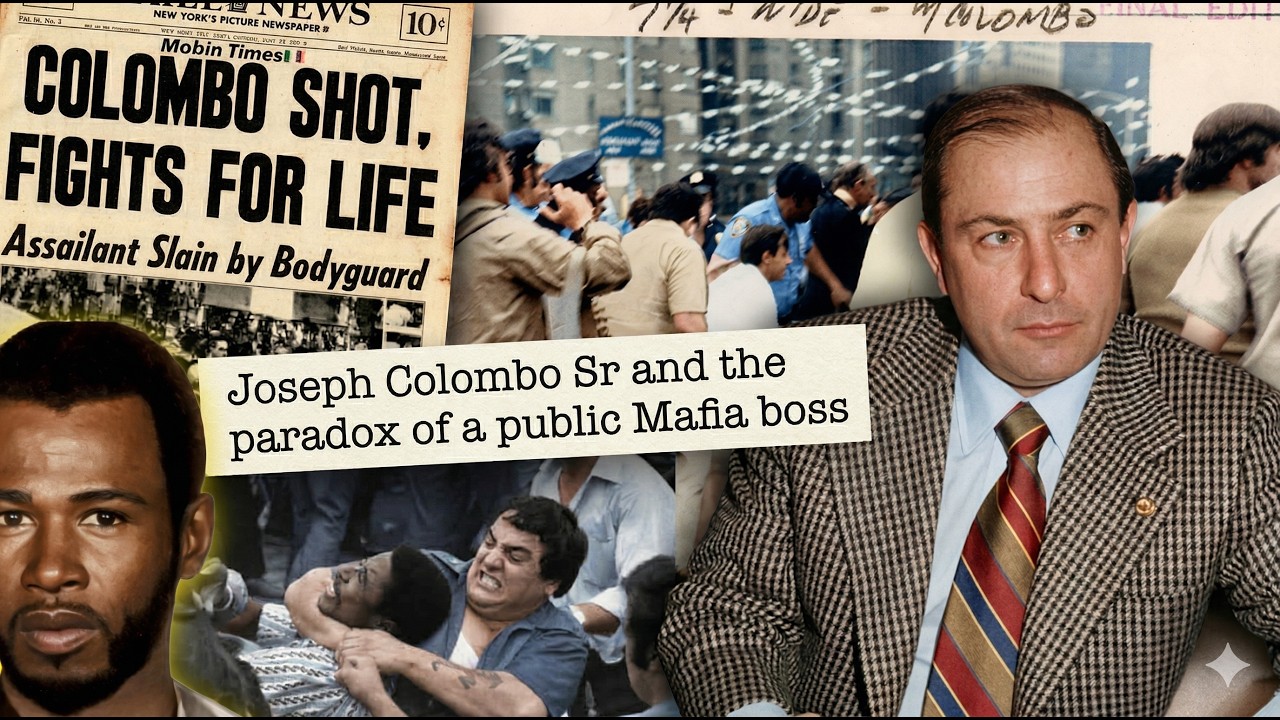
Colombo, the boss of one of New York’s five Mafia families, had spent the last year building something no mob leader had ever attempted before—a public identity as a civil rights champion for Italian-Americans. Jerome Johnson, a 25-year-old Black man from New Jersey, moved through the press section dressed as a news photographer. Credentials hung around his neck. No one stopped him.
He reached the front of the stage, dropped his camera, and pulled a 7. 65 mm Luger pistol from his waistband. Three shots fired in rapid succession. The first bullet shattered Colombo’s jaw.
The second severed an artery in his neck. The third lodged in his brain. Colombo collapsed backward, blood spreading across the stage as the crowd scattered in panic. Within seven seconds, Colombo’s bodyguards fired back.
Three bullets struck Johnson, killing him on the spot. His gun clattered onto the pavement beside the podium. In front of 50,000 witnesses and a dozen news cameras, the most public mob hit in American history had just taken place. The investigation into who ordered it would never produce a definitive answer.
Joseph Colombo was born in Brooklyn on June 16, 1923. His father, Anthony, worked for the Profaci crime family and was found strangled in his car in 1938, a mob execution that police never solved. The murder shaped the teenager. He dropped out of high school and began running numbers for the Profaci organization.
His first arrest came in 1944 for gambling; he paid a small fine. Unlike many young mobsters, Colombo kept a low profile. FBI surveillance reports from the 1950s described him as disciplined. He drove a modest car, lived in a middle-class Brooklyn neighborhood, married Lucille Faiello in 1944, and raised five children.
Neighbors knew him as a Little League coach. His legitimate cover was real estate sales. By the early 1960s, Colombo had risen to capo, controlling gambling operations in Brooklyn. Court testimony later revealed he was earning roughly $50,000 per month from illegal gambling alone.
When Giuseppe Profaci died of cancer in 1962, the family fractured. The Gallo brothers attempted to seize control, and the first Colombo war erupted. Between 1961 and 1963, nine mobsters were killed. Colombo backed the winning side, and when the fighting ended, the Mafia’s ruling commission needed a new boss.
According to FBI informant reports, Carlo Gambino personally recommended Colombo. At age 40, he became the youngest boss in modern New York Mafia history. Colombo’s early years as boss followed tradition. He expanded gambling, moved into loan sharking, and worked construction rackets and labor union infiltration.
FBI wiretaps from 1964 through 1966 captured him discussing these operations. Money flowed steadily. Then, in 1966, federal agents arrested Colombo’s son, Joseph Junior, on charges of melting down silver coins. It was a minor case, but it enraged the boss.
On June 29, 1970, Colombo did something unprecedented. He organized a picket line outside FBI headquarters in Manhattan, bringing his wife, children, and 50 supporters carrying signs that read “FBI unfair to Italians” and “Italians have rights, too. ” The media covered it heavily. Colombo gave interviews, claiming the FBI was targeting Italian-Americans unfairly and using ethnic profiling.
Director J. Edgar Hoover was furious. Colombo pushed further. In June 1970, he founded the Italian-American Civil Rights League.
Its stated mission was fighting discrimination; its real purpose, according to later court testimony, was shielding the Mafia behind a public relations front. The league grew quickly, reaching 45,000 members within six months. It raised over $600,000 in its first year through membership fees and fundraising dinners. Corporate donors, including Gulf Oil and Chrysler, contributed rather than appear anti-Italian.
Colombo appeared on television, met with politicians, and achieved something remarkable—he made mob bosses sympathetic figures. FBI memos from 1970 complained that the league was hampering investigations because agents feared accusations of discrimination. On June 29, 1970, Colombo held the first Italian-American Unity Day rally at Columbus Circle. 75,000 people attended.
Frank Sinatra sent a telegram of support. Politicians gave speeches. It was the largest Italian-American gathering in United States history. Colombo stood on that stage as both a mob boss and a civil rights leader.
Other mob bosses watched with growing alarm. According to FBI informant reports, Carlo Gambino told associates that Colombo was making a dangerous mistake. Mob bosses were supposed to be invisible. Colombo was appearing on the cover of Time magazine.
In private commission meetings, Gambino allegedly argued that the activism was bringing unwanted attention to all five families. Every boss in New York faced new subpoenas and scrutiny. Colombo ignored the warnings. On April 15, 1971, he appeared on the Dick Cavett Show.
Asked about his occupation, he said he was a real estate salesman who owned part of a funeral home. He denied the Mafia existed, calling it a fiction created by prejudiced law enforcement. An estimated 20 million people watched. The second Unity Day rally was scheduled for June 28, 1971.
Colombo expected 100,000 attendees. He had permits, corporate sponsors, and confirmed politicians. He never considered that his celebrity had made him the most exposed mob boss in history. Behind the scenes, according to FBI informant testimony collected years later, Carlo Gambino allegedly decided Colombo had to go.
But killing a civil rights leader in the middle of Manhattan would trigger a massive investigation. Gambino needed plausible deniability—someone with no mob connections who could be killed immediately after the shooting, ending the investigation before it began. Jerome Johnson fit that description. He was born in New Brunswick, New Jersey, with minor arrests for theft and assault.
He was not connected to organized crime. He worked odd jobs and lived with his mother. In May 1971, according to later police investigation, Johnson began telling people he was a freelance photographer. He bought camera equipment and applied for press credentials to the Unity Day rally.
Police never definitively proved who recruited Johnson or why he agreed to the shooting. The official NYPD theory was that he was promised money. Other theories suggested manipulation or coercion. What is certain: Johnson obtained legitimate press credentials, verified by rally organizers.
Security let him through checkpoints. He concealed a Luger pistol in his camera bag. FBI analysis after the shooting revealed sophisticated planning—Johnson approached from Colombo’s left side, where bodyguards had the worst angle, and waited until security focused on the crowd rather than the press area. FBI agents noted the operation seemed beyond Johnson’s capabilities, suggesting someone had walked him through the attack step-by-step.
The rally proceeded on June 28. Colombo took the podium at 11:45 a. m. and began speaking about Italian-American pride.
Johnson moved through the press section. Security saw his credentials and let him pass. Witnesses told police his movements suddenly became mechanical. He dropped the camera, reached for his waistband, and fired without hesitation.
Ballistics confirmed all three bullets struck Colombo. Bodyguards, identified in police reports as Joseph Luparelli and others, fired at least three shots, all hitting Johnson in the chest and abdomen. He died within minutes. Colombo was rushed to Roosevelt Hospital, where surgeons operated for five hours.
They stabilized his vital signs but could not remove the bullet from his brain. The damage was catastrophic. Colombo survived—but he would never wake up. The aftermath was chaos.
Police sealed the circle, interviewed hundreds of witnesses, and examined Johnson’s body. They found the gun, the press credentials, and nothing else. No phone numbers, no incriminating documents, no unusual financial deposits. FBI agents launched a joint investigation with the NYPD.
They immediately suspected a mob conspiracy—Johnson was too clean, his approach too professional, his death too convenient. Johnson’s mother told police her son had recently come into money, but she didn’t know from where. Friends said he had been secretive for weeks. Without Johnson alive to interrogate, the case went cold within weeks.
Joseph Colombo never regained consciousness. He remained in a vegetative state for seven years, his brain damage irreversible. On May 22, 1978, he died of cardiac arrest at age 54. He never spoke another word after that morning at Columbus Circle.
The Colombo family fragmented without its boss. Vincent Aloi became acting boss but lacked Colombo’s authority. Within two years, internal conflicts erupted into the second Colombo war. Between 1973 and 1975, police documented 12 mob murders tied to the power struggle.
The Italian-American Civil Rights League collapsed, losing direction and funding; by 1973 it was defunct. The question of who ordered the hit haunted investigators for decades. FBI documents declassified in the 1990s point to Carlo Gambino as the primary suspect, though no charges were ever filed. The theory holds that Gambino recruited Johnson through intermediaries, ensuring no direct connection.
Other theories point to Joe Gallo, a rival released from prison in 1971. Gallo himself was shot dead at Umberto’s Clam House in Little Italy on April 7, 1972, with police suspecting Colombo family retaliation. The full truth has never been established. The shooting changed the Mafia permanently.
After June 28, 1971, no mob boss sought public attention again. Visibility equaled vulnerability, and the old rules reasserted themselves. Bosses disappeared back into the shadows. Federal law enforcement doubled down on organized crime prosecution.
The RICO Act, passed in 1970, became the weapon that would eventually dismantle the five families. Prosecutors used it to convict dozens of mobsters through the 1980s and 1990s. Today the Colombo family still exists but is a shell of its former power. The era of powerful mob bosses controlling New York is over.
Colombo’s legacy remains complicated. He was a criminal who ran gambling, loan sharking, and extortion rackets, who profited from violence and intimidation. But the league he built also raised legitimate concerns about ethnic stereotyping, and some of the social progress Italian-Americans made in the 1970s grew from conversations it started. The shooting at Columbus Circle marked the moment organized crime’s illusion of invincibility shattered—proof that even in broad daylight, surrounded by police and witnesses, the mob could execute its will.
Colombo wanted to be more than a criminal. He wanted respect and recognition. He paid for that ambition with his life.
