In June 1953, Westminster Abbey filled with the crimson and gold of a coronation, yet one figure near the front rows drew no attention at all. Prince Philip’s mother sat almost unnoticed, dressed in a plain gray nun’s habit, a heavy metal crucifix resting against her chest. She did not wave to the crowds or smile for the cameras. Her face, framed by a simple veil, revealed only calm, unreadable eyes.
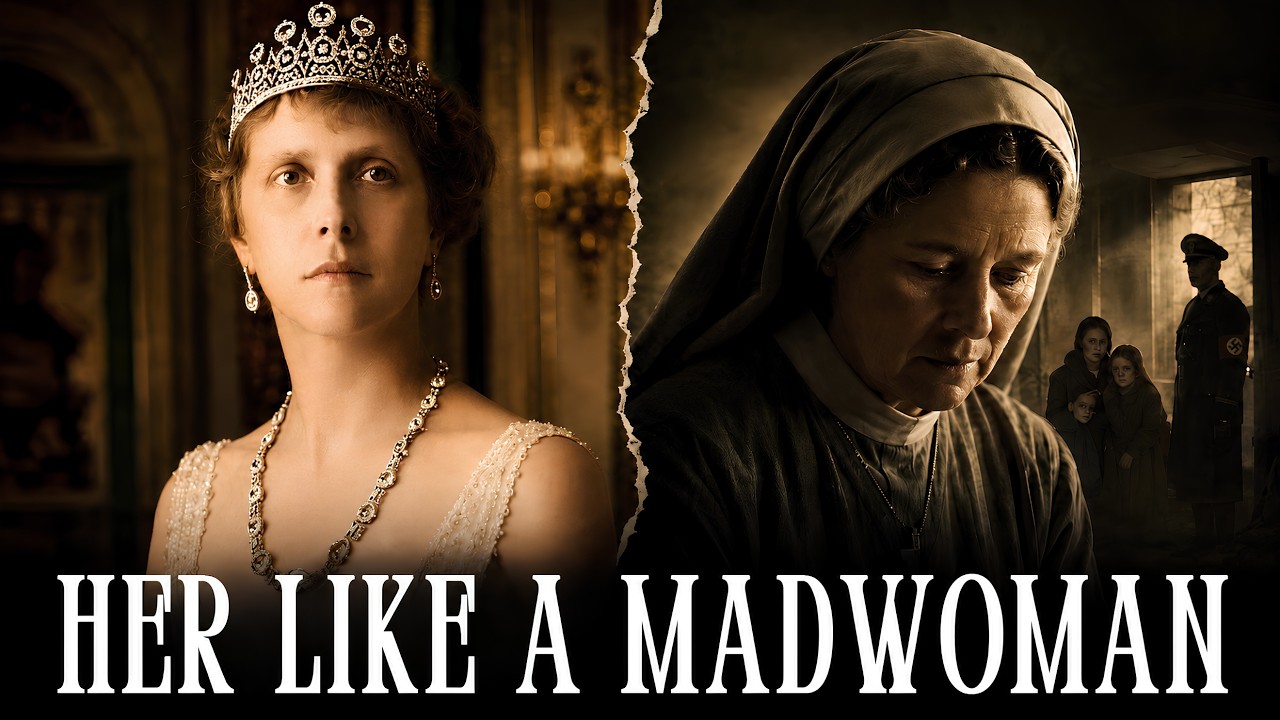
Almost no one in the abbey or among the millions watching on television knew who she was. She was Princess Alice of Battenberg, a great-granddaughter of Queen Victoria and the mother of the Queen’s husband. The public had long forgotten her. Her silence did not begin as a choice.
It began at birth in February 1885, inside Windsor Castle, where Queen Victoria noted in her diary that her newborn great-granddaughter was remarkably pretty. But Alice was born deaf, a fact the family did not discover for four years. As an infant, she sat in grand rooms watching adults move their mouths in ways that produced no sound for her. She lived inside a silent world and built her understanding of it through intense visual observation.
She taught herself to lip-read in English, French, German, and eventually Greek. Because she could not hear, courtiers often assumed she could not understand them. Being underestimated gave her a powerful cover for a sharp and watchful intellect. At eighteen, she met Prince Andrew of Greece in London, and they married in 1903.
She refused the role of a passive royal consort. When Tsar Nicholas II playfully threw a shoe at the newlyweds, Alice threw it back. In Athens, she chose integration over isolation. She learned Greek by reading the lips of ordinary women in the markets.
When the Balkan Wars erupted in 1912, she left the palace to work in field hospitals, bandaging wounded soldiers and managing depleted supplies. She earned the Royal Red Cross for her service. But the stability of Greece proved fragile. In 1917, political upheaval forced the royal family into exile, and they fled to Switzerland.
They returned to Athens, only to face collapse after a devastating military defeat in 1922. Prince Andrew was made the scapegoat for the failed campaign and faced a revolutionary tribunal. King George V of Britain authorized a naval rescue mission to extract his relatives. The family abandoned Greece on a British warship, leaving behind everything.
On the cold deck, an eighteen-month-old boy lay curled inside a wooden fruit box lined with spare clothing. That child was Prince Philip, beginning his life as a displaced refugee. The family settled in a modest house in Saint-Cloud, on the edge of Paris. Alice dressed in simple clothing and worked in a charity shop for Greek refugees.
For her young son, these years in France felt secure and happy. But years of war, exile, and political instability had worn her down. By the late 1920s, she turned deeply toward the Greek Orthodox faith, adopting a strict ascetic diet that left her thin. She began whispering of religious visions, telling those nearby that she was receiving communication from God.
The family responded with alarm. In the winter of 1930, the family arranged a quiet picnic. Alice’s mother-in-law told nine-year-old Philip they were going out for the afternoon. As the boy walked away with his grandmother, carrying his picnic basket, a vehicle pulled into the driveway to collect his mother.
When Philip returned, the house was silent. His calls for his mother met no response. No adult explained what had happened. His mother had not died, but she was erased from his life.
Alice was taken to a German sanatorium. Her case drew the attention of Sigmund Freud, who never examined her in person but diagnosed her religious crisis as a symptom of sexual frustration. He recommended high-intensity X-rays on her ovaries to suppress the supposed source of the problem. Alice resisted the diagnosis.
Transferred to a sanatorium in Kreuzlingen, Switzerland, she insisted to the staff that she was entirely sane and demanded her freedom. But the hospital would only release her with the permission of her mother. Her liberty was stripped away by her closest relative. She never forgave that betrayal.
During two years of confinement, her three eldest daughters were married off to German aristocrats. Alice learned of the weddings by reading newspapers in her room, completely absent from the official family portraits. When a photograph arrived of one daughter holding a newborn, she tore it to pieces. The staff saw emotional detachment.
The reality was a mother protecting herself from the unbearable pain of watching a happiness she was forbidden to join. Prince Andrew, meanwhile, settled in the south of France with his mistress, spending his days gambling aboard a luxury yacht. He visited his confined wife only rarely. In 1932, Alice was released.
She did not return to her family. Instead, she moved quietly between boarding houses across Europe, cutting off her long hair, discarding her silks, and dressing only in coarse fabric. She rebuilt herself as a woman who could move through the world unnoticed. In 1938, she returned to Athens alone and began working with the Red Cross, organizing food distribution for orphaned children.
In 1937, tragedy struck from the sky. Her daughter Cecilia, heavily pregnant, boarded a flight to London with her husband and two young sons. Thick fog obscured visibility, and the aircraft struck a factory chimney in Ostend, Belgium, killing everyone aboard. At the funeral in Germany, Alice stood beside the husband who had left her and the family that had confined her, looking at the coffin of the daughter she had been forbidden to see.
No public confrontations were recorded. Grief silenced old resentments. In April 1941, the German army occupied Athens. Aristocratic families hurried toward the harbor, fleeing to exile.
Alice walked back toward the center of the occupied capital. She was nearly sixty, profoundly deaf, and living alone. She chose to remain with the citizens who were beginning to starve. Her own family was split by the war.
Her son Philip served in the British Royal Navy, while her daughters’ husbands fought for the Axis. Alice refused ideological commentary and poured her energy into organizing soup kitchens. During the occupation, Jewish citizens came under direct pursuit. One night, a widow named Rachel Cohen came to Alice’s door with her daughter Tilda, and Alice opened her home to them.
Michelle joined them later. When the Gestapo came, heavy boots echoing on the cobblestones, Alice faced them alone. She used her deafness as a shield. For sixty years, she had mastered lip-reading in multiple languages; she understood exactly what the officers demanded.
But she gave them a blank stare, playing the role of an elderly woman who could not comprehend the loud world. The interrogation became a stalemate. The Gestapo left. The Cohen family survived the war hidden in her home.
By the time peace returned, Alice’s wealth was exhausted. She had sold her jewelry piece by piece to finance the soup kitchens. One item remained: a meander tiara that had belonged to her mother, given as a wedding gift by Tsar Nicholas II. In 1947, her son Philip, a junior naval officer with no fortune, was preparing to propose to Princess Elizabeth.
Alice removed the diamonds from the tiara and placed them in his hands. They were crafted into an engagement ring for the future queen. At Philip’s wedding in November 1947, Alice sat alone in the abbey. Her three surviving daughters were barred from attending because they had married German aristocrats with connections to the Third Reich, and anti-German sentiment still ran high in postwar Britain.
The cruel symmetry was not lost: she had been locked away during her daughters’ weddings, and now her daughters were barred from her son’s. She sat upright and solitary, the sole representative of the fractured Greek royal house. In 1949, she founded the Christian Sisterhood of Martha and Mary, a nursing order on the island of Tinos. She never took formal vows, but she wore a plain gray habit every day, pinning a silver crucifix to her chest.
The habit gave her a freedom she had never found in court life. She smoked, played cards, and refused to adopt artificial holiness. Her own mother sighed at the sight of a nun who smoked, but to the poor of Athens, she was a saint. In 1967, another military coup shook Greece.
A British Royal aircraft landed in Athens to collect a frail eighty-two-year-old woman. Queen Elizabeth and Prince Philip insisted she move to Buckingham Palace. This time, her departure was not a desperate flight but a journey toward a final refuge. The palace adapted to its unusual guest.
She wandered the gilded corridors in her gray habit, smoking constantly and offering blunt observations. Queen Elizabeth treated her with absolute patience. For Philip, having his mother steps away was the greatest act of love a stoic royal could offer. Realizing her life was ending, Alice wrote a final note to her son.
It was not an apology. According to later accounts, it began: “Dearest Philip, be brave. ” She wrote that she would never leave him and that he would always find her when he needed her most. She signed it with all her devoted love as his old mama.
It was the guarantee of permanence the nine-year-old boy had never received. On a cold December day in 1969, Princess Alice died in her sleep at the age of eighty-four. There was no massive state funeral. She had left instructions for where she wanted to be buried: beside her aunt, Grand Duchess Elizabeth, in the Church of Mary Magdalene on the Mount of Olives in Jerusalem.
When her relatives complained about the distance, she reportedly replied, “Nonsense. There is a perfectly good bus service going directly there. ” For nineteen years, her remains rested in the royal vault at Windsor. In 1988, her coffin was carried into the Russian Orthodox Church in Jerusalem, escorted by Prince Philip and Prince Charles.
In 1993, Israel honored her as Righteous Among the Nations for protecting the Cohen family. The following year, Prince Philip attended the ceremony at Yad Vashem and spoke publicly about her courage. He said she would never have considered her actions unusual, that she simply saw them as a natural human response to people in distress. The photograph from the 1953 coronation still holds her at the edge of the frame, a woman in a gray habit who survived confinement, exile, war, and erasure.
History proved harder to control than royal image.
