In a Murfreesboro attic sits a box of wedding photographs that Corinne Hadley has not opened in a long time. In one of them she stands at the altar in a pale yellow dress, holding daisies, smiling the way you smile when you believe something completely. The groom is on her left, their arms nearly touching. It is February 1980, and she is 24 years old.
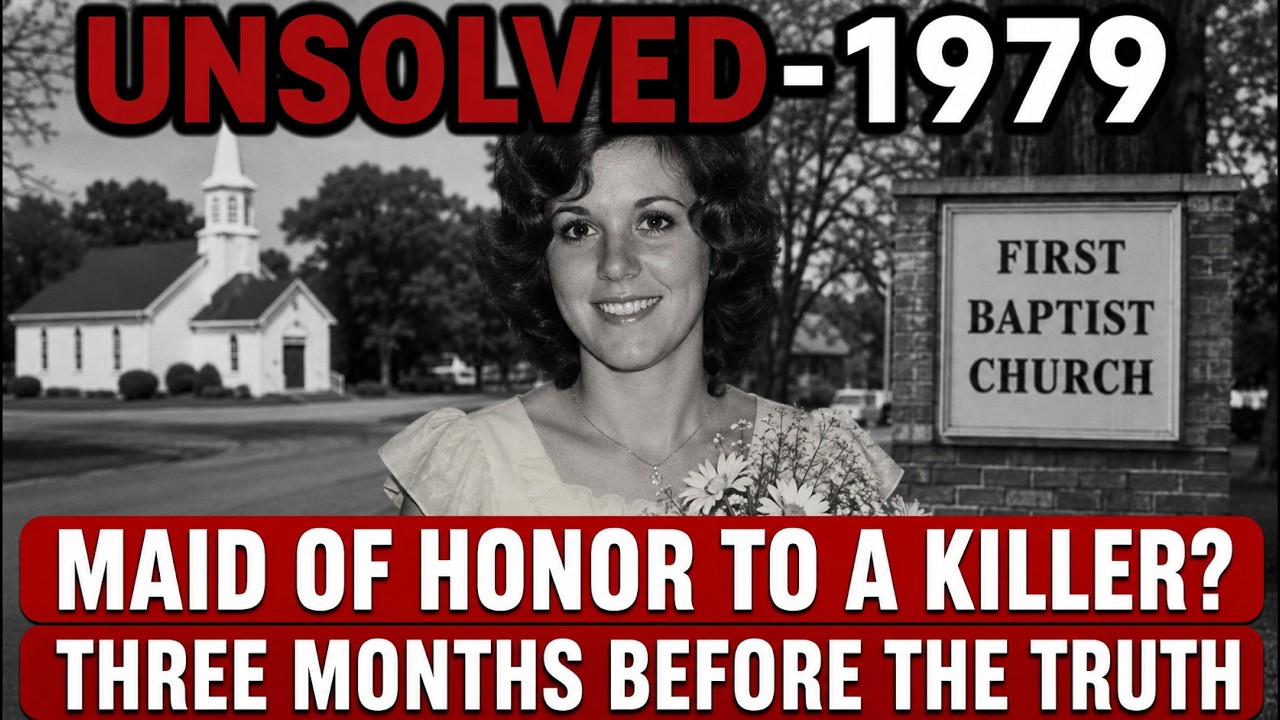
She does not know that the man beside her killed her best friend three months ago. That the woman who should have been the bride is gone because of him. That the ordinary warmth of that February afternoon was built on top of something that should have made everyone in that church run. She did not know.
None of them knew. That is what makes this case so difficult to hold even now, 45 years later. Not just that it happened, but how long the truth was allowed to stand in plain sight wearing a different face. To understand what finally exposed it, you have to go back to Clarkston, Tennessee, in the autumn of 1979.
Clarkston sat in the rolling middle part of the state, east of Nashville by about an hour and a half, in a county where most people had grown up knowing each other’s grandparents. Population just under 6,000. Two stoplights. A grain elevator on the edge of town.
A county fair every September. The biggest social events were Friday night football and Sunday services at First Baptist, where the same families had occupied the same pews for generations. Marcia Elaine Sutton had grown up in all of it. She was 23 years old, the youngest daughter of Bill Sutton, a feed store owner, and his wife Jean.
She had graduated from Clarkston High two years before most of her friends, spent a semester and a half at Middle Tennessee State, then come back home because what she wanted was closer to home than a classroom. She worked for the county extension office, coordinating agricultural programs for local farmers. She was the kind of person who remembered to ask about your mother, who brought a covered dish to every potluck without being asked, who kept hard candy in her jacket pocket for the neighbor kids. She drove a brown Oldsmobile station wagon with a crack in the passenger-side window she kept meaning to fix.
She had saved enough for a down payment on a small house on Sycamore Street the following spring. Her best friend since sixth grade was Corinne Hadley, who had recently started dating Gary Forsythe, a 31-year-old electrician who had come to Clarkston from Cookeville two years prior. Corinne was serious about Gary. Marci had met him maybe a dozen times.
In the careful way a best friend tells the truth when she is not sure she should, she told Corinne that something about Gary made her uneasy. That he asked a lot of questions. That his attention felt different than friendly. Corinne listened and told her she was being protective.
That Gary was good to her. That Marci would see. In early October 1979, Gary Forsythe told Corinne he had feelings for Marci. Corinne told Marci.
What happened after that conversation is, even now, the part investigators believe mattered most. Marci stopped returning Gary’s calls. She was polite when she saw him with Corinne. She never said anything else about it.
But she drew a careful, quiet line. The way a woman in 1979 in a small Tennessee town had learned to draw lines invisibly, without making anything difficult, without naming what she was actually afraid of. On the evening of Saturday, October 27th, 1979, Marci Sutton told her mother she was driving to the Sycamore Street house to check a slow drip under the kitchen sink before the contractor came Monday morning. She kissed her mother on the cheek, took her keys from the hook by the door, and drove out of the driveway at quarter past seven.
She never arrived at Sycamore Street. She never came home. Bill Sutton called the county sheriff’s office at 10:30 that night. By 11:00, a deputy named Warren Phillips was at the property.
The station wagon was not there. The house was dark and locked. The drip under the sink was exactly as Marci had described it. She had never made it inside.
By the following morning, the station wagon had been found, parked at an angle on a dirt pullout off Old Mill Road, six miles south of Clarkston, a road that went nowhere in particular and was used mostly by hunters. The engine was cold. The keys were in the ignition. On the front seat, her key ring.
Her purse in the footwell. Nothing taken. She was not there. Phillips noted the driver’s side door left slightly ajar, a partial boot impression in the mud too degraded to cast cleanly, and, in a single line of his report, that the vehicle appeared to have been driven there rather than abandoned after a breakdown.
The first name that came up was Gary Forsythe’s, because Corinne told the sheriff’s investigator about the October conversation. The investigator, Don Treadwell, drove out to Gary’s shop on a Monday afternoon. Gary was cooperative. Sorry to hear about Marci.
He had been at Corinne’s apartment that Saturday evening, he said. They watched television. He had not left until after midnight. Corinne confirmed it all.
She believed what she was saying. She had no reason not to. Treadwell thanked him, wrote up the interview, and moved on. Two months in, the most promising lead was a transient spotted near Old Mill Road.
He was located in Knoxville, questioned, cleared. A former classmate who had made unwanted advances at a reunion was interviewed and eliminated. The boot impression had degraded beyond usability. The case slowed to a stop.
In March 1980, Gary Forsythe proposed to Corinne Hadley. She said yes. On a Saturday in February 1980, three months and twelve days after Marci Sutton was last seen alive, Corinne stood at the altar of First Baptist Church in a pale yellow dress, holding daisies, smiling at a man she loved completely. Marci was supposed to have been beside her.
Instead, Corinne stood in the place meant for her best friend, flanking the man who had taken her away. She would not know for another 43 years. The next decade settled into the particular sadness that follows when a case closes without closing. Jean Sutton kept the station wagon in the driveway for three years before Bill quietly had it towed.
She kept the light on above the front door of the house on Elm every night for the rest of her life. Not as a signal, she announced. She just never stopped. By 1985, Corinne and Gary had moved to Murfreesboro, where Gary built his electrical business into something more substantial.
They had two daughters. He coached youth soccer. He was the kind of neighbor people described as solid, reliable. Someone you could count on for a jump start or to watch the house when you were out of town.
Corinne stayed in touch with Jean Sutton. She drove down to Clarkston sometimes for Sunday dinner. Gary never came with her. She thought it was out of respect.
By 1993, fourteen years had passed. Treadwell retired. The case file went to a storage unit. Marci’s name appeared in an anniversary piece in the local paper once, a regional cold case roundup once, and then less, and then not at all.
By 2001, Bill Sutton passed away at 73. He had never stopped believing someone in Clarkston knew what had happened to his daughter. He never said Gary Forsythe’s name. The name had moved out of the conversation years before, replaced by the official account, the one where nobody had done anything, and nobody knew anything, and a young woman had simply ceased to exist at the edge of a dirt road in October.
Jean Sutton still had the porch light on. Don Treadwell, 78 and living in a retirement community in Brentwood, still kept a photocopy of the original case file in a folder. He had not stopped thinking about the station wagon. About the key ring left on the seat.
About a woman who drove to check a plumbing leak and ended up on a road she had no reason to be on. He had thought about Gary Forsythe’s alibi every few years when the anniversary came around. He had thought about the fact that the alibi came entirely from the woman Gary married three months after Marci disappeared. He had never been able to do anything with that thought.
But he had never put it down. The case had been cold for 43 years when the Tennessee Bureau of Investigation launched a cold case partnership initiative in 2022, cross-referencing unsolved disappearances from before 1990 with a centralized database of biological evidence. The Clarkston case flagged immediately, not because of the boot impression, which had long been lost, but because of something no one had thought to test in 1979: a single partial fingerprint lifted from the interior door handle of Marci Sutton’s station wagon. Lifted, preserved, logged, and left in a manila envelope for 43 years.
In the winter of 2022, TBI forensic analyst Patricia Morehead ran the print through the state’s AFIS database. It hit on the third attempt, after Morehead adjusted the scan resolution on the original lift. The 1979 technology had introduced a distortion she had been correcting for the wrong axis. The match was Gary Forsythe.
She pulled up the file. She looked at the name. She looked at the original interview. She looked at the date of the marriage license, February 1980, three months and twelve days after the disappearance.
She called her supervisor in. Neither of them said anything for a moment. Then Morehead picked up the phone and called the Rutherford County Sheriff’s Office, where Gary Forsythe had lived for thirty years. What investigators found when they began building the case was devastating in its geography.
His electrical business had done work at the Sycamore Street house six weeks before Marci disappeared. He knew the property, the neighborhood. He knew the plumbing was being worked on. He had been present when Marci mentioned the Monday contractor appointment to Corinne.
He had known on the evening of October 27th exactly where she was going and why. The alibi Corinne had provided was fabricated. She had believed every word of it. She had not known she was lying.
She had not known anything. Gary Forsythe, aged 75, was arrested on a Tuesday morning in March 2023, taken from his brick ranch in Murfreesboro. Corinne was contacted by investigators the evening before. A detective named Sandra Wills sat across from her at her kitchen table and told her everything.
What the fingerprint showed. What it meant. What Gary had been doing on the night she thought they were watching television together. What had happened to Marci.
Corinne sat for a long time. Then she asked to see a photograph of the evidence. Wills showed her the print. Corinne looked at it for a long time.
Then she said, quietly, that Marci had told her something was wrong. That Corinne had told her she was being protective. Gary provided no statement after his arrest. He was charged with first-degree murder, and his attorney entered a not guilty plea.
Over the following eight months, additional evidence emerged: cell tower data establishing a pattern of his movement through the Clarkston area on weekends during his marriage, and a statement from a former hunting partner who came forward to report a fragmentary, ambiguous conversation he had filed away decades ago. He had not known Marci Sutton’s name at the time. He knew it now. In November 2023, facing trial and the totality of the physical evidence, Gary Forsythe changed his plea.
He pleaded guilty to first-degree murder. As part of the agreement, he disclosed the location of Marci Sutton’s remains: a wooded hollow off Old Mill Road, less than a mile from where her station wagon had been found. Investigators recovered her in December 2023. It had been 44 years.
He was sentenced to life without the possibility of parole. He will die in a Tennessee state correctional facility. Jean Sutton is 91 years old. She is still in the house on Elm Street.
The porch light still comes on every evening. When Sandra Wills called her the morning after the arrest, Jean was quiet for a long time. Then she said she needed to call Bill’s sister. She needed to know he was right.
Corinne reverted to her name of Corinne Hadley the week after the guilty plea. In a brief statement to the local press, she said two things that stayed with people. The first was about Marci, that she had been the kind of friend who told you the truth even when it was hard, and that she had died for exactly that quality. The second was about the yellow dress, that she still had it, that she had thought about burning it, and that she had decided not to.
Because the dress had not done anything wrong. Because Marci would have understood that. Marcia Elaine Sutton was 23 years old. She had a house on Sycamore Street she had not moved into yet, curtains picked out, a plumber coming on a Monday.
She had a best friend she loved enough to tell the truth even when it was uncomfortable. She had been right about what she sensed, about the quiet line she drew. The tragedy is not that she was wrong about Gary Forsythe. It is that she was completely correct, and none of the systems that were supposed to protect her were paying close enough attention to help her in time.
The fingerprint that brought justice was lifted from her car door in 1979 and matched in 2022. The technology to make that match existed for decades before anyone ran the test. Justice came for Marci Sutton after 44 years, carried home by a fingerprint that no one had ever properly read.
