On August 7, 1944, Germany launched its final armored gamble in Normandy. Four Panzer divisions, nearly two hundred tanks, and veteran commanders were ordered to cut the American breakout and restore a collapsing front. On paper, the plan made sense. In reality, it was already doomed.
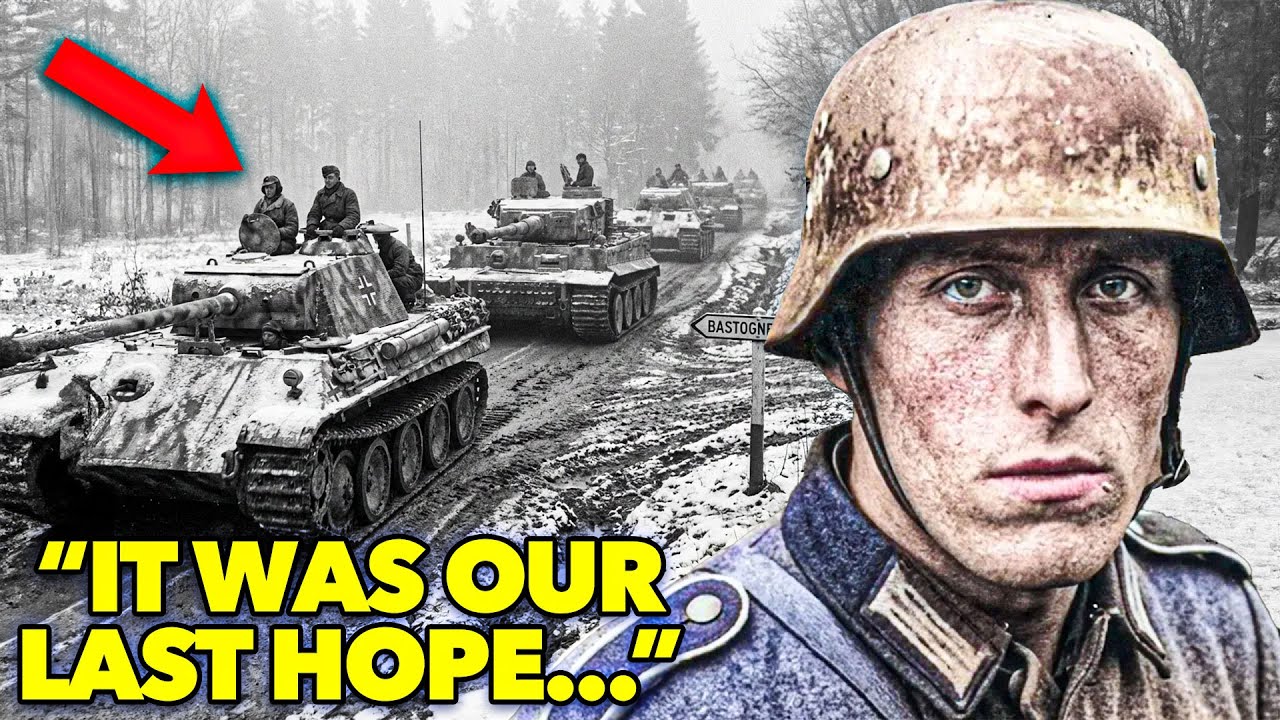
Clear skies meant Allied air power, and Allied air power meant paralysis. What followed was not a clash of tanks, but a demonstration of modern war, where movement required permission from the sky, and permission was never granted. By early August, the German front in Normandy was already cracking. Operation Cobra had torn a hole through the western sector, and American armored units were pouring into open country.
The hedgerow war was ending. The war of movement had begun, and Germany was losing it. Hitler’s response was immediate and absolute. He ordered a counterattack to sever the American corridor to the coast.
The objective was Mortain, the narrow gateway through which General Patton’s Third Army was flooding into France. If that gateway could be cut, the breakout could be reversed and the front restored. Panzer Group West was tasked with the operation. Under General Hans Eberbach, four armored divisions were assembled, veteran units pulled together from across Normandy.
On paper, the force was formidable: nearly two hundred operational tanks and tens of thousands of experienced troops. The plan demanded speed, concentration, and uninterrupted movement. Eberbach recognized the problem immediately. The attack was ordered for daylight, and the weather forecast predicted clear skies.
In Normandy, clear skies meant Allied air supremacy. Fighter-bombers roamed freely, waiting for armored movement. Eberbach objected, arguing for delay and night movement. The response from Berlin was final: advance immediately.
This was not a tactical disagreement. It was a clash between battlefield reality and ideological command. Hitler believed willpower could override material conditions, that aggressive action could compensate for structural weakness. Eberbach understood that tanks moving in daylight without air cover were targets, not weapons.
Despite his objections, preparations continued. Orders were issued, timetables fixed. At dawn on August 7, German armor began moving west through narrow Norman roads, hedgerows closing in on both sides. The advance initially caught American units off guard.
Gains were made, and momentum seemed possible. But the sky remained empty only briefly. What followed exposed a truth the German army could no longer ignore. In 1944, armored warfare did not begin on the ground.
It began in the air. The German plan depended on movement. Armor had to advance rapidly along a limited road network, punch through American positions, and reach Mortain before the Allies could react. In earlier wars, this would have been plausible.
In Normandy in 1944, it was fatal. The terrain dictated everything. The hedgerows that had slowed Allied advances now worked against the Germans. Tanks could not maneuver freely off-road.
Columns were forced onto narrow lanes, compressing vehicles into long, predictable formations. From the ground, these routes felt concealed. From the air, they were unmistakable. Clear weather transformed the battlefield instantly.
Allied reconnaissance aircraft spotted the movement within minutes. The German advance was no longer a maneuver. It was a signal flare. Once detected, the response did not depend on improvisation or heroics.
It depended on a prebuilt system designed for exactly this scenario. Allied fighter-bombers were already forward-based, armed, fueled, and waiting. The moment German armor moved, it triggered a chain reaction. Reports flowed from spotters to air control centers.
Squadrons were assigned targets before the first German units had reached their objectives. This was the core asymmetry. German armor required hours to assemble and coordinate. Allied air power required minutes to respond.
The Germans were still advancing under the assumption that air attack would be intermittent. They were wrong. The first strikes did not annihilate entire units. They did something far more effective: they disrupted timing.
Vehicles stopped. Crews scattered. Commanders lost cohesion. Radio traffic spiked as units attempted to reorient under fire.
Momentum vanished. Every pause made the situation worse. Stopped columns were easier to target. Dispersed units lost mutual support.
Attempts to conceal vehicles invited repeated attacks as soon as movement resumed. The battlefield became a trap where motion attracted destruction and stillness invited encirclement. German doctrine had been built around speed, shock, and concentration. Allied air power neutralized all three simultaneously.
Tanks could no longer mass. Attacks could not maintain tempo. Commanders could not control formations under constant aerial pressure. By mid-morning, the advance was already faltering, not because German crews lacked skill or courage, but because the conditions required for armored warfare no longer existed.
The sky had become an active participant in the battle, and it belonged entirely to the Allies. The aircraft over Mortain were not improvising. They were executing doctrine. By 1944, air-ground coordination in Normandy had evolved into a continuous strike loop: detect, assign, attack, assess, repeat.
The aircraft themselves were only one component of a larger mechanism. The Hawker Typhoon embodied this system. It was fast at low altitude, heavily armed, and designed for one purpose: destroying ground targets. Eight rockets per aircraft, cannons for follow-up passes, and pilots trained specifically to hunt armor.
Against German tanks, direct hits were devastating. Near misses were often enough. Blast effects damaged tracks, engines, and exposed crews. Mobility, not destruction, was the priority.
But the true lethality of the Typhoon came from repetition. Squadrons did not attack once and disappear. They cycled: launch, strike, return, rearm, and launch again. Turnaround times measured in minutes, not hours.
This transformed air power from a supporting arm into a persistent presence. German crews experienced this as a continuous threat. Even brief movement triggered attacks. Tanks that survived the first strike rarely survived the second or third.
Crews began to abandon vehicles at the sound of aircraft engines. Units dispersed into hedgerows, sacrificing cohesion to survive. This was not accidental. Allied planners understood that breaking formations was more valuable than tallying kills.
A tank immobilized without fuel or ammunition was functionally destroyed. A division forced to halt was defeated, even if many vehicles remained intact. The German army had no counter. Antiaircraft guns were scarce, poorly positioned, and quickly suppressed.
The Luftwaffe was absent. Radio coordination between ground and air was minimal or nonexistent. German doctrine had never adapted to sustained air dominance by the enemy. By late morning, German commanders were no longer planning advances; they were reacting to air strikes.
Orders shifted from movement to concealment, from exploitation to survival. The battlefield no longer belonged to the side with better tanks or tactics. It belonged to the side that controlled the rhythm of engagement. At Mortain, that rhythm was set from the air.
By early afternoon, the counterattack no longer resembled an offensive operation. It had fractured into isolated pockets of armor, infantry, and command elements struggling to exist under constant aerial pressure. Tanks were still present, but their purpose had changed. They were no longer instruments of maneuver.
They were liabilities. The destruction was not defined by burning wrecks alone. Many German tanks remained physically intact yet completely ineffective. Tracks damaged, engines overheated or seized, optics shattered, radios destroyed, crews wounded or killed by concussion.
Vehicles that could still fire could no longer move. Vehicles that could move lacked fuel or ammunition. This distinction mattered. German doctrine depended on concentration and tempo.
Panzer divisions were designed to punch through weak points and exploit chaos. Air power removed both conditions. Tanks could not mass without being detected. Attempts to regroup invited immediate attack.
Every effort to restore momentum simply exposed more targets. Logistical vehicles suffered even worse. Fuel trucks, ammunition carriers, and command vehicles were far more vulnerable than tanks and far more critical. When they burned, entire formations became inert.
Infantry units were stranded. Commanders lost control. Even undamaged tanks were rendered irrelevant within hours. German crews adapted instinctively.
They camouflaged vehicles with foliage, dispersed into hedgerows, moved only in short bursts. These measures only slowed destruction. The moment a tank repositioned, aircraft returned. The moment a column reformed, it was attacked again.
The battlefield became a paradox: to advance was to die, to stop was to be bypassed, isolated, or destroyed. Armor had become defensive, reactive, and ultimately static. This was the fundamental shift of 1944. Tanks had once dictated the flow of battle.
At Mortain, they obeyed it. The presence of armor no longer determined outcomes. Air dominance did. What crushed the German counterattack was the integration between air power and ground observation.
Forward air controllers were embedded with American ground units on high ground overlooking the battlefield. Their job was simple: watch, report, and direct destruction. Every German movement, every column leaving cover, every attempt to regroup was observed and transmitted in real time. Coordinates were relayed directly to Allied air control centers without delay.
Squadrons were assigned targets based on proximity, availability, and priority. Aircraft launched from forward airfields only minutes away. Pilots received updated coordinates while airborne. Attacks followed within a quarter hour of the initial sighting.
This process repeated continuously from dawn until evening. The system did not seek spectacle. It sought exhaustion. German units were forced into a perpetual cycle of disruption: advance, strike, halt, scatter, repeat.
The Germans had no equivalent structure. Luftwaffe units were distant, fuel-starved, and vastly outnumbered. Requests for air support arrived too late, if at all. When German aircraft did appear, they faced overwhelming Allied fighter cover.
The asymmetry was absolute. By the end of August 7, German armored formations had lost over half their operational strength in a single day. Some divisions lost closer to two-thirds. Even these figures underestimated the damage.
Many vehicles counted as operational existed only on paper. Without fuel, ammunition, radios, or command cohesion, they could not fight or maneuver. Support vehicles suffered catastrophic losses. Fuel trucks burned, ammunition carriers vanished, command vehicles were destroyed.
These losses mattered more than tanks because they erased the ability to fight tomorrow, not just today. A Panzer division without logistics was not a weakened force. It was a dead one. By evening, German commanders understood the reality.
Requests to consolidate, withdraw, or reposition were denied or ignored. Orders no longer reflected battlefield conditions. The chain of command fractured under pressure. By the evening of August 7, 1944, the Mortain counterattack was over.
The war had already crossed a threshold before the last tank stopped burning. What Germany encountered that day was not defeat in the traditional sense. It was obsolescence. The German army still had capable soldiers, skilled commanders, and weapons that on paper could destroy anything the Allies fielded.
None of that mattered anymore. The structure that once allowed those strengths to function had collapsed. Modern war had evolved faster than German doctrine could adapt. The battlefield was no longer defined by courage, maneuver, or even firepower.
It was defined by systems, logistics, production, coordination, and replacement. Germany had entered a war that required abundance with an economy built for scarcity. Every loss at Mortain carried a cost Germany could not recover. A destroyed tank meant weeks of production.
A lost aircraft meant a pilot who could not be replaced. A burned fuel truck meant formations that would never move again. The Allies absorbed those same losses as routine friction. This is why the battle mattered.
Mortain was the moment German commanders openly acknowledged that daylight operations were impossible. Movement meant destruction. Concentration meant annihilation. Even retreat required permission from the sky.
From that point forward, the German army in the west was no longer an offensive force. It was a delaying force, trading space for time in a war that time could no longer save. The lesson of Mortain is brutal in its simplicity. Wars are not won by who fights harder.
They are won by who can endure loss longer. Germany could not. By 1944, the factories had already decided the outcome. The battlefield was only catching up.
Mortain did not end the war. It proved that the ending was unavoidable.
