Hermann Göring entered the Nazi movement with advantages no other senior leader could match. Born in 1893 into a respectable Bavarian family—his father a judge and diplomat who once governed German South-West Africa—he carried social standing from birth. More importantly, he had earned genuine military glory in the First World War. As a fighter pilot he recorded twenty-two confirmed victories, received the Pour le Mérite, Germany’s highest military honor, and commanded the famed Richthofen squadron after the Red Baron’s death.
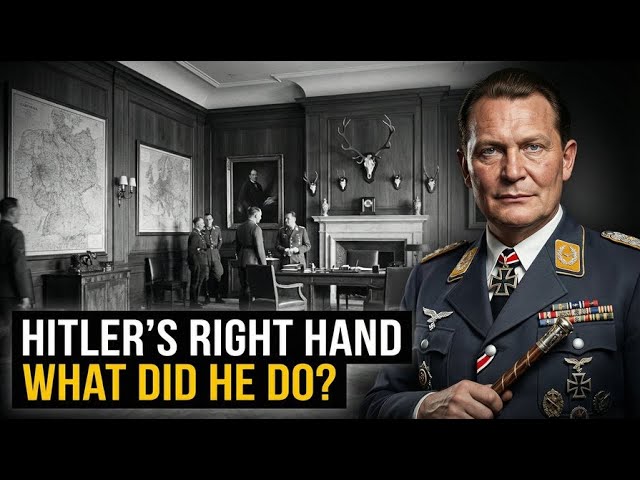
When he met Hitler in 1922, Göring was immediately captivated. He joined the party, took command of its stormtroopers, and stood beside Hitler during the failed Beer Hall Putsch of 1923, where he was wounded by police gunfire and forced to flee Germany. In exile he became addicted to the morphine prescribed for his wounds, an addiction that would shadow him for the rest of his life. Returning after an amnesty in 1927, Göring rose alongside the party’s fortunes.
When Hitler became Chancellor in January 1933, Göring took the post of Prussian Minister of the Interior, gaining control of the police in Germany’s largest state. He used that power to create the Gestapo and to enforce Nazi control through terror. Then came his greatest assignment: building the Luftwaffe. Germany had been forbidden military aviation under the Treaty of Versailles, so the task meant creating a modern air force from nothing.
From roughly 1935 to 1939, Göring was at his most effective. His typical day began around eight or nine in the morning at Carinhall, the enormous estate north of Berlin he had built with state funds and increasingly ill-gotten wealth, named after his first wife. He dressed in elaborate self-designed uniforms, ate a substantial breakfast with champagne, and reviewed reports from his staff. The mornings were given to Luftwaffe business.
He met with aircraft designers, industrialists, commanders, and technical experts, making decisions about aircraft types, production priorities, training, base construction, and strategic doctrine. He drove the air force’s expansion with real energy. The results were formidable. Göring also held the title of Plenipotentiary of the Four Year Plan, which made him, in effect, Germany’s economic dictator.
He coordinated industrial production, allocated raw materials, managed synthetic fuel development, and directed the economy toward rearmament. Even during these productive years, his work habits were looser than those of other Nazi leaders. He preferred his estates to offices in Berlin, organized his days around his comfort, and enriched himself through corruption. But major decisions still passed through his hands.
Lunch was a grand affair, lasting two or three hours, with fine wines, multiple courses, and an audience of industrialists, foreign dignitaries, party officials, or artists. Göring dominated the conversation, recounting his wartime exploits and discussing his art collection. Guests understood that deference was required. Afternoons brought more meetings, though increasingly interrupted by personal pleasures.
He showed off his art, played with the model train set that occupied an entire room at Carinhall, or went hunting. His passion for art was becoming systematic plunder. He acquired pieces from Jewish owners forced to liquidate their collections, often through coercion or at absurdly low prices. Agents scoured Europe on his behalf.
His growing collection became one of the largest in private hands in Europe, assembled through theft. Late afternoons were often spent hunting, which he did as Reichsmaster of the Hunt, a title that gave him control over hunting rights across Germany. Evenings meant yet another costume change, an elaborate dinner, and entertainment—opera, theater, film, including Hollywood movies officially banned in Germany. He saw himself as a cultured Renaissance figure, though his taste ran more to spectacle than refinement.
The war changed everything. In September 1939, the Luftwaffe supported the rapid conquests of Poland, Norway, France, and the Low Countries, and Göring basked in the credit. But he was already delegating command to subordinates while enjoying the prestige. During the Battle of Britain in 1940, his failures became obvious.
He made poor strategic decisions, insisted on tactics his commanders questioned, and could not deliver air superiority. He received the previous day’s reports over breakfast, berated his commanders for failures, and refused to admit his own flawed direction. He made unrealistic demands and lost credibility with the pilots who bore the cost. After the defeat, Hitler’s regard for him started to fade.
By 1941 and 1942, Göring’s days began later, often at ten or eleven. The morphine addiction had returned in full force. He woke sluggish and irritable, and his staff learned to avoid bringing bad news in the morning. Meetings became shorter and less focused, and he increasingly blamed subordinates for failure.
As Allied bombing intensified from 1942 onward, his position became untenable. He had famously boasted that no enemy aircraft would ever reach the Ruhr or Berlin, yet Allied bombers now devastated German cities. Göring’s response was denial and retreat. He avoided Hitler, avoided his air crews, and withdrew to his estates.
His art collecting turned into industrial-scale looting. As German forces overran Europe, Göring directed agents in France, the Netherlands, Eastern Europe, and elsewhere to select the finest pieces for his collection. Trainloads of looted art arrived at his estates. He spent hours reviewing catalogs, selecting pieces, arranging their display—while the air war over Germany collapsed.
By 1943 and 1944, Göring’s routine had become a parody of leadership. He often rose after noon, having spent the night drinking heavily and taking drugs. He weighed over three hundred pounds, suffered heart problems, and wore increasingly absurd costumes, including togas. Meetings about Luftwaffe matters degenerated into rants about betrayal and incompetence, never acknowledging the fundamental problems: catastrophic losses of experienced pilots, fuel shortages, overwhelming Allied numbers.
Much of his day was spent in a drug-induced stupor or with his model trains, which by then occupied multiple rooms with elaborate landscapes. Visitors witnessed surreal scenes of the Reichsmarschall, costumed and medicated, playing with toy trains while Allied bombers struck German cities. His economic responsibilities had been taken over by Albert Speer, who became Armaments Minister in 1942 and sidelined Göring entirely. Other Nazi leaders ignored him.
Hitler made cutting remarks about his failures and addiction but never formally removed him, partly from old loyalty and partly because Göring remained the designated successor. By the final year of the war, Göring was almost fully detached from reality. He left Carinhall as Allied forces approached and moved south with portions of his art collection. There was nothing left to command.
He spent his days drinking, taking drugs, sleeping, and obsessing over his treasures. In late April 1945, he made his final miscalculation. Believing Hitler was trapped in Berlin and possibly incapacitated, Göring sent a telegram asking whether he should assume leadership of the Reich under the 1941 succession decree. Hitler, urged on by Martin Bormann, treated it as treachery.
Göring was stripped of all ranks and placed under house arrest by the SS. Days later, Hitler was dead, and Germany surrendered. Göring surrendered to American forces in May 1945. Detoxified in captivity, he lost weight and recovered some mental sharpness.
He expected to be treated as an important prisoner, perhaps even a negotiating partner. Instead, he stood trial at Nuremberg as the most prominent defendant. From November 1945 to October 1946, he sat in the dock as evidence mounted of his role in establishing concentration camps, planning aggressive war, exploiting occupied territories, looting art, and persecuting Jews. He attempted to organize the other defendants and to mount a collective defense, and his testimony was articulate and self-serving, denying knowledge of the worst atrocities.
On October 1, 1946, he was convicted on all counts and sentenced to death by hanging. Göring refused to accept that end. On the night of October 15, 1946, hours before the scheduled execution, he swallowed a cyanide capsule he had somehow concealed through his imprisonment. The exact method remains unclear, though it likely involved assistance or bribery.
He cheated the hangman, but not the verdict. The arc of Göring’s day-to-day life traced the arc of the regime he served. In the mid-1930s, he was an energetic administrator, building the Luftwaffe and managing the German economy, while already combining genuine work with corruption and self-enrichment. As war came, he delegated real command and pursued pleasure.
In the middle years, he retreated into drugs, hedonism, and fantasy. At the end, he was a convicted war criminal awaiting execution, a man once capable of formidable administrative achievement undone by boundless ambition and total moral collapse. His daily life exposed the hypocrisy at the core of Nazi leadership: a regime that preached sacrifice and discipline while its second-highest official lived in obscene luxury, looted Europe’s art, played with toy trains, and hid from responsibility as Germany burned.
