On the morning of October 19th, 1987, the Dow Jones Industrial Average lost 22. 6 percent of its value in a single session, the largest one-day percentage drop in the history of American stock markets. Ticker machines could not keep up with the selling. Fortunes built over decades evaporated before the closing bell.
In a modest office in Southern California, two engineers named John Tu and David Sun watched their life savings vanish. Tu was 46. Sun was 36. They had spent years building a small computer hardware company called Camon, sold it for $6 million, and invested nearly every dollar of the proceeds in the stock market.
By the close of trading on Black Monday, they had roughly $4,000 left between them. Instead of seeking salaried jobs, on that same day, with that same $4,000, they decided to start a new company. The company they founded in the wreckage of the worst single day in Wall Street history would never go public, never take a dollar of venture capital, never answer to a board of directors, and never lay off a worker. Within eight years it would cross a billion dollars in annual revenue.
Within four decades it would be valued at more than a hundred billion. Its name was Kingston Technology. Tu was born in Chongqing, China in 1941. His family moved frequently before settling in Taiwan around 1947 as the Chinese civil war pushed toward the coast.
In 1960, at 19, he left for West Germany to study electrical engineering, completing a two-year industrial apprenticeship in a shipbuilding factory before enrolling at the Technical University of Darmstadt. He graduated in 1970, worked for Motorola, and immigrated to the United States the following year. He settled in California and cycled through retail and real estate development, none of which used his engineering training. Sun was born in Taiwan in 1951, during the island’s early transformation into an electronics manufacturing power.
He studied electrical engineering at Tatung University in Taipei and immigrated to the United States in 1977, taking an engineering position at Alpha Micro in Los Angeles. It was there in the early 1980s that he met Tu. Tu had the sales instinct. Sun had the engineering instinct.
By 1982 they were collaborating on designs, and in 1984 they founded Camon out of a garage, manufacturing memory upgrades for Digital Equipment Corporation mini computers. The company reached $9 million in annual sales by 1986 and was sold to AS Research for $6 million. They invested the proceeds. Thirteen months later, the market collapsed.
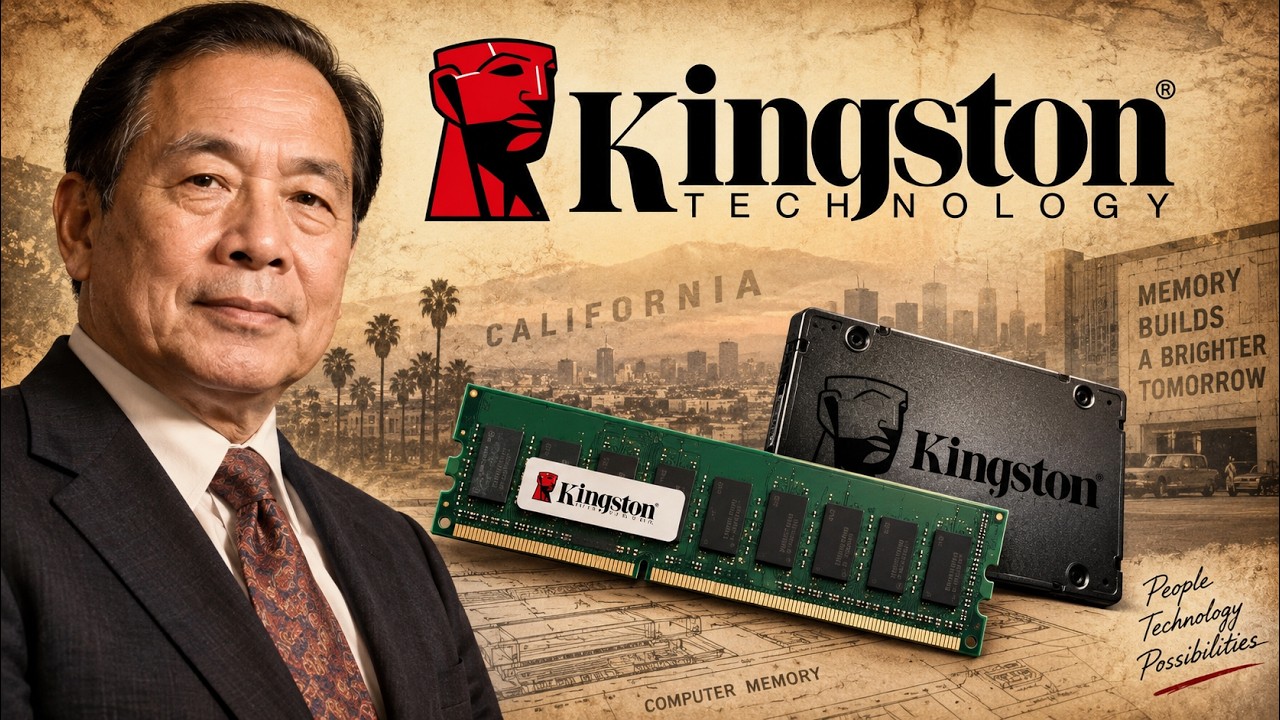
Kingston Technology was incorporated in October 1987 in Fountain Valley, California. The starting capital was $4,000. The workforce was two people. There was no business plan, no pitch deck, no five-year projection.
The company’s name came from Tu’s fondness for the Kingston Trio, the American folk group. Tu was so uncertain about the company’s survival that he wagered Sun a Jaguar if Kingston lasted a full year. What Sun had identified was a gap in the personal computer market that most people mistook for an unqualified disaster. The global supply of DRAM, the chips that gave personal computers their short-term working memory, had collapsed.
The roots of the crisis ran back to 1985, when the Semiconductor Industry Association alleged that Japanese manufacturers were dumping DRAM chips on the American market below cost. The Reagan administration imposed trade sanctions in 1986, doubling the tariff on Japanese semiconductor imports. Japanese dumping slowed, but the second-order effects were catastrophic. American manufacturers, bleeding from years of losses, had abandoned production of older 256-kilobit chips and converted their fabrication lines to the newer 1-megabit standard.
The conversion proved far more complex than anticipated. The supply of 256-kilobit chips dried up, and the supply of 1-megabit chips never materialized at volume. By the summer of 1988, the price of 1 megabyte of RAM surged from $199 to $55 in a single month, and 256-kilobit chips that had sold for $2. 95 jumped to $12.
45. Sun realized that an equivalent memory module could be built using alternative chips that were still available, with matching performance and compatibility at a fraction of the inflated price. He designed a single inline memory module built around those alternatives. Kingston’s first modules were assembled by hand on a workbench.
Tu bought the chips. Sun designed and assembled the boards. Tu picked up the phone and sold them. PC manufacturers who had been unable to ship complete systems suddenly had a supplier who could deliver compatible memory modules within days.
Kingston posted $12. 8 million in revenue in its first year. Tu lost the bet. Sun got the Jaguar, then gave the car to an employee he felt had earned it more than he had.
By 1989 revenue had nearly tripled to $36. 5 million. When the shortage ended, Kingston kept its customers. By 1990, with the release of Microsoft’s Windows 3.
0 driving demand for additional memory, revenue hit $87. 8 million, then $140. 7 million the following year. In 1992 Inc.
magazine named Kingston the fastest-growing private company in the United States. The compounded annual sales increase from 1987 to 1992 was 368 percent: five years, from $4,000 to a quarter of a billion, with no outside investment. The company’s culture was as distinctive as its growth. Tu and Sun worked from cubicles, not corner offices.
They listed employees first, suppliers second, and customers third. Compensation ran 30 percent above industry average. Five percent of every quarter’s pre-tax profit was distributed to employees as a bonus. Every worker was guaranteed a full year’s salary if the company ever ceased operations.
Product testing was 100 percent, and warranties were comprehensive. Annual employee turnover fell below 2 percent by 1994 in an industry where 10 to 15 percent was considered normal. By 1993 revenue reached $433 million with 255 employees. By 1994 it pushed past $800 million with just 310 employees.
In 1995, fueled by demand surrounding the Windows 95 launch, Kingston reported $1. 3 billion in annual sales. The company celebrated by running full-page advertisements listing every employee’s name. In 1996, Masayoshi Son, founder of SoftBank Corporation, approached the two men with an offer to acquire 80 percent of Kingston for $1.
5 billion. They accepted, retained operational control, and in December 1996 distributed approximately $100 million of the sale proceeds to roughly 500 employees as a holiday bonus. Long-serving workers received as much as $300,000. The average was approximately $75,000 per person.
Stories of relief emerged: an engineer who returned to his 11-year-old Ford Thunderbird, a man who opened college accounts for his sons, a worker whose blood pressure dropped so precipitously that his doctor asked what had changed. DRAM prices collapsed by 80 percent between 1996 and 1997. SoftBank, weakened by internet-era investments, still owed money on the purchase. In 1999, Tu and Sun forgave roughly $300 million that SoftBank owed.
Masayoshi Son reciprocated by allowing them to repurchase the 80 percent stake for $450 million, a 70 percent discount on the price paid just three years earlier. Tu and Sun walked out of the 1990s owning 100 percent of Kingston again, split 50/50, with no debt and no outside shareholders. The dot-com bubble burst in March 2000. Trillions evaporated.
Kingston went right on shipping memory modules. Revenue grew from $1. 5 billion in 1999 to $3. 7 billion by 2007 and $4.
1 billion by 2010. The company entered the flash memory card market in 1999, launched its first USB flash drive in 2001, established the HyperX division for gaming enthusiasts in 2002, and opened the world’s largest memory module manufacturing facility in Shanghai in 2005. By 2020 Kingston reported $12. 8 billion in annual revenue, and by 2021 that reached $15 billion.
In February 2021, HP Inc. acquired the HyperX gaming division for $425 million, nearly the same figure Tu and Sun had paid to buy back their entire company in 1999. Kingston kept the memory modules, solid-state drives, and enterprise product lines it had built the company around. The artificial intelligence boom that accelerated through the 2020s created demand for memory and storage at an unprecedented scale.
By 2024 Kingston’s share of the third-party DRAM module market was 66 percent, with the second-place competitor holding just 5 percent. Annual revenue reached an estimated $16 billion. By mid-2026, Bloomberg valued each founder’s personal stake at upward of $80 billion. Tu, at 85, still plays drums in his rock band.
Sun still oversees engineering. The company approaches its 40th anniversary in 2027, privately held, split evenly between the two men who started it with $4,000 on the worst day in the history of American stock markets.






