At the close of the 19th century, the drawing rooms of the Russian Imperial court were filled with whispers. The fiancé of the young Grand Duchess Elena Vladimirovna had abruptly canceled their engagement, and the rejection by Prince Maximilian of Baden fell like a thunderclap. Her mother, the formidable Grand Duchess Maria Pavlovna, was furious at seeing her only daughter humiliated, while the aristocracy began murmuring discreetly about the princess’s difficulty in finding a husband. It was not the first time Elena’s matrimonial prospects had faltered.
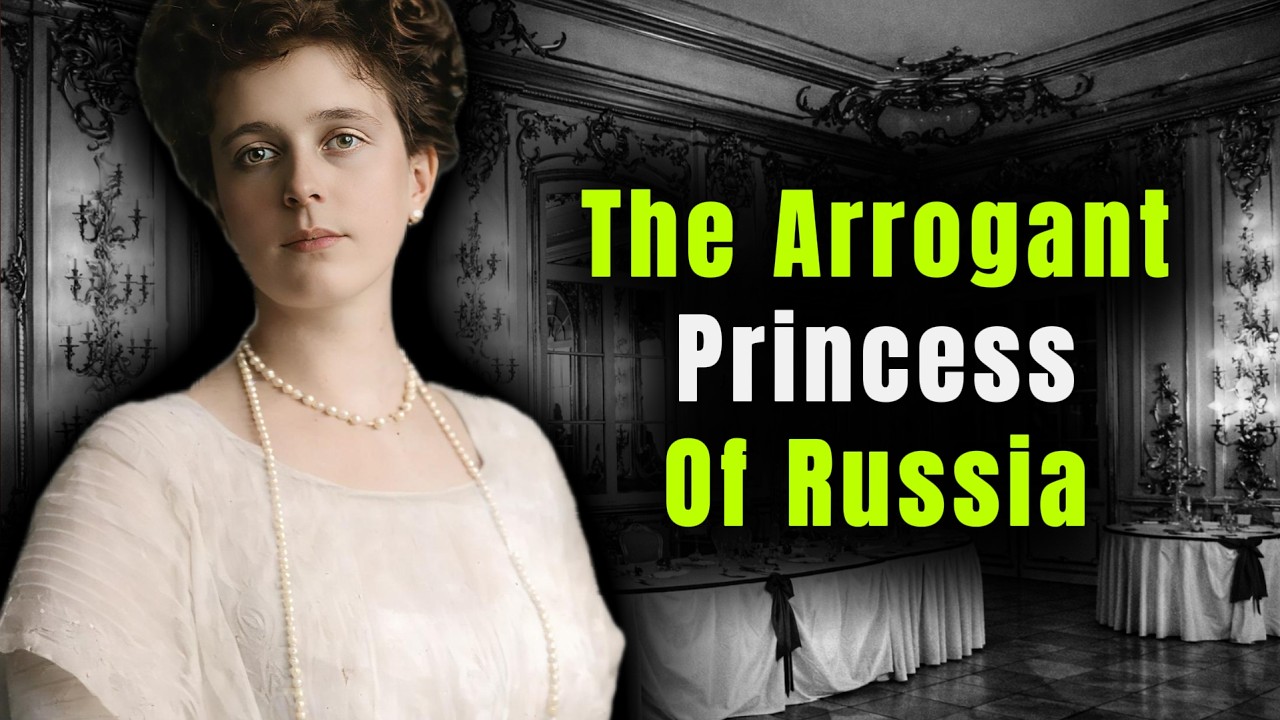
Rumor held that in 1899, at just seventeen, she had been informally considered for a match with Archduke Franz Ferdinand of Austria, heir to the Habsburg throne. That possibility vanished when the Archduke fell in love with a lady-in-waiting, Countess Sophie Chotek. Within a matter of months, Elena had gone from being one of Europe’s most sought-after princesses to finding herself at the center of court gossip and discreet scandal. That early disappointment would not be her last.
Family tensions and the shifting political landscape of Europe would soon begin to shape her destiny. Elena Vladimirovna Romanova was born on the 29th of January, 1882, at Tsarskoye Selo, near St. Petersburg, in the heart of the Russian Empire. She was the daughter of Grand Duke Vladimir Alexandrovich of Russia, himself a son of Tsar Alexander II, and Duchess Marie of Mecklenburg-Schwerin, who upon her marriage adopted the Russian name Maria Pavlovna.
Elena grew up surrounded by the splendor and rigid etiquette of the Imperial family. She was the only daughter among her parents’ four children, the younger sister of Princes Kirill, Boris, and Andrei. From infancy, she received a privileged education. She was raised by an English nanny and learned English before Russian, a reflection of the strong Western influences present at the Romanov court.
From an early age, Elena displayed a forceful temperament. She was quick-tempered and at times prone to losing control. One telling episode remained in family memory. At the age of four, while posing for a portrait, the little Grand Duchess seized a paper knife and threatened her governess, forcing the startled woman to seek refuge behind the artist painting the scene.
“The young lady then turned her attentions towards me, her dark eyes blazing with fury,” the painter later recalled, struck by the child’s fierce outburst. Maria Pavlovna, her mother, was fully conscious of her rank within the Romanov dynasty and raised Elena with a keen awareness of her imperial standing and the importance of her lineage. The girl grew up amid privilege, yet she also developed an air of superiority that did not go unnoticed. In court circles, she was often regarded as proud, even haughty.
The Dowager Empress Maria Feodorovna of Russia, widow of Alexander III and a social rival of Maria Pavlovna, once remarked of young Elena, “Poor child, I feel sorry for her, for she is really very sweet, but vain and rather ostentatious. ”
Around 1898, when Elena turned sixteen, efforts intensified to secure her a husband worthy of her rank. In theory, the young Grand Duchess was an excellent match: a prominent member of the Romanov dynasty and the possessor of a considerable personal fortune from childhood. Yet her formal entrance into the European marriage market proved more complicated than anticipated, ushering in the first public disappointments of her life.
Prince Maximilian of Baden was the first formal suitor for Elena’s hand. An engagement between them was announced. Yet Maximilian withdrew before the wedding, embarrassing the Russian Imperial family. Maria Pavlovna did not conceal her fury at the affront.
For the proud Grand Duchess, seeing her daughter rejected by a German prince was a blow to the family’s prestige. Society gossip spread swiftly, and the press speculated about the reasons behind the broken engagement. In aristocratic circles, it was whispered that Elena’s imperious temperament or perhaps dynastic intrigues had driven the groom away. Whatever the truth, Elena’s reputation came under scrutiny, and questions were raised as to whether the princess would succeed in securing a suitable match.
Shortly afterwards, attention turned towards the Austro-Hungarian Imperial House. In 1899, it was said that Elena was informally linked to Archduke Franz Ferdinand of Austria, heir to the Habsburg throne. Such a union would have forged a powerful alliance between two empires. Yet it never materialized.
Franz Ferdinand fell deeply in love with Countess Sophie Chotek, a Czech lady-in-waiting, and refused to consider any other marriage. For Elena, watching yet another prominent prospect vanish must have been painful, though as the arrangement had never been official, her name was spared direct public humiliation. Amid these disappointments, the man who would ultimately change Elena’s fortunes entered the scene: Prince Nicholas of Greece and Denmark. Nicholas was the third son of King George I of Greece, of the Danish House of Glücksburg, and of Grand Duchess Olga Konstantinovna of Russia.
Through his mother, Nicholas was related to the Romanovs, and he had known Elena since childhood. They were second cousins. Nicholas fell deeply in love with the Russian Grand Duchess and first proposed to her in 1900, when Elena was eighteen. His proposal, however, met with firm opposition from her mother.
In Maria Pavlovna’s eyes, Nicholas was not an adequate match. He was a younger son without significant independent wealth, not being heir to the Greek throne, with little prospect of ruling. In short, the proud Grand Duchess believed her daughter deserved more than a secondary prince. Nicholas persevered despite the initial rejection.
For two years, he remained devoted, and gradually reality prevailed. No superior offers appeared for Elena. In time, Maria Pavlovna relented. The engagement was formally announced, and the wedding took place on August 29th, 1902, at the Imperial Palace of Tsarskoye Selo.
As befitting a Romanov marriage, the ceremony was magnificent. Tsar Nicholas II and Empress Alexandra attended, as did King George and Queen Olga, alongside numerous members of Europe’s royal houses. Elena, aged twenty, married for love with her mother’s belated blessing, leaving behind the shadow of failed engagements. Yet a union between a Russian Grand Duchess and a Greek prince would inevitably involve cultural adjustments and personal compromises.
Now styled Her Royal Highness Princess Elena, consort of Prince Nicholas of Greece and Denmark, the young bride left Russia to establish herself at the Greek court. From the outset, not all welcomed the foreign princess warmly. Elena brought to Athens her imperial manners and a certain hauteur that clashed with a comparatively modest royal environment. From St.
Petersburg, the Dowager Empress Maria Feodorovna observed with prescient concern that Elena possessed “a very brusque and arrogant tone, which may offend people,” and she privately predicted difficulties in the marriage due to her strong character. In time, Elena became involved in incidents that reinforced her reputation for pride. According to the British diplomat Sir Francis Elliot, she openly slighted certain sisters-in-law within the Greek royal family. At one reception, she refused to greet Princess Marie Bonaparte, wife of her brother-in-law Prince George of Greece, and deliberately gathered up her skirt to avoid brushing against her.
The slight stemmed from social prejudice. Although Marie Bonaparte held a princely title by marriage, she was the granddaughter of a wealthy entrepreneur rather than of royal blood, a distinction Elena considered significant. Similarly, she looked down upon Princess Alice of Battenberg, wife of Prince Andrew of Greece, because she regarded Alice’s background as lacking the aristocratic purity she valued. Such attitudes generated tension within the royal household.
To some Greeks, the Russian grand lady appeared excessively ostentatious, and her airs of superiority were quietly criticized. Despite these early social frictions, Elena and Nicholas were privately content. Beneath her imperious exterior, Elena valued her husband’s loyalty and affection, and Nicholas, gentle in temperament and devoted to the arts, balanced her intensity with patience and humor. He was an accomplished amateur painter and cultivated artistic interests that later assumed greater significance.
Settled in Greece, the couple enjoyed a comfortable existence, though without the opulence of the Russian court, an adjustment that required some effort on Elena’s part. Thanks to the substantial Imperial dowry she received upon marriage—one million rubles granted by the Tsar—and her own considerable personal fortune, they possessed ample means. In 1904, they acquired an elegant mansion in central Athens, which became known as the Nicholas Palace. Elena had it enlarged and modernized, recreating, as far as possible, the luxury to which she had been accustomed.
In the years that followed, children were born. Elena gave birth to three daughters who became the center of her world: Olga, born on the 11th of June 1903; Elizabeth, on the 24th of May 1904; and Marina, on the 13th of December 1906. Their arrival brought great joy to the couple. Elena devoted herself to their upbringing, though she maintained exacting standards.
The girls were raised between Athens and frequent summer visits to Russia, surrounded by both their Greek relatives and their Romanov grandparents and uncles in more peaceful times. Elena’s familial network extended across several European royal houses, and those connections would later shape her daughters’ destinies. Yet, before the young princesses reached adulthood, the world around Elena was about to enter an era of profound upheaval. The first decade of the 20th century passed in relative calm for Elena Vladimirovna.
She enjoyed her young family life in Greece and maintained close correspondence with relatives in Russia. But that balance would not endure. In 1914, the First World War erupted, and although Greece initially remained neutral, the conflict destabilized the entire continent. For Elena, the true upheaval came a few years later from her homeland.
In 1917, the Russian Revolution brought centuries of monarchy crashing down. Tsar Nicholas II was forced to abdicate, and the Romanov dynasty was overthrown. The following year, Nicholas II, his wife Alexandra, and their five children were executed by the Bolsheviks, an event that profoundly shocked Elena and the wider Imperial family. In addition to losing her cousin the Tsar, she witnessed relatives and acquaintances disappear or flee Russia amid the violent rise of the new communist regime.
The aristocratic world in which she had been raised vanished almost overnight, and many Romanovs, including Elena’s own brothers, were compelled to escape into exile to save their lives. At the same time, Greece was undergoing its own crisis. During the Great War, King Constantine I, Elena’s brother-in-law, was pressured into abdicating in 1917 due to his perceived pro-German sympathies, and the royal family temporarily fell from favor. Although the Greek throne was briefly restored, the country soon entered into conflict with Turkey.
Greece’s defeat in Asia Minor triggered political chaos, and in 1924, the Greek monarchy was abolished and a republic proclaimed. The entire royal family, including Prince Nicholas, Princess Elena, and their daughters, was forced to leave Greece for safety. In a single stroke, Elena found herself doubly dispossessed. She could not return to Russia, now transformed into a Soviet state hostile to the former Imperial house, and she no longer had a place in Greece, where the crown had ceased to exist.
Elena, Nicholas, and their daughters went into exile, initially settling in France. The choice was not accidental. Paris and the Riviera were home to a substantial colony of Russian émigrés from the former aristocracy. Despite everything, Elena did not succumb to despair.
On the contrary, she devoted herself to charitable work, assisting less fortunate Russian refugees. She gave time, money, and energy to organizations supporting children orphaned by the revolution and aristocratic families reduced to hardship in exile. Material difficulties, however, were unavoidable. The fortune of Elena and Nicholas had diminished dramatically.
Their Russian properties had been confiscated by the new regime, and the stipend they once received in Greece disappeared with the fall of the monarchy. From life in palaces, they moved to more modest residences abroad. The couple lived in what contemporaries described as reduced but elegant circumstances, maintaining dignity though without extravagance. To sustain the family, they relied on their most valuable assets.
Elena possessed an extraordinary collection of Romanov jewels, while Nicholas contributed his artistic talent as a painter. Throughout the 1920s, the sale of jewelry and artworks became an essential source of income. Gradually, the princess parted with some of her inherited jewels, a painful but necessary sacrifice, and her husband succeeded in selling several of his paintings. In this way, the family managed to maintain financial stability in exile, ensuring their daughters’ education and retaining a residence in respectable districts of Paris.
In addition to the sale of jewels, Elena could draw upon her remaining family network abroad, including her brother Grand Duke Cyril, who had succeeded in safeguarding part of his own fortune. As the decade progressed, Elena watched her daughters reach marriageable age, repeating in exile the pattern of dynastic alliances that she herself had experienced years earlier. Despite the fall of empires, Elena’s family continued to intertwine with European royalty. In 1923, her eldest daughter, Princess Olga of Greece, aged twenty, married Prince Paul of Yugoslavia.
Paul, a member of the Serbian royal family and soon regent of Yugoslavia, offered Olga a new home in Belgrade. The wedding, more modest than the lavish ceremonies of earlier times, nevertheless brought a sense of renewed hope to the family. In 1934, her second daughter, Princess Elizabeth of Greece, married Count Karl Theodor of Toerring-Jettenbach, a member of an old Bavarian aristocratic family. After the wedding, Elizabeth settled in Germany, strengthening the family’s ties with the German nobility.
That same year, the youngest daughter, Princess Marina of Greece, celebrated one of the most glamorous weddings of the era in London when she married Prince George, Duke of Kent. Marina thus became a member of the British royal family, captivating Europe with her elegance. For Elena, seeing her daughters well married and established across different parts of the continent brought pride and relief. Despite political upheaval, her lineage endured in prominent positions.
By the mid-1930s, political winds shifted once more in Greece. After eleven years of exile, the Greek monarchy was restored in 1935, and the previously banished royals were able to return. Elena and Nicholas went back to Athens soon after the reinstatement of King George II, ready to rebuild their lives in the country that had once welcomed them. Back in their former home, the years of exile seemed, for a moment, to recede.
Yet this restored normality proved short-lived. In early 1938, Prince Nicholas of Greece suffered a heart attack and died on the 8th of February at the age of sixty-six, leaving Elena widowed after more than three decades of marriage. The loss was profound. Even so, the Grand Duchess gathered her strength and chose to remain in Greece, the country she now considered home.
Although her daughter Marina lived in the United Kingdom following her marriage, Elena remained surrounded by relatives within the Greek royal family. The following year, in 1939, the Second World War broke out. Greece became involved in 1940, and after brief resistance, was occupied by Axis forces. During those dark years, Elena remained in Athens, refusing to leave the city even as conditions became increasingly dangerous.
She was nearly sixty, and many other members of royalty fled or were evacuated. Elena, however, stayed. Under Italian and later German occupation, she endured the same hardships as the wider population: food shortages, power cuts, and daily uncertainty. Despite this, she maintained her dignity and intellectual discipline.
She kept a personal diary in English throughout the war years, recording her experiences and reflections. Decades later, these diaries were published in Greek, offering a valuable first-hand account from a princess who had witnessed the devastation of war. The Second World War ended in 1945, though Greece had been liberated in 1944. By then, Elena Vladimirovna was sixty-three years old and had survived the turmoil of two world wars, a revolution, and multiple exiles.
In the post-war years, she lived quietly in Athens, watching her grandchildren grow and earning respect as the family matriarch. She retained refined habits, spending afternoons reading in French and English and corresponding with her daughters and relatives scattered across Europe. Though her health gradually declined with age, she continued to support cultural and charitable initiatives. In a significant gesture, she donated her personal library, containing numerous volumes in several languages, to the Anavryta School in Athens, a distinguished Greek institution, as a contribution to the education of young people.
It was her final gift to the country that had become her adopted home. The closing years of her life passed in relative serenity. Grand Duchess Elena Vladimirovna of Russia died in Athens on the 13th of March, 1957, at the age of seventy-five. She was buried in the royal cemetery of Tatoi alongside other members of the Greek royal family.
With her passing, a remarkable chapter of European history came to an end: that of a woman born into the splendor of Imperial Russia who concluded her days as a respected princess in modern Greece.
