The rescue volunteers in western North Carolina keep a quiet rule, one that passes between them without explanation. Certain trails are searched in daylight only, and no one who works them will say why. In Tennessee, a mountain called Bear Summit refuses to grow trees, and after decades of study, science still cannot agree on a reason. And in one West Virginia hollow, the last family to leave nailed their own door shut from the inside.
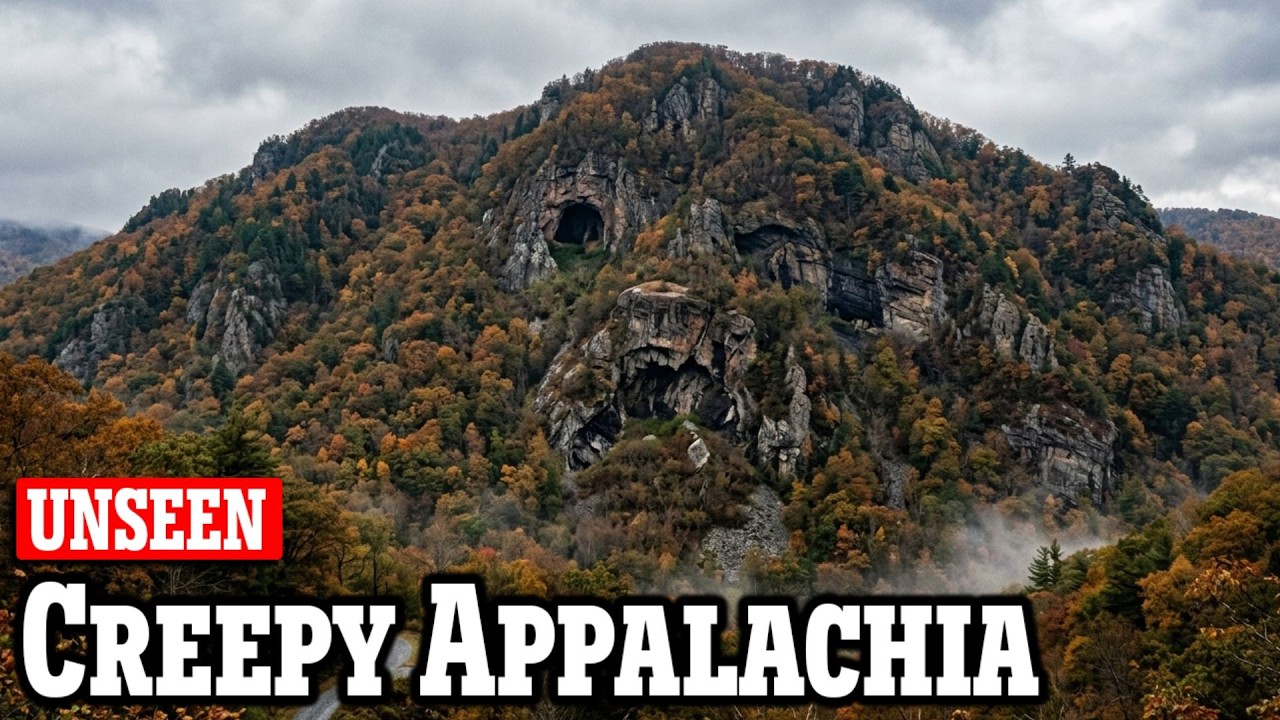
The mountains of Appalachia have swallowed entire towns, railroads, and graveyards. More than three thousand settlements have vanished into the forests, some leaving records, some leaving warnings. The people who live closest to these places know the story of each one, and they stay away. At Gauley Mountain in West Virginia, the story begins with a tunnel.
In 1930, thousands of men were hired to cut through the mountain for a hydroelectric scheme. Within five years, hundreds of them were dead. This became known as the Hawks Nest Tunnel Disaster, the deadliest industrial catastrophe in American history. Union Carbide wanted water diverted from the New River, and roughly three thousand workers were brought in to drive the bore.
Most of them were Black migrant laborers, desperate for Depression wages. The rock they cut through turned out to be almost pure silica, and the company knew what that meant. The men were sent in anyway, without masks, into white dust so thick they could not see the lamps ahead of them. The dust shredded their lungs.
Men began dying within months, some within weeks. A congressional hearing in 1936 confirmed at least 476 deaths, and later researchers pushed the figure above seven hundred. Many of the dead were buried in unmarked graves in a field near Summersville, laid into the ground by an undertaker who was paid by the body. Their families were never told where.
Today Hawks Nest is a state park. Tourists pull over at the overlook to photograph the gorge, and the brochures describe the dam. They do not describe the graves. Standing at that railing on a bright autumn morning, the river glitters far below, the leaves are turning, and somewhere under the quiet grass beyond the trees lie hundreds of men whose names were never recorded.
Mount Mitchell in North Carolina is the highest peak east of the Mississippi, and it killed the man whose name it carries. In June 1857, a professor named Elisha Mitchell climbed into the fog to prove the mountain’s height. He had measured it years earlier, but a rival was challenging his figures, so he went up alone to defend them. He never came down.
Search parties combed the slopes for eleven days before a mountain guide named Big Tom Wilson followed his footprints to the lip of a waterfall. Mitchell had fallen forty feet in the dark and drowned in the pool below. His body was carried off the mountain, then carried back up a year later and buried at the summit. He is still there, beneath the highest ground in the Eastern United States.
The mountain has kept taking people ever since. Summit weather can swing from summer to winter inside an hour, and fog erases the trails without warning. Hikers have died of exposure within a mile of the parking lot. Today a paved road carries tourists almost to the top, and an observation deck stands a short walk from Mitchell’s grave.
Around it, the spruce forest is dying, poisoned by acid rain, thousands of gray trunks standing like bones against the cloud. Locals say the summit feels wrong on overcast days. The records simply say that people keep walking into the fog. In the 1930s, the Commonwealth of Virginia took an entire mountain landscape away from the people who lived on it.
The government wanted a national park within driving distance of Washington, and nearly five hundred families were in the way. These were farming communities that had worked the hollows of Shenandoah for generations, with orchards, mills, churches, and schools. To justify clearing them out, the public had to be convinced the residents were better off gone. In 1933, two researchers published a book called Hollow Folk, portraying the mountain people as primitive, ignorant, and beyond saving.
Newspapers repeated it as fact. The portrait was false, but it worked. Condemnation notices went out across eight counties. Most families walked down the mountain quietly, carrying what they could.
Some refused. A storekeeper named Melancton Cliser barricaded himself behind his counter when the deputies arrived. They carried him bodily off his own porch while he sang the Star Spangled Banner, then padlocked the door behind him. His family had held that land since before the Civil War.
Other holdouts watched from the ridgelines as work crews burned the emptied cabins so that nobody would be tempted to come back. The evictions dragged on for years. A handful of elderly residents were allowed to stay in their cabins until they died alone, inside a park that was quietly erasing every trace of their neighbors. Scattered through those hollows today are more than a hundred family cemeteries slowly disappearing under the forest.
Descendants hike miles of unmarked ground to lay flowers on their own grandparents’ graves. The official story never apologized. Hollow Folk sat on library shelves for decades, cited as science, while the families it slandered were written out of the park’s history. The graves are still up there.
The apology never came. Deep in the Smokies, under a lake of cold green water, lies a place that refuses to stay dead. In 1944, the government completed Fontana Dam to power the war effort, and the rising water swallowed the towns of Judson, Proctor, and Bushnell. More than a thousand people were moved out.
Homes, stores, churches, and an entire railroad went under. But every time drought pulls the lake down, Judson comes back. Stone foundations climb out of the mud. Chimneys reappear.
Old roads surface and run in straight lines toward the waterline, as if the town is trying to climb out. Visitors walk the exposed streets and find doorsteps, canning jars, and pieces of stoves. Then the rains return, and the town goes under again. The cemeteries were stranded on the far shore, cut off from every road.
To this day, the National Park Service ferries descendants across the lake several times a year so they can decorate the graves of people whose towns no longer exist. One elderly former resident described those crossings as visiting a world that drowned. Elkmont, Tennessee, is frozen in the summer it died. It began as a logging town, then became a resort colony where wealthy Knoxville families spent every June in wooden cottages under the hemlocks.
When the National Park arrived, the owners signed lifetime leases. One by one, the lifetimes ran out. The final leases expired in 1992, and the families walked away from furnished houses. For decades, the cottages simply stood there, rotting in rows along a lane locals called Daisy Town.
Wallpaper peels in the parlors. Stone fireplaces wait for fires that will never be lit. Porch swings hang on rusted chains. Walk that lane at dusk, and it feels as if the residents stepped out for a swim in the river and never came back.
Every June, the forest around the ruins fills with synchronous fireflies, thousands of cold lights blinking in rhythm above the empty houses. The heaviest story on this list begins on the morning of May 19, 1902, when the Fraterville mine exploded beneath the ridges of Coal Creek, Tennessee. Two hundred and sixteen men and boys were underground. The blast killed most of them instantly.
But twenty-six men survived it, sealed inside a side passage deep in the mountain. What they did with their final hours is why this place is remembered. As the air ran out, they wrote farewell letters in the dark. A miner named Jacob Vowell sat beside his fourteen-year-old son Albert and wrote to his wife Ellen, telling her the air was failing, asking her to raise the children to believe, promising that he and the boy would die holding on to each other.
They did. Rescuers found the letters folded into pockets and lunch pails. Some were scratched in chalk on pieces of slate. The town above the mine was destroyed in one morning.
Records show the disaster left Coal Creek with only three adult men, hundreds of widows, and roughly a thousand fatherless children. Eighty-nine of the dead were buried together in a circle at Leech Cemetery, around a monument that still stands. This place is not creepy in the supernatural sense. It is creepy because you can stand at that circle of graves and read the words of men who knew exactly how their story would end, and who spent their last breath comforting the people they were leaving behind.
When Fontana’s waters rose in 1943, the government gave the people of Swain County, North Carolina, a promise in writing. The old highway along the north shore was going under, cutting families off from their land and from their dead. In exchange, a 1943 agreement guaranteed a new road along the lake so the descendants could still reach the cemeteries. The road was never finished.
Crews laid about seven miles of pavement, bored a tunnel through the mountain, and stopped. The money went elsewhere. The agreement sat in filing cabinets for decades while the county waited. Today, the asphalt ends at the mouth of a twelve-hundred-foot tunnel that opens onto bare forest.
Locals named it the road to nowhere. In 2010, after sixty-seven years, the government finally settled its broken promise with a cash payment instead of a road. The tunnel still stands, swallowing daylight, leading toward people no road will ever reach. Brown Mountain, North Carolina, is famous for ghost lights that drift above its ridge, and the real story is stranger than the legend.
The most repeated tale claims the lights are a lantern carried by an enslaved man still searching for his lost master. But that story was essentially written in 1961, for a ballad recorded to sell records. It was absorbed into mountain lore and has been repeated as ancient fact ever since. The lights themselves are real.
The United States Geological Survey investigated in 1913 and blamed locomotive headlights. Then the flood of 1916 tore out the rail lines and cut power across the valley, and the lights kept appearing. A second federal study in 1922 pointed to cars, brush fires, and St. Elmo’s fire, and explained nothing.
Sightings have been documented for more than a century, photographed, and never reproduced. Fabricated legends, real lights. So the question stands: does a mountain become haunted because something unexplained lives on it, or because enough people decided it was haunted, and the belief itself became real? On the morning of February 26, 1972, a coal company’s waste dam gave way at the head of a mountain hollow in Logan County, West Virginia.
A black wave of water and sludge, thirty feet high, tore down the valley through sixteen mining communities. It took everything in three hours. One hundred and twenty-five people were killed. Over eleven hundred were injured.
More than four thousand were left without homes. A company inspector had declared the dam satisfactory only days before it failed. And when the lawsuits came, lawyers for the Pittston Coal Company stood up in court and described the disaster as an act of God. Survivors never forgave those three words.
Whole communities along that creek were never rebuilt. The valley today is a corridor of empty flats and overgrown foundations. People there still repeat the same two words like a vow: Remember Buffalo Creek. Sometimes the creepiest thing about a mountain is not what haunts it.
It is what was done to the people who lived beneath it. Somewhere in the folds of Eastern Kentucky, or possibly Southern West Virginia, there is a hollow that local people talk about, but no modern survey will name. The stories are consistent. A cluster of cabins up a creek that should not be there.
A churchyard with no burial records after a certain date. Smoke that hunters swear they have seen rising above the trees where no road goes. And a local reluctance to discuss it that goes beyond ordinary mountain privacy. One researcher who tried to visit was told by a farmer that the creek road leads nowhere and never has.
When she checked the old county maps, the road was clearly marked, climbing to a settlement that appears on no modern survey. The hollow does not want to be named. Before dismissing this as folklore, consider the numbers. Appalachia is scattered with thousands of confirmed ghost towns, coal camps, and emptied hollows.
Historians estimate the true count of vanished settlements across these mountains could run far past ten thousand. Most were never formally recorded. Most faded quietly when the coal ran out or the water rose. A few of them, it seems, vanished on purpose.
These mountains are full of places that quietly disappeared. The ten on this list are real, and most of them can still be visited. If you go, bring a flashlight. And if you find yourself on a trail that the volunteers only search by daylight, or standing at the mouth of a tunnel that leads to nowhere, or looking across a green lake at a town that rises from the mud whenever the water drops, consider what it means for a place to be forgotten on purpose.
The hollows that were supposed to be forgotten refused to disappear.
