The pathologist found sand deep inside their lungs. Medically, there is only one way for soil to reach that far into a man’s airways: he has to inhale it, gasping for breath while the earth is shoveled onto his face. For decades, people have debated whether the Spilotro brothers were buried alive. The autopsy suggests that when the dirt began to fall in that Indiana cornfield, they were still fighting to breathe.
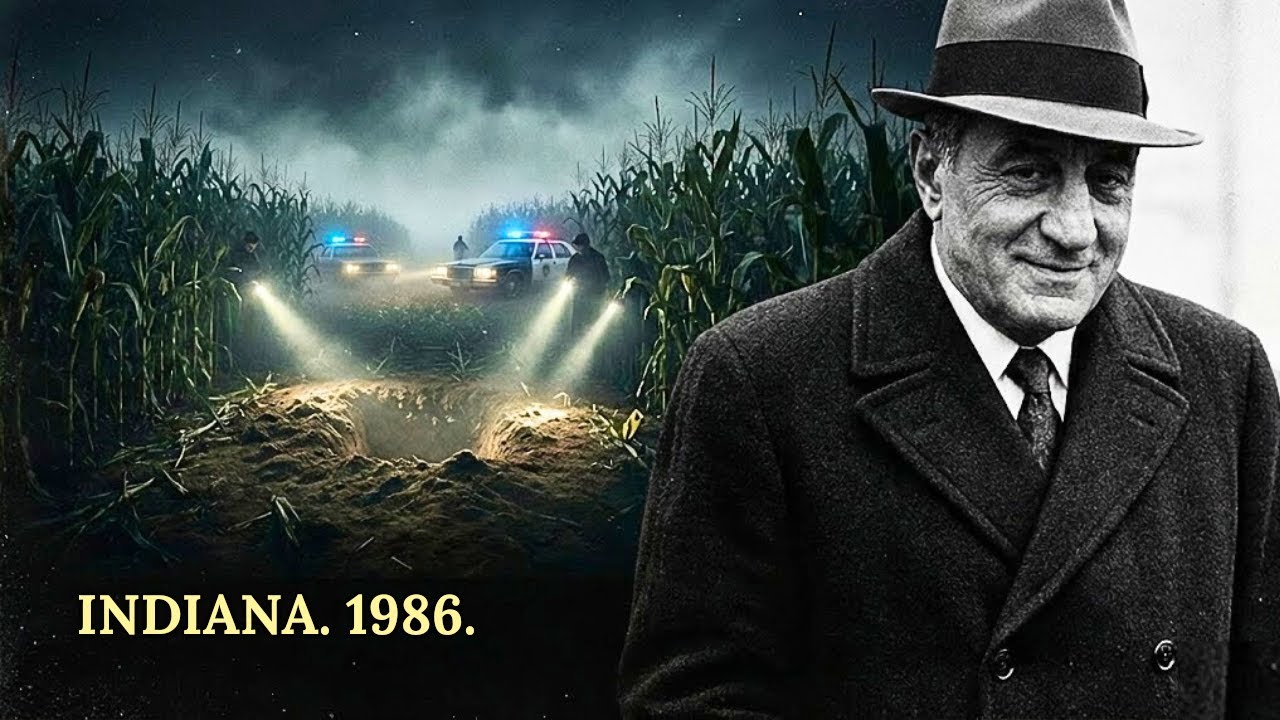
This is not how kings are supposed to die. And make no mistake, Tony Spilotro was a king. He ruled Las Vegas for the Chicago Outfit, walking through casinos like a god, terrifying anyone who crossed his path. He wore Italian silk suits and drove the best cars, backed by the full power of the Chicago mob.
So how does a man like that end up in a shallow grave in the middle of nowhere, stripped to his underwear, beaten beyond recognition, and left to rot like garbage? It wasn’t a robbery gone wrong. It wasn’t a rival gang. It was a message from his own family.
In the late 1970s and early 1980s, Las Vegas was the mob’s ultimate playground. It wasn’t the corporate Disneyland of today. It was raw, dangerous, and a gold mine. The Chicago Outfit viewed Las Vegas as its personal ATM, and the man sent to guard that ATM was Anthony Spilotro.
They called him the Ant. He stood only about five foot five, but he carried himself with a weight that made him feel ten feet tall. When Tony walked into the Stardust or the Fremont, pit bosses started sweating and dealers kept their heads down. Everyone knew Tony represented the heavy hand of Chicago.
His job was deceptively simple: protect the skim. The skim was the lifeblood of the American mafia, the process of taking cash directly out of casino count rooms before it could be recorded for taxes. Millions of dollars a month were stuffed into suitcases and flown back to the Midwest to be distributed among the bosses. For a long time, Tony was perfect for the job.
He was vicious and efficient, with a dead-eyed stare that made people realize their lives hung by a very thin thread. He protected the organization’s interests with absolute loyalty. If someone cheated the house, Tony took care of it. If someone talked to the feds, Tony took care of it.
In return, the bosses gave him a long leash, allowing him to run his own rackets on the side. Tony formed a crew of burglars, thieves, and killers known as the Hole-in-the-Wall Gang, drilling into luxury jewelry stores, cracking hotel vaults, and fencing stolen goods. Tony Spilotro was living the dream. He had money, fear on the streets, and the power of the Chicago Outfit.
But here is the thing about power in the mafia: it is never really yours. It is leased. You are just a middle manager, and the board of directors is watching every move from a thousand miles away. The chairman of that board was Tony Accardo.
He was the Big Tuna, the man who started as Al Capone’s bodyguard swinging a baseball bat and rose to become the most powerful, intelligent, and elusive godfather in American history. Accardo was the polar opposite of Spilotro. He was quiet, lived in a respectable suburb called River Forest, hated publicity, and didn’t wear flashy suits. To Accardo, the mafia was a business, not a movie.
By the mid-1980s, Tony Spilotro had forgotten who he worked for. In 1986, he was fighting publicly with the Nevada Gaming Control Board and getting banned from entering casinos, which forced him to hold court in parking lots and diners, drawing even more attention. FBI surveillance teams parked so close to his Las Vegas house they could tell you what he had for breakfast. They were bugging his phones, following his crew, and building a massive RICO case.
For Accardo and the other bosses back in Chicago, this was a disaster. The one rule of the Outfit was to keep your head down. Spilotro was bringing heat to the entire organization, and every time his face appeared in the newspaper, it put the skim at risk. But the publicity wasn’t the worst part.
The unforgivable sin was the money. Whispers floated back to Chicago that the suitcases of cash arriving from Vegas were getting lighter. The bosses suspected that Tony was building his own little empire, keeping a slice of the pie that didn’t belong to him. Spilotro made a fatal miscalculation.
He thought he was too important to be touched, that his history of violence would protect him. He was wrong. In the corporate world, when a manager steals, you fire him. In the Outfit, when you become a liability, you are erased.
But you can’t shoot a high-profile guy like Spilotro on the streets of Vegas. That creates a war. No, when the Outfit wants to get rid of you, they do it with a smile. They use your own dreams against you.
This is where the story shifts to Michael Spilotro, Tony’s younger brother. Michael wasn’t a made man. He was an associate who ran a restaurant in Chicago and handled bookmaking. He hadn’t been formally inducted into the family, and like anyone in that life, he wanted the button, the protection, the status, and the respect that comes with being a full member of the Chicago Outfit.
In June 1986, the bosses set the trap. It was elegant, simple, and absolutely ruthless. They put out the word that Michael was finally going to be made. They told him, “It’s time.
You’re going to be a capo. ” It was the news he had waited his entire life to hear. Then came the kicker. They told Tony he had to be there, that because he was such a respected member, his presence was required to vouch for his brother at the ceremony.
Tony was under indictment, stressed, and paranoid, wondering if he was out of favor. This invitation was exactly what he wanted to hear. It reassured him: you’re still one of us. It lowered his guard completely.
On June 14, a Saturday, Tony flew into Chicago from Vegas and met up with Michael. Witnesses said they looked happy and relieved. They went to Michael’s house to say goodbye to his wife. Before they left, they took off all their jewelry, their Rolexes, their pinky rings, their gold chains, and their wallets, leaving everything on the kitchen counter.
This was standard procedure for a making ceremony. You go in with nothing as just a man and come out reborn as a member of the Outfit. In a tragic twist of irony, they were preparing for a new life, but they were actually preparing themselves for identification at the morgue. They got into a Lincoln Town Car driven by James Marello, a trusted mob driver, and headed to a town called Bensenville near O’Hare Airport.
It was probably a beautiful June day. They chatted, likely joking with the driver, with Tony giving Michael advice on how to handle himself during the ceremony. They had no idea they were driving to their own funeral. The car pulled up to a modest brick suburban home, the kind of place where families have barbecues in the backyard.
This was the banality of evil that the Chicago Outfit perfected. They didn’t need a dungeon. A living room would do just fine. They walked up the driveway and entered through the side door.
The house was quiet. They were led toward the basement stairs. Tony Spilotro, the man who had spent his life being the predator, the one who sets the traps and decides who lives and dies, took the first step down into the darkness, still convinced he was the king. He expected a table with a gun and a knife, a picture of a saint, the ritual of the omertà.
He expected to shake hands, drink wine, and celebrate his brother’s promotion. At the bottom of the stairs, the atmosphere shifted instantly. Standing in the dim light were almost a dozen men, but they weren’t smiling and they weren’t holding wine glasses. They were wearing gloves.
These were the Outfit’s deadliest hitters, men like Nick Calabrese and Louis Marino, with high-ranking capos watching from the shadows. In a split second, the illusion shattered. There was no ceremony. There was no button.
There was only judgment. According to court testimony from the Family Secrets trial years later, there were no cinematic speeches. Tony didn’t beg or try to make a deal. He knew the rules better than anyone.
He simply looked at the men he had known for decades, men he had eaten dinner with and trusted, and asked, “Can I say a prayer? ” The answer was silence. The attack was immediate and overwhelming. Despite the famous scene in the movie Casino, they didn’t use aluminum baseball bats in a cornfield.
The reality was much more personal. They used their fists, their feet, and gun butts, swarming the brothers in a storm of violence in a confined space. Michael Spilotro, the man who just wanted to be part of the club, was beaten alongside his brother. It wasn’t quick, but it was efficient.
The myth of the Ant ended right there on a cold concrete floor in a Chicago suburb. But the work wasn’t done. The killers loaded the bodies into a van and drove south to Enos, Indiana, to the Willow Slough Game Preserve. The cornfield had been chosen beforehand, and a grave roughly five feet deep had already been dug.
They stripped the bodies down to their underwear, a final act of humiliation and a practical one, since clothes can be identified and traced. The brothers were thrown in, one on top of the other, and dirt was shoveled over them. But were they alive? This is the question that haunts the case.
When the pathologists examined the lungs of the Spilotro brothers days later, they found sand and dirt in their airways. Medically, this creates a strong argument for the buried alive theory. However, later testimony in the Family Secrets trial suggested they were already dead when they left the basement. The defense argued that the dirt in the lungs could have resulted from the violent beating breaking nasal passages and forcing debris down.
Or perhaps, the most terrifying possibility, they were in a comatose state, technically alive with hearts beating faintly but brain dead, when the soil hit their faces. Either way, whether they died on the concrete floor or in the dark earth of Indiana, the end was terrifying. But why leave them there? Why not use a crematorium or weigh them down in Lake Michigan?
The fact that the Spilotro brothers were found so quickly suggests something chilling. Many FBI experts and mafia historians believe they were meant to be found. Tony Accardo didn’t just want to eliminate Tony Spilotro. He wanted to make an example of him.
He wanted every soldier and associate to see the photos of that cornfield. The message was clear: it doesn’t matter how much money you make or how famous you are. If you steal from the family, if you bring heat to the bosses, if you let your ego get bigger than the organization, you will end up in a hole in the ground in your underwear, forgotten. Tony Accardo remained in power for decades after the hit, sitting in his home in River Forest, untouchable.
The murder secured his control and brought the Vegas crews back in line instantly. No one dared to skim from the skim after that. The Hole-in-the-Wall Gang fell apart, and the Chicago grip on Las Vegas began to loosen, not because of Spilotro’s death but because the corporate era of casinos was taking over, pushing the mob out. In a way, Spilotro was the last of the street guys who thought muscle was enough to run a billion-dollar industry.
Years later, the movie Casino immortalized Tony Spilotro, played by Joe Pesci as a charming, volatile monster. But even the movie gave him a somewhat dignified death. The reality of the cornfield was far grimmer. There was no dignity in that basement.
There was only the cold, hard math of the Chicago Outfit. Tony Spilotro spent his life breaking people and terrifying innocents. In the end, he was broken by the very machine he served. He walked down those stairs trusting the system, and the system ate him alive.
The code of honor was always a myth, a tool used by the bosses to control the soldiers. Loyalty only goes up, never down. Spilotro gave his life to the Outfit, and the moment he became inconvenient, the Outfit crushed him.
