Look at the backs of your hands. If you are the right age, there is a mark on one of them, and you can date it precisely. A burn, a scar, a finger joint that healed wrong. You know exactly which summer it happened, and you remember perfectly what you were building at the time.
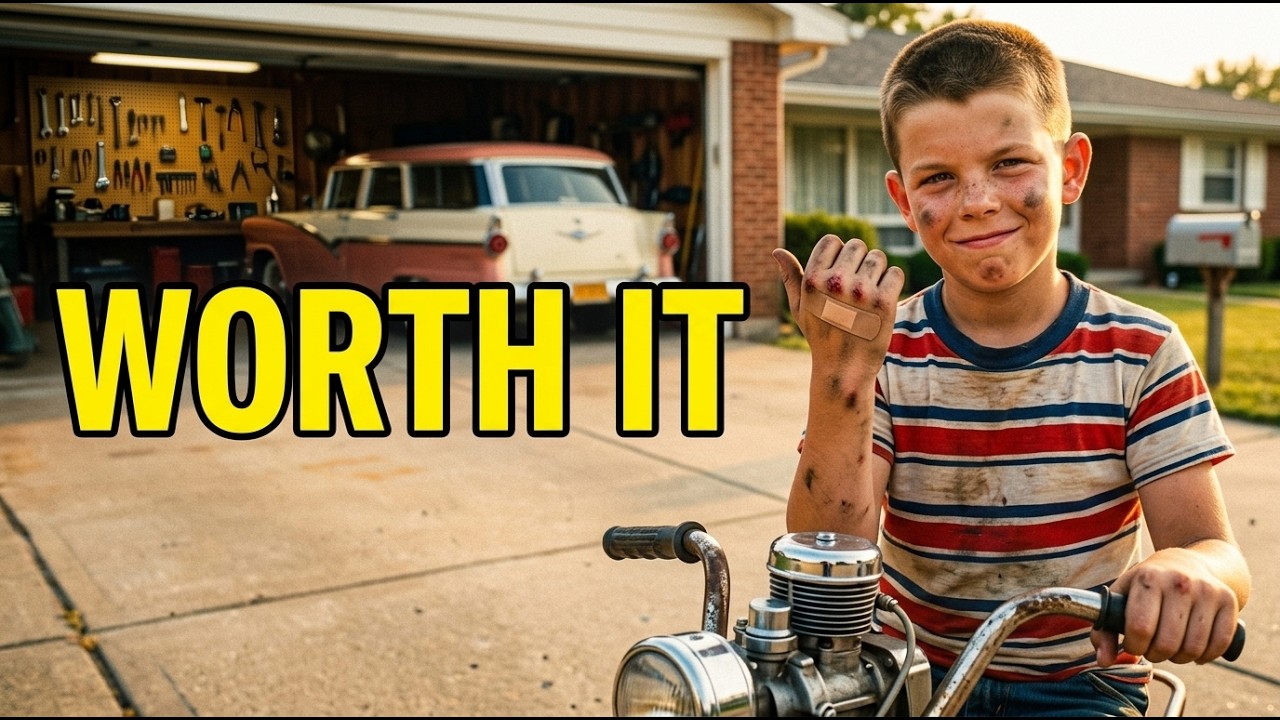
If you grew up in America between roughly 1955 and 1972, you probably have one. That mark is your membership card. Every one of these things was capable of hurting you, and most of them did. A chain drive spinning two inches from your ankle.
Bare copper screwed onto live terminals under a plywood table. Two steel lines turning at head height in an empty schoolyard. An adult put each one of them into a boy’s hands deliberately. He looked at you, decided you could handle it.
The last one on this list is the worst of them all: 150 miles per hour, no driver, no steering, no brakes. Faster than anything at Indianapolis. And the boy standing beside it was not allowed to touch it once it started moving. Eight things.
Every one of them left a mark. There is a garage somewhere in America around 1965. On the floor, a frame of steel tubing and four-inch wheels, no suspension at all. On the workbench, an engine from a lawnmower that died last summer.
Nobody is helping you. You lift the engine onto the frame and line up the bolt holes by eye. You start the nuts with your fingers and finish them with a wrench one size too big. The cooling fins scrape the skin off your knuckles every time.
The fuel line runs along the top tube, and you pull the slack out of it. Chain tension is set by feel. Your brakes are a steel strip rubbing against the rear tire. That is the entire system.
By the mid-1960s, more than one hundred companies were building mini-bikes. Sears put them in its catalog. Rupp, Taco, Bonanza, Montgomery Ward. Most people do not know this about those names: Mickey Rupp started out making Go-Karts in the basement of his house in Mansfield, Ohio.
By 1970, his factory was turning out 35,000 machines a year. It began with Go-Karts, a basement, and two employees. You wrap the starter rope around your hand, plant your shoe against the tire, and pull. Nothing.
You pull again. The rope scrapes the skin off your palm. Maybe you lie on the concrete for an hour before the engine fires. And when it does, you are gone down the alley before your mother even notices.
The next one never moved at all. But its inventor had won an Olympic gold medal before he ever touched a toy. It is January, and you are sitting on the living room carpet with an open red steel box beside you. Inside are hundreds of steel pieces: girders, gears, pulleys, and a bag of nuts and bolts.
There is a paper diagram, and that is the only instruction you get. You lay two girders over each other so the edges overlap and the holes line up. The bolt goes through, and the nut goes on the back. The screwdriver slips off the head about every third try, and those sharp edges cut your fingertip.
In the larger sets, there is an electric motor in the bottom of the box, and you have to wire it yourself. You do this maybe two hundred times. The tower rises. The boom extends over the edge of the rug, and it looks like it is going to fall.
This is the part of the story nobody tells. The man who invented it was A. C. Gilbert, Olympic pole-vault champion, London, 1908.
He trained as a doctor and never practiced medicine a single day. The idea came to him from a train window while he watched linemen raising the girders of power-line towers. He and his wife Mary cut cardboard prototypes on the kitchen table until the shape was strong enough to hold weight. The first Erector sets appeared at the New York Toy Fair in 1913.
By the mid-1930s, the company had sold more than thirty million sets — almost one for every three households in America. You hang the weight on the end of your boom and let it go. The tower holds. Perfectly straight.
Or it tilts, then settles. And everyone in the room is watching to see what happens. The next one had no kit, no diagram, no instruction sheet. And for a few years, it was bigger than bowling.
At the end of the street, there is a shop with painted windows and a hand-lettered sign. Inside, eight miniature-car racing tracks run the length of the building. Some tracks were over two hundred feet long. Banked turns, and a straightaway you can hear from outside.
The air smells of solder smoke and hot ozone. Two dollars buys you an hour of track time. By 1966, there were about three thousand such tracks across America — more than bowling alleys in some states. Then comes the part nobody mentions.
About eighty percent of the cars running on those tracks were handmade. The boys who built their own cars lapped the ones who did not. The store-bought car lost. You cut the chassis from brass sheet with tin snips and bent music wire into the frame.
The joints were soldered one at a time with a hot iron, and the first three fell apart quickly. You rewound your own armature to get better performance than the motor had out of the box. You geared the car for that particular track and no other. A vacuum-formed body went over the whole thing and was glued down.
Then they call your heat, you put the guide pin in the slot, and after ninety seconds you know the result. Every joint you soldered either held, or one of them let you down. The next hobby put you inside a circle, tethered to the thing you built. A Saturday morning, and the schoolyard is completely empty.
You stand in the middle of it holding a control handle. Two sixty-foot lines of steel run out to a balsa-wood airplane in the grass. The whole place smells of model fuel and castor oil. It took three weeks to build.
You cut the balsa ribs with a razor blade and pinned them over the plan. You stretched tissue paper over the frame and put on coat after coat of dope until it was drum-tight. You mounted a control arm inside the fuselage and ran the lines out through the wingtip. A Cox .
049 engine sat on the nose. You flipped the propeller with your finger until the skin blistered. Control-line flying goes back to Oba St. Clair, who flew the first known version near Yamhill, Oregon, on July 4, 1937.
Jim Walker turned it into an industry on the strength of one promise: a boy could build a Fireball and fly it within six hours. Walker patented it. He lost the case to Cox — the same company whose engine was on your airplane took the patent from the man who invented the hobby. Your friend launches the plane, and the lines go taut around your wrist.
Those lines are steel wire, thinner than a shoelace. Now you are turning constantly, because you cannot stop. That airplane passes your head sixty feet away on the end of the wire, and there is nobody else in that circle. You keep flying until the fuel runs out, or the plane does not fly at all.
Either way, you get your answer within thirty seconds. The next one had no engine, no wires, and exactly one try. The top of a hill in August. The road is closed to traffic.
There is a ramp at the top, and most of the town is standing on the sidewalk. You are folded into a wooden car you built yourself, and there is no engine in any part of it. It started with a news photographer named Myron Scott. In 1933, he found kids racing homemade cars down a hill in Dayton and organized an official race.
362 racers showed up. The final of the first national Soap Box Derby was held in August 1934. The first boy to win was eleven years old. He built his car from the wood of an old tavern and a set of baby-carriage wheels.
The planks were cut with a handsaw in the garage. You filed the axle square, because axles that are not square make the car pull. And a car that pulls loses. You ran the steering cable through the pulleys and bolted a steering wheel to it.
Your brake was a piece of wood dragged on the road. The part that made it real was the rules: the boy had to build the car himself. Fathers could give advice but were not allowed to touch it. And here is the part that changed everything: an official could ask you to rebuild any part of it on the spot, with no help.
The ramp drops. One try. No second run, no adjustments, no one to blame. Thirty miles an hour on a public road inside a wooden box, with the whole town watching you come down.
The next time, you did not build it alone. Go down to the basement, because this is where these live. There is a sheet of plywood over two sawhorses. Your father is underneath it holding a soldering iron in his teeth.
The two of you laid out the roadbed and fixed the track down section by section. He showed you how to strip the wire with a pocketknife without cutting the copper. Then he stepped back and let you do the rest. You wired the underside and connected the bare copper to the terminals.
That transformer was plugged into the wall the whole time. You built the mountain from wire mesh and plaster and made a mess that never quite came out of the carpet. Lionel was the largest toy company in the world in the early 1950s, selling nearly 25 million dollars’ worth of trains a year. Joshua Cowen is probably the reason trains and Christmas are tied together.
In the 1920s, he convinced department stores to put loops of track around their holiday displays. By the 1960s, the sets in American basements were often inherited. The ones on the plywood had been your father’s. He was about your age when someone wired them up for him.
You push the throttle forward, and he is standing right next to you. It runs smoothly. Or it stops dead at a joint you made yourself. You both go under the table together to find the problem.
And you fix it together. The next one took months to build and thirty seconds to answer. Out to a field at the edge of town, early, before the wind picks up. You carry a metal transmitter box with an antenna.
On the grass is an airplane you built from scratch over the whole winter. You pinned the ribs over the plan on the workbench. You sanded the leading edges until the curve was right. You shrank the covering and bolted on the engine.
Then came the radio, the part that could ruin everything. The first radios gave you three positions: right, neutral, left, in sequence. Press the button one extra time, and the plane does the opposite of what you asked. Men learned to tap the controls fast enough to fake a smooth turn.
The reed sets came after that. Then proportional control arrived in the 1960s, priced like a good used motorcycle today. Phil Kraft built his own radio gear in his garage and then won the World Championship with it. You set the plane down, open the throttle, and let it go.
The first turn is the one that tells you the truth. The whole winter comes down to that first turn. The airplane knows before you do. Sometimes the plane stopped responding mid-flight.
The fix for that was a man running across the field, holding his transmitter over his head, as if six extra feet of height might bring it back. Nobody laughed at him. Everyone on that field had done it before. The last one used radio too.
A flat concrete circle, seventy feet in diameter, with a steel pole in the center. The car is under eighteen inches long, made of aluminum, shaped like something dropped from a bomber. It has no steering wheel, because the wire steers it. The engine is six-tenths of a cubic inch, small enough to fit in your palm, running on nitro.
Most of these tether cars were built by grown men who owned lathes and machine shops. A boy got near one because an older man looked at him and decided he was ready. By the late 1940s, they were doing over 150 miles per hour. That was faster than the midget racers and faster than the cars at Indianapolis.
The Dooling brothers in Los Angeles built the engine everyone was chasing. Cox sold a ready-made car called the Thimble Drome. The serious men built their own. One man remembered paying 25 dollars for the car and 35 for the engine.
At the time, fifty dollars would buy you a used Model A you could actually drive. They hand you the fuel can, then leave you to do the rest. You hook the cable to the axle on the pole. You push the rear wheels on the concrete to start the engine.
Then you let it go. You step back behind the fence. You cannot reach it. You cannot slow it, correct its line, or help it.
It just keeps running back and forth, screaming. All you can do is stand and watch — 150 miles an hour, held by a single wire. Every one of these eight things gave you the same gift. You designed it, prepared it, released it, and then it told you whether you got it right, in front of everyone who was there.
We did not lose these hobbies. You can still buy a soldering iron, a minibike kit, a fuel tank. What was lost is something else entirely. What was lost is the right to make mistakes in public while something is at stake.
We were afraid of what would happen after the crash. So we removed the crash, and never noticed what went with it. Look at the backs of your hands again. That mark cost you something back then.
It also meant someone trusted you and handed you the thing that made it. Someone passed you the first piece — a father, an uncle, a neighbor, an older brother who had broken his own before. Someone decided you were old enough to handle it.
Tell me who that person was.
