In 1936, Pennsylvania sent survey crews into the Allegheny ridges to answer a strange question. Could a railroad abandoned half a century earlier become a 160-mile superhighway? The crews pushed through brush and young trees growing out of an old graded line, and they came to stone tunnel portals standing in the woods. Water stood inside the bores.
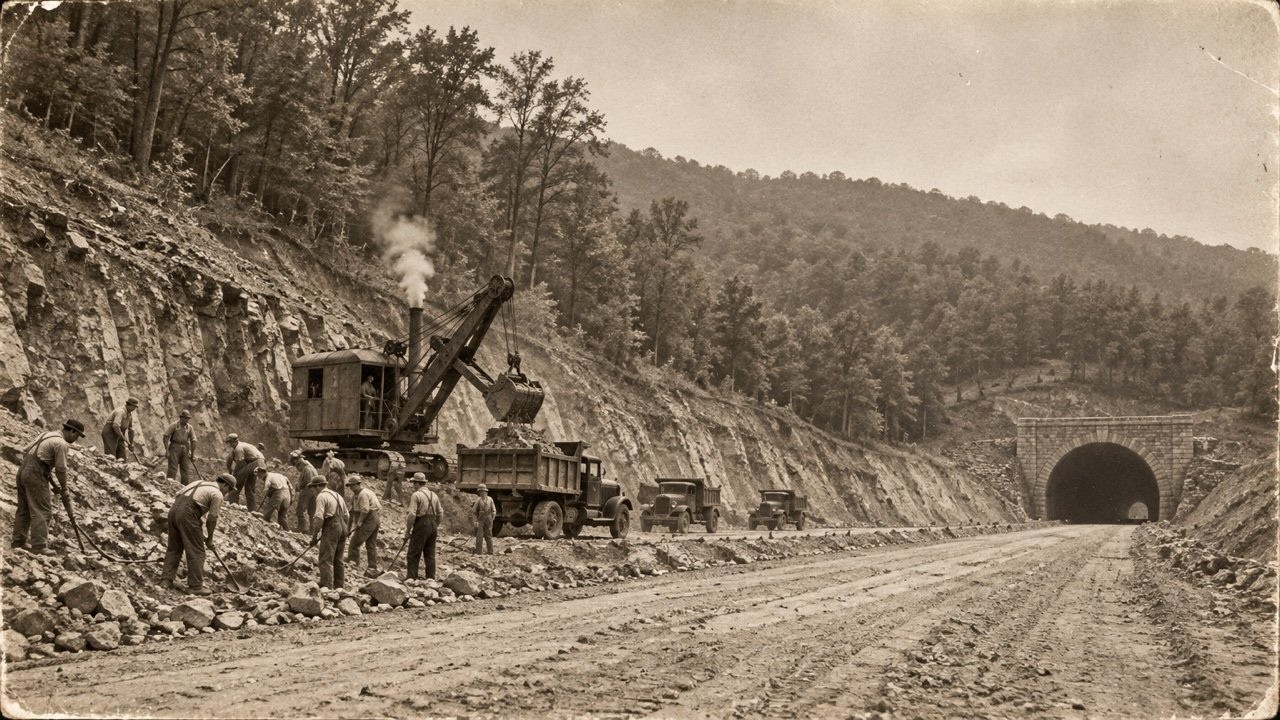
Through most of them, no train had ever run, but the masonry was still sound, laid by men who had walked off the job in 1885. Four years later, the first cars would roll onto a highway built along that line at one minute past midnight. The surveyors’ verdict was startling. One history of the road quotes their report calling it the best route ever devised between the ocean and Ohio.
A route that good does not happen by accident, and this one had been bought with money, sweat, and lives fifty years before anyone needed it for a car. Go back to 1883. The Pennsylvania Railroad owned the good line across the state, and a Pittsburgh steel man like Andrew Carnegie paid its freight rates because he had nowhere else to ship. So Carnegie, Henry Clay Frick, and William H.
Vanderbilt of the New York Central backed a rival. It was called the South Pennsylvania Railroad, and it would run from Harrisburg to Pittsburgh straight across six mountain ridges. Six ridges meant nine tunnels. Crews went into the hillsides to drive them, and the tunnel men earned $1.
25 for a ten-hour day. Twenty-six workers died on the project. By 1885, about $10 million had gone into the ground. Half the grading was finished, and miles of tunnel had been driven into the rock.
Then the money men stopped it. The banker J. P. Morgan, tired of watching two railroad giants bleed each other, brought the rival sides aboard his yacht, the Corsair, on the Hudson River, and he did not let the talks end without a deal.
The South Penn was finished. Work stopped where it stood. At Harrisburg, a line of stone bridge piers had already been set across the Susquehanna, waiting for steel that never came. People called the whole thing Vanderbilt’s folly.
For fifty years the folly sat in the woods, with lawsuits fought over the right of way. Two short stretches went to small local railroads, and the rest grew over. Meanwhile, the state above it changed. By the middle of the 1930s, the depression had emptied pay envelopes across Pennsylvania, and a driver bound from Harrisburg to Pittsburgh still had to climb ridge after ridge on old two-lane roads, through every town and around every curve.
So the state had two problems at once: men with no work, and mountains with no fast way across. An old railroad grade sat in the brush between them. Here is why that grade was worth so much. A steam locomotive cannot climb a steep hill.
Railroad engineers spent years hunting for the gentlest possible line through mountains, and where no gentle line exists, they tunnel. So a railroad survey across the Alleghenies is already the hard part of a highway survey, done by people even fussier about grades than a road builder would be. It is a little like buying a lot and finding the foundation already poured. The turnpike’s planners would later set a ceiling of three percent on every grade, meaning the road could never rise more than three feet for every hundred feet forward.
The old South Penn line made that possible, and the bores themselves were a gift no depression budget could have paid for. The surveyors found the finished tunnel masonry in good condition, along with stretches of graded roadbed and old drainage culverts. But a dead railroad is not a road, and nine half-built tunnels are not a highway. Somebody had to see the possibility first, and somebody else had to find the money for it.
In 1934, nobody in Harrisburg had even put the two problems and the old grade together. The first link came from a childhood memory. One history of the road says Victor Locock, who worked for the state planning board, learned about the tunnels from Edward Flickinger, a planner in the state’s Department of Internal Affairs. Flickinger had played in those dark bores as a boy, and in 1933 he went back to look at them again.
Locock looked at the old line and saw an all-weather highway, and he saw jobs. In late 1934, he took the idea to William Sutherland of the Pennsylvania Motor Truck Association, a man whose members fought those mountain roads every working day. Together they pitched a toll highway built on the old roadbed and the old tunnels. It is a strange inheritance for a highway: a railroad that never carried a passenger handing its route to the automobile.
The idea found a lawmaker. On April 23, 1935, state representative Cliff Patterson introduced a resolution calling for a study of whether it could work. The Works Progress Administration ran the numbers and put the cost at $60 to $70 million. That was an enormous figure for a state in the middle of the depression, and still the idea kept moving.
On May 21, 1937, Governor George Earle signed Act 211, and the Pennsylvania Turnpike Commission was born. Its first members were named in June, with Walter A. Jones as chairman. So now there was a commission, a route, a survey, and a law.
There was just one thing missing. The act gave the commission no money to build with, and when it went looking for buyers for its bonds, the banks were not interested. A highway that existed only on paper had the same problem the railroad had died of. Nobody would pay to finish it.
The money finally came from Washington, and it came with a clock attached. Through the spring and summer of 1938, the commission chased the funding piece by piece. On October 10, 1938, the deal was final. The Reconstruction Finance Corporation agreed to buy $35 million of turnpike bonds to be paid back out of tolls, and the Public Works Administration put in a federal grant on top.
But the grant came with a condition: the highway had to be substantially complete by May 1, 1940. Think about that date. One hundred sixty miles of four-lane road through the Alleghenies, with tunnels, cuts, and hundreds of bridges, in about nineteen months. Even with half the mountain work inherited from the 1880s, that is a brutal calendar.
From here on, the calendar is the second antagonist in this story, right behind the mountains. Seventeen days after the money was settled, on October 27, 1938, the commission broke ground on the Eberly Farm in Cumberland County, near Carlisle. Chairman Jones turned the first spade of dirt. The road would run from Middlesex near Carlisle west to Irwin, just east of Pittsburgh.
The very first contract on the whole job was not for pavement at all. It went to a Pittsburgh contractor named George Vang, and his task was to pump the water out of the old tunnels. Before a single car could go through those mountains, fifty years of seepage had to come out of the dark. What the crews found inside was half a tunnel in the most literal sense.
The railroad bores had been cut for a double track of steam trains, not for two lanes of cars with trucks among them. So every reused bore was blasted wider and taller, to twenty-three feet across and fourteen feet high, and then lined with concrete. Each tunnel got a ventilation building, because locomotive smoke and a line of car exhaust are very different problems in a closed mountain. Not every bore deserved saving.
Of the nine South Penn tunnels, the turnpike reused six. Two others, at Negro Mountain and Quemahoning, were not worth the trouble. The engineers bypassed them and carried the road over in open rock cuts instead. The ninth was Allegheny Mountain east of Somerset, and its old bore was in such poor shape that the engineers walked away from it.
They drilled a brand new tunnel eighty-five feet to the south and left the railroad’s hole sitting in the rock beside it. That gave the road seven tunnels in all, six inherited and one new, and drivers soon had a nickname for the whole thing. They called it the tunnel highway. The longest of them went through Sideling Hill, 6,782 feet, well over a mile of mountain.
Tunnel driving on the new work started in June of 1939, and progress was measured in feet, not miles. In hard gray sandstone, a crew could clear about ten feet of tunnel in twelve hours. In softer shale, it went faster. Either way, a mile of rock was a long way to go on a calendar that ended in May.
Where the railroad had left no tunnel, the highway had to make its own way. Near Everett, at Clear Ridge, crews dug a cut 153 feet deep and half a mile long. It was the deepest highway cut anywhere in the country at the time, and the promoters gave it a nickname borrowed from the most famous dig on Earth. They called it Little Panama.
The line kept crossing things. Creeks, farm lanes, township roads, state highways, and railroad tracks all had to pass over or under the turnpike, because the whole point of this road was that nothing crossed it at grade. By the end, the builders had put up 307 bridges on the original stretch. Every one of them had to be designed, poured, and finished inside the same nineteen-month window.
By the summer of 1939, every mile of the road was under contract. The money was in hand, the crews were hired, and the old bores were open. Then the mountains reminded everyone that they had been there first. The first warning came from inside Kittatinny Mountain, near the eastern end of the line.
The railroad men of the 1880s had left only a short stretch of that tunnel unfinished, so it looked like one of the easy ones. Then the crews widening the bore cut into a seam of wet sand. The sand came pouring into the tunnel under pressure, a slurry of mountain where solid rock was supposed to be, and the engineers had to stop and redesign that section before anyone could go on. That is the trap of inheriting somebody else’s tunnel.
The railroad builders had only ever opened the rock for a narrower hole. Every foot the highway crews blasted outward was rock that nobody had ever tested, and the mountain did not care that the drawings said it should hold. At Laurel Hill, farther west, it did not hold. A section of the tunnel workings caved in, and four men were killed.
The crews drilled wet and ran ventilation fans to keep the rock dust out of their lungs, but no amount of care could make a mountain predictable. These were men working for wages in the worst years of the Depression, in the dark, on a deadline set in Washington. The pay on the turnpike ran from fifty-two and a half cents an hour for an unskilled laborer up to a dollar forty for a man running heavy equipment. Many of them lived in tents pitched near the work.
Half a century earlier, the South Penn tunnel men had earned their dollar and a quarter for a full ten-hour day. The wage had roughly quadrupled for work in the very same mountains, and in places the very same rock being drilled for the second time. And the deadline was slipping away. Paving had started on August 31, 1939, and the plan depended on long open seasons to pour concrete.
Instead, the rain came, and then a Pennsylvania mountain winter, and concrete cannot be poured into frozen ground. In October of 1939, the commission had already pushed its target back to June 29, 1940. Then it slid to the Fourth of July. Then it slid again to sometime in late summer.
So picture the spring of 1940. The May 1 date that the federal money had been tied to was gone. Bores were still being lined, miles of concrete were still unpoured, and a road that had already waited fifty years for its chance looked like it might run out of calendar. The commission’s answer was to stop letting the night go to waste.
Work went to two and sometimes three shifts a day. Where there was no electric line in the mountains, the contractors ran floodlights off gasoline generators so the cuts and the tunnel mouths glowed through the night. By the spring of 1940, about 15,000 people were working on the turnpike at once. The work was split among 155 contractors from eighteen states.
The concrete itself went down in a way that sounds reckless now. The paving crews poured it directly onto the graded earth with no gravel bed beneath it. That saved time and money on a job that had neither to spare, and it kept the paving trains moving through the last hard months. One of those contractors had history on this line.
Mason and Hanger, a New York firm, had also worked on the South Penn fifty-five years earlier, and at least one man who had worked on the railroad in the 1880s came back to work on the turnpike. Picture him walking into a mountain in 1939 and recognizing a tunnel he had helped dig as a young man, now being widened for automobiles. Directing all of it was the chief engineer, Samuel W. Marshall, and beside him a special highway engineer named Charles M.
Noble. Their problem was one no railroad engineer ever faced. A train stays on its rails no matter who is at the throttle. A car goes wherever a tired, distracted, or speeding human being points it.
Noble wrote that the design was attacked from the viewpoint of motor car operation and the human frailty of the driver. That one phrase explains almost everything about how this road looks, because it was laid out to forgive a driver’s mistakes. So the turnpike got a right of way two hundred feet wide. It had four concrete lanes, each twelve feet wide, with ten-foot shoulders and a ten-foot median between the two directions.
There were no traffic lights, no intersections, and no railroad crossings anywhere on its length. Every grade stayed at three percent or less, and the curves were banked and wide. Drivers got on and off at just eleven interchanges, and because the whole idea was that a driver never had to leave the road, the commission set up ten service plazas along the line with Howard Johnson’s restaurants and Standard Oil stations, spaced so a car never had to go far for food or fuel. The dead railroad’s second gift to the highway is easy to miss.
A railroad grade and a superhighway want the same thing from a mountain: a gentle and steady climb with no sharp surprises. The South Penn surveyors of the 1880s had picked their line for heavy trains. Fifty years later, it turned out to be very nearly the right line for fast cars. What the railroad could not give was everything a driver needs and a train does not: width, fresh air in the tunnels, room to pass, and a place to stop.
By late September of 1940, those pieces were finally in place. The deadline was months behind them, but the road was ready, and the way the commission chose to open it was almost an afterthought. On September 30, 1940, Chairman Jones announced that the Pennsylvania Turnpike would open the next day at one minute past midnight. The notice was so short that there was no ribbon cutting at all.
A preview tour for officials had already run in August, with a banquet at the Hotel Hershey at one end and a dinner at the Duquesne Club in Pittsburgh at the other. For the public, there was just a time on a clock. People came anyway. At the Carlisle end, the first driver through the booths was Homer D.
Romberger, a feed and tallow dealer from Carlisle itself, and an attendant named R. H. Pistorius handed him his ticket. At the Irwin end, out at the far western terminus, the first car belonged to Carl A.
Boe of McKeesport. Two hitchhikers, Frank Lori and Dick Gangle, flagged Boe down. So one of the very first rides on America’s first long-distance superhighway carried two passengers nobody had planned for. There is something fitting in that.
The South Penn was supposed to carry passengers between Harrisburg and Pittsburgh, and it never carried a single one. Fifty-five years after the digging stopped, its line finally carried them. The toll for a car running the full length was a dollar and a half, about a penny a mile. On opening day, the counters logged about 1,550 vehicles at Irwin and more than 1,900 at Carlisle.
In its first fifteen days, the road carried more than 150,000 vehicles. A bus trip from Pittsburgh to Harrisburg that used to take nearly nine hours now took about five and a quarter. And for the first months, there was no general speed limit outside the tunnels, a detail that tells you how far this road was from anything Americans had driven before. The price of all that was steep, and it was paid in more than money.
The road cost about $370,000 a mile. About twenty workers died building it, on top of the twenty-six who had died digging for the railroad half a century before. Count both crews, and the line between Carlisle and Irwin was paid for by two generations of workers, with at least one man who belonged to both. And the inherited tunnels were both the road’s pride and its weak spot.
Every one of the seven was a single bore with two lanes, one each way, while the open road outside ran four lanes with a median. Within about fifteen years, traffic would swamp them. The state would bore second tubes beside some and route the highway around others. But on the night of October 1, 1940, the tunnels were the proudest thing on the road.
That road still runs today, and most of what those crews built can still be seen from behind the wheel. Start at Harrisburg, on the Cumberland County shore of the Susquehanna. Out in the river stand stone piers from the South Penn, set in 1885 for a railroad bridge that never got its steel. They are the oldest piece of this story still standing in daylight, and they sit east of the farm country near Carlisle, where the turnpike’s first spade went into the ground.
Head west past Carlisle, and the road runs straight and level across the Cumberland Valley before the ridges begin. Then come the first three mountains: Blue Mountain, Kittatinny, and Tuscarora. All three of those tunnels are South Penn bores, widened in 1939, and all three still carry traffic today, each now paired with a second tube that opened beside it in 1968. If you have driven the turnpike between Carlisle and Breezewood, you have driven through railroad tunnels that were started in the 1880s.
Past Breezewood, the modern road swings around Rays Hill and Sideling Hill, and the two old bores sit abandoned in the trees, now part of a trail for walkers and cyclists. In July of 1942, a government photographer named Arthur Rothstein photographed the Rays Hill Tunnel at night, and that picture is in the Library of Congress today. Farther on, near Everett, the highway still runs through Clear Ridge, the cut they called Little Panama. Near Bedford are the Midway Service Plazas, where the South Side Plaza was the largest on the original road, recorded by federal historians in the Historic American Engineering Record.
East of Somerset, the Allegheny Mountain Tunnel still carries traffic too, in two tubes now. Farther west, the Laurel Hill Tunnel was bypassed in 1964 and is private property today. Then the road comes down out of the mountains toward New Stanton, where the original eastbound ramps still stand, and on to Irwin, where Boe and his two hitchhikers started their ride. In 1990, the original Irwin to Carlisle section was named a National Historic Civil Engineering Landmark.
The paper trail survives as well. The Pennsylvania State Archives in Harrisburg holds the commission’s construction field notebooks, arranged by contract number, and the photographs of the crews who widened the bores and poured the concrete. The names of the contractors and many of the men are in there. In 1936, a survey crew pushed through the brush to a stone portal with water standing in the dark behind it, the leftover of a railroad that had never run a train.
Four years later, that same mountain line carried 160 miles of four-lane highway, and on its very first night, two hitchhikers flagged down a ride on it. The railroad died at a meeting on a yacht. The road it left behind is still carrying traffic across Pennsylvania today.
