In the winter of 1958, Hollis Marbury knelt at the edge of the stone well in Stone Penny Hollow and measured what he saw at the bottom. He was fifty-six years old, a county surveyor who had spent thirty-one years measuring boundary lines in three counties of southern West Virginia, and he had come back to this place on purpose, in February, when the hollow was stripped down and nothing could hide. He took out his notebook because that was the only thing his training had ever given him to do in a situation he did not understand. He wrote down the depth of the well as best he could estimate it, the diameter at the mouth, and the number of pairs of eyes looking up at him from the bare earth sixty feet below.
There were six pairs, floating just above the floor of the dry well, open, the color of dark water, with no whites visible. They were arranged in a circle, evenly spaced, all facing inward toward something at the center that he could not see from where he stood and did not want to see. And then, from the center of that circle, he heard a sound. It was not a voice, not exactly water.
It was the shape of a man calling from a great distance, the rise and fall of it with none of the words, and it was calling his name. It had taken him seventeen years to get back to this point, and the road to that February afternoon ran long and crooked through the hills. In the spring of 1798, a man named Cornelius Threlkeld walked west out of the Shenandoah Valley with a wife, two oxen, and one cracked iron pot. He was thirty-one years old, with no money, no people waiting for him, and only the vaguest idea of where he was going.
What he had was a piece of paper from a land office in Winchester promising him 160 acres on the far side of a ridge nobody had bothered to name. He found the ridge in late June, the hollow on the other side in early July, and the well, near as anyone could tell, three days after that. The well was already there. That was the thing nobody talked about later when the talking started.
The stones around the mouth were the size of a man’s chest, fitted together without mortar, worn smooth in a way that did not fit the hundred or so years white settlers had been in that part of the country. Cornelius noted the well in his almanac in a neat hand: “Good water, cold, deep, no need to dig. ” He did not write anything about who might have stacked those stones, or when, or why a well would be there at all in a hollow with no sign of any cabin, clearing, or old hearthstones. He was a practical man.
The well saved him weeks of work. His almanac survived. The Threlkelds, for all their other strangenesses, were keepers. They kept records the way some families keep silver.
Marbury found the almanac in a county museum two ridges over, in a glass case on loan from a man in Pikeville who claimed to be a distant cousin and would not return his letters. It was a small book, the size of a hand, written in iron gall ink in a tight, even script. From that first summer: Tuesday, cleared the lower ground, found chestnut roots harder than expected. Wednesday, Drusilla unwell from the heat, gave her water from the well, which steadied her.
Thursday, the well water is cold even in this weather. The cold goes through a tin cup. I do not understand how in a hollow this shallow the water is this cold. That last entry was the only thing he ever wrote about the well that was not simply useful, and he did not go back to it.
He drank from it that first afternoon on his knees, scooping the water up in his hat. Drusilla drank from it that evening from a tin cup. By the end of that first summer they had a cabin, a garden, and the beginnings of what people in the next county would come to call Stone Penny Hollow. The name came later, from a peddler who said the stones around that well looked like big flat coins stacked on edge, the kind you’d find in a dead man’s pocket.
Cornelius was a long, narrow man, pale across the cheekbones, hair the color of wet rope. His eyes were a particular shade of light brown, the kind of brown that goes almost yellow in certain light, like a held-up glass of cider. There is a portrait of him hanging in the county museum, painted in 1811 by a traveling man who took a meal and a bed in exchange for the work. You can still see those eyes behind the cracked varnish.
Cornelius and Drusilla had one son who lived past his first winter. They named him Absalom, born in the spring of 1803. Drusilla lived a long life by the standards of that country and time, dying in 1847 in her late seventies, having outlived her husband by nine years. One record of her speech survives.
A neighbor’s son named Eldridge Burchem, who later moved to Ohio and became a printer, wrote down a story about visiting the Hollow as a young man in the 1830s and hearing the old woman say of her well, “The water remembers everybody who drinks it. ” He thought she was making a joke and laughed. “She did not laugh,” he wrote, “and she did not look at him when he laughed. And he never went back to the Hollow again.
” That is the recurring shape of every outsider’s account of Stone Penny Hollow that Marbury was ever able to find: they go in, something small happens, they do not go back. By the 1820s the Hollow had four families in it. By the time Absalom buried his father in the 1830s, it had eleven. And by the time Absalom himself was an old man putting his own son Lorenzo in charge of the homestead, the Hollow was a sealed-off community of maybe sixty people, almost all of them Threlkelds, or married into the Threlkelds, or beholden to them in some way the law down in the county seat had never figured out how to write down.
They all drank from the well. That was the first rule of the Hollow, and nobody had to say it out loud. You could keep a cistern for the wash, catch rain for the garden, but the water you drank, the water you cooked with, the water you gave to anybody who came up sick, came from the stone well in the middle of the Hollow. In 1842, a Methodist circuit rider named Reverend Phineas Ott passed through on his way to a camp meeting in Logan County.
He kept a journal that eventually made its way into the archives of a small Bible college in Ohio, where Marbury read it on a microfilm reader in the autumn of 1956. Ott wrote that the people there were polite, that they fed him well, that the cabins were clean and the singing in the little log chapel on Sunday was, in his exact words, more solemn than is the custom even among the most pious mountain congregations. But he wrote one other thing: “The eyes of the Threlkeld family disturb me. Old Absalom and his son Lorenzo and Lorenzo’s wife and even the cousins married in have a sameness about the eye that I cannot explain.
The color is wrong somehow. As if the brown of an ordinary eye had been steeped too long in a pot and turned the color of strong tea and then turned again toward something I have no word for. ” He wrote about the Sunday evening in the Threlkeld house when Absalom asked if he had ever drawn water from a well so deep that the bucket came back colder than the air around it. When Ott said he had not, Absalom smiled in the firelight and said, “Then you have never had real water, Reverend.
” He said it kindly, the way a man tells a younger man that he has never tasted the apples from the high orchard. “And his eyes in the firelight,” Ott wrote, “were not the eyes of any man I have met in a long life of meeting men. ” Cornelius’s eyes had been the color of cider in 1811. By 1842, his son’s and grandson’s had gone past tea into something Ott could not name.
Nobody in the Hollow had noticed, because the change had happened slowly over two generations, and because they all had the same eyes now, looking at each other every morning. Marbury did not build the whole story on one preacher’s journal. Between 1941 and 1956 he found four more outside accounts. A peddler’s bill of sale from 1861 with a note on the back: “They none of them look quite at you.
They look just past you the way a cat looks at a corner. ” A surveyor’s report from 1888 with a hand-drawn map and a paragraph crossed out so hard the paper had torn underneath: “I do not believe these people see what I see when I look at them. ” A Pinkerton field memo from 1903, when a railroad company had considered running a spur up that valley: “The family is uniform in feature and in gaze to a degree I have seen only in inbred populations. I do not recommend the railroad spur.
” A letter from a county doctor in 1922, called up to treat a case of pneumonia, who never sent another bill and never returned anybody’s letters. He wrote to his wife: “Mary, I will not be going back up there. The wife of the man with the pneumonia thanked me for my work and walked me to my buggy, and the whole way she did not blink. I counted.
We were together a quarter of an hour. She did not blink one time. I do not know what to make of this, and I do not wish to make anything of it. ” Four men, four decades, four different reasons to be in that hollow.
All of them wrote down some version of the eyes are wrong. Generation three married outside the Hollow one last time. Lorenzo Threlkeld took a wife named Marcelina Quillen in 1851, from a French-descended family down near the Big Sandy. She was the last person to marry into the Threlkelds from any meaningful distance.
After her, the family started looking inward, cousins and second cousins, the kind of marriages a county clerk approves with a tight mouth and does not write down too clearly. Marcelina had a normal walnut brown when she came. Within five years of drinking from the well every day, her eyes had gone dark enough that her own sister, Constance, visiting in 1856, refused to sit across the table from her at supper. Constance wrote to her mother by candle the same night she got home, after walking twenty miles up from the Big Sandy in good shoes that were ruined.
She wrote that Marcelina did not remember their father, or the song he used to sing when they churned. “I asked her to sing it with me, and she looked at me a long while, and then she sang a little of it. But the words were not right, and the tune was not right, and I do not believe she was singing what I was singing at all. She was singing what the people in that hollow sing, which is the same tune in everybody’s mouth, and no words I could pick out.
” The husband was kind, the old people were kind, the cousins were kind. “I did not feel hated, and I did not feel feared. I felt looked at. The way a deer feels looked at in a clearing when there is no wind and no sound.
” She left, and never spoke of Marcelina again, even when her own relatives asked. Her granddaughter sold the family papers to a college library in 1943, which is how Marbury read the letter in the spring of 1955, sitting in a reading room with a green-shaded lamp and a sandwich in his coat pocket he had forgotten about. Marcelina lived another forty-one years in Stone Penny Hollow and bore four offspring, all born with eyes the color of wet bark. Generation four was Purnell Threlkeld, born in 1861, who took over the homestead in the 1880s.
By then the Hollow had stopped sending its young people out to work in the county seat. A schoolteacher three miles down the ridge had asked in 1879 why the Threlkeld cousins all looked at her the same way. “They all look at me the same way as if they were one person divided into eleven bodies and the one person did not like what it was seeing. ” The superintendent wrote back and told her to mind the Lord’s work.
She quit at the end of that term. After that the Hollow taught its own. Purnell married his second cousin Verena in 1886. Their middle son, Wendell, born in 1894, was generation five, and the thing that had been happening in that well began, near as Marbury could tell, to come up out of the water and look around.
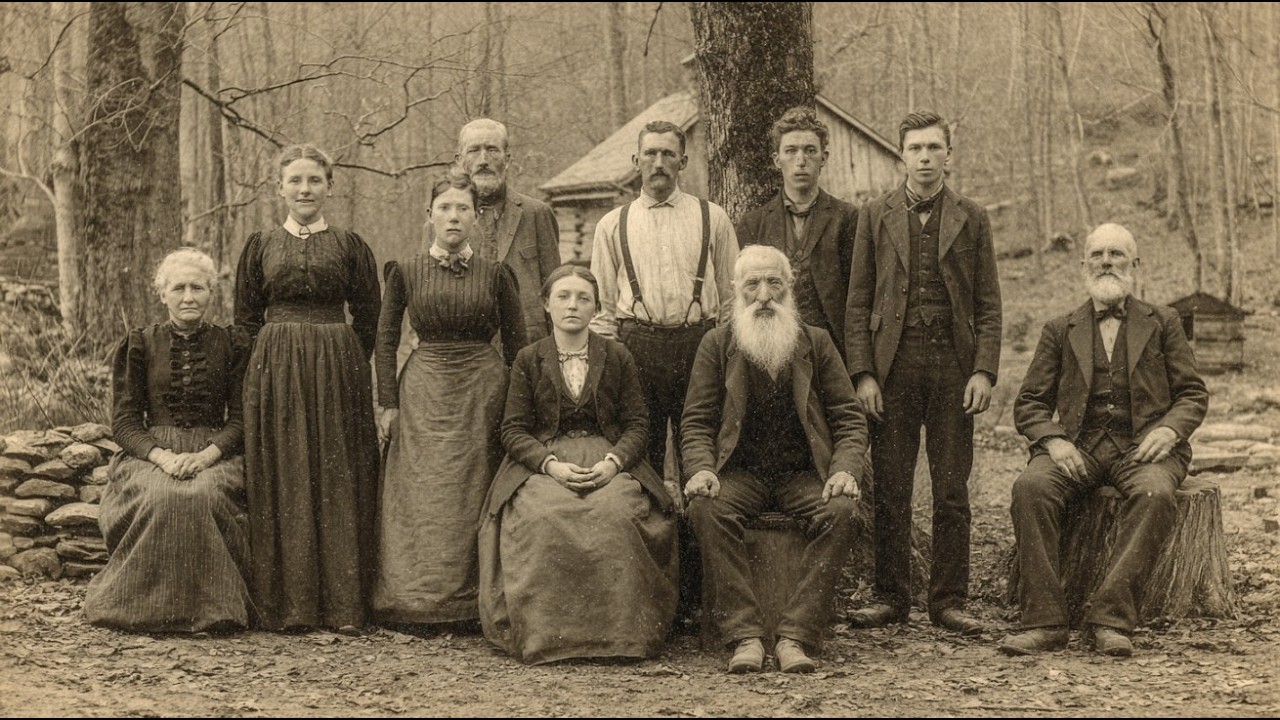
Wendell was the first of the line to be photographed. A traveling photographer named Lemuel Streke came through in 1914 on a swing through the coal camps, stopped because somebody on the road told him there was an old place up there with strange people who might pay for a picture. He set up in the dooryard and took twelve plates that afternoon. He developed them that night in a wagon two ridges away, and wrote in his ledger the next morning: “I will not be selling these.
” His entry ran six lines. “Threlkeld place, top of the hollow. Family of nine, three old, six middle. Sat them in the yard.
The light was bad. I told them to look at the camera and they did, all of them. Without me needing to ask twice. The plates came out clean.
The plates came out cleaner than any plates I have ever taken. I am not going to develop the second six. I am not going to sell the first six. I am leaving for Welch in the morning.
I am not going back up that hollow. ” Marbury bought one of those photographs in 1949 from a junk dealer in Charleston for forty cents, an old tintype in a cracked paper sleeve, with “Threlkeld family, Stone Penny Hollow, 1914” written in pencil on the back. In it, nine people: Purnell standing in the back, Verena in a straight chair, three grown sons and two grown daughters around them, a grandmother on the left in a black dress who would have been Marcelina, then about seventy, and a very thin old man in the place of honor on the right, Lorenzo, born 1828, eighty-six years old, the oldest living person in the hollow. Every single one of them had the same eyes, not similar eyes, the same eyes.
Black as the bottom of a kettle, no iris visible, or if there was an iris, the same color as the pupil. There was still some white at the corners in the old man and a little in Purnell, but in the younger ones the white had gone almost gray, like the inside of an oyster shell. And they were all looking right at the camera, the same look. Marbury kept that photograph in the bottom drawer of his desk for nine years before he went up to Stone Penny Hollow to ask his questions in person.
Partly that was because of what had happened in 1941. That summer, he was thirty-nine, four years into the job, sent up to walk a property line the state was trying to settle for tax purposes. The Threlkelds had not paid taxes in some time, and the land had a kind of bureaucratic fog around it. Every clerk who had tried to put a number on it had quit, transferred, or let the file slide to the bottom of the pile.
Marbury parked his truck at the end of the county road and walked the last mile and a quarter with a transit on his shoulder and a sandwich in his pocket. It was high summer and should have been loud with cicadas, birds, the creek running over its stones. There was none of that. There was no sound in Stone Penny Hollow that day except his own boots on the dirt, and eventually the sound of a woman somewhere singing a hymn very slowly, without words.
The track went down off the ridge in long shallow switchbacks, beech trees on either side, their bark the gray-silver color of an old nickel, the ground under them bare and packed smooth, the way ground gets where animals have bedded down for a long time, except there were no animals. Halfway down he stopped because he thought he had heard somebody walking behind him. The track was empty. He stood there a long minute, giving whatever it was that was not there a chance to be there.
Nothing came. About a quarter mile farther, he found a knee-high stone marker by the track, initials badly weathered and a date: C. T. 1799.
He knelt to look at it, and as he knelt, the earth under his knee gave very slightly, the way earth gives when there is a hollow space underneath, not a tree root hollow, a bigger hollow than that. He stood up too fast, and for just a second had the bad sense of standing on a thin crust of something with the rest of the country dropped out beneath him. That was the first sense he had that Stone Penny Hollow was not shaped the way it looked from the road. The Threlkeld place was at the head of the hollow.
A two-story log house that had been a cabin once, then added onto in the 1840s and again in the 1870s, looking like three different houses leaning on each other for support. No flowers, no garden, no dogs. A man stood on the porch, tall and thin, somewhere in his late forties, in clean overalls and a white shirt. He told Marbury his name was Wendell Threlkeld, generation five, the young man from the 1914 photograph.
Marbury wanted to be careful about how he described Wendell, because he had been told over the years that he was a calm man, a reasonable man, not given to imagination. Wendell Threlkeld’s eyes had no whites. None. Not gray, not yellow, not bloodshot.
From corner to corner, top lid to bottom lid, they were the color of dark water in a deep well, nothing distinguishable, one color all the way across, and the color was nothing Marbury had ever seen in a human face. Wendell was polite. He shook Marbury’s hand, warm and dry and ordinary. He asked after the drive and the truck and whether Marbury had had his dinner.
He invited him inside, and Marbury went, because he was thirty-nine and had a job to do and did not yet know how to be afraid of a polite man in a clean shirt. The inside was clean. No cobwebs, no rot. Floors swept, windows open, a pot of beans on the stove, a calendar from the feed store in Welch on the wall turned to the right month.
There were six people: Wendell; his wife Tessaline, also a Threlkeld by birth, his second cousin once removed; his mother Verena; and three grown sons, the oldest named Garvin, generation six. All six had the same eyes, and all six pairs were on Marbury the whole time he was in that house. At first it was not frightening, only like being noticed, the way men around a wood stove in a hardware store turn to look at you, friendly enough but counting you. After ten minutes, he began to notice that none of the eyes had looked away.
Not once. They did not look at each other, at the map he drew, at the cup of water in Tessaline’s hand, at the door behind him. About twenty minutes in, Tessaline got up and brought him a glass of water. He drank it, because he had walked a mile and a quarter in the July sun and his mouth was dry, and he had not yet put together that the water came from the well in the dooryard.
The water was colder than it should have been, colder than the air, colder than his hand on the glass, and it tasted very faintly of iron, not the iron of rust in a pipe, but the iron of blood in a cut on the inside of your cheek. He drank the whole glass. When he set it down, all six were still looking at him. Verena said the only words he heard her say all afternoon: “Good water, isn’t it?
” He said, “Yes, ma’am, it is. ” She nodded once, slowly, and said nothing else. Before he left, he went out to look at the well, between the house and the springhouse in the middle of the dooryard. Stones the size of a man’s chest, fitted without mortar, a wooden cover on a hinge with a bucket and windlass.
The water was very far down. He leaned over and looked, and the well went down farther than any well he had ever measured. Most hand-dug wells in that country go down twenty feet, thirty at the outside. This one went down past where his eyes could follow.
The water was black, the way water gets when it is deep enough that no light reaches it. And while he was looking down into it, he had the very clear feeling that something was looking back up at him. Not a person, not an animal, just an attention, a kind of patient noticing far down in the dark. He stood up too fast and caught his balance on the windlass.
When he turned around, all six of the Threlkelds were standing in the dooryard behind him in a half circle, watching him look at their well. None of them had made a sound coming out of the house. He left without finishing his work. He lied about it later in the file, fudged the corner he had not gotten to, closed it, put it in the drawer for completed work, and went home.
He sat in his kitchen and shook for about an hour before he could pour a cup of coffee. He did not tell his wife. He did not tell anybody for fifteen years. The taste of that water stayed in his mouth for three days.
He brushed his teeth, gargled with whiskey, drank coffee, milk, tomato juice. On the third day it was gone. About a week after that, he started having a dream: at the bottom of the well, not drowning, just down there in the dark, looking up at the small circle of daylight at the top, with faces around the circle looking down at him, the Threlkelds, all six, curious the way you would be curious looking down at a fish you had just dropped a hook for. He had that dream four nights in a row.
Then it stopped. He did not go back for fifteen years, but he started reading. He found Reverend Ott’s journal, the schoolteacher’s letter, the photographer’s ledger, the 1856 letter from Marcelina’s sister, the tintype in the junk shop in Charleston. He built a file in the bottom drawer of his desk and added to it every year, like a man pulling a thread out of an old sweater, trying not to unravel the whole thing at once.
He wrote to county clerks within a hundred miles, historical societies, Bible colleges, agricultural extension offices, the Federal Land Office, the Geological Survey, a folklorist in Morgantown collecting Appalachian ballads, and a hydrologist in Charleston who studied karst formations. The hydrologist, Dr. Crispin Vail, sixty-eight and recently retired, had never been to Stone Penny Hollow, but when Marbury described the well, he wrote back a long letter ending in a sentence Marbury could not stop thinking about: “Mr. Marbury, the geology of that part of the country does not support a hand-dug well of the depth you describe.
There is no aquifer at that depth in that location. Whatever water is in that well is not coming from anywhere I can put on a map. ” Marbury wrote back asking what he meant by that. Vail did not answer.
Six months later, his daughter wrote that her father had died in his sleep in the spring of 1953, and that she had found among his papers a folder marked “Stonepenny” containing nothing but a single sheet of paper on which her father had written in his careful engineer’s hand the words “Do not pursue. ” She sent him the sheet. Marbury kept it in his desk. He did not stop pursuing.
A wiser man would have stopped. But his wife was dying that year, slowly in their bedroom, of a long illness the doctors could not name, and he needed something to think about that was not his wife dying. Stone Penny Hollow was what he had. He found, in the records of an old surveyor’s office in Logan County, a map drawn in 1873.
It showed the hollow as a roughly oval depression about a mile long and half a mile wide, with the Threlkeld house, the creek, the few other cabins, and the well. At the bottom of the hollow, under the creek, the surveyor had drawn a faint dashed line in a circle about three hundred yards across, and inside the circle, in pencil so faint Marbury had to take the map to a window to read it: “Ground sounds wrong here. Echo as of hollow beneath. Did not survey further.
” The surveyor was Alpheus Sennett of Beckley, a respected man who had drawn boundary maps for half the coal leases in that part of the state, a deacon in the Presbyterian Church, father of five. In 1879, six years after drawing the Stone Penny map, he quit surveying, sold his instruments, moved his family to Indianapolis, and became a clock maker. He never came back to West Virginia and never explained why. His grandson, a polite attorney, wrote back to Marbury in 1956 that his grandfather had spoken only once in his hearing about why he left surveying, on the porch of a summer cottage in Michigan in 1901: “There are places in those mountains, Walter, that have a floor and a ceiling.
And the ceiling is the part you walk on. I made the mistake of measuring through the floor one time. I did not like what I measured. I do not survey anymore.
” That was the seventh outside witness to Stone Penny Hollow, and he was telling Marbury that the hollow was hollow, that the ground he had walked on in July of 1941 was not solid, that underneath the smooth packed earth and the silver beech roots there was a space, and the space was big, and the well went down into it. In the winter of 1958, Marbury was fifty-six. His wife had been gone two years, his family grown and out of the house, and he had nothing left to be afraid for except himself. So he drove back up to Stone Penny Hollow, in February, because he wanted it stripped down, no leaves, no insects, nothing hiding what was there.
He drove as far as he could and walked the rest. The track was narrower than he remembered, younger trees grown up where the ruts used to be. Nobody had been driving in or out in some time. The house was still there, smaller than he remembered, the porch swing gone, the shake roof sagging on the south side, no smoke from the chimney.
He knocked, and nobody came. He tried the door, an old plank door latched on a wooden peg. He lifted the peg and pushed it open. The inside was just as clean and just as empty as the outside.
No pot of beans on the stove, no calendar. A layer of fine dust on the kitchen table, the kind that takes a year to settle, maybe more. He drew his finger across it, and the line was the only mark on the whole surface. No dishes, no clothes, no boots by the door.
He walked through every room, expecting something terrible in one of them, because that is the shape these stories are supposed to take. There was not. The rooms were clean, the beds were made, a quilt folded at the foot of one bed, a Bible on a nightstand, and a glass of water next to it, half full, with no dust on the surface, which he noticed but did not stop to think about until much later. He walked out the back door and around the side of the house to the dooryard.
The well was still there, exactly as he remembered it, down to the smooth stones and the windlass and the wooden cover on its hinge. There were footprints in the snow around it. Bare feet. Several pairs, going to the well and not coming back.
He followed them because that is what a surveyor does, follows lines on the ground. They all went to the wooden cover and stopped there, with no footprints going the other way. He counted. Six sets of prints, two larger and four smaller, but all adult.
They were not fresh; the edges had hardened and refrozen and softened again the way prints do over a few cold nights and warmer afternoons. By his best estimate, they had been there somewhere between four days and two weeks. He stood at the well a long time before he lifted the cover. The hollow was very quiet, a high thin wind in the tops of the beech trees above, no wind at all where he was standing.
His breath went straight up and hung in the air a second before disappearing. He thought, for the first time since starting up the track, about going back. He thought about it for a long time, about the warm cab of his truck and the road home and the cup of coffee he would have in his kitchen, about the version of himself that had not lifted the cover and the version that had, and which one he wanted to be that night and the nights after. And he lifted the cover.
The well was dry. In all the years of picturing the black water and the deep and the thing looking up, he had not pictured a dry well. The bottom was sixty feet down, maybe more, the walls the same stacked stone all the way down, fitted without mortar, worn smooth. The bottom was bare earth.
And on the bare earth, looking up at him, were six pairs of eyes. Not people. He wanted to say that clearly. There were no people down there; he would have heard them breathing, moving, crying out.
The hollow was so silent that February afternoon he could hear the snow settling on the branches over his head. There were eyes, six pairs, floating just above the bare earth, open, the color of dark water, with no whites visible. The same eyes he had seen in the dooryard in 1941, in the tintype, the same eyes Reverend Ott could not name in 1842. Six pairs, for Wendell and Tessaline and Verena and the three grown sons.
The whole of generation five and generation six. He did not scream. He did not run. He measured.
He wrote down the depth, the diameter at the mouth, the number of pairs, the approximate position of each. He sketched the pattern: a circle, six pairs evenly spaced, all facing inward toward the center. None of them were facing up at him. They were arranged around something at the center he could not see from where he was standing, and which he did not, when he leaned a little farther over the lip to try to make it out, want to see.
He leaned back and closed his notebook. The eyes were still there. They had not blinked. He was not certain they had ever blinked.
And while he was leaning over that well, he heard a sound from the bottom. It was not a voice, not exactly water. It was the sound a man makes when he is far away and trying to call to somebody, and the distance is so great that all you can hear is the shape of the calling, the rise and fall of it with none of the words. It came from the center of the circle, from whatever the six pairs of eyes were arranged around.
And it was his name. A voice that knew his name because it had been listening for a very long time to a man at the top of the well leaning over, drinking a glass of water. He lowered the cover. He walked back around the house and out of the dooryard and down the track, the mile and a quarter to his truck, and he did not look behind him.
He had read enough by then to know what looking behind you cost you in a place like that. He drove home, poured a cup of coffee, sat in his kitchen the way he had sat in 1941, and shook for about an hour. But this time he knew what to do. The next morning he went to the county records office, pulled the Threlkeld file, and wrote across the front in red pencil the word CLOSED.
He put the file at the bottom of a stack of closed files, put that stack in a drawer in the basement, and locked it. He never went back to Stone Penny Hollow. He retired in the spring of 1963. A young surveyor from over in Boone County took his job, and on his first week Marbury drove him around the three counties and showed him the lay of the work.
They went to most of the hollows. They did not go to Stone Penny. The young man asked about it, had seen the name on a map. Marbury told him the file was closed, that there were no taxes owed, no boundary in question, no living owner to talk to.
He told him to leave it alone. The young man looked at him a long moment in the cab of the truck, then nodded, the way you nod when an older man tells you something you do not fully understand but are willing to take on faith for now. He went on to be county surveyor for twenty-seven years, and he never went up to Stone Penny Hollow, and he never asked Marbury about it again. Marbury took some comfort in that.
He took less comfort in the dreams. They started again last winter, in the cold weeks before Christmas, the same dream as before: at the bottom of the well, looking up at the small circle of daylight, faces around the circle looking down at him, curious. This time, though, he recognized one of the faces. It was his own, up there, fifty-six years old, in his surveyor’s coat, leaning over the lip of the well in February of 1958, and the version of him up there was looking down at the version of him at the bottom, and they were both noticing each other for the first time.
In the dream, the version at the bottom has eyes the color of dark water with no whites in them anywhere. He does not know which version of himself is the real one. He has been telling himself for many months that the version with his wife’s photograph on the dresser and the cup of coffee in his hand is the real one, that the dream is only a dream, that a man who has spent his life measuring lines on the ground does not get pulled down into anything just because he leaned over a well one February afternoon and saw what he saw. But he wants to be honest, because he has been honest the whole way through, and would not insult anybody by stopping now.
When he looks in the mirror these mornings in the dim light before he turns the lamp on, he cannot always tell what color his eyes are. It is probably nothing, a man his age with his wife gone and his household grown and gone, looking too hard at himself at five in the morning. It is probably nothing. But he does not drink water out of any well he cannot see the bottom of.
And when he dreams about that hollow and that circle of daylight and the curious faces looking down, he no longer tries to wake himself up. He has started to wonder whether waking up is the part he has wrong.
